
Last updated: 25 November 2026. By the GTI Group editorial team, Genex Tech Industries LLP (Food Tech Projects), Kolkata, India.
Direct answer: A makhana processing plant turns raw fox nut seeds into popped kernels in six stages: cleaning, drying, size grading, a first roast, tempering, and a second roast with shell breaking (popping). ICAR research describes a first roast at 270-280 °C, 48 hours of tempering and a second roast at 260-270 °C. Most stages can now be mechanised.
Request a Quotation: Planning a makhana plant or adding cleaning, drying and grading lines? Email mktg@foodtechprojects.com or call/WhatsApp +91-93300-77417 | +91-87774-75596. Please include raw seed volume per day, season length, the stages you want to mechanise, packing format and site location.
Key takeaways
- Popping is the bottleneck. Traditionally seeds are roasted at 250-320 °C in pans, tempered for 2-3 days and struck with a mallet by skilled workers (ICAR).
- An ICAR-CIPHET mechanised system covers threshing, cleaning, seed grading, drying, roasting and popping, and ICAR reports it cuts process time from 2-3 days to about 20 hours.
- Size grading before roasting matters: one ICAR study graded seeds into seven classes from below 7 mm to 12 mm and roasted each class separately.
- Tempering needs a large holding area. Plan it as part of the plant, not as spare floor space (see the worked example).
What is makhana, and why is processing a challenge?
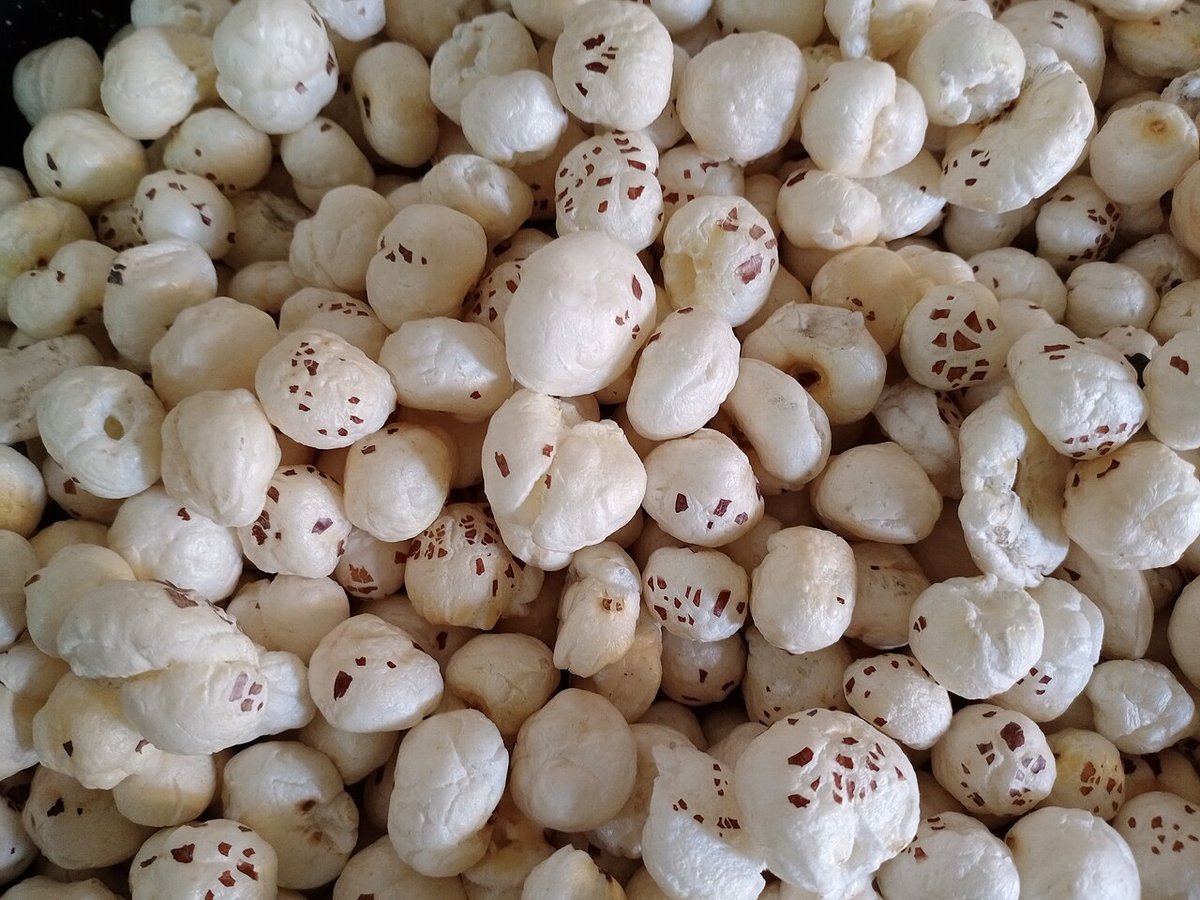
Makhana (Euryale ferox), also called fox nut or gorgon nut, is the seed of an aquatic plant. The edible white kernel sits inside a hard black shell that does not come off easily. Popping cracks the shell and expands the kernel.
ICAR states that makhana is grown mainly in Bihar, Assam, West Bengal, Tripura and Odisha. In Bihar alone it covers about 15,000 hectares of water bodies. Published research describes the seed as round, 4.5-14.5 mm across.
Interest in organised processing has grown. India set up a National Makhana Board, launched in Bihar on 15 September 2025, backed by a ₹476.03 crore central scheme for 2025-26 to 2030-31. At its first meeting the Board stressed infrastructure for grading, drying, popping and packaging (PIB, 12 December 2025).
What are the steps in makhana processing?
The sequence below follows ICAR descriptions and an ICAR-CIPHET study published in the Journal of Food Processing and Preservation (2020). The figures are research conditions, not settings for any particular machine.
- Harvest and wash. Seeds are collected from pond or field beds and washed to remove mud and plant matter.
- Clean. Remove light trash, stones and empty or damaged seeds before drying.
- Dry. In the 2020 study, seeds were sun-dried in a single layer to about 30% moisture before roasting.
- Grade by size. The study graded seeds into seven diameter classes (below 7, 7, 8, 9, 10, 11 and 12 mm).
- First roast. Each grade was roasted separately in 1 kg batches at 270-280 °C. This step gelatinises the starch in the kernel.
- Temper. Roasted seeds were held in jute sacks in the shade for 48 hours.
- Second roast and pop. The ICAR-CIPHET popping machine ran at about 265 °C (260-270 °C) for 3-5 minutes; its decorticator broke the shell to release the popped kernel.
- Separate and pack. Popped makhana of 13 mm and above was separated from the bran (shell fragments) and packed.
Which steps can be mechanised?
All of them can, but the payoff differs. Cleaning, drying, grading and packing use well-known machine types. Roasting and popping need purpose-built equipment because of the very high temperatures and split-second timing.
| Stage | Manual practice | Mechanised option | Main benefit |
|---|---|---|---|
| Cleaning | Hand winnowing and washing | Washer, vibro cleaner, destoner | Fewer stones and foreign matter |
| Drying | Sun drying on the ground or mats | Tray, belt or heat pump dryer | Even moisture; not dependent on weather |
| Grading | Hand sieves | Multi-deck vibratory or rotary grader | Uniform roasting for each size class |
| Roasting | Earthen or cast-iron pans at 250-320 °C | Closed roaster with controlled heating | Worker safety; repeatable roast |
| Popping | Mallet strike by skilled workers | Popping machine with decorticator | No hand contact with hot seeds |
| Sorting and packing | Hand sorting, manual bagging | Grader, sorter, form-fill-seal packer | Consistent grades and pack weights |
ICAR describes its mechanised roaster as a closed, insulated barrel heated with electrically heated thermic oil, though any heat source can be used. Hot roasted seeds hit a closed casing within seconds, which replaces the mallet.
Why does size grading come before roasting?
Small and large seeds heat at different rates. If they are roasted together, small seeds scorch while large ones stay under-roasted and pop poorly. Grading first lets each size class get its own roast time.
Grading also sets the plant’s flow. With seven size classes, the roaster and tempering store must handle seven separate lots, so batch tracking and labelled bins are needed. For machine choices, see GTI’s guide to vibratory, rotary and roller graders.
Request a Quotation: Tell us your raw seed tonnage, how many size grades you need and your drying method today, and GTI will propose cleaning, drying, grading and packing equipment. Email mktg@foodtechprojects.com.
How big must the tempering store be? A worked example
This example uses illustrative assumptions. It shows why tempering space is often under-planned.
| Item | Value |
|---|---|
| First-roast output (all grades) | 100 kg/h |
| Roasting hours per day | 16 h |
| Daily roasted seed = 100 × 16 | 1,600 kg/day |
| Tempering time (research condition) | 48 h, about 2 days |
| Seed in tempering at any time = 1,600 × 2 | about 3,200 kg |
| Plus one day’s buffer for grading and loading | about 4,800 kg |
At 50 kg per sack, that is roughly 96 sacks, split across up to seven size grades. Each lot needs a label showing grade and roast time, so the second roast takes them in order. Measure your own seed’s bulk density before sizing racks or bins.
What should a makhana plant include?
A complete plant usually has these sections, sized for peak season:
- Raw seed receiving, washing and draining.
- Cleaning: aspirator or vibro cleaner, destoner.
- Drying: tray, belt or low-temperature heat pump dryer.
- Size grading: multi-deck grader for the size classes you sell.
- First roaster, tempering store, popping machine with decorticator.
- Bran separation, grading of popped kernels, optional sorting by colour.
- Optional flavouring or roasting of popped kernels for snack products.
- Packing in moisture-barrier bags, with a dry, clean packing room.
Popped makhana is a ready-to-eat dry product, so the area after popping must be kept clean and dry. Check the applicable FSSAI standard and your buyer’s specification for moisture and microbiological limits.
Which GTI machinery fits a makhana plant?
GTI pages do not list a makhana roaster or popping machine, and GTI has not published makhana trial data. GTI pages do list machines for the cleaning, drying, grading and packing sections. Suitability for your seed should be confirmed by trial.
- Grading Machine: vibratory, rotary or roller types with multi-deck screening; applications include dry fruits and nuts.
- Sorting Machine: listed for dry fruits, nuts, grains and snack lines. See also how to choose an optical colour sorter.
- Mesh Belt Dryer: lists nuts, grains and seeds, with an optional cooling conveyor and packing integration. GTI Dryers also offers a heat pump dryer that lists grains and seeds.
- Packaging Machinery: form-fill-seal pouch packing, weighing and conveying.
GTI’s spices page lists drum roasters for spices. Whether a roaster can reach and hold makhana roasting temperatures must be confirmed with GTI engineering before you plan around it.
FAQ
At what temperature is makhana roasted?
ICAR research describes a first roast at 270-280 °C and a second roast at 260-270 °C after 48 hours of tempering. Traditional pan roasting ranges from 250 to 320 °C.
Can makhana popping be fully mechanised?
Yes. ICAR-CIPHET developed and commercialised a system covering threshing, cleaning, grading, drying, roasting and popping. ICAR reports that it removes manual malleting.
Why is makhana tempered between roasts?
In the first roast the kernel starch gelatinises. The ICAR-CIPHET study observed the starch structure change and fine fissures form as moisture was lost during the 48-hour hold, and the kernel then expanded in the second roast.
What size is popped makhana graded to?
In the ICAR-CIPHET study, popped makhana of 13 mm and above was separated from the bran. Commercial grades depend on buyer specifications.
Request a Quotation from GTI
Planning a makhana processing plant or upgrading manual cleaning and grading? Contact Genex Tech Industries LLP (GTI Group) to discuss your material, production capacity, product specifications and utility requirements. To help us respond usefully, please share your raw seed volume (kg/day) and season, seed moisture at receipt and after drying, the size grades you sell, packing format, available utilities, installation location and project timeline.
Email: mktg@foodtechprojects.com
Call or WhatsApp: +91-93300-77417 | +91-87774-75596 (WhatsApp)
Website: https://foodtechprojects.com/
For Industrial Dryers: https://gtidryers.com
This article gives general technical guidance. Figures marked as illustrative are examples, not plant guarantees. Equipment selection and performance for your seed should be confirmed through trials and engineering assessment.
References
- Indian Council of Agricultural Research. Mechanizing Makhana Popping: A way to save health of millions and improve livelihood of makhana growers. icar.org.in
- Devi M., Sharma K., Jha S.N., et al. Effect of popping on physicochemical, technological, antioxidant, and microstructural properties of makhana seed. Journal of Food Processing and Preservation (2020). doi.org
- Press Information Bureau. National Makhana Board holds first meeting; ₹476-crore Central Sector Scheme rolled out (12 December 2025). pib.gov.in