
Last updated: 22 November 2026. By the GTI Group editorial team, Genex Tech Industries LLP (Food Tech Projects), Kolkata, India.
Direct answer: Acrylamide in French fries forms when asparagine reacts with reducing sugars (glucose and fructose) at frying temperatures. The most effective plant controls are low-sugar potato supply and storage above 6 °C, removing immature tubers and slivers, well-controlled blanching, avoiding added sugars for colour, and colour-checking the finished fry. EU rules set a 500 µg/kg benchmark for ready-to-eat fries.
Key takeaways
- Reducing sugar in the potato is usually the limiting precursor, so raw material control comes first.
- Blanching washes reducing sugars from strip surfaces; time and temperature must suit each potato lot.
- Fry colour tracks acrylamide closely, so colour testing is a practical in-line control.
- Regulation (EU) 2017/2158 lists mandatory mitigation measures for food businesses selling in the EU.
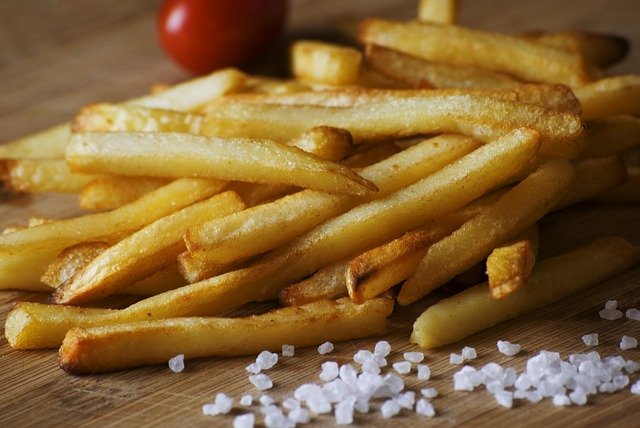
How does acrylamide form in French fries?
Acrylamide forms in the Maillard reaction between the amino acid asparagine and reducing sugars at temperatures above about 120 °C. Potatoes contain much more free asparagine than reducing sugar, so the sugar level usually decides how much acrylamide and browning develop on frying.
That is why the same fryer can produce very different acrylamide levels from different potato lots. Process control has to start before the potatoes reach the line.
What do EU rules require?
Commission Regulation (EU) 2017/2158 requires food business operators to apply mitigation measures and to check acrylamide against benchmark levels. Benchmarks are performance indicators, not legal maximum limits. For ready-to-eat French fries the benchmark is 500 µg/kg; for potato crisps it is 750 µg/kg.
For French fries and other cut potato products, the regulation’s Annex I includes:
- Testing potatoes for reducing sugars before use, for example by fry-testing 20–25 centre strips against a colour chart or with colour measuring equipment.
- Removing immature tubers with low underwater weight and high reducing sugar, for example by brine flotation.
- Removing slivers right after cutting to avoid burned pieces.
- Blanching strips to remove some reducing sugars, with blanching adapted to the raw material.
- Preventing discolouration, for example with disodium diphosphate (E450).
- Avoiding reducing sugars as a browning agent unless needed to meet colour specifications.
- Giving end users validated cooking instructions.
Operators running their own potato stores must keep storage above 6 °C, control humidity to limit senescent sweetening and test reducing sugars during storage. Check the current EU text before export, as acrylamide rules have been under review.
Which process steps control acrylamide in a fries line?
Each step either removes precursors, limits browning or catches high-risk pieces. The table maps the controls to a typical frozen French fries line.
| Line step | Acrylamide control | What to monitor |
|---|---|---|
| Potato intake and storage | Low-sugar varieties; store above 6 °C; avoid cold sweetening | Reducing sugar or fry-colour test per lot |
| Washing and destoning | Brine or flotation to remove immature tubers | Specific gravity or dry matter |
| Peeling and inspection | Remove damaged and bruised tubers | Defect counts |
| Cutting | Uniform strips; remove slivers and nubbins | Strip size distribution, sliver removal |
| Blanching | Leach reducing sugars from surfaces | Water temperature, time, water refresh rate |
| Dipping (if used) | Prevent discolouration; avoid unnecessary dextrose | Dosing and colour target |
| Drying before frying | Remove surface water for stable par-frying | Strip surface moisture |
| Par-frying | Control oil temperature and time; maintain oil quality | Oil temperature profile, oil filtration |
| Freezing and packing | Colour sorting; clear consumer cooking instructions | Finished fry colour after reference cooking |
GTI’s potato processing line page describes the frozen French fries process as washing, peeling, cutting, blanching, drying, par-frying, freezing and packaging, with oil filtration and recycling and IQF integration.
How much can blanching reduce acrylamide?
Blanching can reduce acrylamide substantially, but results depend on potato lot, storage history, strip size and blanch conditions. It is a precursor-removal step, not a guarantee.
A 2018 study on potato chips (crisps) tested blanching at 65–85 °C for 2–10 minutes. It reported maximum reductions of 64.2% for reducing sugars, 49.8% for asparagine and 61.3% for acrylamide. Blanching time mattered more than temperature, with the best results at about 9–10 minutes and 69–75 °C. After the potatoes had been stored for three months at 10 °C, changing blanch settings made no significant difference. Acrylamide also tracked the red-green colour value (a*) of the fried product closely.
Two lessons follow for a fries plant. First, validate blanch settings on your own potatoes and recheck them as storage progresses. Second, use finished colour as a routine control, backed by periodic laboratory acrylamide tests.
For blancher types and how to prove a blanch, see our blancher selection guide.
How should a plant set up routine monitoring?
Combine fast colour checks with less frequent laboratory tests. Colour tells you within minutes when a lot is drifting; laboratory acrylamide results confirm that the system works.
- Lot acceptance: fry test or reducing sugar test on every incoming lot; set a reject or treat limit.
- Storage checks: track reducing sugars over storage time and temperature.
- Line checks: sliver removal, blancher temperature and time, oil temperature, every shift.
- Finished colour: cook samples by the consumer instructions and grade colour.
- Laboratory verification: test acrylamide at a set frequency and after any process or supplier change.
- Records: keep results to show that mitigation measures are applied.
What should buyers ask when specifying a fries line?
Ask how each machine supports these controls, not only about capacity. Useful questions include:
- Can the blancher hold temperature and time accurately and refresh water at a controlled rate?
- Does the cutting section include sliver and nubbin removal?
- Is there an optical or manual colour sorting point after par-frying?
- How is fryer oil temperature controlled and oil filtered?
- Is there space and sampling access for quality checks?
Related reading: potato chips and French fries processing plant guide, chips cutter vs food slicer and optical colour sorter selection.
Frequently asked questions
Is 500 µg/kg a legal limit for French fries in the EU?
Under Regulation (EU) 2017/2158 it is a benchmark level, used to verify that mitigation works. It is not described as a maximum limit in that regulation. Check the latest EU rules before export.
Does lower frying temperature always reduce acrylamide?
Lower temperatures generally slow acrylamide formation, but they change texture, oil uptake and cooking time. Settings must be validated for quality and food safety on each product.
Why store potatoes above 6 °C?
Cold storage causes sweetening, which raises reducing sugars and therefore acrylamide and dark colour. The EU regulation sets storage above 6 °C for operators with their own stores.
Can enzymes help?
Asparaginase treatment has been studied as a mitigation tool for potato products. Its use must follow food additive and enzyme regulations, and its effect should be validated on your line.
Talk to GTI about your project
Planning a French fries or potato snack line with acrylamide controls? Contact Genex Tech Industries LLP (GTI Group) to discuss your material, production capacity, product specifications and utility requirements. To help us respond usefully, please share your product or raw material, required capacity, feed and final moisture (state wet or dry basis), finished-product specification, available utilities, installation location and project timeline.
Email: mktg@foodtechprojects.com
Call or WhatsApp: +91-93300-77417 | +91-87774-75596 (WhatsApp)
Website: https://foodtechprojects.com/
For Industrial Dryers: https://gtidryers.com
This article gives general technical guidance. Figures marked as illustrative are examples, not plant guarantees. Equipment selection and performance for your material should be confirmed through trials and engineering assessment.
References
- Commission Regulation (EU) 2017/2158 establishing mitigation measures and benchmark levels for the reduction of the presence of acrylamide in food. eur-lex.europa.eu
- European Commission. Acrylamide toolbox: French fries (FoodDrinkEurope catalogue). food.ec.europa.eu
- Zhang Y., Kahl D.H.W., Bizimungu B., Lu Z.X. (2018). Effects of blanching treatments on acrylamide, asparagine, reducing sugars and colour in potato chips. J Food Sci Technol 55:4028-4041. pmc.ncbi.nlm.nih.gov