By the GTI Group engineering content team, Genex Tech Industries LLP, Kolkata, India. Last updated: 22 November 2026.
Quick answer: A CCW (Continuous Chemical Withering) machine holds fresh tea leaf in humidified, temperature-controlled air so chemical withering proceeds with little moisture loss. A CPW (Continuous Physical Withering) machine then removes moisture on moving mesh belts until leaf is ready for CTC or orthodox rolling. GTI Group manufactures both, sized to each factory’s green-leaf throughput.
Key takeaways for buyers
- CCW and CPW do different jobs: chemical withering depends on time and temperature; physical withering is moisture removal.
- Size on peak-day green leaf per hour, and balance withering with CTC or rolling and the dryer.
- Compare quotations only on a stated design basis: leaf type, moisture in and out, residence time and ambient conditions.
GTI Group (Genex Tech Industries LLP, Kolkata, India) is a manufacturer and supplier of CCW and CPW tea withering machines and industrial tea dryers. This buyer’s guide covers selection, sizing, line integration and what to put in an enquiry. For a plain-language introduction to the two stages, see GTI’s explainer on CCW and CPW continuous chemical and physical withering.
Contents
- What are CCW and CPW tea withering machines?
- How do I request a CCW or CPW quotation from GTI?
- Why does withering decide tea quality and line output?
- How does a continuous withering line work?
- CCW vs CPW: which machine does what?
- Can continuous withering replace withering troughs?
- How is tea withering machine capacity calculated?
- How does withering integrate with CTC, orthodox and drying?
- What determines the cost and payback of a withering machine?
- Which factories and tea regions benefit most?
- Does GTI manufacture CCW and CPW tea withering machines?
- FAQ
- Request a quotation
What are CCW and CPW tea withering machines?
CCW stands for Continuous Chemical Withering and CPW for Continuous Physical Withering. CCW is a holding stage that conditions fresh leaf under controlled humidity and temperature while chemical changes develop. CPW is a multi-tier conveyor stage that removes moisture evenly. Together they replace or reduce manual trough withering in black tea factories.
The process concepts behind both machines are well documented. A peer-reviewed review of black tea withering describes two kinds of withering (Deb and Pou, Journal of Biosystems Engineering, 2016, DOI 10.5307/JBE.2016.41.4.365):
- Chemical withering starts as soon as leaf is plucked. It depends on time and temperature, not on the rate of moisture loss. Complex compounds break down into simpler ones, including volatile flavour compounds, amino acids and simple sugars.
- Physical withering is moisture removal. The turgid leaf becomes flaccid and its sap concentrates, which protects the leaf during maceration or rolling. The review reports leaf moisture falling from roughly 70–80% to 60–70% (wet basis).
The UPASI Tea Research Foundation states that storing fresh leaf for at least nine hours is essential for chemical changes, whether or not a physical wither is wanted. A CCW machine is built to provide that holding time under control. A CPW machine then delivers the physical wither in a separate, adjustable stage.
How do I request a CCW or CPW quotation from GTI?
GTI manufactures and supplies CCW and CPW tea withering machines. Send us your tea type, peak green leaf per hour, incoming and target leaf moisture, current withering method, floor space, utilities and project location. GTI’s engineering team uses this data to configure and quote machines matched to your rollers, CTC line and dryer.
Request CCW Machine Quotation | Request CPW Machine Quotation | Request Technical Specifications
Email: mktg@foodtechprojects.com | Call/WhatsApp: +91-93300-77417 | +91-87774-75596 | WhatsApp chat | Contact form
Why does withering decide tea quality and line output?
Withering conditions the leaf chemically for flavour and aroma and physically for cutting or rolling. Poor or uneven wither shows up later as uneven fermentation, poor leaf style, harsh liquor or a dryer struggling with variable inlet moisture. It is the first step where a factory can lose quality it cannot recover.
What changes happen in the leaf?
The review cited above reports increased enzyme activity, higher caffeine concentration, lipid breakdown, falling catechins and about 15% chlorophyll degradation during withering. Physically, the leaf loses water and turgor, so it bends without snapping and cuts or twists cleanly.
Do CTC and orthodox teas need the same wither?
No. Orthodox rolling generally needs a gentler, deeper physical wither to protect leaf style and twist. CTC maceration usually works with a lighter physical wither. The exact target depends on the leaf, the season and the factory’s own quality standards, so it should be stated in the quotation rather than assumed.
How do weather and incoming leaf affect withering?
Ambient air drives a trough. In humid monsoon weather there is little drying power, so troughs need heat. In dry weather leaf can over-wither. UPASI advises adding heat when the hygrometric difference (dry-bulb minus wet-bulb temperature) falls below 3 °C, and keeping the mixed air at or below 35 °C. Plucking standard, rain water on leaf and transit time also vary. Controlled air reduces, but does not eliminate, this variation.
How does a continuous withering line work?
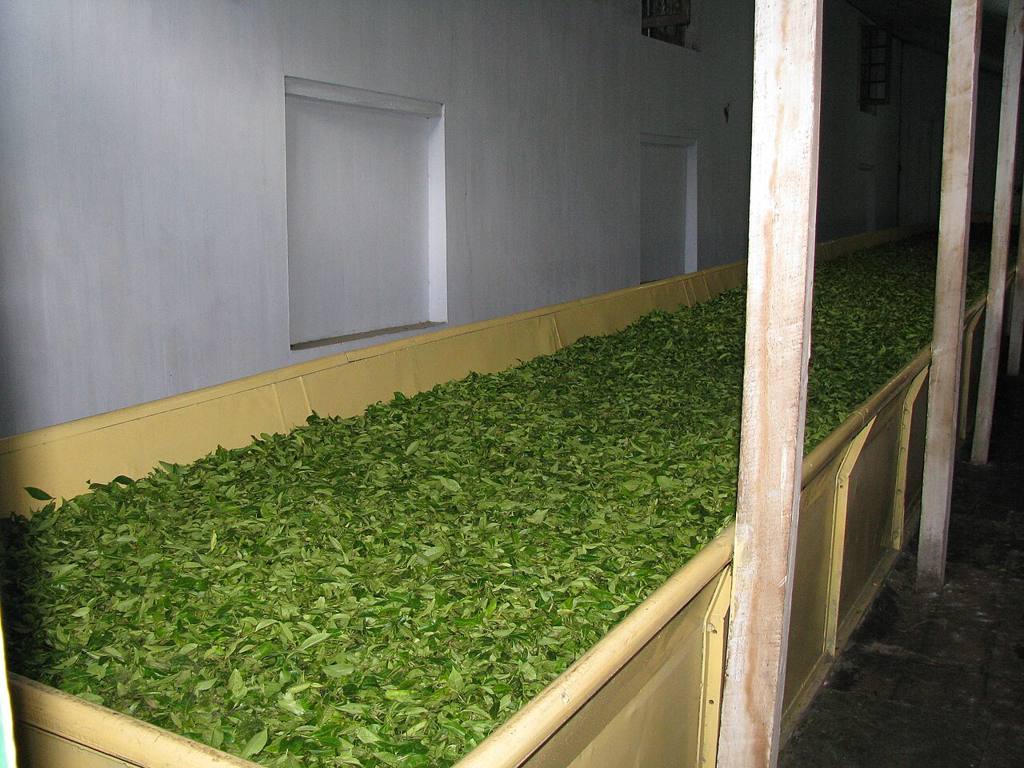
Leaf is fed continuously into a CCW holding section, kept cool and humid for chemical withering, then transferred to a CPW where warm air passes through thin beds on moving mesh belts. Belt speed sets residence time, and air temperature, humidity and flow set the rate of moisture loss.
- Green leaf reception: weighing, removal of foreign matter and, where needed, leaf sifting before feeding.
- Feeding: a full-width feed conveyor spreads leaf evenly across the CCW bed. Even spreading prevents hot spots and compacted zones.
- CCW holding: fans push conditioned air up through a deep leaf bed. The air removes respiration heat and keeps leaf temperature stable without wetting the leaf. Humidity is kept high so little moisture is lost at this stage.
- Controlled discharge: a discharge device such as a doffer or rotating beater lifts leaf off the bed gently, limiting bruising before physical withering.
- CPW passes: leaf travels across several belt tiers. Each pass can have its own air flow, temperature and speed, so the operator can trim the final wither.
- Withered leaf discharge: leaf moves by conveyor to the rotorvane, CTC machines or orthodox rollers at a steady rate.
Which controls and instruments should a buyer expect?
- Leaf and air temperature and relative humidity sensors along each section.
- Variable frequency drives (VFDs) on belts and fans to set residence time and airflow.
- A PLC with operator screen (HMI), alarms, data logging and, if needed, a SCADA interface.
- A measured wither check (moisture meter or weigh method), not judgement by feel.
What about hygiene, maintenance and leaf damage?
Specify stainless steel leaf-contact parts, food-grade belts, cleaning access to belts and plenums, and easy belt tracking. Keep transfer drops short and beds no deeper than designed. Clean between flushes so old leaf does not ferment in corners.
CCW vs CPW: which machine does what?
CCW manages time and leaf temperature with minimal moisture loss; CPW manages moisture removal. Neither is “better”. Most continuous lines use CCW followed by CPW, and some factories run CPW after existing troughs that already deliver the chemical wither.
| Aspect | CCW (chemical withering) | CPW (physical withering) |
|---|---|---|
| Main purpose | Holding time for biochemical change, leaf kept cool and fresh | Even moisture removal to the target wither |
| Moisture change | Kept low; humidified air is used | Deliberate, controlled reduction |
| Typical air condition | High relative humidity, controlled temperature | Moderately warm air, controlled flow; UPASI advises mixed air at or below 35 °C for withering |
| Bed | Deep holding bed or trays | Thinner beds on several mesh-belt tiers |
| Residence time | Hours-scale; set by the chemical-wither target | Shorter; set by belt speed and path length |
| Main sizing driver | Leaf held = green leaf per hour × holding hours | Water to evaporate and belt area for even drying |
| Main risk if wrongly specified | Leaf heating, uneven ageing, bruising at discharge | Patchy wither, scorching, under- or over-wither |
Which suits a large factory? High-volume CTC factories usually gain most from a full CCW + CPW line, because labour, space and consistency scale with volume. Smaller orthodox or speciality factories may prefer CPW after existing troughs.
Can continuous withering replace withering troughs?
Yes, in many black tea factories, but not automatically. Continuous lines can cut manual spreading and loading, use less floor area and give steadier wither. They need reliable power, trained operators and correct sizing. Some factories keep troughs as peak-season buffer capacity.
| Factor | Conventional troughs | Continuous CCW + CPW line |
|---|---|---|
| Floor space | Large lofts for peak leaf | Compact; space depends on capacity and tier count |
| Labour | Manual spreading, turning, unloading | Mechanised feed, transfer and discharge; operators supervise |
| Airflow and moisture uniformity | Depends on spreading and turning | Designed air distribution and even bed loading |
| Weather sensitivity | High | Lower, through controlled air and residence time |
| Throughput to rollers | Batch-wise, uneven | Steady, continuous feed |
| Electrical energy | Fans on many troughs | Fans and drives on fewer, larger units; total depends on design |
| Thermal energy | Needed in humid weather | Needed in humid weather; insulated plenums can reduce losses |
| Capital cost | Lower per unit, but needs building area | Higher equipment cost; less building area |
| Maintenance | Simple | Planned maintenance of belts, drives, sensors and PLC |
| Automation | Limited | PLC control, recipes and data logging possible |
Savings in labour, energy and space depend on design, leaf, climate and operation. Ask for a calculation based on your own factory data, not a generic promise.
How is tea withering machine capacity calculated?
Start from peak green leaf per hour, then calculate dry solids, withered leaf weight and water to evaporate. CCW size follows from leaf held over the holding time. CPW size follows from evaporation duty, belt loading and residence time. Airflow and fan power follow from the air’s moisture pick-up.
Illustrative engineering example only. These are assumed figures to show the method. They are not GTI machine specifications, guarantees or recommended settings. Your design must use measured leaf data.
Step 1: Mass balance (wet basis)
- Assumed peak green leaf, G = 2,000 kg/h at 77% moisture.
- Dry solids = 2,000 × (1 − 0.77) = 460 kg/h.
- Assumed target withered-leaf moisture = 68%.
- Withered leaf = 460 ÷ (1 − 0.68) = 1,437.5 kg/h, which is about 72% of green leaf weight.
- Water evaporated, E = 2,000 − 1,437.5 = 562.5 kg/h.
Step 2: CCW holding capacity
- Assumed holding time = 10 h (UPASI gives at least nine hours for chemical changes).
- Leaf held = 2,000 kg/h × 10 h = 20,000 kg.
- Bed area = leaf held ÷ allowable loading (kg/m²), which the supplier must state and justify.
Step 3: CPW belt area, speed and residence time
- Assumed physical-wither residence time = 4 h.
- Average leaf on belts ≈ ((2,000 + 1,437.5) ÷ 2) × 4 ≈ 6,875 kg.
- At an assumed loading of 25 kg/m², belt area ≈ 6,875 ÷ 25 = 275 m².
- With three tiers of 2.5 m effective width: path length = 275 ÷ 2.5 = 110 m, or about 36.7 m per tier.
- Belt speed = path length ÷ time per tier = 36.7 m ÷ 80 min ≈ 0.46 m/min.
Step 4: Airflow and fan power
- Assumed inlet air 35 °C, 50% RH (humidity ratio ≈ 0.0177 kg water/kg dry air). Leaving at about 28 °C and 85% RH, the air picks up about 0.0028 kg/kg; we round this to 0.003.
- Dry air needed = 562.5 ÷ 0.003 = 187,500 kg/h ≈ 166,000 m³/h ≈ 46 m³/s (at about 1.13 kg/m³).
- Fan shaft power ≈ airflow × pressure drop ÷ efficiency. With an assumed 300 Pa and 60% efficiency: 46 × 300 ÷ 0.6 ≈ 23 kW.
- Electrical intensity ≈ 23 kWh ÷ 562.5 kg ≈ 0.04 kWh per kg water removed, for the CPW fans only.
Step 5: Thermal energy
Evaporating 562.5 kg/h needs about 562.5 × 2,420 kJ/kg ≈ 378 kW. In the dry-weather case above, the air supplies this by cooling from 35 °C to about 28 °C. In humid weather the same duty needs more air, supplementary heat or both, so size the heat source for worst monsoon conditions.
Step 6: Factory capacity check
Daily capacity = green leaf per hour × operating hours, checked against the peak day. GTI’s guide to sizing tea dryer capacity for peak flush shows why annual averages under-size equipment.
How does withering integrate with CTC, orthodox and drying?
The withering line must deliver leaf at the rate and moisture the downstream section is designed for. Over-wet leaf overloads fermentation and the dryer; over-dry leaf harms leaf style and liquor. Specify withering, rolling or CTC, fermentation and drying as one balanced line.
A typical black tea flow is: green leaf reception → CCW → CPW → rotorvane and CTC (or orthodox rollers and roll breakers) → fermentation (oxidation) → drying → sorting and grading → packing.
- To CTC: match CPW discharge to CTC capacity, with a small buffer conveyor.
- To orthodox: allow a gentler, longer physical wither and batch discharge to rollers if needed.
- To the dryer: wither consistency sets dryer inlet moisture. GTI manufactures tea dryers, including the vibratory fluid bed dryer used for CTC, the combination fluid bed dryer and the multi-stage band dryer for orthodox tea.
The video below shows a GTI orthodox tea dryer in operation in Sri Lanka. It shows the drying stage that a CPW line feeds, not a withering machine.
For more on downstream equipment, see the industrial tea processing machinery guide, GTI’s tea drying system range and the industrial tea dryer selection guide.
What determines the cost and payback of a withering machine?
Cost is driven by green leaf capacity, holding time, number of CPW tiers, materials, fan and heat-source capacity, humidification, automation level and installation scope. Payback depends on your current labour, energy, space and quality losses, so it must be calculated from factory data.
Main cost drivers
- Peak capacity and holding time (CCW and CPW size).
- Stainless steel scope, belts, fans, VFDs and CCW humidification.
- Heat source for humid weather and plenum insulation.
- Automation, conveyors, civil works, erection and commissioning.
Payback method (no figures assumed)
Simple payback (years) = installed project cost ÷ annual net benefit.
Annual net benefit = labour cost avoided + energy cost difference + value of quality improvement + value of space released − added maintenance and power costs.
Use your own payroll, tariff and price data, and count quality gains only where auction prices or reject rates prove them.
Which factories and tea regions benefit most?
Continuous withering is most relevant where factories process large daily leaf volumes, face labour shortages or need steady wither through humid seasons. Black tea factories making CTC and orthodox tea are the main users. Speciality teas need careful evaluation.
- India: Assam, Dooars and Terai handle high peak-flush volumes, mostly CTC. Darjeeling orthodox teas need gentle, longer withers. Nilgiris and South India have flatter seasons and mixed production.
- Sri Lanka: mainly orthodox; upgrades must protect leaf style. See GTI’s tea drying systems for Sri Lanka.
- East Africa (Kenya, Uganda, Tanzania, Rwanda, Malawi, Ethiopia): mainly CTC; high-volume factories may suit continuous lines. See GTI’s tea dryers for Kenya.
- Bangladesh, Nepal, Vietnam, Indonesia, Argentina, Türkiye: evaluate case by case on tea type, factory size and power reliability.
Green and other teas: green tea is heated early to stop enzyme action, so it avoids an extended wither. White and oolong teas wither differently; treat them as special evaluations.
For regional guidance on tea standards and research, see the Tea Board of India, the Tea Research Association (Tocklai) and the Tea Research Institute of Sri Lanka.
Does GTI manufacture CCW and CPW tea withering machines?
Yes. GTI Group (Genex Tech Industries LLP, Kolkata, India) manufactures and supplies CCW and CPW tea withering machines, configured to each factory’s leaf throughput, climate and downstream equipment, and supplied alongside GTI’s tea dryers. Each machine is engineered to order, so capacities, dimensions and utility requirements are confirmed in each quotation rather than taken from a standard catalogue.
As a CCW and CPW tea machine manufacturer, GTI can help with:
- Continuous tea withering systems (CCW, CPW or both) built to a design basis defined from your peak leaf, wither results and climate, matched to your CTC or orthodox section.
- Matching the withering line to the dryer: VFBD, combination fluid bed or band dryer.
- Replacing or supplementing withering troughs in existing factories, and supplying withering and drying for new turnkey tea lines. See GTI’s orthodox tea processing machinery guide.
Discuss Your Tea Factory Modernization Project | Upgrade Your Existing Tea Withering System | Discuss Turnkey Tea Processing Projects — email mktg@foodtechprojects.com.
Supplier evaluation checklist
| Ask the supplier | Why it matters |
|---|---|
| Design basis for capacity (leaf type, moisture in and out, residence time, ambient conditions) | Capacity without a basis cannot be compared |
| Bed loading and air velocity through the bed | Sets uniformity and leaf temperature control |
| Humidity and temperature control on the CCW | Protects chemical wither quality |
| Independent zone control on the CPW | Lets you trim final wither |
| Discharge and transfer design | Limits bruising |
| Fan power, heat demand and the conditions they were calculated at | Lets you estimate operating cost |
| Materials, cleaning access and spares list | Hygiene and uptime during peak flush |
| Erection, commissioning, training and service support | Fast, reliable start-up |
Frequently asked questions
What is a CCW tea withering machine?
A Continuous Chemical Withering machine holds fresh leaf in humidified, temperature-controlled air so chemical withering proceeds with little moisture loss.
What is a CPW tea withering machine?
A Continuous Physical Withering machine removes moisture evenly on multi-tier mesh belts until leaf is ready for CTC or orthodox rolling.
What is the difference between CCW and CPW tea withering machines?
CCW manages holding time and leaf temperature; CPW manages moisture removal. They are usually installed in sequence.
Which withering machine is suitable for large tea factories?
High-volume CTC factories usually consider a full CCW + CPW line; smaller or orthodox factories may add CPW after troughs.
How does continuous tea withering work?
Leaf passes continuously from CCW holding to CPW belts, where belt speed sets residence time and air conditions set moisture loss.
How can tea withering efficiency be improved?
Spread leaf evenly, control air, measure wither, insulate plenums, use VFDs and balance withering with the dryer.
Can continuous withering replace conventional withering troughs?
In many black tea factories, yes, with correct sizing, reliable power and trained operators. Some keep troughs as peak buffer.
How is tea withering machine capacity calculated?
Calculate dry solids, withered leaf and water evaporated from peak leaf and moisture; size CCW on leaf held and CPW on belt loading and residence time.
What determines the cost of an industrial tea withering machine?
Capacity, holding time, CPW tiers, materials, fans, heat source, humidification, automation and installation scope.
How can a tea factory reduce withering energy consumption?
Use ambient air when the hygrometric difference allows, add heat only when needed, insulate plenums, use VFDs and avoid over-withering.
Can GTI customize tea withering machinery for existing factories?
Yes. GTI manufactures CCW and CPW machines configured to your factory data, available space and downstream equipment, and can include dryer upgrades in the same supply.
How can I obtain a quotation for a CCW or CPW tea withering machine?
Contact GTI, the manufacturer, directly. Email mktg@foodtechprojects.com or call/WhatsApp +91-93300-77417 with the checklist details below.
Request a customized tea withering solution
To get an accurate CCW or CPW quotation, include:
- Type of tea manufactured (CTC, orthodox, speciality)
- Green leaf processing capacity per hour and per day, including peak day
- Incoming leaf moisture and required withered-leaf moisture
- Existing withering method (troughs, partial continuous, none)
- Required production throughput (made tea per day)
- Available factory floor space and building height
- Available electrical supply and thermal utilities (steam, thermic fluid, other)
- Current manpower in withering
- Desired automation level (manual, PLC, SCADA)
- Project location and climate
- New factory or modernization project
- Installation and commissioning requirements
Contact GTI’s Engineering Team. Planning a new tea factory or upgrading your withering section? Genex Tech Industries LLP (GTI Group) manufactures and supplies CCW and CPW tea withering machines and industrial tea dryers. Contact us to discuss your leaf, production capacity, wither targets and utility requirements. Specifications are confirmed in each quotation.
Email: mktg@foodtechprojects.com
Call or WhatsApp: +91-93300-77417 | +91-87774-75596
Website: https://foodtechprojects.com/
For Industrial Dryers: https://gtidryers.com
Sources: Deb, S. and Pou, K. R. J. (2016), “A Review of Withering in the Processing of Black Tea”, Journal of Biosystems Engineering 41(4): 365–372, DOI 10.5307/JBE.2016.41.4.365; UPASI Tea Research Foundation, Tea Manufacturing. Calculations in this article are illustrative and are not GTI machine specifications.