
Last updated: 24 November 2026. By the GTI Group editorial team, Genex Tech Industries LLP (Food Tech Projects), Kolkata, India.
Direct answer: For tahini, hulled sesame is usually hot-air roasted to a golden colour. One optimisation study found the best tahini colour and texture at 155-170 °C for 40-60 minutes. Cool the seed quickly, aim for paste moisture of 1.5% or less, and treat everything after the roaster as a high-hygiene zone, because Salmonella can survive in tahini.
Request a Quotation: Planning a tahini or halva line, or adding a roaster and cooler to a sesame hulling plant? Email mktg@foodtechprojects.com or call/WhatsApp +91-93300-77417 | +91-87774-75596. Include hulled seed in kg/h, seed moisture into the roaster, roast colour target, location and timeline.
Key takeaways
- The Codex regional standard for tehena (tahini) sets maximum moisture at 1.5% and extracted-oil acidity at 1.8% as oleic acid.
- Published research puts the best tahini colour and texture at 155-170 °C for 40-60 minutes of hot-air roasting; one flavour study favoured 170-180 °C.
- Roasting is the main Salmonella kill step, but seeds that are already dry when they enter the roaster are harder to sterilise.
- Salmonella that gets into tahini after roasting can survive for months, so post-roast hygiene matters as much as the roast.
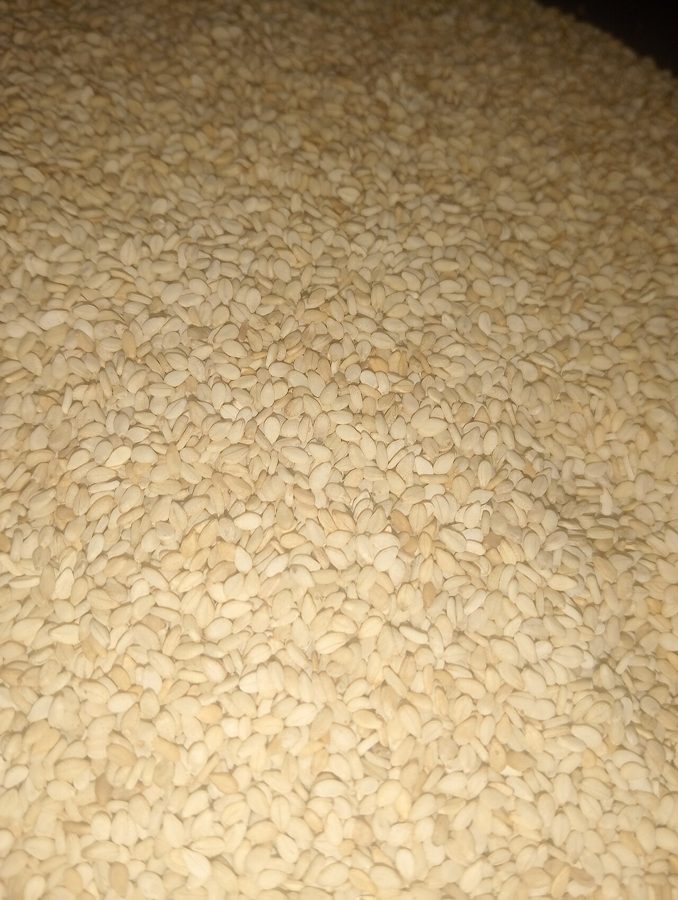
What does tahini need from the sesame roasting step?
The roaster must deliver three things at once: a uniform golden colour and roasted flavour, low seed moisture so the paste meets specification, and a reliable Salmonella reduction. A short cooling step then stops the roast at the right point before the seed goes to milling.
The Codex Regional Standard for Tehena (CXS 259-R-2007) defines it as a product made by grinding mature, roasted and husked sesame seeds. Its quality limits are:
| Parameter | Codex limit for tehena |
|---|---|
| Moisture | 1.5% maximum |
| Protein | 25% minimum |
| Fat (as sesame oil only) | 45% minimum |
| Total ash | 3.5% maximum |
| Acid-insoluble ash | 0.3% maximum |
| Extracted oil acidity | 1.8% maximum, as oleic acid |
Moisture in the paste comes almost entirely from the roasted seed, so the roaster and cooler control it. Acid-insoluble ash reflects sand and dirt, which is controlled earlier by cleaning and hulling.
What roasting temperature and time suit hulled sesame?
Start trials in the 155-170 °C range for 40-60 minutes of hot-air roasting, then adjust to your market’s colour and flavour. Researchers cited by Osaili and colleagues (2021) found this range gave the best tahini colour and texture. A separate flavour study found pastes made at 170-180 °C the most aromatic and most acceptable to tasters.
That second study (Hou, Zhang and Wang, 2019) processed sesame pastes at 140-190 °C. Volatile compounds rose 4.15-fold between 140 °C and 180 °C, mainly pyrazines. Panellists rated the 180 °C paste highest for acceptability, followed by 170 °C.
- Lighter, milder tahini: lower end of the range, shorter time.
- Darker, roastier paste or halva base: higher temperature, with close colour checks.
- Over-roasting: very dark colour and burnt notes; treat this as a quality risk, not a flavour choice.
These temperatures describe the roasting conditions in each study, not your seed core temperature. A drum roaster, a hot-air roaster and a continuous roaster with the same set point will roast differently, so confirm settings by trial on your equipment.
How does roasting control Salmonella in tahini?
Roasting is usually the only lethal step in traditional tahini making, so it must be validated. Torlak and colleagues (2013) achieved complete inactivation of a high Salmonella load on sesame at 110 °C for 60 minutes, 130 °C for 50 minutes or 150 °C for 30 minutes.
Seed moisture going into the roaster changes the result. Zhang, Keller and Grasso-Kelley (2017) roasted seed at 130 °C. Moist seed (water activity 0.90 or more) fell below detection within 10 minutes. When the seed was first dried to water activity 0.45, Salmonella still remained after 60 minutes. The same study found Salmonella grew by more than 3 log during a 24-hour soak.
For a plant, this means:
- Keep soaking short and controlled, because soak water can multiply bacteria.
- Do not assume a dry-seed roast kills as well as a moist-seed roast; validate with your actual inlet moisture.
- Record roast temperature and time for every batch or shift, as a critical control point.
- Use a food-safety specialist or laboratory to validate the kill step for your market.
Why cool roasted sesame quickly?
Hot seed keeps roasting after it leaves the roaster, so colour and flavour drift unless it is cooled promptly. Fast cooling also brings the seed to a safe, even temperature before milling. GTI’s sesame processing plant and machinery page lists sesame seed roasting and cooling within its turnkey scope.
Use clean, filtered air for cooling, because the seed is now a ready-to-eat ingredient. Keep the cooler and everything after it in the clean zone.
How much water must be removed before and during roasting?
It depends on how wet the seed is after hulling and washing. In the illustrative example below, about 240 kg of water leaves every tonne of washed seed. The moisture values are assumptions to show the method; measure your own seed.
- Washed hulled seed: 1,000 kg/h at an assumed 25% moisture (wet basis), so dry solids = 750 kg/h.
- Roasted seed at an assumed 1.5% moisture: 750 / 0.985 = about 761 kg/h.
- Water removed in drying and roasting: 1,000 – 761 = about 239 kg/h.
Many plants split this duty between a dryer and the roaster. Remember the Salmonella point above: drying the seed further before roasting can make the kill step harder, so plan the two steps together.
How do you stop Salmonella getting in after roasting?
Separate the post-roast area and keep it dry. Torlak’s team found Salmonella survived in tahini (water activity 0.17) for at least 16 weeks. Zhang’s team saw no change in Salmonella numbers over 119 days at 4 °C. Osaili’s team found survival over 12 months varied with water activity and storage temperature.
- Physically separate raw seed handling from roasted seed, cooling, milling and filling.
- Prefer dry cleaning in the post-roast zone; water left on equipment raises local water activity. See our dry-cleaning plan for sesame and powder lines.
- Control people, air and tools moving from raw to clean areas.
- Test finished tahini and the environment under a documented sampling plan.
What does a hulled-sesame-to-tahini line look like?
- Cleaning, destoning and grading of raw seed.
- Soaking and conditioning, then hulling. Problems at this stage are covered in our guide to sesame dehulling problems.
- Washing and separation of hulls; drying of the washed seed.
- Roasting to colour target, then rapid cooling.
- Sorting or sifting of roasted seed.
- Milling to paste, then filling and packing.
GTI’s sesame page covers cleaning, hulling, washing and drying, roasting and cooling, and packaging integration. It names tahini and halva producers as applications. GTI’s spice processing page lists drum roasters with controlled temperature zones and hot air generators. Paste-milling scope should be confirmed with GTI for each project. For an oil-focused line, see our sesame oil and dryer guide.
FAQ
What temperature should sesame be roasted at for tahini?
Research suggests 155-170 °C for 40-60 minutes of hot-air roasting for colour and texture. In one flavour study, pastes made at 170-180 °C were rated most acceptable.
What is the maximum moisture of tahini?
The Codex regional standard for tehena sets 1.5% maximum moisture.
Does roasting make tahini safe from Salmonella?
A validated roast can inactivate Salmonella, but seed moisture affects the kill. Contamination after roasting can survive for months in tahini.
Should I dry hulled sesame before roasting?
Some drying is normal, but very dry seed is harder to sterilise. Plan drying and roasting together and validate the kill step.
Request a Quotation from GTI
Setting up a tahini, halva or roasted sesame line? Contact Genex Tech Industries LLP (GTI Group) to discuss your material, production capacity, product specifications and utility requirements. To help us respond usefully, please share your product (hulled or natural seed, tahini, halva base), required capacity in kg/h, seed moisture in and target moisture out, roast colour target, available utilities and fuel, installation location and project timeline.
Email: mktg@foodtechprojects.com
Call or WhatsApp: +91-93300-77417 | +91-87774-75596 (WhatsApp)
Website: https://foodtechprojects.com/
For Industrial Dryers: https://gtidryers.com
This article gives general technical guidance, not food-safety validation. Figures marked as illustrative are examples, not plant guarantees. Equipment selection and performance for your material should be confirmed through trials and engineering assessment.
References
- Codex Alimentarius. Regional Standard for Tehena, CXS 259-R-2007. fao.org (PDF)
- Osaili T. et al. (2021). Effect of water activity and storage of tahini on the viability of stressed Salmonella serovars. Food Science and Technology (Campinas). scielo.br (cites Kahyaoglu and Kaya, 2006, J Sci Food Agric 86(10):1452-1459, doi.org/10.1002/jsfa.2509)
- Hou L., Zhang Y., Wang X. (2019). Characterization of the volatile compounds and taste attributes of sesame pastes processed at different temperatures. Journal of Oleo Science 68(6). jstage.jst.go.jp
- Torlak E., Sert D., Serin P. (2013). Fate of Salmonella during sesame seeds roasting and storage of tahini. International Journal of Food Microbiology 163(2-3):214-217. pubmed.ncbi.nlm.nih.gov
- Zhang Y., Keller S.E., Grasso-Kelley E.M. (2017). Fate of Salmonella throughout production and refrigerated storage of tahini. Journal of Food Protection 80(6):940-946. pubmed.ncbi.nlm.nih.gov