
Last updated: 24 November 2026. By the GTI Group editorial team, Genex Tech Industries LLP (Food Tech Projects), Kolkata, India.
Direct answer: A practical jackfruit processing plant usually starts with two dried products: dehydrated or osmo-dried ripe bulbs, and raw (green) jackfruit flour. Both use the same washing, cutting, pre-treatment, drying and packing equipment. Cutting and bulb separation are still largely manual, so plan labour and size the dryer around peak-season fruit intake.
Request a Quotation: Planning a jackfruit processing line for dehydrated bulbs, raw jackfruit flour or both? Email mktg@foodtechprojects.com or call/WhatsApp +91-93300-77417 | +91-87774-75596. Include products, daily fruit or bulb intake, season length, target moisture, packing format, available fuel or power, location and timeline.
Key takeaways
- CSIR-CFTRI’s osmo-air-dried jackfruit process runs: bulb, seed separation, cutting, osmotic treatment, drying, packing.
- A national market feasibility study reports that peeling and bulb separation are usually done manually.
- Laboratory studies dried jackfruit at about 50-80 °C. In one trial, cabinet-dried raw soft-flesh bulbs at 60 °C reached 5.87% moisture with 23.96% recovery.
- Raw jackfruit flour in a published study was made by cubing 6-7 week tender fruit, citric acid pre-treatment, tray drying at 60 °C for 24 hours and grinding.
- Season length decides plant economics. Planning two products from different fruit maturities helps extend operating days.
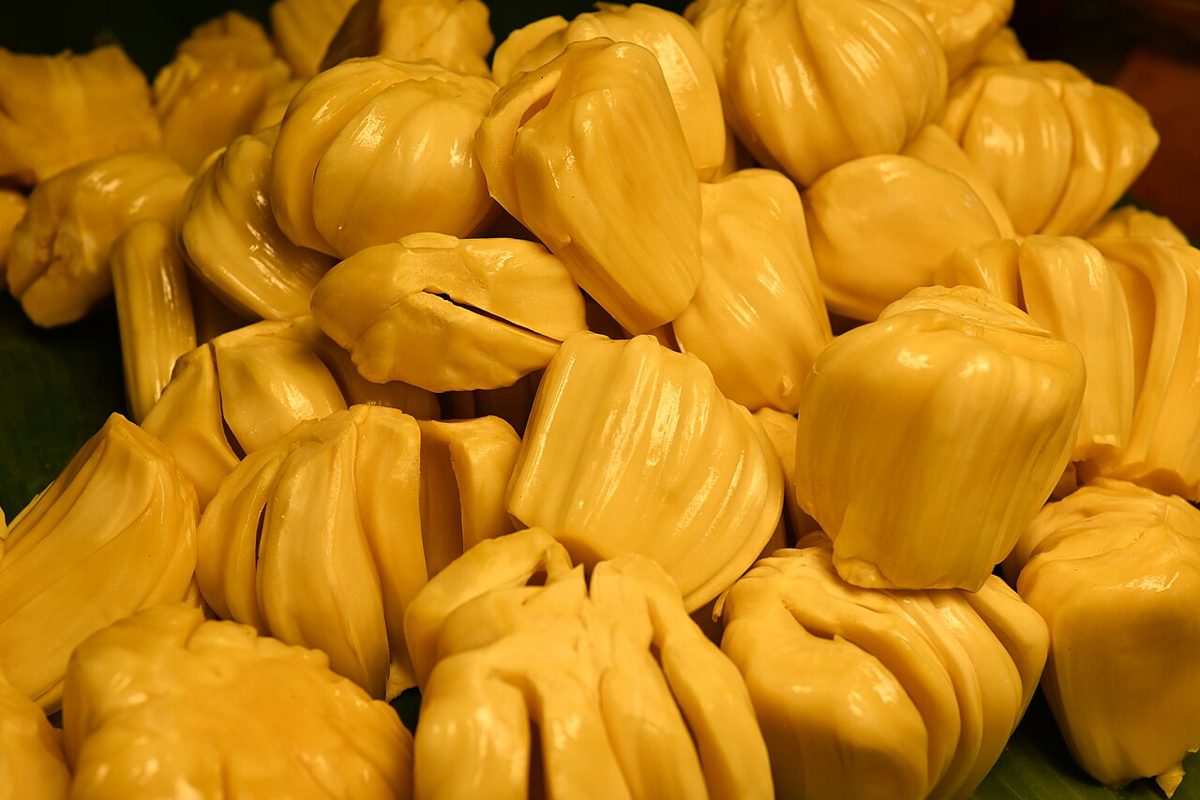
Which jackfruit products should a new plant start with?
Start with products that share equipment and keep well. Dehydrated bulbs and raw jackfruit flour both need a dryer, cutting tools and dry packing, so one line can make both. Chips, pulp and canned bulbs need extra equipment such as fryers, pulpers or retorts.
| Product | Fruit stage | Main steps | Extra equipment |
|---|---|---|---|
| Dehydrated or osmo-dried bulbs | Ripe | Bulb separation, deseeding, cutting, pre-treatment or syrup soak, drying, packing | Jacketed kettles for syrup |
| Raw (green) jackfruit flour | Tender, unripe | Peeling, cubing, anti-browning dip, drying, grinding, sieving | Pulveriser, sifter |
| Jackfruit seed flour | Seeds from ripe fruit | Cleaning, drying, grinding | Shares dryer and pulveriser |
| Chips | Raw (unripe) bulbs | Slicing, frying, packing | Fryer, de-oiler |
The market study for India also describes jackfruit seed flour, which can be made from seeds that the bulb line removes. That turns a by-product into a saleable item.
What is the process flow for dehydrated jackfruit bulbs?
The CFTRI technology sheet lists the osmo-air-dried process as: separate seeds from bulbs, cut, give an osmotic treatment in sugar syrup with citric acid, dry and pack. A typical line runs as follows:
- Receive and wash whole fruit; sort for ripeness.
- Cut the fruit and separate bulbs from rind and core by hand.
- Remove seeds; cut bulbs to a uniform size.
- Pre-treat: a published recommendation is steeping bulbs in 0.1% potassium metabisulphite for 30 minutes; the osmo-dried route soaks bulbs in sugar syrup with citric acid.
- Drain and spread evenly on trays or a belt; dry to the target moisture.
- Cool, grade and pack in moisture-barrier packs.
Jackfruit releases sticky latex when cut. Plan stainless tables, cleanable tools and a cleaning routine around this, and keep the latex off belts and trays.
What drying temperatures and times have been reported?
Published work used hot air at about 50-80 °C. Higher temperatures dry faster but can affect colour and texture. Treat these as trial starting points.
| Study | Material and method | Reported result |
|---|---|---|
| Ciencia y Tecnología Alimentaria (2006) | Jackfruit slices, tray dryer at 50, 60 and 70 °C | 9.92, 6.1 and 4.75 h to reach 21.3% moisture, dry basis |
| Int. J. Advanced Biochemistry Research (2026) | Raw soft-flesh bulbs, 0.5% KMS dip; cabinet at 60 ± 2 °C vs solar and sun | Cabinet: 10-12 h, 5.87% moisture, 23.96% recovery; sun: 26-28 h, 6.67%, 27.77% |
| Jurnal Teknologi (2013) | Bulbs, hot air at 60, 70, 80 °C vs microwave-vacuum | Microwave-vacuum at 321 W was 133 times faster than hot air at 60 °C (laboratory) |
| Int. J. Chemical Studies (2021) | Raw jackfruit cubes, tray dryer 60 °C for 24 h vs freeze drying | Freeze-dried flour lighter in colour; tray-dried flour slightly darker |
The 2026 study also found cabinet drying had the highest processing cost per 100 g but better sensory acceptability than sun drying. Mechanical drying gives hygiene and control that open sun drying cannot.
How do you size a jackfruit dryer for a short season? A worked example
Illustrative assumptions only. Measure bulb yield and recovery on your own fruit.
- Peak intake: 2,000 kg/day of prepared ripe bulbs (assumed).
- Recovery of dried bulbs: 24% (assumed, close to the 23.96% cabinet-drying result above). Dried product = 2,000 × 0.24 = 480 kg/day.
- Water removed = 2,000 − 480 = 1,520 kg/day.
- If the dryer runs 16 hours a day (assumed), average evaporation = 1,520 ÷ 16 = 95 kg/h.
- Whole fruit needed = 2,000 ÷ bulb fraction. The bulb share of fruit weight varies by variety and maturity, so weigh a sample of fruit before sizing receiving and cutting areas.
Osmo-dried bulbs take up sugar, so their recovery is higher than plain dried bulbs. Recalculate using your own syrup trials. CFTRI’s model project, for reference, assumed 200 kg of osmo-dried jackfruit per shift over 150 working days. Its sheet says CFTRI does not guarantee machine performance and buyers should confirm performance with the equipment fabricator.
How do you deal with seasonality?
Tender fruit for flour comes earlier than ripe fruit for bulbs. Running both products, plus seed flour, keeps the dryer busy for more weeks.
- Sign supply agreements with growers before the season.
- Choose a dryer you can also use for other local crops out of season, such as banana, other fruits or vegetables.
- Store dried intermediates such as raw jackfruit cubes in barrier packs and grind into flour later, if your quality tests support it.
- The market study also suggests off-season varieties as a way to tackle seasonality.
For a similar seasonal planning problem, read our guide on mango pulp plant planning for a short season.
Which GTI machinery fits a jackfruit line?
GTI’s fruit and vegetable processing machinery page lists jackfruit among the fruits its systems can process. It covers washers, sorting and inspection conveyors, cutters, blanchers, steam jacketed kettles, a range of dryers and packaging equipment such as weigh fillers, nitrogen flushing and metal detectors.
- Drying: the Mesh Belt Dryer and Continuous Tray Type Dryer for continuous drying of bulbs and cubes. GTI’s fruit drying systems page lists jackfruit and describes mesh belt dryers for fruit slices and heat pump dryers for low-temperature fruit drying.
- Flour: GTI’s pulveriser machinery for grinding dried cubes and seeds into flour.
- Whole-line planning: see our overview of fruit and vegetable dehydration plants.
GTI’s product pages do not list a dedicated jackfruit bulb-separating machine, so plan bulb separation as a manual station unless your supplier proves otherwise. Dryer type, capacity and zone settings for your fruit should be confirmed through trials with GTI engineering.
FAQ
What temperature is used to dry jackfruit bulbs?
Published studies used about 50-80 °C hot air; one cabinet trial at 60 °C took 10-12 hours to reach about 5.9% moisture.
How is raw jackfruit flour made?
Tender fruit is peeled, cubed, dipped in an anti-browning solution such as citric acid, dried (60 °C for 24 hours in one study) and ground.
How much dried product do I get from fresh bulbs?
One study recorded 23.96% recovery for cabinet-dried raw soft-flesh bulbs. Osmo-dried bulbs differ because they absorb sugar.
Can jackfruit bulbs be separated by machine?
Bulb separation is mainly manual today. Mechanical slicers exist for cutting separated bulbs.
Request a Quotation from GTI
Planning a jackfruit processing plant or adding jackfruit to an existing dehydration line? Contact Genex Tech Industries LLP (GTI Group) to discuss your material, production capacity, product specifications and utility requirements. To help us respond usefully, please share your products, daily fruit or bulb intake, required output in kg/h or kg/day, feed and final moisture (state wet or dry basis), season length, available utilities, installation location and project timeline.
Email: mktg@foodtechprojects.com
Call or WhatsApp: +91-93300-77417 | +91-87774-75596 (WhatsApp)
Website: https://foodtechprojects.com/
For Industrial Dryers: https://gtidryers.com
This article gives general technical guidance. Figures marked as illustrative are examples, not plant guarantees. Laboratory drying results do not translate directly to production dryers; equipment selection and performance should be confirmed through trials and engineering assessment.
References
- CSIR-Central Food Technological Research Institute, Mysore. Osmo air-dried jackfruit (technology sheet). cftri.res.in
- Mittal R., Sankaran K., Achar A.P. Market feasibility study for jackfruit value added products. National Institute of Agricultural Marketing and Justice K.S. Hegde Institute of Management. ccsniam.gov.in
- Giraldo Zuñiga A.D., Arévalo Pinedo A., Rodrigues R.M., Lima C.S.S., Feitosa A.C. (2006). Kinetic drying experimental data and mathematical model for jackfruit slices. Ciencia y Tecnología Alimentaria 5(2): 89-92. redalyc.org
- Samant A.P., Pawar C.D., Salvi B.R., Kadam J.J., Khandekar R.G., Sawant P.S. (2026). Comparative evaluation of drying techniques for physico-economic optimization of dehydrated matured raw soft flesh jackfruit bulbs. International Journal of Advanced Biochemistry Research SP-10(4): 239-242. biochemjournal.com
- Taib M.R., Muhamad I.I., Ngo C.L., Ng P.S. (2013). Drying kinetics, rehydration characteristics and sensory evaluation of microwave vacuum and convective hot air dehydrated jackfruit bulbs. Jurnal Teknologi 65(1). journals.utm.my
- Preethi N.S., Sangeeta A., Jaganmohan R. (2021). Comparative study of physicochemical properties of freeze dried and tray dried raw jackfruit flour. International Journal of Chemical Studies 9(1): 3053-3057. chemijournal.com