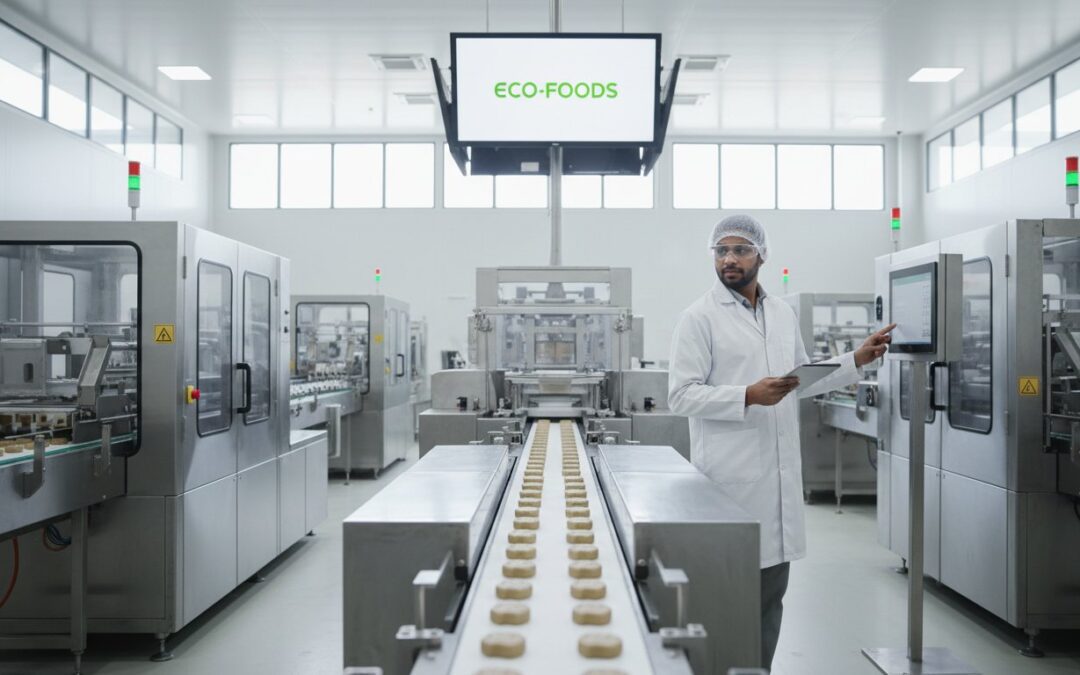
In the competitive landscape of food manufacturing, achieving efficiency, consistency, and the highest standards of hygiene is paramount. A well-engineered food production line is the cornerstone of a successful operation, transforming raw ingredients into finished, packaged goods at scale. This guide explains the core components, essential stages, and key benefits of implementing an automated food production line to optimize your manufacturing process from start to finish.
The required space, or footprint, varies greatly depending on the production capacity and the size of the individual machines. While large plants require extensive layout design, the same principles apply to compact mobile kitchens, a specialized area where companies like Build Food Truck Online design and fabricate entire production lines within the footprint of a vehicle.
What is an Industrial Food Production Line?
An industrial food production line is a complete, integrated system of machinery and equipment designed to automate the manufacturing of food products. It arranges various processing stations in a logical sequence to handle every step, from the initial intake of raw ingredients to the final packaging of the finished goods. The primary goal of a production line is to streamline operations, increase throughput, ensure consistent product quality, and maintain strict food safety standards.
Unlike using separate, standalone machines that require manual transfer of products between stages, an integrated line uses conveying systems to create a continuous, uninterrupted workflow. This synchronization minimizes delays, reduces the potential for human error, and maximizes overall operational efficiency.
Automatic vs. Semi-Automatic Production Lines
Food production lines can be categorized based on their level of automation. Automatic lines are engineered to require minimal human intervention, with sensors, controllers, and sophisticated machinery managing nearly every task. In contrast, semi-automatic lines strategically combine advanced machinery with manual labor for specific tasks that may require human dexterity or oversight. The choice between them depends on critical factors such as production scale, project budget, and the complexity of the food product being manufactured.
The Core Stages of a Food Production Line
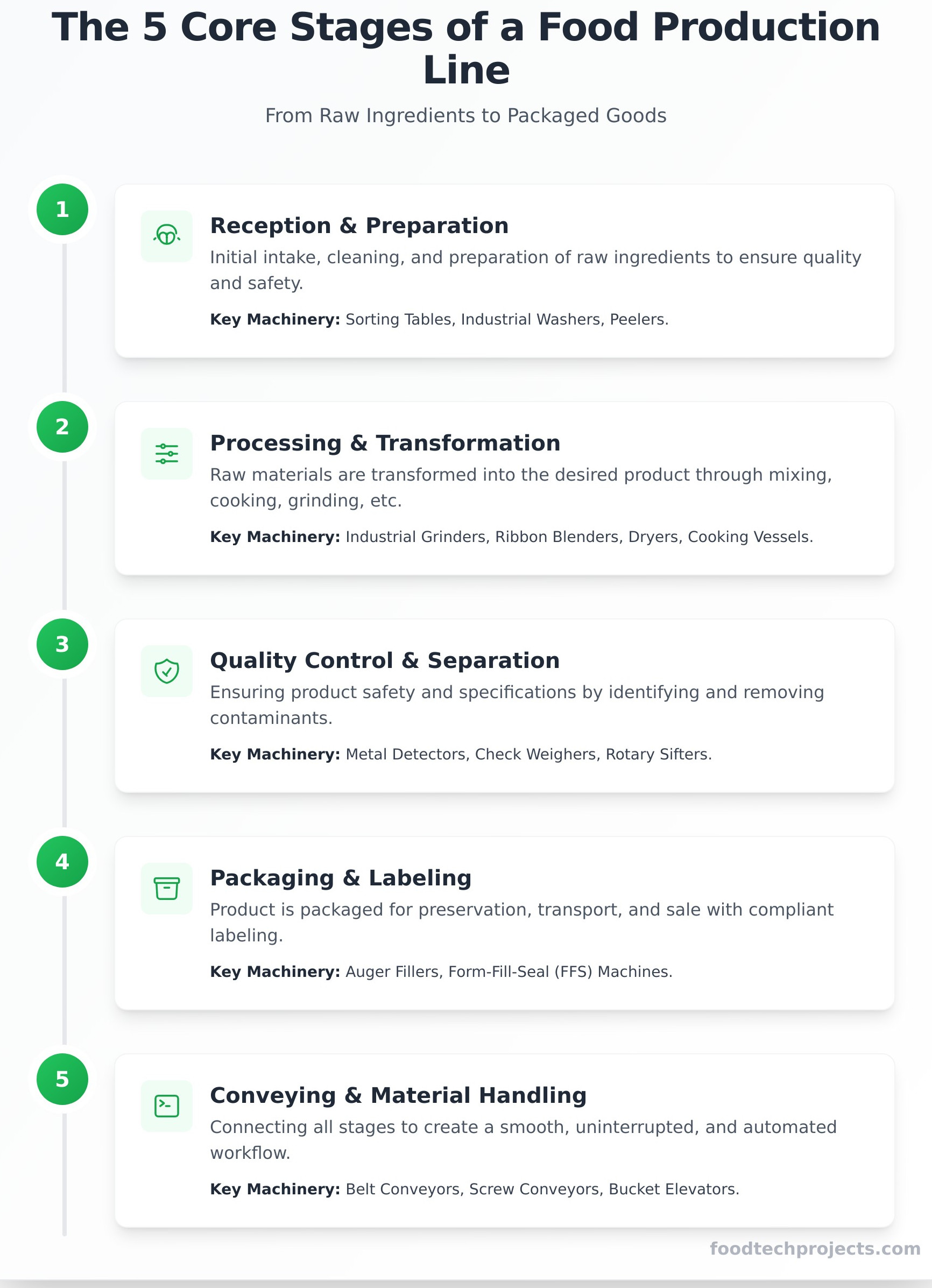
A typical food production line follows a logical, step-by-step manufacturing process. While the specific machinery varies based on the product—such as spices, fruits, or baked goods—the fundamental stages remain consistent. Each stage is designed to perform a specific function, building upon the previous one to create the final product.
Stage 1: Raw Material Reception and Preparation
The process begins with the initial intake of raw ingredients. This stage focuses on cleaning and preparing the materials for processing to ensure a high-quality and safe final product. Specialized machinery for this phase can include sorting tables to remove defective items, industrial washing machines to eliminate dirt, and equipment like peelers, destoners, or cutters to bring the ingredients to the required initial state.
Stage 2: Processing and Transformation
This is the central stage where the raw materials are transformed into the desired product. The processes here are highly specific to the food being produced. This could involve grinding spices into a fine powder, mixing ingredients to create batters and doughs, cooking sauces to the correct temperature, or dehydrating fruits and vegetables. Key machinery in this stage includes industrial grinders, pulverizers, ribbon blenders, industrial dryers, and cooking vessels.
Stage 3: Quality Control and Separation
Throughout and after processing, quality control is critical for ensuring product safety and adherence to specifications. This stage involves machinery designed to identify and remove contaminants or separate components based on size, weight, or density. Common equipment includes industrial metal detectors, check weighers to ensure proper portioning, and rotary sifters or centrifugal filters to achieve a uniform particle size and remove foreign matter.
Stage 4: Packaging and Labeling
Once the product is finalized and has passed quality checks, it must be packaged for storage, transport, and sale. This stage is crucial for product preservation, brand presentation, and regulatory compliance. Automated machinery handles tasks like filling bags or containers, sealing packages to ensure freshness, and applying labels with essential information such as ingredients, nutritional facts, and expiration dates. This includes auger fillers, form-fill-seal (FFS) machines, and label applicators.
Stage 5: Conveying and Material Handling
Connecting every stage of the production line are the material handling and conveying systems. These are the arteries of the factory, ensuring a smooth and uninterrupted workflow. Equipment such as belt conveyors, screw conveyors, and bucket elevators transport materials efficiently between machines, eliminating the need for manual handling and preventing production bottlenecks. Properly engineered conveying is critical to the overall speed and reliability of the line. Design an efficient line with our turnkey solutions.
Key Benefits of an Integrated Production Line
Investing in a complete, integrated food production line provides significant operational and financial advantages. These benefits directly impact efficiency, product quality, and long-term profitability, making it a strategic investment for any serious food manufacturer.
Increased Throughput and Efficiency
Automated systems operate at a consistent and rapid pace, far exceeding the output of manual processes. By synchronizing every stage and eliminating bottlenecks, an integrated line dramatically increases production volume and overall plant efficiency.
Enhanced Product Consistency and Quality
Machinery performs tasks with high precision and repeatability, ensuring that every unit of product is uniform. This minimizes variations between batches, leading to a consistent final product that meets customer expectations and quality standards every time.
Improved Food Safety and Hygiene
Automated lines reduce the need for direct human contact with food products, significantly lowering the risk of contamination. Furthermore, industrial machinery is typically constructed from food-grade stainless steel, which is durable, non-corrosive, and easy to clean and sanitize, helping to meet stringent hygiene regulations.
Reduced Labor Costs and Operational Expenses
While the initial investment is significant, automation drastically decreases the long-term reliance on manual labor, leading to substantial savings in labor costs. Additionally, modern production lines are designed for optimized energy consumption, further lowering day-to-day operational expenses.
Frequently Asked Questions
What is the difference between a food production line and food processing?
Food processing refers to the specific actions taken to transform raw ingredients into food products (e.g., grinding, drying, mixing). A food production line is the complete, integrated system of machinery that automates these processing actions in a sequential and continuous flow.
How do you design a food production line?
Designing a production line involves analyzing the product requirements, calculating desired throughput, selecting the appropriate machinery for each stage, and engineering a layout that ensures a logical and efficient workflow. This complex process is best handled by experienced engineers specializing in turnkey food plant solutions.
What are the most important machines in a food production line?
This depends entirely on the product. For a spice plant, the grinder and sifter are critical. For a juice plant, the fruit washer, pulper, and pasteurizer are essential. The “most important” machine is the one that performs the core transformation of your specific raw material.
How much space is required to install a full production line?
The required space, or footprint, varies greatly depending on the production capacity, the number of stages, and the size of the individual machines. A comprehensive plant layout design is necessary to determine the exact spatial requirements for a safe and efficient operation.
Can a production line be customized for a unique food product?
Absolutely. The most effective production lines are custom-designed around the specific characteristics of the food product. A turnkey solutions provider can engineer and fabricate specialized machinery to meet unique processing requirements and ensure optimal performance.
A well-engineered food production line is the engine of modern food manufacturing, enabling businesses to scale production while maintaining uncompromising standards of quality and safety. By integrating the right machinery into a seamless, automated workflow, you can achieve superior efficiency and a strong competitive advantage. With over 35 years of engineering experience and a history of successful global installations, our team specializes in turnkey project execution from initial design to final commissioning. Consult Our Experts to Engineer Your Turnkey Food Production Line and build a foundation for growth and profitability.
