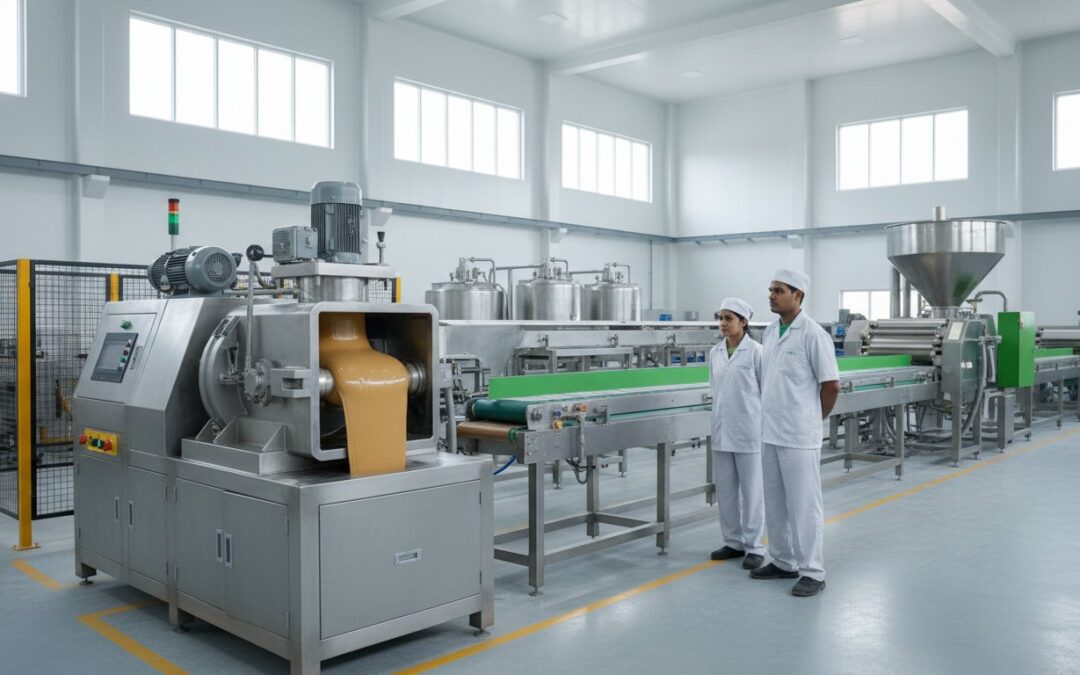
For entrepreneurs and established food businesses, venturing into peanut butter production offers a significant market opportunity. However, scaling from a small-batch concept to industrial manufacturing requires a deep understanding of the process and machinery involved. This guide will help you understand the complete process, machinery, and investment required to launch a successful, large-scale peanut butter production business, moving beyond a single machine to a fully integrated production line.
From Raw Nut to Jar: The Industrial Peanut Butter Production Line
A common misconception is that a single “peanut butter maker” is all that’s needed for commercial production. In reality, an industrial operation is a multi-stage process that requires a complete, integrated line of machinery to ensure product consistency, food safety, and operational scalability. Each stage relies on specialized equipment to perform a critical function, transforming raw peanuts into a shelf-stable, finished product.
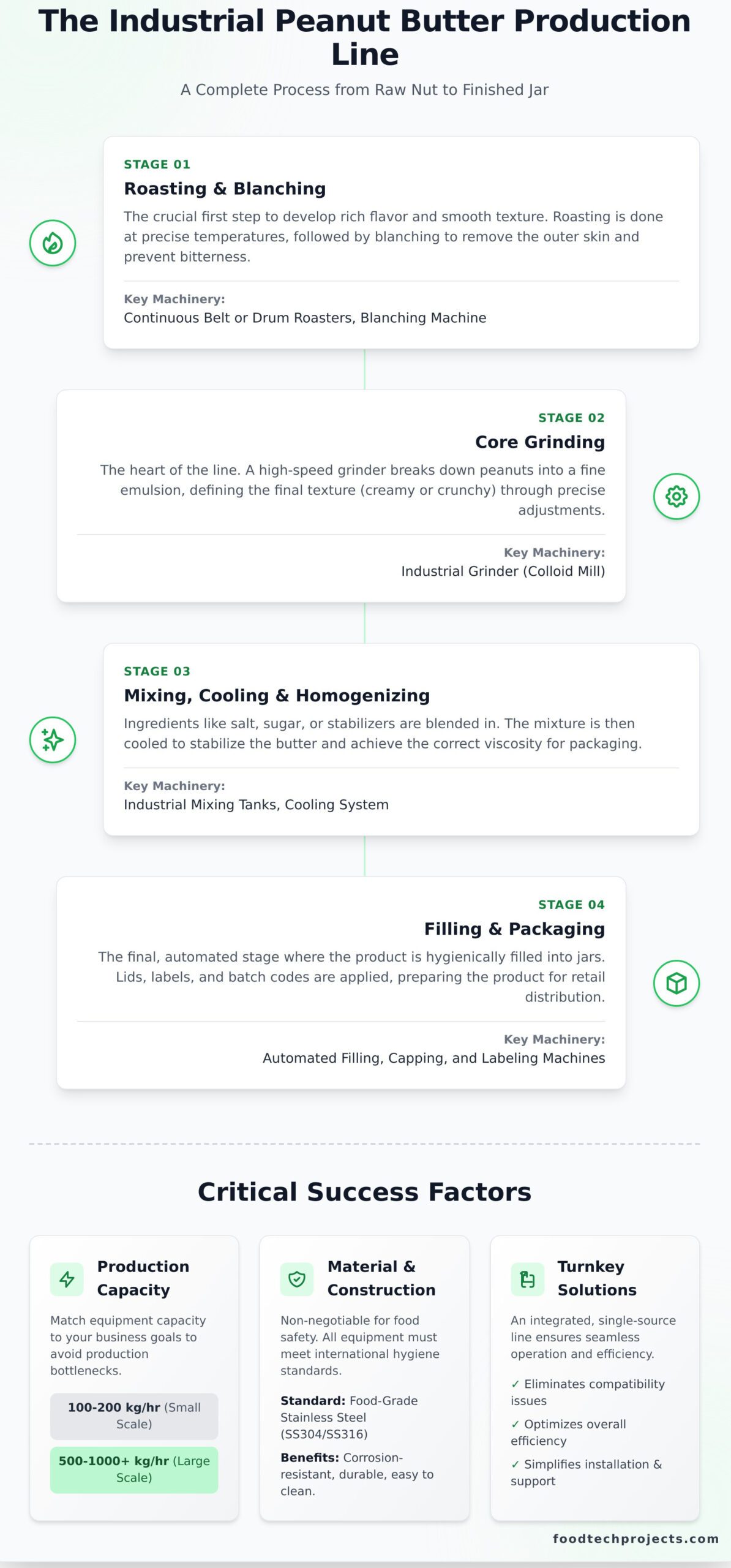
Stage 1: Roasting and Blanching Machines
The journey begins with preparing the raw peanuts. Roasting is a critical first step, as it is essential for developing the deep, rich flavor profile that consumers expect from high-quality peanut butter. Industrial roasters, such as continuous belt or drum roasters, provide precise temperature and time control for uniform roasting of large batches. Following roasting, a blanching machine is used to gently remove the outer skin, a crucial step for achieving a smooth, appealing texture and preventing bitterness in the final product.
Stage 2: The Core Grinding Process (Colloid Mill)
At the heart of the production line is the industrial grinder, often a specialized machine known as a colloid mill. This is the true “peanut butter making machine” responsible for the product’s final texture. The colloid mill uses a high-speed rotor and stator to apply intense hydraulic shear, breaking down the roasted peanuts into a fine, homogenous emulsion. Key operational factors include adjusting the grinding fineness to produce either creamy or crunchy textures, precise temperature control to prevent overheating, and selecting a machine with the appropriate capacity to match the rest of the production line.
Stage 3: Mixing, Cooling, and Homogenizing
After grinding, the base peanut butter is transferred to large industrial mixing tanks. Here, other ingredients such as salt, sugar, stabilizers, or emulsifiers can be uniformly blended into the batch to meet specific recipe requirements. Once mixed, the product must be passed through a cooling system. This step is vital for stabilizing the butter and preparing it for packaging, ensuring it has the correct viscosity for the filling machines.
Stage 4: Filling and Packaging Machinery
The final stage is packaging the finished product for distribution. This is handled by a series of automated machines that ensure efficiency and hygiene. An automated filling machine precisely dispenses the peanut butter into jars or other containers. This is followed by equipment that applies and seals the lids, affixes labels with branding and nutritional information, and prints batch codes for essential product traceability. This automated process prepares your product for shipment to retail markets.
How to Select an Industrial Peanut Butter Machine & Production Line
Choosing the right equipment is a critical decision that will directly impact your business’s efficiency, product quality, and long-term success. The selection process should focus on overall performance, reliability, and scalability, not just the initial purchase price.
Key Technical Specification: Production Capacity (kg/hour)
The first step is to assess your business goals and projected market demand. Production capacity, measured in kilograms per hour (kg/hr), will define your output potential. A small-scale industrial line might start at 100-200 kg/hr, while medium to large-scale operations could require capacities of 500 kg/hr, 1000 kg/hr, or more. It is crucial to ensure the capacity of your grinder is matched by the throughput of your roaster and packaging equipment to avoid bottlenecks in the production line.
Material and Construction: Why Stainless Steel is Standard
In the food processing industry, the choice of material is non-negotiable. Industrial peanut butter machinery must be constructed from food-grade stainless steel (typically SS304 or SS316) to meet international food safety and hygiene standards. This material is corrosion-resistant, durable, and easy to clean, preventing contamination and ensuring a long operational life. Look for robust engineering and high-quality welds, which indicate a machine is built for continuous, demanding industrial operation.
Considering a Turnkey Solution vs. Individual Machines
While it is possible to source machinery from various suppliers, a turnkey solution offers significant advantages. An integrated, single-source production line ensures all components are designed to work together seamlessly, eliminating compatibility issues and optimizing overall efficiency. This approach also simplifies the complex process of installation, commissioning, and ongoing technical support. If you are serious about launching a professional operation, we highly recommend you Request a consultation for your turnkey project.
Planning Your Peanut Butter Business: Investment and ROI
A successful launch and a profitable operation depend on careful and realistic financial planning. Understanding the key factors that influence your total project cost is essential for securing funding and calculating your potential return on investment.
Factors Influencing Project Cost
The total investment for a peanut butter production plant is influenced by several key variables. The primary driver is the scale of the equipment and the desired level of automation. Larger capacity lines naturally have a higher capital cost. Additionally, you must account for the factory layout and the required utilities, including sufficient power supply, water access, and waste management systems. Finally, the total project budget must include costs for shipping, professional installation, and the commissioning of the plant by experienced engineers.
Why Partner with an Experienced Manufacturer?
Navigating the complexities of setting up a food processing plant can be daunting. Partnering with a manufacturer with a proven track record is invaluable. At Food Tech Projects, we leverage over 35 years of global expertise in food processing to deliver comprehensive, end-to-end solutions. We manage the entire project from initial design and engineering to final execution, ensuring your plant is efficient, reliable, and built to the highest quality standards. You can see our successful turnkey plant installations.
Frequently Asked Questions
What is the difference between a commercial and an industrial peanut butter machine?
A commercial machine is typically a smaller, standalone grinder designed for in-store use, like in a grocery store or café, producing small batches on demand. An industrial machine is a high-capacity component of a complete production line, built for continuous, large-scale manufacturing in a factory setting.
Can the same production line make other nut butters, like almond or cashew?
Yes, most industrial peanut butter lines are versatile. With proper cleaning protocols and minor adjustments to parameters like roasting time and grinding pressure, the same equipment can be used to produce almond butter, cashew butter, and other nut-based spreads.
How much factory space is required for a small-scale industrial line?
The required space depends on the line’s capacity and layout. A small-scale industrial line (e.g., 100-200 kg/hr) might require a minimum of 1,500 to 2,500 square feet to comfortably accommodate the machinery, raw material storage, and finished product areas.
What is the typical power requirement for a peanut butter production line?
The power requirement is substantial and depends on the scale of the machinery. A complete line requires a three-phase industrial power supply. The total connected load can range from 50 kW for a small line to over 200 kW for larger operations, with the roaster and grinder being the most power-intensive components.
Do you provide installation and training for the machinery?
Yes, as a turnkey solution provider, we offer complete installation, commissioning, and operational training services. Our engineers ensure the plant is set up correctly and your team is fully trained on how to operate and maintain the equipment safely and efficiently.
Starting an industrial peanut butter business is a significant undertaking, but with the right planning and expert partnership, it can be a highly rewarding venture. By investing in a complete, high-quality production line, you lay the foundation for a brand known for its consistency and quality. With over 35 years of engineering experience and a history of successful turnkey solutions delivered to over 30 countries, Food Tech Projects is the ideal partner to bring your vision to life. Design Your Peanut Butter Production Line with Our Experts today to begin your journey.
