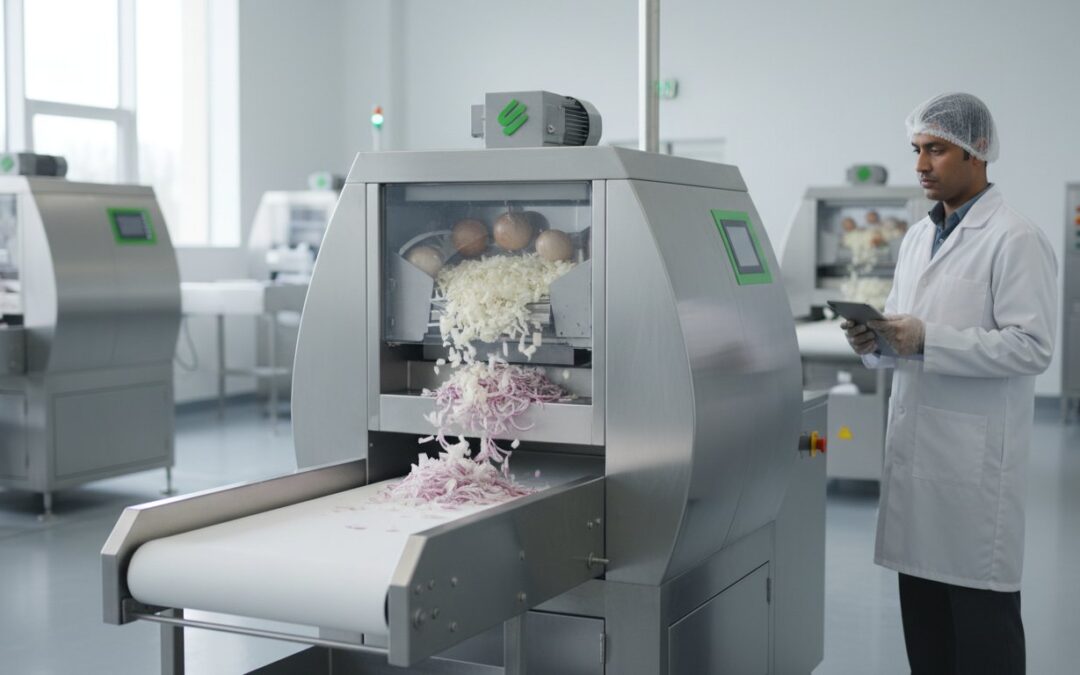
For large-scale food processors, achieving efficiency, consistency, and safety in production is paramount. While manual preparation may suffice for small operations, industrial-scale output demands specialized equipment. This guide provides a comprehensive overview of industrial onion cutting machines, covering the key types, critical specifications, and integration into complete processing lines to help you make an informed investment for your facility.
Beyond the Kitchen: Why Industrial Onion Cutting Machines are Essential
An industrial onion cutting machine is a piece of heavy-duty equipment engineered for high-volume, continuous processing in a factory environment. Unlike domestic choppers or light-duty restaurant slicers designed for intermittent use, these machines are built for durability, precision, and high throughput. The core benefits for any food processing business are significant: dramatically increased production capacity, unparalleled consistency in cut size and shape, and a substantial reduction in manual labor costs and associated risks. This level of performance is critical for manufacturers of products such as dehydrated onion flakes, frozen onion rings, soup and sauce bases, and ready-to-eat meal components.
Types of Industrial Onion Cutters by Final Product
Selecting the right machine depends entirely on the desired final form of the onion. Different applications require specific cutting technologies to achieve the correct texture and appearance.
- Onion Dicing Machines: These machines are engineered for precision. They produce small, uniform cubes of onion, which are essential for products where even distribution and consistent cooking are required, such as in salsas, relish, soup mixes, and sauces.
- Onion Slicing Machines: Designed to create uniform, cross-sectional rings, slicers are fundamental for producing items like fried onion rings, dehydrated onion slices for snack mixes, and toppings for various food products. Blade thickness is often adjustable to meet specific product requirements.
- Onion Cubing & Strip Cutters: For applications requiring larger cuts, such as in prepared meals, stews, or certain types of salads, cubing and strip cutters provide a robust solution. They are designed to handle high volumes while producing larger, consistently shaped pieces.
Key Technical Specifications to Evaluate
When assessing an industrial onion cutter, moving beyond the basic function to evaluate its technical specifications is crucial for ensuring it meets your operational demands.
- Processing Capacity: The most critical metric, capacity is measured in kilograms or tons per hour. This figure must align with your production line’s overall throughput to avoid bottlenecks.
- Cut Size Range & Adjustability: A machine’s versatility is determined by its ability to produce different cut sizes. Look for models with interchangeable blade assemblies or adjustable settings to accommodate various product specifications.
- Material of Construction: For food processing, food-grade Stainless Steel (typically SS 304) is the industry standard. This material is corrosion-resistant, durable, and easy to clean and sanitize, ensuring compliance with food safety regulations.
- Motor Power and Energy Consumption: The machine’s motor must be powerful enough to handle your maximum capacity without strain. It’s also important to consider its energy efficiency to manage long-term operational costs.
- Safety Features: Industrial machinery must prioritize operator safety. Essential features include emergency stop buttons, protective covers over moving parts, and safety interlock sensors that halt operation if a guard is opened.
Integrating an Onion Cutter into a Full Processing Line
An industrial onion cutting machine does not operate in isolation; it is a vital component within a larger, integrated system. For maximum efficiency, it must be seamlessly incorporated into a complete onion processing line. Understanding this flow is key to designing a productive and cohesive operation.
The Step-by-Step Onion Processing Flow
A typical turnkey project for onion processing involves a sequence of synchronized stages to transform raw onions into a finished, packaged product.
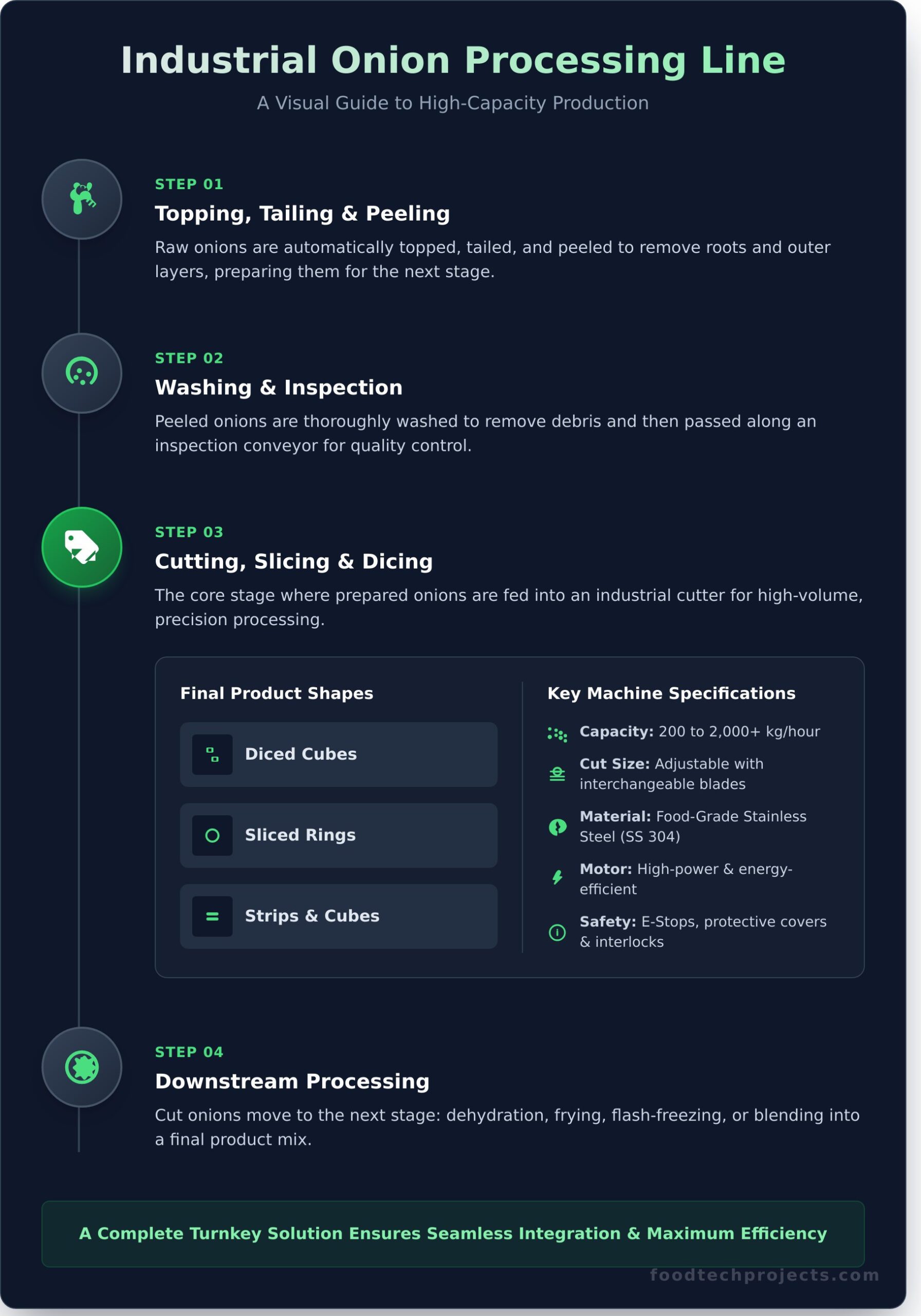
- Step 1: Topping, Tailing, and Peeling: The process begins with machines that automatically remove the root and top of the onion, followed by peeling to remove the outer layers.
- Step 2: Washing and Inspection: After peeling, the onions are thoroughly washed to remove any dirt or debris. They then pass along an inspection conveyor where any imperfections can be manually removed.
- Step 3: The Cutting/Slicing/Dicing Stage: The prepared onions are fed into the industrial cutting machine, which processes them into the desired shape and size.
- Step 4: Downstream Processing: Following cutting, the onions move on to the next stage, which could include dehydration in an industrial dryer, frying, flash-freezing, or blending into a mix.
Why a Turnkey Solution Offers Superior Efficiency
Opting for a complete turnkey solution from a single, experienced manufacturer provides significant advantages over sourcing individual machines from multiple vendors.
- It ensures all machinery in the line is perfectly compatible and balanced for capacity, preventing inefficiencies and production gaps.
- This approach significantly reduces the complexities of integration, streamlining project management and shortening the timeline from concept to commissioning.
- A turnkey provider offers a single point of contact for the entire project, covering design, manufacturing, supply, and installation. If you are looking to build a complete system, you can explore our complete agro processing production lines.
Choosing Food Tech Projects for Your Onion Processing Needs
At Food Tech Projects, we leverage our deep expertise in specialized food machinery to deliver robust, high-performance solutions for our global clients. Our philosophy is grounded in a commitment to superior engineering, quality manufacturing, and building equipment that stands the test of time in demanding industrial environments.
Our Engineering Advantage
- With over 35 years of manufacturing and global export experience, we have a proven track record of delivering reliable and efficient food processing solutions.
- We understand that every production facility has unique needs. We offer customizable machine designs to meet your exact product specifications and facility layouts.
- Our machines are built with high-quality materials and components to ensure durable construction, leading to uninterrupted production and a long service life.
- We provide comprehensive support throughout the entire project lifecycle, from initial design consultation and engineering to final installation and commissioning.
Frequently Asked Questions (FAQs)
What is the typical capacity range (kg/hour) for your onion cutting machines?
Our industrial onion cutting machines are available in a wide range of capacities, typically from 200 kg/hour to over 2,000 kg/hour. We can engineer a solution tailored to your specific production volume requirements.
Can the same machine be used to cut other vegetables like potatoes or carrots?
Yes, many of our cutting machines are versatile and can be equipped with different blade sets to effectively process a variety of other vegetables, including potatoes, carrots, cabbage, and peppers. Please discuss your specific needs with our engineering team.
What are the maintenance requirements for an industrial onion cutter?
Routine maintenance includes daily cleaning and sanitization, regular inspection of blades for sharpness, and periodic checks of belts and motor components as per the operational manual. We design our machines for easy access to simplify these procedures.
How do you ensure the machines meet international food safety standards?
All our machines are constructed using food-grade materials, primarily SS 304 stainless steel. The design prioritizes hygiene, with smooth surfaces and easy-to-clean components to prevent residue buildup and comply with GMP (Good Manufacturing Practices) and other international standards.
What information do I need to provide to get an accurate quote?
To provide an accurate quote, we need to understand your required processing capacity (kg/hour), the desired final cut type (dice, slice, etc.) and size, and any integration requirements with your existing production line.
Investing in the right industrial onion cutting machine is a critical step toward optimizing your food processing operations. By focusing on robust construction, appropriate capacity, and seamless integration, you can significantly enhance your productivity and product quality. To discuss the specific requirements of your facility and discover how our advanced solutions can benefit your business, we invite you to Request a Quote for Your Onion Cutting Machine Project and let our team of experts design the perfect solution for you.