
The rising global demand for plant-based beverages and clean-label vegan ingredients has transformed coconut processing into a highly profitable industrial venture. Consequently, setting up a commercial facility or upgrading an existing production line requires a deep understanding of food engineering. In addition to this, raw coconut kernels contain delicate fats, sensitive proteins, and highly complex oil-water emulsions that are vulnerable to mechanical abuse and thermal degradation. Therefore, selecting the right coconut milk & powder processing machinery manufacturers is the single most critical decision determining your plant’s throughput, yield, and global export compliance.
The Engineering Challenge: Navigating the Liquid-to-Powder Value Chain
Industrial liquid-to-powder conversion is far more complex than simple dehydration. Because pure coconut oil has a low melting point, any uncalibrated exposure to thermal stress causes immediate oil separation and rapid product spoilage. As a result, elite turnkey manufacturers design heavily automated, multi-stage processing systems to preserve the natural taste, brilliant white color, and nutrient profile of the coconut. Specifically, the raw material must flow seamlessly through a tightly controlled thermodynamic cycle.
[Raw Coconuts] ➡️ [Breaking & Paring] ➡️ [Screw Press Extraction] ➡️ [Homogenization] ➡️ [Spray Drying] ➡️ [Export Powder]
1. Primary Extraction: Maximizing Mechanical Yield
The processing line begins with automated Breaking, Deshelling, and Paring Systems to rapidly fracture the hard outer shells. This step quickly shaves away the brown skin (testa). Subsequently, the white meat is subjected to a continuous hot water blanching wash to neutralize microbial load and clean away residual sour water.
Following this preparation, the kernels are fed into heavy-duty Coconut Milk Extractors.
-
Heavy Screw Press Gear: These systems utilize high-torque grinding teeth paired with automated continuous screw drives. Furthermore, they process up to 1.5 tons of fresh kernels per hour.
-
High Extraction Efficiency: Advanced mechanical configurations achieve an initial fluid extraction yield above 50%. Accordingly, this setup ensures maximum milk recovery while ejecting a dry, clean pulp cake.
2. Standardization & Emulsion Stability
Raw extracted milk must pass through immediate treatment loops to secure physical stability. Specifically, high-speed Filtration & Vibrating Screening Decks isolate fine pulp fibers from the liquid stream. This process provides a smooth, clean milk base.
In addition to this, manufacturers integrate two critical sub-systems:
-
High-Speed Centrifugal Cream Splitters: Operating at capacities like 300 LPH, these units split raw liquid into heavy cream or low-fat skim milk. Thus, they give operators complete control over recipe fat percentages.
-
Industrial Homogenizers: By subjecting the fluid to high mechanical shear, these systems reduce oil droplet sizes to stabilize the fat emulsion. Hence, this critical phase improves mouthfeel and extends shelf stability.
Advanced Powder Engineering: Spray Drying Systems
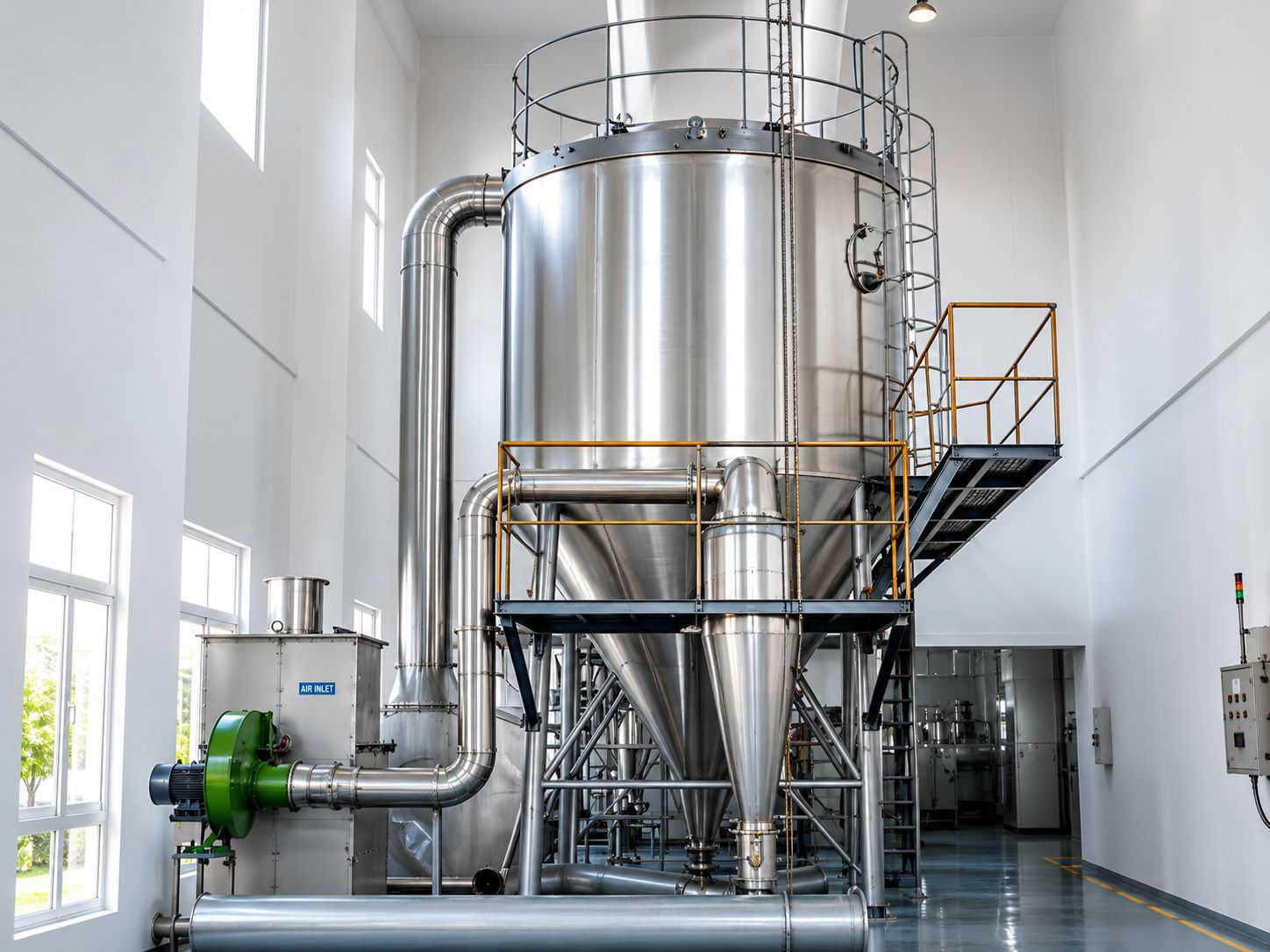
To produce a free-flowing, instantly soluble coconut milk powder, the liquid matrix must be transformed into dry particles. This must happen without exposing the delicate fats to melting temperatures. To achieve this, industrial manufacturers like Genex Tech Industries LLP supply specialized Standardization and Micro-Encapsulation Tanks. Inside these high-shear vessels, carriers such as maltodextrin are uniformly blended into the milk. Accordingly, this step completely coats the microscopic oil droplets, forming a rugged thermal shield before the particles ever touch hot air streams.
[Stabilized Milk Feed] ➡️ [High-Pressure Atomizer] ➡️ [Controlled Hot Air Vortex] ➡️ [Instant Co-Current Evaporation] ➡️ [Cyclone Separation]
Key Technical Pillars of Industrial Spray Dryers:
-
Controlled Thermal Loops: The core drying chamber uses precise PLC-managed temperature paths to instantly flash-evaporate moisture within 1 to 3 seconds. On the one hand, this rapid action protects heat-sensitive nutrients. On the other hand, it prevents structural charring or aroma loss.
-
Anti-Stick Chamber Walls: Coconut powder is naturally sticky due to high fat and sugar content. For this reason, elite spray dryers incorporate advanced anti-stick air sweepers or mechanical hammers. Meanwhile, these features maintain high powder flowability and prevent chamber accumulation.
-
Cyclone & Vibro-Sifters: Finished powder is instantly pneumatically evacuated into high-efficiency cyclones and bag filters. Ultimately, it passes through a cooling vibro-sifter to secure a stable final moisture target of 2% to 4% with completely uniform particle distributions.
Technical Benchmarks and System Specifications
For global investors evaluating Capital Expenditures (CAPEX), system capacities must align with international food safety certifications. As detailed below, modern turnkey processing installations balance extreme performance with highly controlled physical boundaries:
| Technical Parameter | Liquid Milk Processing Plant | Powder Processing Plant |
| Production Capacity Range | 500 LPH to 10,000+ LPH | 100 kg/hr to 2,000+ kg/hr (Output) |
| Material of Construction (MOC) | Premium Stainless Steel (SS304 / SS316) | Food-Grade Stainless Steel (SS304 / SS316) |
| Primary Automation Tier | Central PLC / SCADA with Touch HMI Panels | PLC / SCADA with Closed-Loop Controls |
| Core Thermal System | HTST Continuous Pasteurizer Line | Multi-Cyclone Spray / Freeze Dryer |
| Final Product Output Metric | Stabilized Coconut Milk & Heavy Cream | Free-Flowing Powder (2%–4% Moisture) |
| Hygiene Infrastructure | Integrated Clean-in-Place (CIP) Loop | Fully Enclosed Clean-in-Place (CIP) System |
| Regulatory & Export Marks | CE, US-FDA, ISO 9001:2015 Compliance | CE, US-FDA, ISO 9001:2015 Compliance |
Why Turnkey Manufacturing Partnerships Matter
Investing in uncoordinated, standalone machinery elements from disjointed suppliers frequently yields devastating manufacturing bottlenecks. Moreover, it also leads to high microbiological risks and excessive energy bills. On the contrary, partnering with an established turnkey engineering brand ensures a totally synchronized, highly optimized floor plan:
-
Uncompromised Microbiological Safety: The line uses continuous Short-Time Heat Loops (HTST Pasteurizers) immediately paired with high-efficiency Rapid Plate Chillers. As a result, this setup halts enzymatic activity and spoilage dead in its tracks without altering the natural coconut profile.
-
Hygienic Clean-In-Place (CIP) Systems: Fully automated CIP loops ensure precise chemical-to-water recycling across all extraction presses, tanks, and spray columns. Consequently, this minimizes operational downtime while maintaining rigid international regulatory compliance.
-
Optimized Thermal Footprint: State-of-the-art spray drying air ducts incorporate advanced heat recovery systems. These systems capture and recycle exhausting thermal energy. As a direct result of this engineering, these plants save up to 25% on overall fuel and utility expenditures.
Conclusion: Engineering Your Competitive Advantage
In summary, scaling up a coconut processing facility into a global market leader requires far more than just purchasing basic grinding and boiling hardware. Success relies heavily on continuous processing automation, precise fat-emulsion management, and highly optimized drying tech. By and large, by executing capital upgrades with heavy-duty, PLC-controlled turnkey plants from certified manufacturers, progressive agri-businesses can secure absolute batch consistency, zero product wastage, and commanding premium prices across competitive global export sectors.
Technical Inquiries & Global Engineering Support
For custom factory layout designs, processing scaling blueprints, pilot trial evaluations, or equipment quotations, connect directly with our global engineering divisions:
-
📧 Technical Inquiries: mktg@foodtechprojects.com
-
📞 Phone / WhatsApp Support: +91 93300 77417
-
🌐 Engineering Portals: www.foodtechprojects.com | www.gtidryers.com