
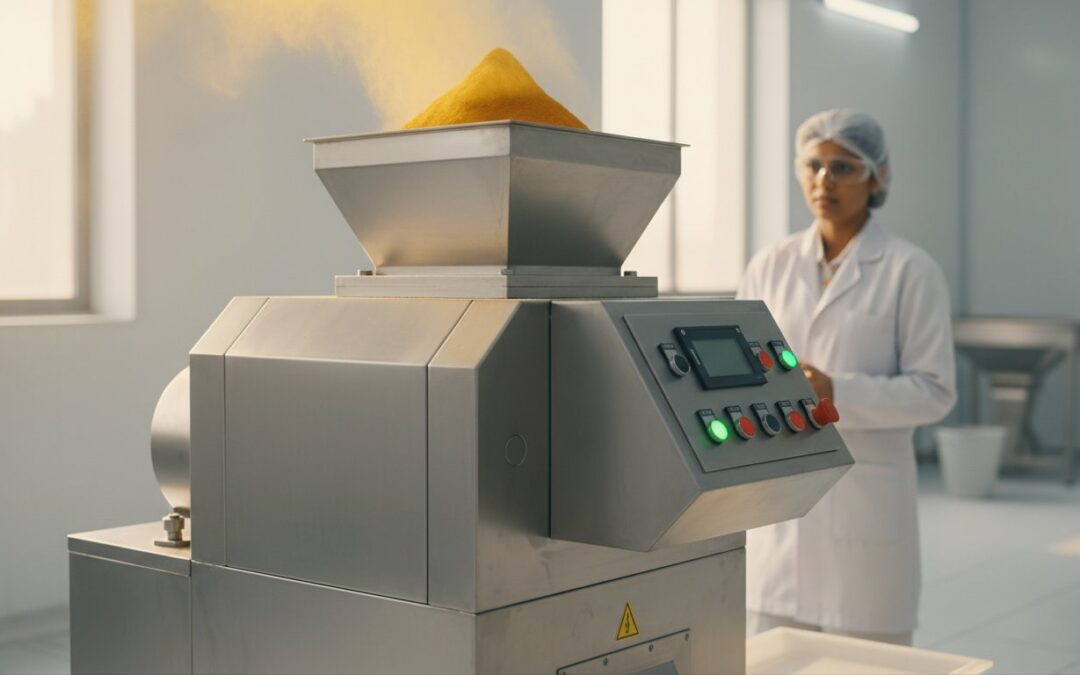
Investing in the right equipment is paramount for any large-scale food processing operation. For spice manufacturers, the grinder is the heart of the production line, directly impacting product quality, consistency, and profitability. This guide is designed to help you make an informed investment by understanding the key technical specifications for selecting a high-capacity commercial spice grinder that meets the rigorous demands of your production line.
Industrial vs. Countertop: Defining Your ‘Commercial Spice Grinder’ Needs
The term ‘commercial spice grinder’ can be misleading. A search often reveals countertop models designed for restaurants or small-scale food service. However, for industrial applications, the requirements are vastly different. This guide is specifically for plant managers, production engineers, and business owners in the food processing industry who require machinery built for high-volume, continuous operation. Your key goals are achieving significant throughput, ensuring absolute product consistency, and seamlessly integrating the machine into a larger processing line.
Key Questions to Ask Before You Buy
Before evaluating specific models, you must define your operational parameters. Answering these fundamental questions will narrow your search and ensure you invest in a machine that is fit for purpose:
- What is your required output in kilograms per hour? This is your production target and dictates the necessary scale and power of the grinder.
- What is the desired final particle size? Specify your requirement in mesh or microns. This determines the type of grinding mechanism needed to achieve the desired texture and quality.
- What are the characteristics of your raw spice? Consider factors like oil content, moisture level, and fibrousness. An oily spice like nutmeg requires a different grinding approach than a dry, fibrous root like turmeric.
Critical Technical Specifications for Industrial Spice Grinders
Moving beyond basic features like wattage and bowl capacity, an industrial buyer must focus on the engineering specifications that drive performance, reliability, and return on investment. This checklist covers the critical factors that determine a grinder’s suitability for your large-scale operation.
Throughput Capacity (kg/hr): Matching Scale to Production Demand
For any industrial process, throughput is the most important metric. It defines the volume of product your facility can process in a given timeframe. When selecting a grinder, calculate your current and projected future production needs to ensure the machine can handle demand. Investing in a machine with scalable capacity prevents production bottlenecks as your business grows.
Grinding Technology: Pin Mill vs. Hammer Mill vs. Pulverizer
The grinding mechanism is the core technology of the machine. Different spices and desired end-products call for different methods. The most common industrial types include:
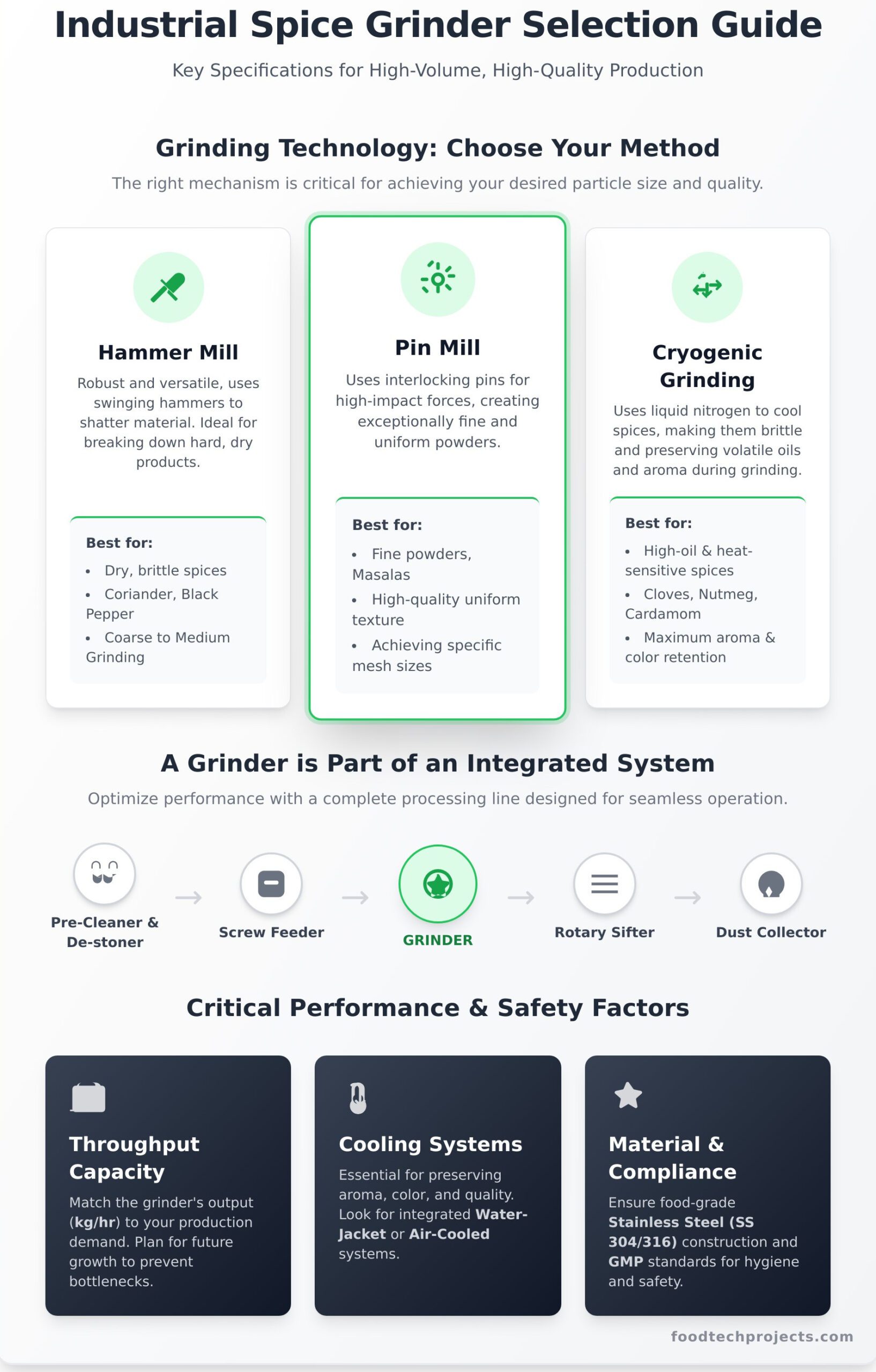
- Hammer Mills: These are robust and versatile, ideal for the coarse to medium grinding of dry, brittle, and non-oily spices like black pepper and coriander. They use swinging hammers to shatter the material against a liner plate.
- Pin Mills: For achieving very fine, uniform particle sizes required for products like fine powders and masalas, a pin mill is superior. It uses rows of interlocking pins on a rotor and stator to create a consistent, fine grind through high-impact forces.
- Cryogenic Grinding: This is the premier solution for high-oil or heat-sensitive spices like cloves, nutmeg, and cardamom. Liquid nitrogen is used to cool the spice, making it brittle and preventing the loss of volatile essential oils and aroma during the grinding process.
Cooling Systems: Preserving Spice Quality, Aroma, and Color
Heat generation during the high-speed grinding process is the primary enemy of spice quality. Excessive heat can burn off essential oils, degrade the aroma, and alter the color of the final product. An effective cooling system is non-negotiable. Look for machines with integrated water-jacket cooling around the grinding chamber or air-cooled systems that circulate cool air to dissipate heat. Superior cooling efficiency directly translates to a higher-value, more potent end-product.
Material of Construction and Food Safety Compliance
In food processing, hygiene and safety are paramount. Ensure the grinder is constructed from food-grade stainless steel (typically SS 304 or SS 316 for all contact parts) to prevent contamination and corrosion. The machine should be designed according to Good Manufacturing Practice (GMP) standards, with a focus on easy access for cleaning and maintenance to minimize downtime and ensure product purity.
Beyond the Grinder: Integrating a Complete Spice Processing Line
An industrial grinder does not operate in isolation; it is a critical component within a larger, integrated system. To achieve maximum efficiency and product quality, you must consider the upstream and downstream equipment that supports the grinding process. Adopting a turnkey approach, where the entire line is designed to work in harmony, eliminates integration challenges and ensures seamless, optimized operation from raw material intake to final packaging.
Essential Ancillary Equipment for Your Grinding System
- Pre-cleaners and De-stoners: These machines remove impurities like dust, stones, and metal contaminants from the raw spice, protecting the grinder from damage and ensuring product purity.
- Screw Feeders: A variable-speed screw feeder provides a controlled, consistent flow of material into the grinder, preventing overload and ensuring a uniform grinding process.
- Rotary Sifters: Placed after the grinder, a sifter or grader separates the ground particles to ensure the final product meets exact size specifications and removes any oversized particles for re-grinding.
- Dust Collectors: An efficient dust collection system is vital for operator safety, preventing product loss, and maintaining a clean production environment.
The Food Tech Projects Advantage: A Single-Window Solution
With over 35 years of engineering experience, we specialize in designing and commissioning complete, end-to-end processing plants. We understand that optimal performance comes from engineering the entire line as a single, cohesive system, not just supplying individual machines. By choosing Food Tech Projects, you benefit from a fully integrated, performance-guaranteed system designed for maximum efficiency and reliability. Discuss your complete spice processing plant with our engineers.
Frequently Asked Questions
What is the difference between a pulverizer and a spice grinder?
In an industrial context, the terms are often used interchangeably. A pulverizer is a type of grinder designed to reduce solid materials into fine powder or small particles. Both hammer mills and pin mills are types of pulverizers commonly used for spice grinding.
How do you prevent heat damage to spices during industrial grinding?
Preventing heat damage is achieved through a combination of machine design and process control. This includes using integrated cooling systems like water jackets, selecting the correct screen size and rotor speed to optimize material flow, and for high-oil spices, utilizing cryogenic grinding technology.
What level of maintenance does an industrial spice grinder require?
Regular maintenance is crucial for longevity and performance. This includes daily cleaning, periodic inspection of hammers, pins, and screens for wear, and routine lubrication of bearings as per the manufacturer’s schedule. A well-maintained machine will provide years of reliable service.
Can one industrial grinder be used for multiple different spices?
Yes, many industrial grinders are versatile. However, thorough cleaning is required between batches to prevent cross-contamination of flavor and aroma. For very different materials (e.g., oily vs. dry), adjustments to rotor speed, screen size, and feed rate may be necessary to achieve optimal results.
What safety features are important for spice grinding machinery?
Key safety features include motor overload protection, emergency stop buttons, safety interlocks on access doors to prevent operation during cleaning or maintenance, and properly designed dust collection systems to mitigate the risk of dust explosions.
How do I determine the right motor power (HP) for my grinder?
Motor power (Horsepower or HP) is directly related to the required throughput and the hardness of the material being ground. A reputable manufacturer will calculate the necessary motor power based on your specific application, ensuring the machine operates efficiently without being underpowered.
Choosing the right industrial spice grinder is a critical decision that impacts your entire production process. By focusing on technical specifications, understanding the complete processing line, and partnering with an experienced engineering firm, you can secure a solution that delivers quality, efficiency, and a strong return on investment. If you are ready to elevate your spice processing capabilities, our team is here to provide an expert consultation and a detailed proposal tailored to your needs. Request a Quote for Your Industrial Spice Grinder and let our expertise power your production.