For commercial chilli producers and spice processors, selecting the right drying equipment is a critical investment that directly impacts product quality, operational efficiency, and profitability. An industrial chilli dryer is not just a machine for removing water; it is a precision instrument designed to preserve the essential characteristics that define a high-value final product. This guide will help you understand the technology, types, and key selection criteria for industrial chilli dryers to optimize your food processing operations.
The Critical Role of Industrial Drying in Chilli Processing
While traditional sun drying is a low-cost method, it is entirely unsuitable for commercial-scale operations due to its dependency on weather, long processing times, and high risk of contamination. Industrial drying provides a controlled environment to overcome these challenges, ensuring a consistent, safe, and high-quality product. The primary goals are to preserve quality by maintaining color (ASTA) and pungency (SHU), achieve optimal moisture levels for extended shelf life, and prevent microbial growth and the formation of harmful aflatoxins.
Understanding Key Quality Metrics for Dried Chillies
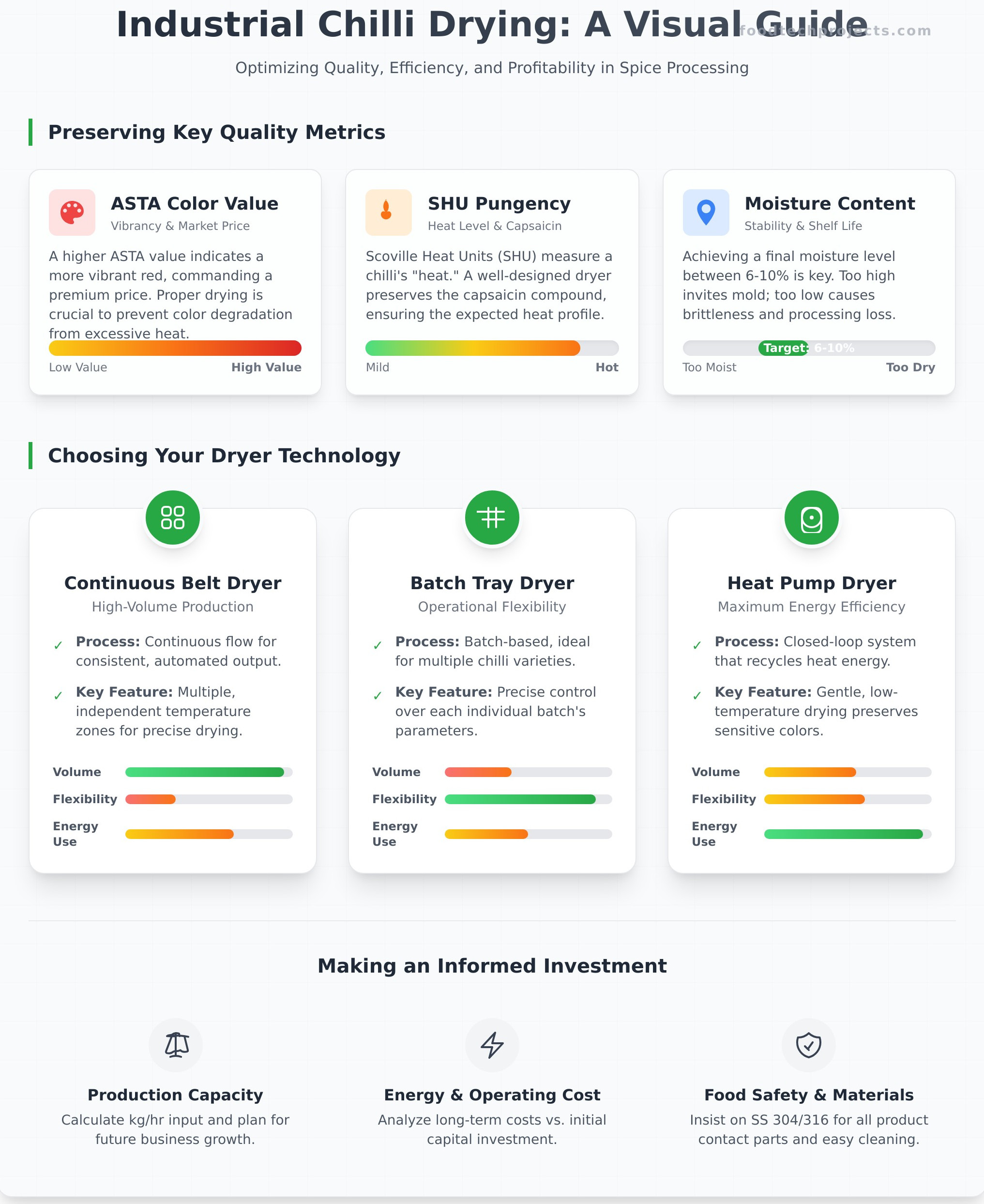
- ASTA Color Value: The American Spice Trade Association (ASTA) color value is the primary international standard for the redness of chillies and paprika. A higher ASTA value indicates a more vibrant red color, which commands a premium price in the market. Improper drying techniques, especially excessive heat, can degrade this color significantly.
- Scoville Heat Units (SHU): SHU measures the pungency or “heat” of a chilli, which is derived from the compound capsaicin. A well-designed dryer preserves capsaicin levels, ensuring the final product meets the expected heat profile for its variety.
- Moisture Content: The key to stability and successful grinding is achieving a precise final moisture content, typically between 6-10%. Too high, and the product is susceptible to mold; too low, and it can become overly brittle, leading to losses during subsequent processing steps like grinding.
Types of Industrial Chilli Dryer Machines: A Technical Overview
Industrial chilli dryers can be broadly categorized into continuous and batch processing systems. The choice between them depends on production volume, product variety, and operational workflow. Each technology offers unique benefits tailored to different scales of production.
Continuous Multi-Layer Belt Dryers
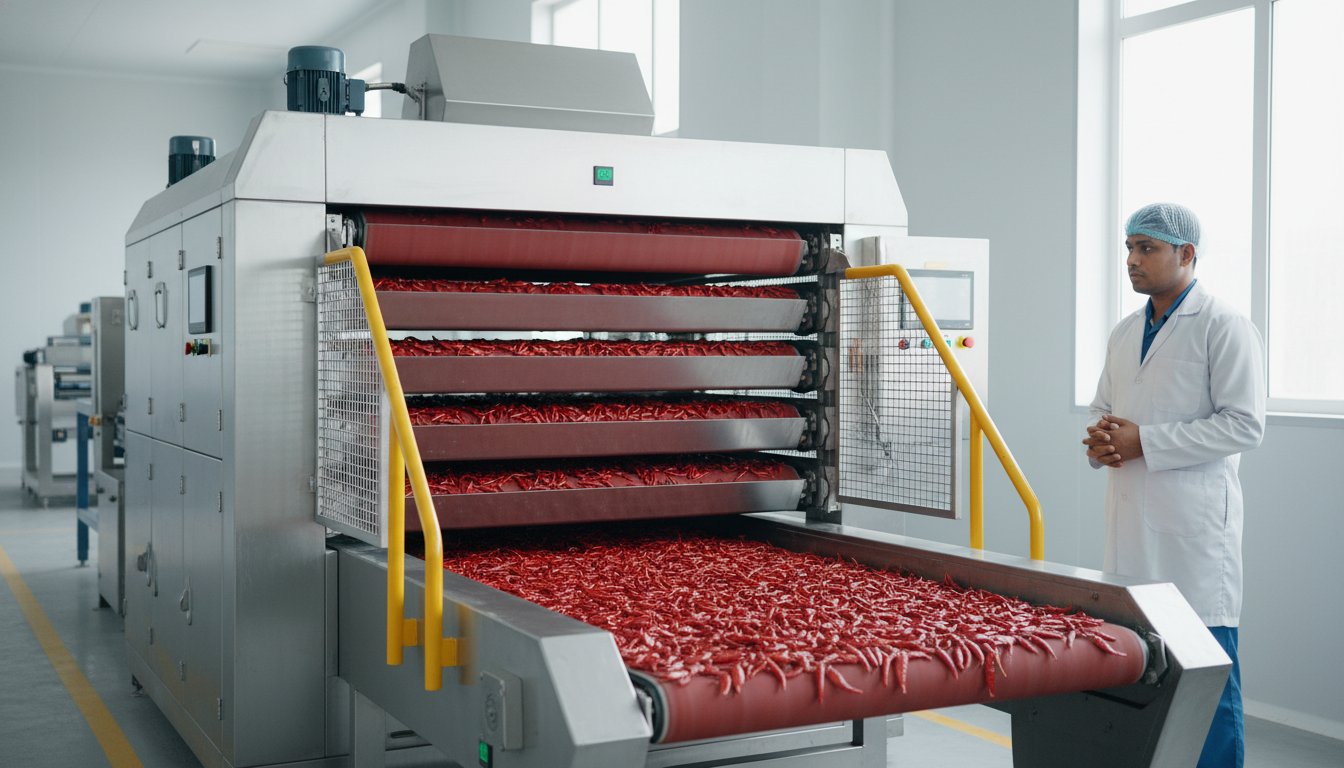
Continuous belt dryers are the ideal solution for high-volume, uniform production lines. Fresh chillies are fed onto a slow-moving, perforated conveyor belt that passes through multiple temperature-controlled zones. This continuous feeding and discharge mechanism ensures a highly consistent output and is perfectly suited for integration into a fully automated processing line. Key features include variable belt speed and independent temperature zones, allowing for a precise drying curve that optimizes both quality and throughput.
Batch Type Tray Dryers
Tray dryers are the preferred choice for smaller production volumes, businesses processing multiple chilli varieties, or those requiring greater operational flexibility. In this system, chillies are spread evenly on trays, which are then loaded into a drying cabinet. This batch method offers precise control over drying parameters like temperature and airflow for each specific load, making it ideal for specialty products or for producers who need to switch between different chilli types frequently.
Heat Pump Drying Technology
Heat pump dryers represent a highly energy-efficient approach to dehydration. They operate at lower temperatures by using a closed-loop refrigeration system to remove moisture from the air. This gentle drying process is excellent for preserving sensitive colors and volatile aromatic compounds. By recovering and reusing heat within the closed system, a heat pump dryer can significantly reduce energy consumption and operational costs compared to conventional hot air dryers.
How to Select the Right Chilli Dryer for Your Business
Choosing the right equipment requires a systematic approach that aligns machine specifications with your specific business goals. Consider the following factors to make an informed investment.
Calculating Your Required Production Capacity
First, assess your input capacity in terms of raw material processed per hour or day (kg/hr). You must then factor in the expected moisture reduction to determine the final output weight. For example, fresh chillies can have a moisture content of over 80%, which needs to be reduced to under 10%. Always plan for future business growth and select a machine that offers scalability to avoid production bottlenecks down the line.
Evaluating Heating Source and Energy Consumption
Industrial dryers can be powered by various sources, including electric heaters, steam boilers, natural gas, or an integrated heat pump system. It is crucial to analyze the long-term operational costs associated with each energy source versus the initial capital investment. The quality of the machine’s insulation and its overall engineering design will also have a major impact on its thermal efficiency and running costs.
Material of Construction and Food Safety Standards
For any food processing application, the material of construction is non-negotiable. Insist on high-grade Stainless Steel (SS 304 or SS 316 for corrosive environments) for all product contact parts. This ensures compliance with international food safety regulations, prevents contamination, and guarantees durability. Furthermore, the machine should be designed for easy cleaning and maintenance to uphold hygienic production standards.
The Food Tech Projects Advantage: Turnkey Chilli Processing Solutions
At Food Tech Projects, we provide more than just a machine; we deliver a complete, integrated system engineered for performance and reliability. When you partner with us, you can leverage our 35+ years of global engineering experience to build a processing facility that meets the highest standards. Our industrial chilli dryers are designed to function as a core component of a fully integrated processing line, covering every stage from washing and sorting to drying, pulverizing, and packaging. We design end-to-end solutions that guarantee efficiency and product quality. Request a consultation for your complete processing plant.
Frequently Asked Questions
What is the optimal temperature for drying chillies?
The optimal temperature typically ranges from 50°C to 75°C (122°F to 167°F). The process often starts at a lower temperature and gradually increases to preserve color and prevent case hardening, where the outside dries too quickly and traps moisture inside.
How long does it take to dry chillies in an industrial dryer?
Drying time can vary from 4 to 12 hours, depending on the dryer type, chilli variety, initial moisture content, and desired final moisture level. Continuous belt dryers are generally faster for high volumes.
Can one machine handle different types of chillies, like paprika and cayenne?
Yes, versatile machines like batch tray dryers are excellent for handling different varieties, as drying parameters can be adjusted for each batch. Continuous dryers can also be adjusted, but are more efficient when processing large, uniform lots.
What is the difference between a chilli dryer and a standard dehydrator?
An industrial chilli dryer is a heavy-duty machine built for large capacities, precise process control, and continuous operation. It is constructed from food-grade stainless steel and designed to meet industrial hygiene standards, unlike smaller commercial or domestic dehydrators.
How much energy does an industrial chilli dryer consume?
Energy consumption depends on the machine’s size, heating source, and technology. Heat pump dryers are the most energy-efficient, while older, poorly insulated electric models will have the highest operational costs.
What maintenance is required for a commercial chilli dryer?
Regular maintenance includes cleaning of belts or trays, inspection of heating elements and fans, lubrication of motors and bearings, and periodic checks of control systems and sensors to ensure consistent performance.
Investing in the right industrial chilli dryer is fundamental to producing a world-class product. With over 35 years of experience and a portfolio of successful turnkey projects delivered to over 20 countries, Food Tech Projects is your trusted partner in food processing technology. Our solutions are engineered for precision, performance, and power. Get a Quote for Your Industrial Chilli Dryer and let our experts design a system tailored to your specific needs.