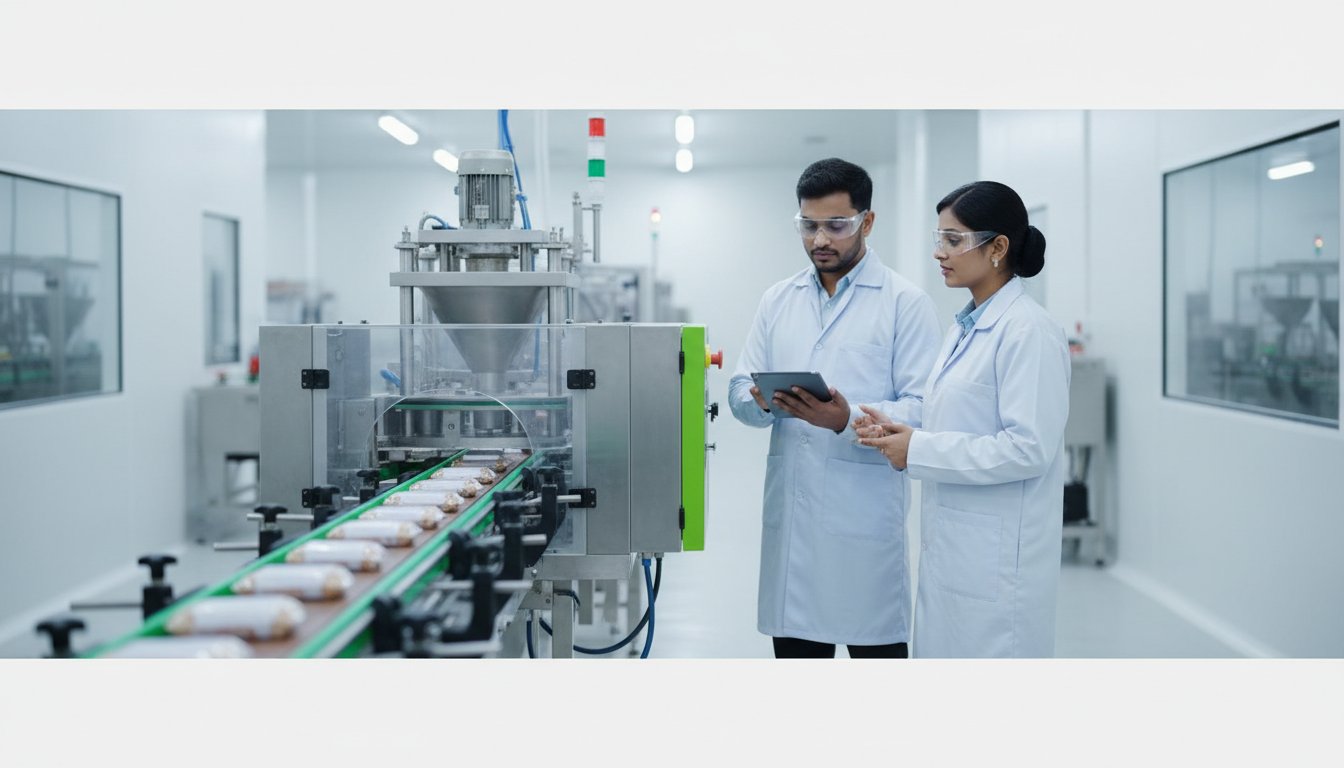
Navigating the world of industrial food production requires a deep understanding of the equipment that forms the backbone of any successful operation. From raw ingredient preparation to final packaging, the right food processing machine is critical for achieving efficiency, quality, and scale. This guide provides a comprehensive overview of the core types of food processing machinery, offering the clarity needed to select the right equipment for your production line and business objectives.
What is an Industrial Food Processing Machine?
An industrial food processing machine is a piece of equipment designed for the large-scale transformation of raw agricultural products—such as grains, fruits, vegetables, and meats—into finished, packaged, and preserved consumable goods. The primary goals of this machinery are to enhance food preservation, ensure product safety and consistency, and maximize production efficiency. Unlike smaller commercial equipment found in restaurants or bakeries, industrial machinery is built for continuous, high-volume operation within a factory environment, emphasizing durability, automation, and compliance with stringent food safety standards.
Core Functions in Food Production
The journey from raw material to finished product involves several key stages, each requiring specialized machinery. These core functions include Preparation, which involves washing, sorting, peeling, and grading raw ingredients to ensure quality from the start. The next stage is Processing, where the physical form of the food is altered through actions like size reduction, mixing, heating, or cooling. To ensure a long and stable shelf life, Preservation techniques such as drying, dehydrating, freezing, or vacuum sealing are employed. Finally, Quality Control machinery, including inspection systems and industrial scales, verifies that every product meets the required specifications before it leaves the plant.
Key Types of Food Processing Machines by Function
To simplify selection, industrial machinery is best categorized by its primary role within the production line. Understanding these categories helps plant managers and engineers identify the precise equipment needed to perform a specific transformation process efficiently and reliably.
Size Reduction Equipment
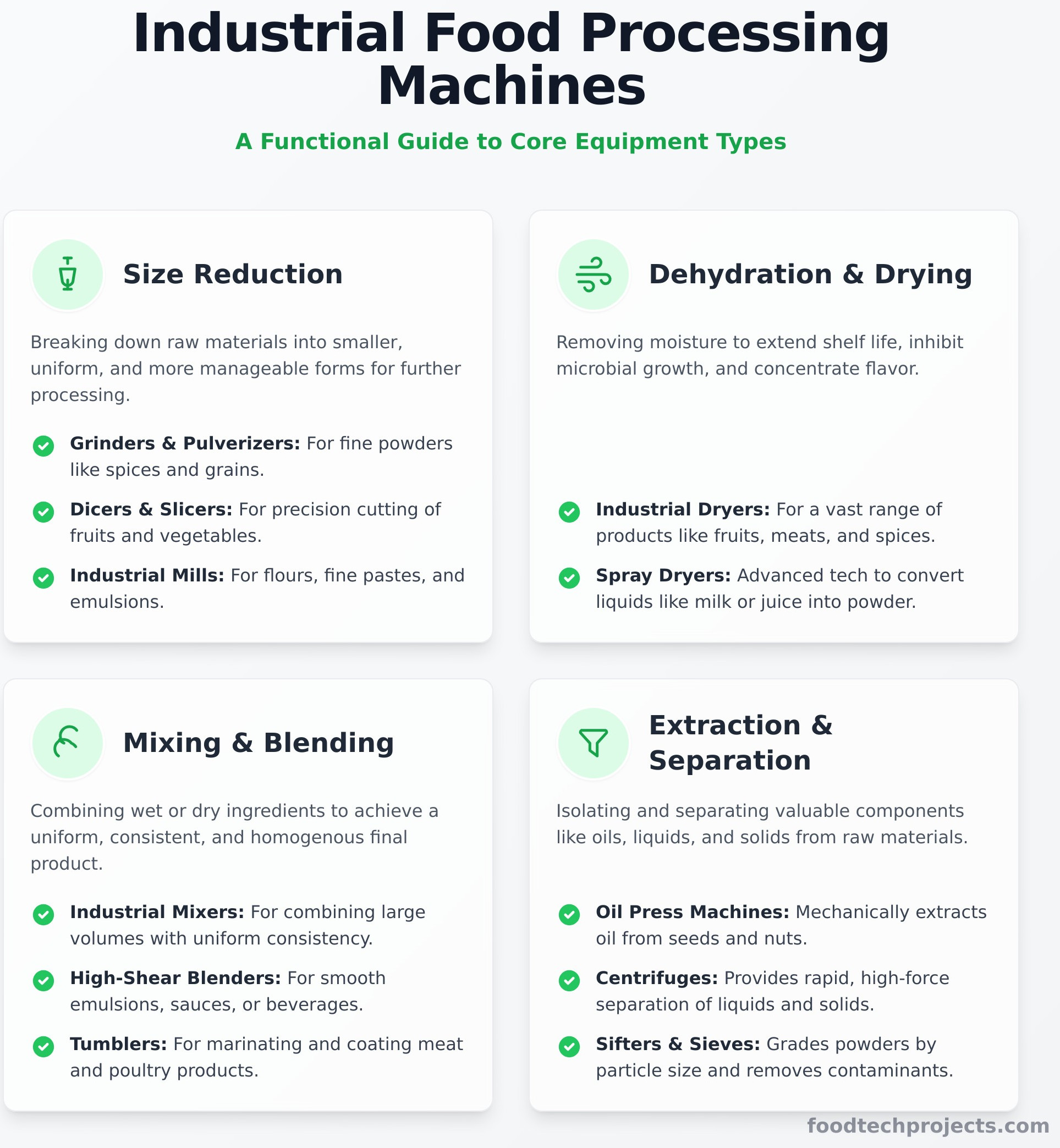
Size reduction is one of the most fundamental steps in food processing. This category includes a wide range of machines designed to break down raw materials into smaller, more manageable forms. Grinders and Pulverizer Machines are essential for producing fine powders from spices, grains, and herbs. For creating uniform pieces of fruits and vegetables, Dicers and Slicers provide precision and speed. Meanwhile, industrial Mills are used to produce flour from grains or create fine pastes and liquid emulsions.
Dehydration and Drying Technology
Removing moisture is a critical preservation technique that extends shelf life and inhibits microbial growth. Industrial Dryers and dehydrators are engineered to efficiently remove water from a vast range of products, including fruits, vegetables, spices, and meats. This process concentrates flavor and preserves nutritional value. For converting liquids like milk or fruit juice into powder form, advanced technologies like Spray Dryers are utilized, offering high-speed evaporation and consistent particle size.
Mixing and Blending Machines
Achieving a consistent and homogenous product requires powerful and precise mixing technology. Industrial Mixers are designed to combine large volumes of wet or dry ingredients with uniform consistency. For creating smooth emulsions, sauces, or beverages, high-shear Blenders are employed. In the meat and poultry sector, Tumblers are used to marinate and coat products, ensuring deep flavor penetration and tenderness.
Extraction and Separation Equipment
This category of machinery is designed to isolate and separate valuable components from raw materials. Oil Press Machines are used to mechanically extract oil from various seeds and nuts, such as sunflower seeds, peanuts, or soybeans. For separating liquids from solids or liquids of different densities, Centrifuges provide rapid, high-force separation. To ensure the purity and quality of powders like flour or spices, Sifters and Sieves are used to grade materials by particle size and remove foreign contaminants.
How to Select the Right Machinery for Your Plant
Choosing the right food processing equipment is a critical investment that directly impacts production capacity, product quality, and profitability. A strategic approach that considers your specific product, operational scale, and long-term business goals is essential for making an informed decision.
Key Selection Criteria
Several key factors must be evaluated when selecting machinery. First, consider the product characteristics, including the properties of the raw material and the specifications of the desired final product. Next, determine the required production capacity, measured in output per hour or day, to ensure the equipment can meet demand. The material of construction is also vital; food-grade stainless steel is the industry standard for ensuring hygiene and durability. All equipment must meet compliance with local and international food safety standards. Finally, assess the long-term operational costs, including energy consumption, maintenance requirements, and labor.
Beyond a Single Machine: The Turnkey Solution Advantage
While individual machines perform specific tasks, a truly efficient production line requires them to work together seamlessly as an integrated system. This is where the advantage of a turnkey project becomes clear. Instead of sourcing equipment from multiple vendors, a turnkey solution provides a complete, custom-engineered production line from a single, experienced partner. The benefits are significant: a single point of contact simplifies project management, integrated design ensures faster commissioning, and overall system performance is guaranteed. This approach is ideal for entrepreneurs building new factories or established companies planning major production line upgrades. If your project requires a comprehensive, end-to-end solution, Consult our engineers about a turnkey project.
After optimizing your production line for efficiency and quality, remember that market visibility is equally vital. When preparing to showcase your products or advanced machinery at industry trade shows and events, a strong presentation is key. For premium portable display systems tailored for such exhibitions, consider solutions from Display Junction.
Frequently Asked Questions
What is the main purpose of a food processing machine?
The main purpose is to convert raw agricultural ingredients into safe, shelf-stable, and consumable food products on a large scale. This involves processes like cleaning, cutting, mixing, cooking, and packaging to improve taste, safety, and convenience.
What are the most common types of food processing equipment?
The most common types include grinders for size reduction, industrial dryers for preservation, mixers for blending ingredients, oil presses for extraction, and packaging machines for finishing the product.
How do I ensure food safety with industrial machinery?
Ensure food safety by selecting machines made from food-grade materials like stainless steel, designed for easy cleaning and sanitation. The equipment must comply with international food safety standards, and operators must follow strict hygiene and maintenance protocols.
What is the difference between commercial and industrial food equipment?
Industrial equipment is designed for high-volume, continuous operation in a large factory setting, built for durability and automation. Commercial equipment is intended for lower-volume use in environments like restaurants, catering kitchens, or small bakeries.
How much does an industrial food processing machine cost?
The cost varies widely based on the machine’s type, capacity, level of automation, and country of manufacture. A single machine can range from several thousand to hundreds of thousands of dollars, while a complete turnkey plant is a significant capital investment.
Why choose a turnkey plant over buying individual machines?
A turnkey plant ensures all machinery is perfectly integrated to work together, guaranteeing performance and efficiency. It simplifies project management with a single point of responsibility, often leading to faster installation and a quicker start to production compared to sourcing and integrating equipment from multiple suppliers.
With over 35 years of engineering experience and successful installations in more than 30 countries, Food Tech Projects is your trusted partner for high-performance food processing solutions. Our uncompromising commitment to quality and performance ensures your production line is built for success. To discuss the specific needs of your operation and discover how our advanced machinery can elevate your business, Request a Quote for Your Food Processing Project today.