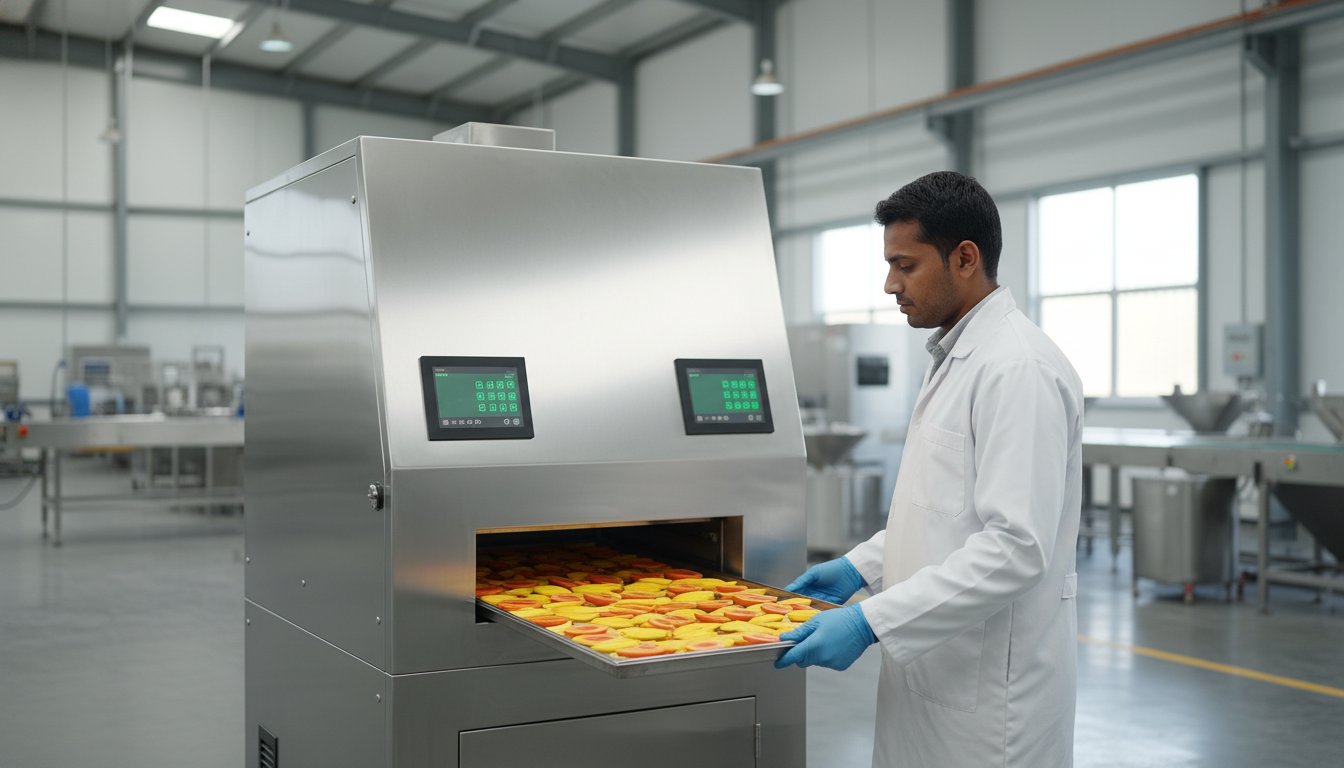
Master the principles of industrial food dehydration, from raw material preparation to final packaging, using commercial-grade machinery. This guide provides the technical knowledge necessary to scale your operations, ensure product quality, and optimize efficiency for large-scale production.
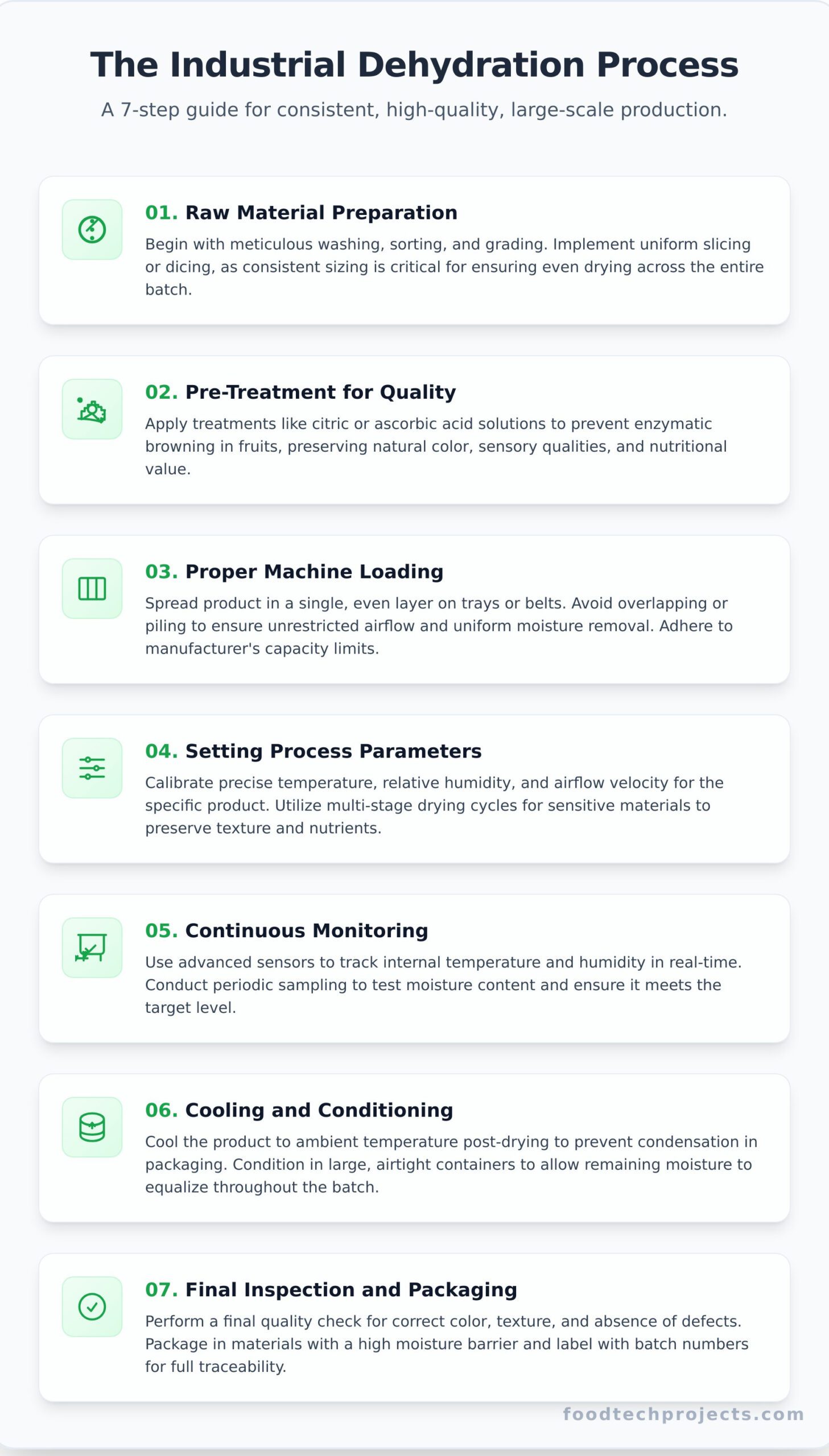
The Industrial Dehydration Process: A 7-Step Operational Guide
Transitioning from small-scale or laboratory dehydration to full industrial production requires a systematic and precise approach. The process is far more than simply placing food in a heated chamber; it involves a series of controlled steps to ensure consistency, safety, and shelf stability across large batches. This guide outlines the standard operating procedure for using a commercial dehydrator, focusing on the critical pillars of quality control, operational efficiency, and batch-to-batch consistency.
Step 1: Raw Material Preparation and Quality Control
The quality of your final dehydrated product is determined before it ever enters the dryer. The process begins with meticulous raw material preparation. Start with a thorough washing, sorting, and grading of all incoming materials to remove contaminants and select only items that meet your quality standards. Following this, implement uniform slicing, dicing, or cutting using industrial-grade equipment. Consistent sizing is critical for ensuring even drying, as pieces of varying thickness will have different moisture removal rates, leading to an inconsistent final product.
Step 2: Pre-Treatment for Optimal Results
Pre-treatment is a crucial step in commercial dehydration to preserve the sensory and nutritional qualities of the food. For fruits like apples and bananas, this often involves applying an ascorbic acid or citric acid solution to prevent enzymatic browning, preserving the product’s natural color. For certain other products, a process like sulfuring may be used to maintain quality and extend shelf life. Understanding and implementing the correct pre-treatment is fundamental to producing a commercially viable product that remains appealing and stable over time.
Step 3: Loading the Industrial Dehydrator
Proper loading of an industrial dehydrator is essential for achieving uniform airflow and consistent drying. Ensure that the product is spread in a single, even layer across the trays or conveyor belts. Overlapping or piling the product creates dense spots where airflow is restricted, resulting in uneven moisture removal and potential spoilage. It is critical to avoid overloading the machine beyond its specified capacity. Always adhere to the manufacturer’s guidelines for maximum load to maintain optimal performance and prevent damage to the equipment.
Step 4: Setting Critical Process Parameters
Unlike simple home units, industrial dehydrators offer precise control over multiple process parameters. You must calibrate the temperature and relative humidity settings based on the specific characteristics of the product being dried. Airflow velocity must also be set to ensure uniform moisture removal without damaging delicate products. For sensitive materials, programming multi-stage drying cycles—where temperature and airflow change over time—can yield superior results, preserving texture and nutrients more effectively than a single, static setting.
Step 5: Monitoring the Dehydration Cycle
Continuous monitoring is key to a successful dehydration cycle. Modern industrial systems are equipped with advanced sensors to track internal temperature, humidity, and exhaust air data in real-time. This data allows operators to make adjustments as needed. Throughout the cycle, conduct periodic sampling of the product to test for its moisture content, ensuring it is on track to meet the target level. Understanding and interpreting a product’s unique dehydration curve—the rate at which it loses moisture—is a critical skill for optimizing drying times and energy consumption.
Step 6: Cooling and Conditioning the Final Product
The process does not end when the product leaves the dehydrator. It must be properly cooled to ambient temperature before packaging. Packaging warm products can lead to condensation inside the container, which introduces moisture and creates a risk for microbial growth. After cooling, a step known as conditioning is often employed. This involves holding the dehydrated product in large, airtight containers for several days to allow the remaining moisture to equalize throughout the batch, resulting in a more uniform and stable final product.
Step 7: Final Inspection and Packaging
The final stage involves a thorough quality inspection. Check the product for the correct color, texture, and the absence of defects or case hardening (a condition where the outside is dry but the inside remains moist). Once approved, the product must be packaged in materials with a high moisture barrier to prevent rehydration from the ambient air. Each package should be clearly labeled with batch numbers and production dates to ensure full traceability, a requirement for commercial food production.
Choosing the Right Industrial Dehydrator for Your Application
The type of industrial dehydrator you select will have a direct and significant impact on your production efficiency, energy costs, and final product quality. The optimal choice depends entirely on the specific food product you are processing, your required daily or hourly throughput, and the physical constraints of your facility.
Tray Dryers: Versatility for Batch Production
Industrial tray dryers, also known as cabinet dryers, are the workhorses of batch production. They are an ideal solution for startups, small to medium-sized enterprises, and businesses with diverse product lines that require frequent changeovers. These machines are best suited for drying fruits, vegetables, meat jerky, and other products that can be laid on trays. Their primary advantage is the ability to maintain precise control over individual batches, allowing for tailored drying cycles for different products.
Tunnel and Conveyor Belt Dryers: For Continuous Production
For high-volume operations, tunnel and conveyor belt dryers offer a continuous processing solution. In these systems, the product moves through a long drying chamber on a conveyor belt, ensuring a first-in, first-out process. They are commonly used in large-scale facilities for drying cereals, snack foods, pet food, and bulk vegetables. A continuous dryer is engineered for maximum throughput and operational efficiency, minimizing labor and ensuring a highly consistent output.
Fluidized Bed Dryers: For Granular Products
Fluidized bed dryers are specifically designed for granular, powdered, or particulate materials. They work by forcing a stream of hot air upwards through a perforated bed, which lifts and suspends the product particles in a fluid-like state. This “fluidization” exposes the entire surface of each particle to the air, resulting in extremely rapid and uniform drying. This technology is excellent for drying grains, spices, powders, and various granulated materials where efficiency and consistency are paramount.
Consult with Experts for a Turnkey Solution
A successful industrial dehydration line involves much more than just the dryer itself. It requires an integrated system of pre-treatment equipment, conveyors, cooling tunnels, and packaging machinery to function efficiently. Partnering with an experienced engineering firm ensures that all components work together seamlessly as part of a fully integrated, efficient system. A comprehensive approach prevents bottlenecks and maximizes your return on investment. Design your industrial dehydration plant with our experts.
Frequently Asked Questions
What is the main difference between a commercial and a home dehydrator?
The primary differences are scale, control, and construction. Commercial dehydrators are built with durable materials like stainless steel for continuous operation, can process hundreds or thousands of kilograms per batch, and offer precise control over temperature, humidity, and airflow. Home units are small, designed for intermittent use, and typically only have basic temperature settings.
How do you determine the correct drying time and temperature for a new product?
This is typically determined through a process of research and development. It starts with baseline parameters from industry data for similar products, followed by small-scale test batches. Operators monitor the dehydration curve and adjust temperature, time, and airflow until the desired final moisture content and product quality are consistently achieved.
What is ‘water activity’ and why is it important in commercial dehydration?
Water activity (aW) is a measure of the “available” water in a food product for microbial growth. It is a more accurate indicator of shelf stability than simple moisture content. A low water activity (typically below 0.60 for most foods) inhibits the growth of bacteria, yeasts, and molds, which is the primary goal of commercial dehydration for preservation.
Can industrial dehydrators be used for different types of food products?
Yes, many industrial dehydrators, particularly tray dryers, are highly versatile. However, optimal efficiency is achieved when the dryer is matched to the product type. For example, while you could dry a powder in a tray dryer, a fluidized bed dryer would be far more efficient. The key is to develop and save specific drying “recipes” or parameter settings for each product you process.
How much energy does an industrial food dehydrator consume?
Energy consumption is a major operational cost and varies significantly based on the dryer’s size, technology (e.g., heat pump vs. electric), and the amount of water being removed. Modern industrial dryers are designed with energy efficiency in mind, often incorporating heat recovery systems to recycle exhaust heat and reduce overall consumption. An energy audit is recommended when planning a new line.
Achieving success in commercial food dehydration requires a combination of the right technology and deep process knowledge. With over 35 years of experience in food processing technology and successful turnkey plant installations in more than 20 countries, our team provides the expertise needed to build an efficient and profitable operation. We leverage a state-of-the-art R&D center to develop custom dehydration solutions tailored to your specific product and production goals. Explore our range of high-performance industrial dryers and dehydrators.