
Last updated: 23 November 2026. By the GTI Group editorial team, Genex Tech Industries LLP (Food Tech Projects), Kolkata, India.
Direct answer: Black pepper is made by threshing the berries, blanching them briefly in boiling water and drying them to about 10-12% moisture or lower. Pepper above 12% moisture is prone to fungal attack. Mechanical drying gives faster, cleaner and more predictable results than open sun drying, but the dryer and settings must be proven on your berries.
Request a Quotation: Planning a pepper or whole-spice processing and drying line? Email mktg@foodtechprojects.com or call/WhatsApp +91-93300-77417 | +91-87774-75596. Include green berry volume per day, harvest season, target moisture, export market and location.
Key takeaways
- A national food-processing institute manual describes the sequence as threshing, blanching, drying, cleaning, grading and packaging.
- Blanching in boiling water for about one minute speeds browning and drying and gives a uniform dark colour.
- Sun drying typically takes 3-5 days to about 10% moisture, with a dry recovery of 33-37% by weight, depending on variety.
- Export buyers set moisture and microbial limits. Check the current standard and your contract.
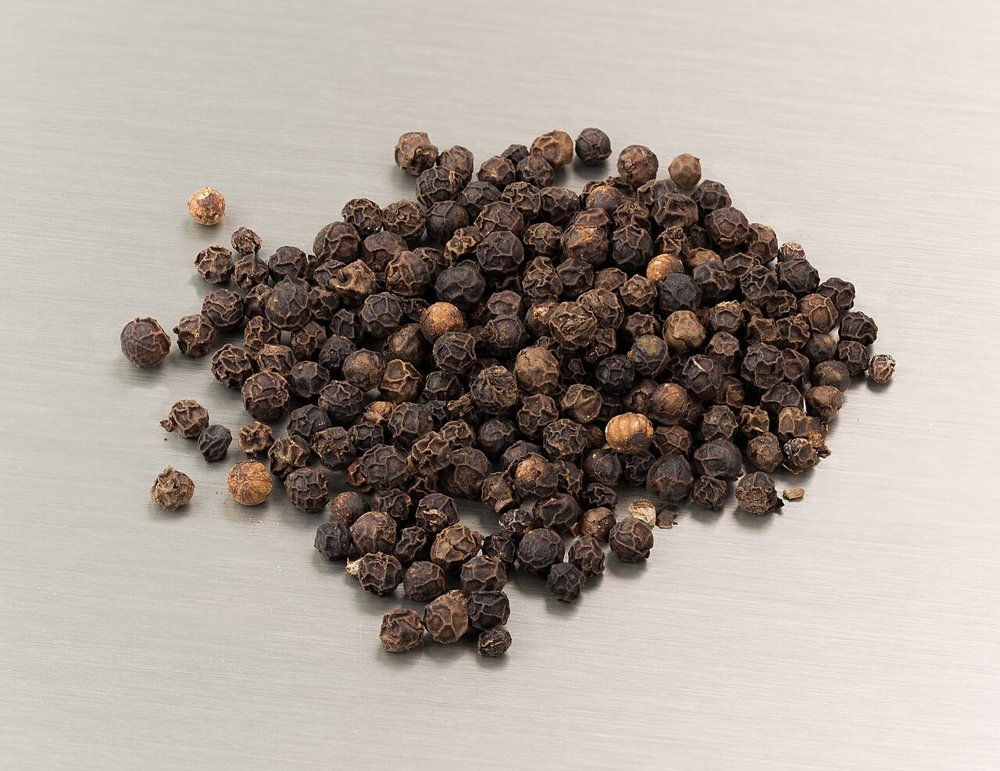
What are the steps in black pepper processing?
The steps are simple but each affects quality. The NIFTEM (India) manual lists them as below.
- Harvest the spikes at the right maturity.
- Thresh the berries from the spikes; mechanical threshers are available from 50 to 2,500 kg/h in the manual.
- Blanch the berries in boiling water for about one minute.
- Dry to a safe moisture.
- Clean, grade and pack.
Enzymatic browning during drying is what turns the skin black. Careful, even drying gives uniform colour.
Why does blanching matter?
The manual states that blanching for one minute before sun drying speeds browning and drying, gives a uniform lustrous black colour and shortens the drying period. Keep blanch time consistent from batch to batch so berries dry evenly.
What moisture is safe for dried pepper?
The manual reports that dried pepper above 12% moisture is prone to fungal attack. Drying is continued to about 10% in its sun-drying description. Buyers often set limits in contracts and standards such as ISO 959-1 for black pepper, so check the version your buyer uses.
Moisture should be tested on every lot. A pepper lot can look dry outside while the berry core is still wet, so test a ground, representative sample.
How much water does a tonne of green berries lose? A worked example
The manual reports a dry recovery of 33-37% from fresh berries and about 10% final moisture in sun drying. From these, the water removed can be estimated.
- Green threshed berries: 1,000 kg.
- Dried pepper at 33-37% recovery: 330-370 kg.
- Water removed: about 630-670 kg per tonne of green berries (estimate from the published recovery).
A dryer must be sized on this water load and on your peak harvest rate. Pepper arrives in a short season, so peak-day tonnage, not annual tonnage, decides capacity.
Why use a mechanical dryer instead of the sun?
Sun drying needs several days of good weather and open floor space. Rain, dust and birds risk mould and contamination. A mechanical dryer controls temperature and airflow, so lots finish in hours with a consistent final moisture, and the product is kept off the ground.
| Factor | Open sun drying | Mechanical dryer |
|---|---|---|
| Time | 3-5 days (manual) | Set by dryer design and trial |
| Weather risk | High | Low |
| Contamination risk | Dust, birds, rain | Enclosed, cleanable |
| Control of final moisture | Manual raking | Zoned temperature and time |
GTI’s spice drying systems page lists pepper berries among whole spices dried, and GTI’s Spices Processing Plant & Machinery page lists pepper in the spice range. Relevant machines include the Mesh Belt Dryer and Vibratory Fluid Bed Dryer. Berry size, bed depth and air settings should be confirmed by trial. For other whole-spice lessons, see our guide on ginger drying problems and red chilli colour loss.
What else must a pepper plant plan for?
- Cleaning and grading: remove stalks, light berries and foreign matter before packing.
- Microbial control: many export buyers require a validated treatment step such as steam. Equipment for that step must be confirmed with GTI engineering; do not assume it is part of a standard dryer line.
- Dust and aroma: ground pepper loses volatile oil with heat in milling; ask about cooling.
- Traceability: record lot, moisture and test results.
FAQ
What moisture should black pepper have?
The NIFTEM manual reports that pepper above 12% is prone to fungal attack and describes drying to about 10%. Follow your buyer’s specification.
How long does pepper take to dry?
The manual describes 3-5 days of sun drying. A mechanical dryer time depends on design and must be set by trial.
Why blanch pepper?
Blanching in boiling water for about one minute speeds browning and drying and gives uniform black colour, according to the manual.
Does GTI make pepper dryers?
GTI lists pepper berries on its spice drying page and makes belt and fluid bed dryers used for whole spices. Confirm fit by trial.
Request a Quotation from GTI
Planning a black pepper or whole-spice processing and drying line? Contact Genex Tech Industries LLP (GTI Group) to discuss your material, production capacity, product specifications and utility requirements. To help us respond usefully, please share your product or raw material, required capacity in kg/h, feed and final moisture (state wet or dry basis), finished-product specification, available utilities, installation location and project timeline.
Email: mktg@foodtechprojects.com
Call or WhatsApp: +91-93300-77417 | +91-87774-75596 (WhatsApp)
Website: https://foodtechprojects.com/
For Industrial Dryers: https://gtidryers.com
This article gives general technical guidance. Figures marked as illustrative are examples, not plant guarantees. Equipment selection and performance for your material should be confirmed through trials and engineering assessment.
References
- NIFTEM (PMFME). Reading manual for black pepper processing (threshing, blanching, drying, recovery, moisture and fungal risk). niftem.ac.in
- ISO 959-1: Pepper (Piper nigrum L.), whole or ground. Specification. Part 1: Black pepper (check the current edition). www.iso.org