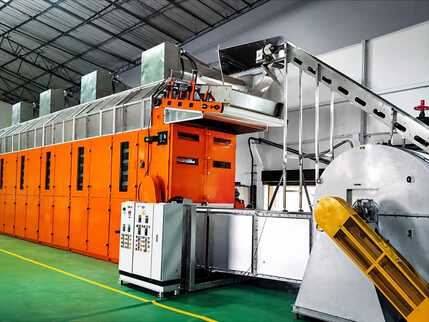
In modern industrial processing, selecting the right thermal dehydration system is a critical decision. Indeed, this choice directly influences product quality, operating margins, and throughput efficiency. For high-volume processing lines, static batch drying is rarely viable due to its steep labor costs and uneven moisture profiling. Consequently, advanced manufacturing plants rely heavily on continuous processing technologies. Ultimately, among the most reliable options engineered today are Mesh Belt Dryers and Continuous Tray Type Belt Dryers.
As specialized industrial thermal systems engineered by Genex Tech Industries LLP, these continuous drying solutions are custom-built. Specifically, they fulfill the precise moisture-removal needs of the food, agro, pharmaceutical, chemical, and biomass sectors. Therefore, this article explores the engineering mechanics, operational parameters, and key distinctions between these two leading continuous dehydration technologies.
Understanding the Mechanics of Continuous Dehydration
Continuous belt dryers operate on the core principle of convective heat transfer. Instead of keeping material stationary in a single batch chamber, these systems transport wet material through a series of enclosed, highly insulated thermal zones.
1. What is a Mesh Belt Dryer?
A Mesh Belt Dryer utilizes a high-grade, perforated stainless steel or food-grade mesh belt to convey material. First, the wet product is distributed evenly across the belt width using an automated oscillating feeder. Then, as the belt glides through the drying chamber, controlled hot air is continuously forced up or down through the product bed. Because the air passes directly through the material, heat transfer is highly efficient. As a result, the system achieves uniform moisture extraction from the entire product bed.
2. What is a Continuous Tray Type Belt Dryer?
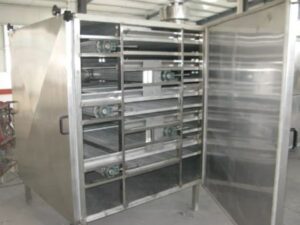
In contrast, a Continuous Tray Type Belt Dryer transports materials on a series of articulated, moving trays or staggered tray circuits. Clearly, this design is engineered specifically for products that require a longer residence time or multi-stage turning. Furthermore, it provides strict physical isolation during processing. As the trays index through the distinct heating zones, the product experiences minimal structural stress. Consequently, it is an excellent solution for highly uniform, staged dehydration.
Key Operational Differences: Mesh Belt vs. Continuous Tray
While both systems deliver continuous throughput, they serve distinct application profiles. Thus, they eliminate the inefficiencies of batch processing entirely.
| Operational Parameter | Mesh Belt Dryers | Continuous Tray Type Dryers |
| Material Handling | Ideal for slices, dices, granules, and flakes that permit air to pass through the product matrix. | Preferred for highly fragile, uniform products requiring controlled tipping and turning. |
| Airflow Dynamics | Direct through-bed circulation, which provides superior thermal contact. | Cross-flow and parallel-flow air circulation, optimizing surface evaporation without shifting material layout. |
| Residence Time Control | Highly dynamic; adjusted via conveyor variable-frequency drives (VFD) for fast to medium drying cycles. | Engineered for long residence times, allowing complex moisture-diffusion profiles over extended periods. |
| Bed Depth Optimization | Supports varied bed depths depending on material porosity and airflow fan capacities. | Maintains strict, fixed material depths across distinct tray boundaries for perfect batch traceability. |
Critical Engineering Parameters for System Optimization
Achieving optimal energy efficiency and target moisture percentages requires precise control over several interconnected parameters. Specifically, engineers must balance thermodynamic and mechanical variables:
-
Variable Belt Speed: This controls the residence time inside the chamber. Consequently, it matches the material’s specific drying curve perfectly.
-
Multi-Zone Temperature Regulation: Employs independent heating zones. For example, it utilizes higher heat at the inlet for rapid constant-rate surface evaporation. Meanwhile, it applies lower heat near the outlet to prevent case hardening.
-
Airflow Distribution and Velocity: This ensures an engineered balance between recirculated hot air and exhaust air. Therefore, it maximizes thermal efficiency while pulling out humid air.
-
Product Bed Porosity: This dictates static pressure drops. Thus, optimizing bed thickness prevents air channeling and ensures consistent moisture extraction across the entire belt width.
Diverse Industrial Applications
Thanks to their continuous automation, these drying technologies are deployed across wide-ranging industrial verticals. Moreover, they offer flexible heat integrations and hygienic build qualities:
-
Food Processing: Essential for the uniform dehydration of vegetable slices, fruits, nuts, grains, snack pellets, and spices. It successfully removes moisture while preserving essential colors and nutritional indices.
-
Insect Protein & Circular Bio-Economy: Widely adapted for scaling insect protein production. Specifically, it provides efficient, continuous drying of Black Soldier Fly Larvae (BSFL) to maintain protein integrity.
-
Nutraceuticals & Pharmaceuticals: Safe processing of botanical extracts, medicinal herbs, and pharmaceutical granules. It handles these sensitive products under tightly controlled, low-temperature conditions.
-
Specialty Chemicals & Polymers: Uniform moisture reduction for chemical salts, specialized resins, and catalyst granules. Most importantly, it removes moisture without causing thermal degradation.
-
Biomass & Renewable Energy: High-capacity processing of wood chips, sawdust, and agricultural by-products prior to pelletization.
Customization Options & Turnkey Engineering
Every industrial product features a unique moisture profile. For this reason, a “one-size-fits-all” design is never sufficient. To address specific factory floor footprints and thermal energy access, systems can be customized with advanced sub-system options:
-
Material Construction: SS304 or SS316 food-grade contact parts or complete stainless steel structures. These are built to meet stringent US FDA and European standards.
-
Alternative Heating Mediums: Seamless integration with steam coils, hot air generators, thermic fluid systems, gas burners, or energy-efficient electric heaters.
-
Advanced Automation: Central PLC and SCADA integration. This allows for comprehensive data logging, moisture monitoring, and precise automated loop controls.
-
Energy Recovery Modules: Integrated air-to-air heat exchangers. These modules recover waste heat from the exhaust air stream, cutting total energy footprints significantly.
-
Downstream Processing: Integrated cooling conveyors, automated sorting lines, dust-collection cyclones, and bag filters. Together, they create a complete turnkey operation.
Consult with Engineering Specialists
In conclusion, selecting, sizing, and configuring a continuous dehydration system requires rigorous calculations. These calculations must be based on initial moisture levels, target wet-basis moisture content, and material heat sensitivities. Therefore, whether you are expanding an existing production line or designing a brand-new processing facility from scratch, our expert engineering team is equipped to provide comprehensive support. This includes capacity mapping, plant layout modeling, and detailed commercial assessments.
For personalized engineering consultations, custom layout blueprints, or updated pricing sheets, please connect with our specialized technical desk using the access channels below:
-
📧 Technical Inquiries: mktg@foodtechprojects.com
-
📞 Phone / WhatsApp Support: +91 93300 77417
-
🌐 Engineering Portals: Food Tech Projects | GTI Dryers