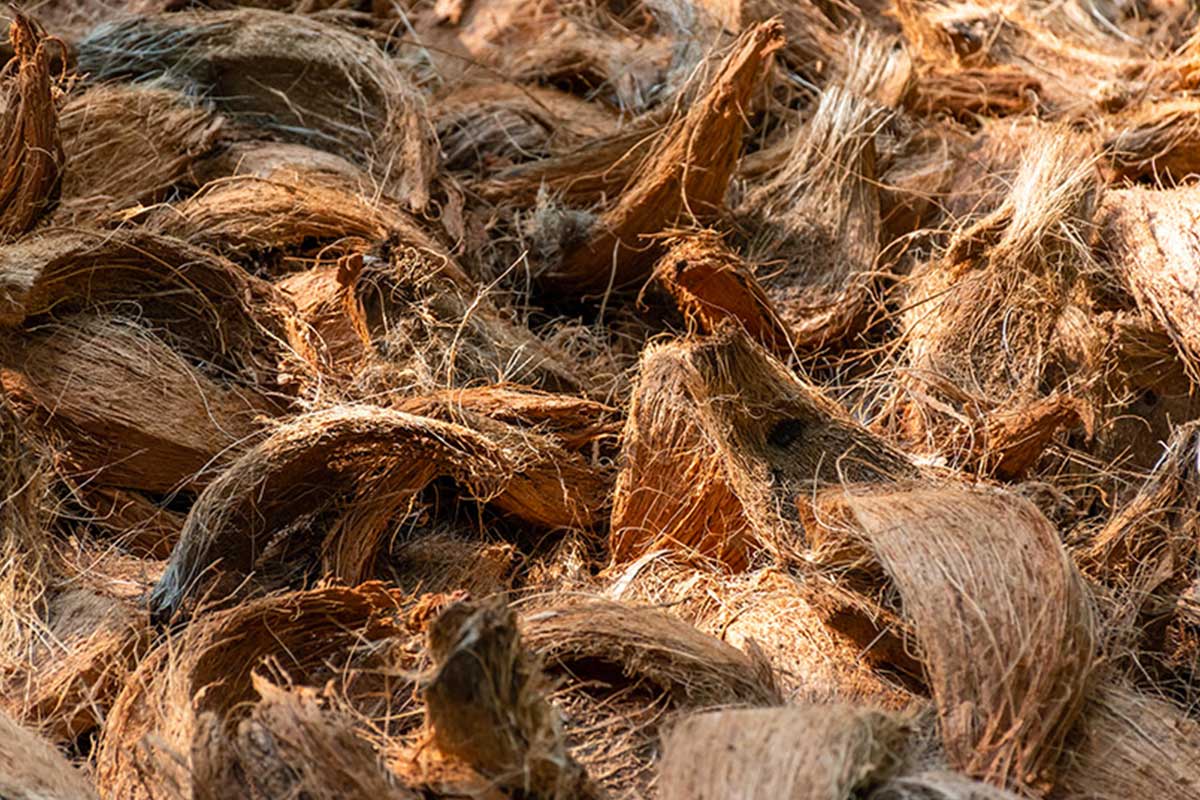
The global shift toward sustainable, biodegradable, and eco-friendly raw materials has transformed agricultural residual processing from a low-margin rural activity into an automated, high-yield industrial sector. Central to this transition is the utilization of coconut husks—historically treated as discarded agro-industrial waste—to manufacture premium coir fiber and nutrient-dense coir pith. Consequently, meeting this exploding global demand requires industrial infrastructure that limits fiber degradation, maximizes yield, and retains consistent final moisture thresholds. This is precisely why specialized coconut fibre machinery manufacturers step in to bridge the gap between raw biomaterial extraction and export-grade standardization.
Understanding the Coir Value Chain: From Raw Husk to Revenue Streams
A coconut husk is a complex, multi-layered fibrous matrix. Therefore, extracting commercial value from it requires segregating the raw material into two highly profitable primary derivatives:
-
Coir Fiber (Brown & White): Highly sought after by the automotive bedding industry, mattress manufacturers, structural geotextiles, acoustic insulation panels, and global brush/matted consumer goods exporters.
-
Coir Pith (Coco Peat): A spongy, porous non-fibrous binding material extracted during milling. In addition to this, it has emerged as the global benchmark for professional horticultural substrates, soil conditioning, hydroponics crop cultivation, and premium coco-block export markets.
To achieve this successfully, instead of relying on isolated, standalone machinery components, modern processing plants deploy fully integrated, automated processing configurations. As a direct result of this setup, plant operations experience minimized material handling bottlenecks.
Market Insight: Scalable engineering setups designed by tier-1 manufacturers allow processing capacities to flex easily from 500 kg/hr up to 10,000+ kg/hr. Accordingly, they adapt fluidly to localized husk accumulation rates and commercial processing requirements.
The Anatomy of a Fully Automated Coir Processing Plant
In order to achieve high fiber recovery efficiency with minimal structural damage, leading manufacturers develop centralized, automated production lines. Specifically, a state-of-the-art turnkey installation typically integrates the following essential modules:
1. Sizing and Pre-Conditioning: Husk Cutters & Crushers
Raw coconut husks are naturally bulky and tough. Hence, the processing cycle begins with industrial Husk Cutters and Disintegrators. These machines break the thick outer shells down into uniform, workable feed sizes, optimization-ready for mechanical extraction. Subsequently, this initial preparation guarantees a continuous, uniform mass flow rate downward through the conveyor network.
2. The Core Extraction Engine: Mechanical Defibering
Following the sizing stage, the material enters the heart of the entire line: the Coir Fibre Extraction Machine (Defibering Machine). Utilizing heavy-duty, high-velocity pinned cylinders, this module mechanically shears the pre-crushed husks to release embedded fibers from their sticky pith matrices. Furthermore, advanced engineering ensures maximum structural fiber length retention, which directly correlates with higher market value per metric ton.
3. Separation and Sorting: Screeners & Pith Segregators
Once liberated, the mixed stream passes instantly into high-capacity Rotary Screeners or Pith Separators. These vibrating or tumbling drums feature precisely calibrated screen openings that separate fine coir pith (coco peat) away from long fiber strands. Meanwhile, raw debris is collected via specialized lower-level conveyors.
Advanced Moisture Balancing: Integrated Drying Technology
Freshly processed coir fiber and pith carry high internal moisture from natural sap, atmospheric retting, or structural washing. For this reason, lowering this moisture level is essential to maximize physical fiber strength, prevent microbial degradation, and satisfy global export shipping standards. To meet this need, leading coconut fibre machinery manufacturers customize systems using two core pneumatic and thermal drying innovations:
A. Pneumatic Flash Drying Systems
The GENEX Pneumatic Flash Dryer is engineered for high-speed moisture removal from fine coir particles, fiber fragments, and coir pith blends. By introducing the wet material into a highly turbulent, high-velocity heated airstream, instant convective heat and mass transfer occur.
-
Ultra-Fast Residence Time: On the one hand, moisture evaporation completes in just 1–3 seconds. Accordingly, this rapid action protects the natural color, texture, and physical characteristics of heat-sensitive fractions.
-
Powder and Particle Engineering: Simultaneously, it delivers finished coir pith or short-fiber substrates with a stable final moisture target of 2% – 8% and controlled particle distributions (typically 80–150 microns).
-
Low Maintenance Footprint: Moreover, the absolute lack of internal moving parts inside the main flash drying duct ensures outstanding operational uptime, low wear, and a compact mechanical profile.
B. Industrial Rotary Drum Dryers
On the other hand, for heavy-duty, large-scale processing of raw, brown, and white long coir fiber bundles, the GTI Industrial Rotary Drum Dryer provides unmatched reliability. The system exposes bulk granular solids and fibrous materials to consistent convective heat transfer via continuous cascading drum operations.
-
Cascading Internal Flights: Specifically, specially configured internal lifting flights systematically raise the coir fiber as the drum rotates at controlled speeds. In doing so, they shower it repeatedly through co-current or counter-current hot air streams.
-
Rugged Material Accommodation: In contrast to delicate alternative setups, this system is highly tolerant of irregular feed volumes and variable initial moisture profiles. As a benefit, it prevents product accumulation or scorching inside the drum under harsh 24×7 industrial duty cycles.
-
Optimal Final Conditioning: Ultimately, it gradually reduces loose fiber bundles to an export-ready moisture range of 10% to 15%, thereby enhancing bulk density and flowability for downstream baling compaction.
5. Final Densification: Baling Presses & Block Makers
Because loose fiber and coco peat are low-density, high-volume products, direct bulk transport is financially unviable. To resolve this problem, the final processing line incorporates automated Fibre Baling Presses to compress dried fiber strands into tightly bound high-density bales. At the same time, Coir Pith Block Making Machines press coco peat into specialized 5kg or 25kg commercial blocks for streamlined shipping logistics.
Technical Benchmarks and Specifications
For processing enterprises analyzing operational expenditures (OPEX) and capital allocation (CAPEX), modern coir extraction installations balance performance with rigorous physical boundaries. As detailed below, standard technical baselines across modern plants are clearly mapped out:
| Technical Parameter | Standard Industrial Specification |
| Processing Capacity Range |
500 kg/hr to 10,000+ kg/hr (Modular Scale) |
| Primary Raw Input |
Green or Matured Brown Coconut Husks |
| Key Revenue Outflows |
Long Coir Fiber, Fine Coir Pith (Coco Peat) |
| Total Power Consumption |
20 kW to 200+ kW (Based on line automation scale) |
| Materials of Construction (MOC) |
Heavy-Duty Mild Steel (MS) / Premium Stainless Steel (SS304 / SS316) |
| Flash Drying Performance |
1–3 seconds drying window; final moisture reduced to 2% – 8% |
| Rotary Drum Performance |
Continuous cascading action; final fiber moisture stabilized at 10% – 15% |
| System Control Architecture |
Central PLC-Based Automation with Touchscreen SCADA / HMI Panels |
The Role of Mathematical Processing Efficiency
The financial success of a coir processing plant hinges on maximizing fiber yield while minimizing energy waste. Thus, fiber extraction efficiency can be evaluated using the material balance equation:
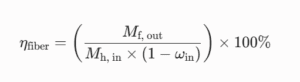
Where $\eta_{\text{fiber}}$ represents the net fiber recovery percentage, $M_{\text{f, out}}$ is the mass flow rate of dry finished fiber exiting the baler, $M_{\text{h, in}}$ is the total mass flow rate of raw husks fed into the disintegrator, and $\omega_{\text{in}}$ is the initial moisture fraction of the input husk material. Evidently, modern processing systems are calibrated to achieve maximum recovery with minimal fine-fiber loss.
Why Partnering with a Turnkey Manufacturer Matters
Investing in individual, uncoordinated processing elements often yields systemic bottlenecks, uneven moisture levels, and high maintenance downtime. On the contrary, partnering with a dedicated turnkey partner like Genex Tech Industries ensures complete physical and operational synchronization across your factory floor:
-
Optimized Energy Consumption: Perfectly balanced machinery layouts ensure conveyor systems, extraction cylinders, and thermal drying fans use minimal power—consequently keeping operational costs highly competitive.
-
Reduced Fiber Degradation: Precision engineering inside the defibering drum ensures husks are opened clean. As a result, this maximizes long fiber strands and shrinks low-value dust waste.
-
Integrated Environmental Safety: High-volume processing lines come standard with state-of-the-art Dust Collection Networks (incorporating cyclones, bag filters, or wet scrubbers). Hence, they contain fly-away micro-fibers to maintain safe, code-compliant factory floor conditions.
Conclusion: Powering the Future of Sustainable Processing
In summary, the transformation of simple coconut husks into high-demand, industrial eco-products represents one of the most profitable circular economy business models available today. Success, however, relies heavily on processing efficiency, precise thermal drying control, and robust machine life. By in large, executing capital improvements with heavy-duty, PLC-controlled turnkey plants ensures modern coir processors secure maximum uptime, exact moisture control, and premium market prices globally.
🌐 Contact Information & Technical Support
For custom layout design, process scaling metrics, or machinery engineering consultations, please reach out to our global technical service teams:
-
📧 Technical Inquiries: mktg@foodtechprojects.com
-
📞 Phone / WhatsApp Support: +91 93300 77417
-
🌐 Engineering Portals: www.foodtechprojects.com | www.gtidryers.com