
American processing companies rank among the top importers of industrial dryers globally. Specifically, as US import demand grows, plant managers actively seek high-performance, energy-efficient, and FDA-compliant thermal systems.
Whether a food processor needs a spray dryer for dairy powders, or a botanical manufacturer requires a gentle refractance window dryer for heat-sensitive fruit purées, choosing the right manufacturer is vital. Furthermore, pharmaceutical plants evaluate a combination fluid bed dryer or vibratory fluidised bed dryer. Chemical processors select a paddle dryer or flash dryer, while mineral plants select a heavy-duty rotary drum dryer. Consequently, picking the right engineering partner directly determines product quality, operating costs, and long-term ROI.
Why USA Companies Import Industrial Dryers
In today’s competitive market, US processing plants require equipment built to strict sanitary and technical standards:
-
FDA and GMP Compliance: First and foremost, equipment must meet strict sanitary guidelines for food, dairy, and pharma operations. To achieve this, fabricators use sanitary welds, smooth internal surfaces, and 316L stainless steel contact parts.
-
High Thermal Efficiency: In addition, advanced heat recovery loops and insulated double walls cut fuel use by 20%–30%. As a result, plant managers effectively offset rising energy costs.
-
Custom Process Engineering: Rather than offering rigid off-the-shelf units, engineers size systems for exact evaporation rates. Capacities range from 50 kg/hr pilot units to over 10,000 kg/hr continuous plants.
-
Reliable Support & Spares: Furthermore, standardized commercial parts, VFD controls, and rapid-dispatch components prevent costly downtime during continuous 24/7 runs.
-
Proven Export Capabilities: Finally, manufacturers deliver turnkey systems with ASME compliance, UL-listed control panels, and native 480V/3Ph/60Hz power compatibility.
For these reasons, American procurement teams actively source from global OEMs—such as GENEX TECH INDUSTRIES LLP—to obtain custom machinery at competitive prices without sacrificing quality.
Key Engineering Considerations for US Process Plants
Before installing an industrial dryer into a US facility, engineering teams must evaluate specific process dynamics to prevent bottlenecks:
-
Material Handling & Feeding Automation: Initially, feeding systems convert raw materials into a uniform stream. For example, positive displacement pumps move liquid feeds. Meanwhile, twin-screw feeders with lump breakers transport sticky filter cakes.
-
Air Filtration & Environmental Compliance: Moreover, North American emission regulations enforce tight limits on air discharge. Therefore, modern drying setups use multi-stage recovery—combining high-efficiency cyclones with secondary wet scrubbers or baghouses—to lower dust emissions below 10 mg/Nm³.
-
Thermal Source Selection: Depending on utility pricing, plants configure dryers for direct natural gas, indirect steam coils (up to 15 bar), thermal oil loops, or electric heaters. Consequently, selecting the right heat source lowers operating costs per ton.
-
System Automation & Data Logging: In addition, modern plants integrate PLC controls with SCADA or DCS via Ethernet/IP. As a result, automated loops monitor temperatures, pressures, and feed rates to ensure consistent product moisture.
Most In-Demand Industrial Dryer Types: Deep Technical Insights
                                  INDUSTRIAL DRYER SELECTION
                                              │
         ┌───────────────────┬────────────────┼───────────────────┬───────────────────┐
         ▼                   ▼                ▼                   ▼                   ▼
   LIQUID / SLURRY    HEAT-SENSITIVE    BULK SOLIDS / ORES  PASTES / CAKES      STICKY / SLUDGES
         │             PURÉES / EXTRACTS      │                   │                   │
         ▼                   ▼                ▼                   ▼                   ▼
    Spray Dryer      Refractance Window  Rotary Dryer        Flash Dryer         Paddle Dryer
(Atomization/Drying)   (Infrared/Belt) (Cascading Motion) (Pneumatic Dispersal) (Indirect Heat)
1. Spray Dryers
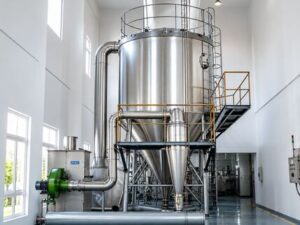
Primarily, spray drying transforms liquid feeds, solutions, emulsions, and slurries (20% to 60% initial solids) into free-flowing powders in a single step. Accordingly, processors deploy this technology across dairy, plant proteins, coffee extracts, specialty chemicals, and active pharmaceutical ingredients (APIs).
Operating Principle & Process Physics
To initiate the process, high-pressure pumps deliver liquid feed to an atomizer at the top of a cylindrical chamber. Subsequently, hydraulic nozzles or rotary atomizers spinning at 10,000 to 25,000 RPM break the liquid stream into micro-droplets (20 to 180 microns). Because this creates a massive surface area, co-current hot air vaporizes moisture within milliseconds before particles hit the chamber walls.
Key Process Capabilities
-
Instantaneous Moisture Vaporization: In particular, inlet air temperatures of 150°C to 350°C drop rapidly upon contacting moisture. Thus, outlet gas temperatures remain cool (70°C to 105°C), protecting heat-sensitive ingredients from thermal damage.
-
Engineered Particle Morphology: Furthermore, precise control over atomizer speed, feed viscosity, and drying temperatures enables exact customization of powder density, particle size, solubility, and wettability.
-
Closed-Loop Nitrogen Operation: In addition, engineers configure systems with closed-loop nitrogen gas circuits and solvent condensers. As a result, operators safely process flammable organic solvents without fire risks.
Technical Highlights
Key features include sanitary 316L stainless steel polished contact surfaces (Ra < 0.4 µm), automated multi-zone CIP spray balls, integrated reverse-pulse baghouses delivering >99.9% powder recovery, and NFPA/ATEX explosion venting.
2. Refractance Window Dryers (RWD)
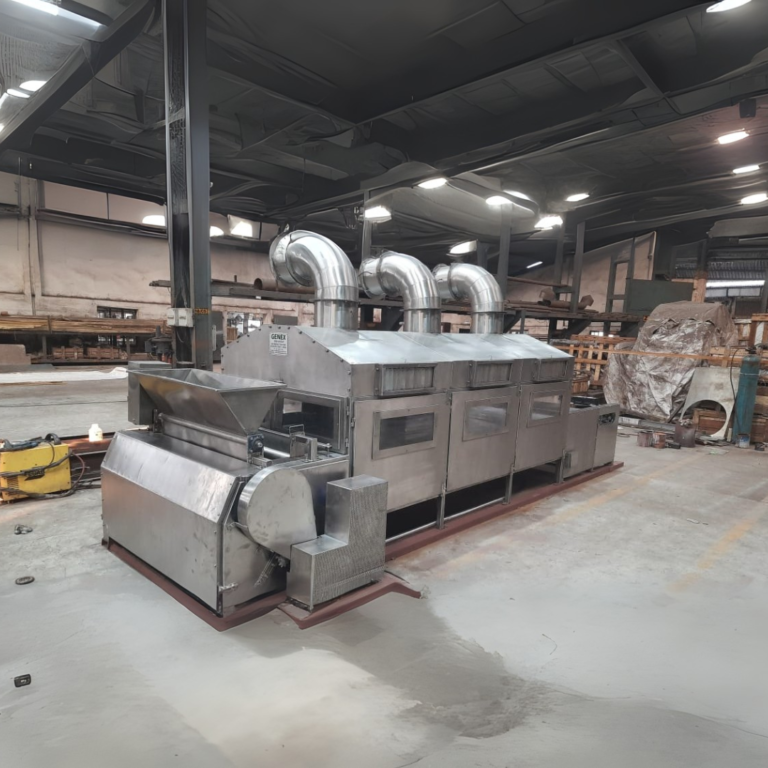
By comparison, Refractance Window Drying is an advanced fourth-generation, low-temperature drying system engineered for heat-sensitive liquid concentrates, fruit purées, juices, herbal extracts, algae, and biopharmaceuticals. In fact, RWD systems match freeze-dried product quality at a fraction of the capital and energy cost.
Operating Principle & Thermodynamic Strategy
During operation, a spreader applies liquid feed as a thin layer (0.5 mm to 2.0 mm) onto a continuous conveyor belt. This food-grade belt moves over circulating hot water (90°C to 98°C). In this setup, the wet film acts as a “refractance window.” Infrared thermal energy passes through the belt directly into the wet film, triggering rapid evaporation. However, as the product dries, its refractive index shifts, closing the “window” and preventing further heat absorption. Consequently, product temperatures remain low (<60°C to 70°C).
Key Process Capabilities
-
Maximum Bioactive & Vitamin Retention: Most importantly, RWD preserves heat-vulnerable compounds—such as Vitamin C, pigments, active enzymes, and flavor profiles—at rates exceeding 90% to 95%.
-
Rapid Thin-Film Kinetics: In contrast to traditional methods, drying finishes within 3 to 10 minutes. Therefore, production speeds up while energy consumption per kilogram of evaporated water drops.
-
Versatile Flake & Powder Production: Additionally, the dried material emerges as a thin sheet. A scraper blade continuously removes this sheet at the discharge cooler, allowing easy milling into flakes or instant powders.
Technical Highlights
Standard specifications include FDA-compliant polyester conveying belts, dual water circulation loops with heat exchangers, pneumatic belt alignment systems, integrated doctor blades, and sanitary 316L stainless steel wash-down casings.
3. Rotary Drum Dryers
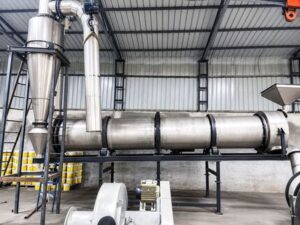
On the other hand, rotary drum dryers serve as continuous workhorses for bulk solids, minerals, sand, ores, fertilizers, biomass, and agricultural by-products requiring moisture reduction from 40% down to under 1%.
Operating Principle & Mechanical Physics
Mechanically, a heavy steel shell set at a slight incline (2% to 5% slope) rotates on forged steel trunnion rolls via VFD-driven gear assemblies (2 to 8 RPM). Meanwhile, internal lifters scoop and shower material continuously through a stream of hot air or direct combustion gases. As a result of drum rotation and gravity, mechanical tumbling gently transports solids toward the discharge outlet.
Key Process Capabilities
-
High-Volume Continuous Throughput: For instance, systems process from 1 to over 50+ metric tons per hour with continuous 24/7 reliability under heavy industrial conditions.
-
Extreme Mechanical & Thermal Ruggedness: Furthermore, these drums handle abrasive, non-uniform, or high-density mineral feeds without jamming, warping, or shell fatigue.
-
Flexible Fuel Integration: In addition, operators can pair units with direct-fired natural gas burners (combustion gas up to 800°C), biomass gasifiers, or indirect steam-tube bundles.
Technical Highlights
Construction details include heavy carbon steel or alloy shell fabrication, refractory brick linings for high-heat zones, graphite face seals, dual-drive assemblies, and exhaust cyclone heat recovery loops.
4. Flash Dryers & Spin Flash Dryers
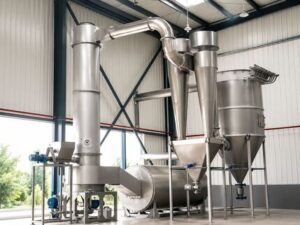
Alternatively, flash dryers are ultra-fast pneumatic drying systems engineered to convert high-moisture filter cakes, centrifuge cakes, pastes, and wet powders into fine particulates within 1 to 3 seconds.
Operating Principle & Process Thermodynamics
Specifically, a variable-speed screw feeds wet material (30% to 70% moisture) into a vertical drying column. In Spin Flash models, a mechanical agitator at the chamber base violently breaks down cohesive pastes into small fragments. Simultaneously, a high-velocity hot air stream (20 to 30 m/s) lifts the particles pneumatically into the tower, evaporating surface moisture instantly during transit.
Key Process Capabilities
-
Sub-3-Second Residence Time: Because surface moisture flashes off instantly, core product temperatures stay cool (60°C to 80°C) despite high inlet air temperatures (180°C to 400°C).
-
Minimal Installation Footprint: In addition, the vertical riser tower delivers high drying capacity while occupying a fraction of the floor space required by horizontal drum systems.
-
Elimination of Pre-Grinding Steps: Moreover, integrated disintegrator blades reduce wet filter cakes directly inside the drying zone. This eliminates the need for standalone extruders or pre-milling units.
Technical Highlights
System components include hard-faced disintegrator blades, adjustable air classifier rings for particle size control, high-efficiency secondary cyclones, and pulse-jet baghouses.
5. Paddle Dryers (Indirect Contact Vacuum / Thermal Dryers)

Additionally, paddle dryers excel at processing sticky, heat-sensitive filter cakes, hazardous industrial sludges, ETP cake, and fine chemicals without requiring large volumes of carrier air.
Operating Principle & Thermodynamic Strategy
Operationally, dual counter-rotating shafts equipped with wedge-shaped hollow paddles intermesh inside a jacketed trough. Meanwhile, heating media—such as saturated steam (up to 10–15 bar), thermal oil, or hot water—circulates through the outer vessel jacket and the hollow paddle shafts. Thus, direct conductive contact transfers heat as overlapping paddles agitate, knead, and convey the wet paste forward.
Key Process Capabilities
-
Exceptional Thermal Efficiency (>85%): Because heat transfers purely through direct conduction rather than convective hot air, exhaust gas volumes drop by up to 80%. Consequently, air scrubber sizing and utility costs decrease significantly.
-
Self-Cleaning Intermeshing Wedge Profile: Furthermore, counter-rotating wedge paddles continuously scrape heat-transfer surfaces clean. This prevents sticky sludges from forming insulating crusts.
-
Deep Vacuum Capabilities: In addition, operators easily seal the vessel for low-temperature vacuum drying, evaporating moisture at boiling points between 40°C and 70°C.
Technical Highlights
Features include ASME Section VIII code-stamped pressure vessel jackets, heavy-duty stuffing box gland seals, high-torque industrial gearboxes, and closed-loop solvent recovery condensers.
6. Fluid Bed Dryers (Combination & Vibratory)
Finally, fluid bed dryers perform high-efficiency drying, agglomeration, and cooling of heat-sensitive granules, crystals, extruded pellets, and fragile food or pharma powders. In these systems, fluidization ensures optimal gas-solid contact. Every individual particle suspends in a controlled hot air stream, maximizing heat transfer without thermal degradation.
A. Vibratory Fluidised Bed Dryers (VFBD)
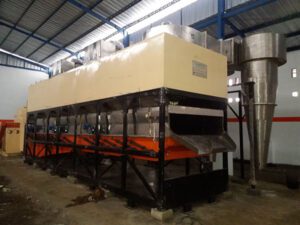
In particular, VFBD units suit cohesive materials, wide particle-size distributions, fragile agglomerates, and wet feeds that would otherwise clump under standard static air velocity.
-
Operating Principle & Mechanical Physics: To achieve uniform fluidization, filtered hot air passes upward through a perforated distributor plate. Simultaneously, dual electric motors impart high-frequency mechanical vibration (500 to 1,200 VPM at a stroke amplitude of 2 to 7 mm) to the deck structure. As a result, the vibration vector propels the fluidized bed linearly while lowering the minimum fluidization velocity ($U_{mf}$) needed to suspend sticky feeds.
-
Key Process Capabilities:
-
Zero Fluidization Dead Zones: Because mechanical vibration breaks surface tension between wet particles, the system prevents localized overheating and clumping.
-
Low Mechanical Shear: Furthermore, gentle conveying protects fragile crystals, instant tea granules, and extruded feeds from breaking or generating fines.
-
Integrated Multi-Zone Processing: In addition, operators split the bed length into distinct thermal zones. These include initial drying (120°C–160°C), secondary drying (70°C–90°C), and final cooling (15°C–25°C) to prepare powders for immediate packaging.
-
-
Technical Highlights: Perforated deck-plate options (Gill plate, directional, or woven mesh), built-in CIP spray nozzles, dust-tight construction, and integrated baghouses delivering >99.5% powder retention.
B. Combination Fluid Bed Dryers (Multi-Stage Tray & Fluidized Finishing)
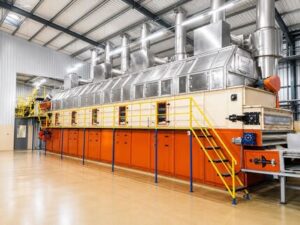
In contrast to single-stage units, combination systems integrate multi-pass tray/belt pre-drying with a final fluidized bed finishing phase to handle high-moisture feeds with slow internal diffusion rates.
-
Operating Principle & Thermodynamic Strategy:
-
Primary Drying Zone (Multi-Layer Tray/Belt): First, high-moisture feeds (30% to 60% initial moisture) pass through continuous multi-pass perforated trays. Here, controlled hot air removes unbound surface moisture down to 12%–15%.
-
Fluidized Finishing Zone: Second, semi-dried material drops directly into an integrated fluid bed section. Here, air velocity dynamically tumbles the particles, stripping internal moisture down to <0.5% without scorching product surfaces.
-
-
Key Process Capabilities:
-
Elimination of Wet Centers: Specifically, this setup suits dense granules, extruded foods, and botanical extracts where rapid exterior drying risks “case hardening” or trapping core moisture.
-
Preservation of Color & Volatiles: Moreover, graduated thermal profiles prevent thermal shock, keeping natural pigments, oils, and aromas intact.
-
Up to 35% Higher Thermal Efficiency: In addition, recirculating exhaust gas from the finishing fluid bed into the initial tray pre-drying stage drastically reduces fuel consumption per kilogram of evaporated water.
-
-
Technical Highlights: Variable-frequency drive (VFD) tray speed control, independent multi-zone temperature loops via PLC/SCADA, differential pressure monitoring across distributor decks, and sanitary 316L stainless steel polished construction (Ra < 0.4 µm).
Technical Comparison Matrix
| Dryer Type | Feed Condition | Moisture Range (In → Out) | Heat Transfer Method | Air/Water Temp (°C) | Residence Time | Primary Application |
| Spray Dryer | Liquids, Slurries | 80% → 3% | Direct Convective | 150°C – 350°C | 5 – 30 Seconds | Dairy, Coffee, Yeast, APIs |
| Refractance Window | Purées, Slurries, Concentrates | 80% → 3% | Infrared / Conductive Water | 90°C – 98°C (Water) | 3 – 10 Minutes | Fruit Purées, Nutraceuticals, Natural Colors |
| Rotary Dryer | Free-Flowing Solids | 50% → <1% | Direct or Indirect | 200°C – 800°C | 15 – 60 Minutes | Minerals, Ores, Sand, Biomass |
| Flash Dryer | Filter Cakes, Pastes | 60% → 2% | Direct Pneumatic | 180°C – 400°C | 1 – 3 Seconds | Starches, Proteins, Pigments |
| Paddle Dryer | Sludges, Thick Pastes | 80% → 10% | Indirect Conductive | 120°C – 250°C | 30 – 120 Minutes | ETP Sludge, Polymers, Fine Chemicals |
| Vibratory FBD | Granules, Pellets | 25% → 0.5% | Direct Fluidized | 60°C – 160°C | 5 – 20 Minutes | Pharma Granules, Salt, Sugar, Spices |
What American Buyers Prioritize in Global Suppliers
When US engineering teams evaluate international equipment partners, final decisions depend on five critical factors:
-
Compliance Certifications: First, verified US FDA, cGMP, CE, and ISO 9001:2015 manufacturing standards with full material traceability certificates (MTRs) are mandatory.
-
Electrical & Safety Standards: Second, full compliance with US electrical grids (480V / 3-Phase / 60Hz), NEMA enclosures, UL-listed control panels, and Allen-Bradley or Siemens PLC automation is essential.
-
Pilot Testing & Data Verification: Third, pilot plant testing facilities let engineers plot drying curves, measure heat consumption, and optimize powder density prior to full-scale fabrication.
-
Hygienic Surface Finishing: Fourth, food and pharma-grade mirror polishing (Ra < 0.4 µm) with electro-polishing options ensures maximum sanitary compliance.
-
Turnkey Export Support: Finally, seaworthy packaging, container loading, complete mechanical drawing packages (2D/3D CAD), and remote or on-site commissioning support guarantee seamless plant integration.
Conclusion
In summary, choosing the right industrial drying technology is a strategic investment that directly impacts product quality, utility costs, and throughput. Whether your process requires the rapid atomization of a spray dryer, the nutrient preservation of a refractance window dryer, the rugged capacity of a rotary drum dryer, the ultra-fast flash drying of filter cakes, or the energy-efficient conductive drying of a paddle dryer, working with an experienced manufacturer ensures your plant achieves maximum efficiency and long-term reliability.
Ready to Upgrade Your Process Line?
If your facility is planning to install a new drying system or upgrade an existing processing line, partner with GENEX TECH INDUSTRIES LLP for export-ready, US-compliant thermal drying solutions tailored to your exact process specs.
Get a Custom Engineering Proposal & Technical Quotation
Contact our process engineering team today for:
-
Free material drying feasibility assessments & lab testing
-
Custom evaporation rate calculations & utility heat-balance profiles
-
Complete CAD layouts, equipment sizing, and commercial quotes
📩 Email: mktg@foodtechprojects.com | sales@foodtechprojects.com
📞 Phone / WhatsApp: +91-97489 06968 | +91-9330077417
🌐 Websites: www.foodtechprojects.com | www.gtidryers.com
🏢 Head Office: 10C, Sir William Jones Sarani (Middleton Row), Park Street, Kolkata – 700071, India