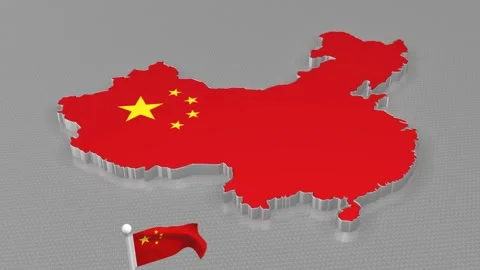
Currently, China stands as one of the world’s fastest-expanding importers and processors of coconut-derived products. Driven by explosive consumer demand across Hainan, Guangdong, and major domestic food, beverage, nutraceutical, and chemical processing hubs, Chinese facilities actively scale up production of coconut water, virgin coconut oil (VCO), coconut milk powders, and bio-industrial byproducts.
However, raw nut utilization in large-scale Chinese processing plants demands extreme thermal efficiency, zero-contamination hygiene, and end-to-end automation. Consequently, modernizing a facility from raw dehusking to advanced spray-dried powders or bio-diesel refining requires robust turnkey machinery tailored strictly to rigorous international and Chinese standards.
For this reason, this comprehensive sourcing guide covers the market drivers in China, core plant engineering considerations, deep technical breakdowns of our flagship coconut processing systems, and an in-depth focus on specialized thermal dehydration equipment.
Why Chinese Processing Plants Import Specialized Coconut Machinery
Chinese coconut processing plants operate under stringent environmental and industrial frameworks. As a result, global engineering partners supplying machinery to China must satisfy several non-negotiable requirements:
-
Mandatory GB Standards & Pressure Vessel Compliance: First and foremost, equipment installed within the PRC must comply with localized GB Standards (Guobiao). Additionally, pressure vessels and high-pressure steam blanchers/dryers must adhere strictly to SELO certification.
-
Dual-Carbon Mandate & Thermal Efficiency: Furthermore, because national carbon-neutrality targets are rising, Chinese plants specifically demand continuous heat recovery circuits and low-power drying loops. Consequently, these design choices yield 20% to 35% lower thermal energy consumption.
-
Zero-Contamination Food & Pharma Hygiene: In addition, because coconut milk, spray-dried powders, and pharma-grade Medium-Chain Triglyceride (MCT) oils require absolute purity, contact surfaces feature sanitary SS304/SS316 construction with mirror polishing ($\text{Ra} < 0.4\ \mu\text{m}$). Moreover, fully integrated CIP/SIP automation is standard.
-
24/7 Heavy-Duty Reliability: Meanwhile, facilities in major industrial zones operate around the clock. Therefore, plants require heavy-duty mechanical drives, VFD speed regulation, and full electrical compatibility with China’s 380V / 3-Phase / 50Hz grid.
Core Engineering Considerations for China Coconut Facilities
To achieve maximum ROI, modern facilities rely on integrated systems designed around four key operational pillars:
-
Automated Raw Nut Handling: First, mechanized dehusking, deshelling, and precision paring (testa removal) operate continuously. As a result, this process maintains ultra-white kernel purity for premium export-grade powders and oils.
-
Microbial Control & Sterilization: Second, integrated high-temperature short-time (HTST) pasteurization and steam blanching with rotary steam locks operate inline. Consequently, this continuous action eliminates bacterial growth prior to drying.
-
Ultra-Low Emission Dust Controls: Third, micro-powder operations (DC, VCO powder, coconut water powder) utilize primary cyclones paired with pulse-jet baghouse filters. Because of this specialized design, atmospheric dust emissions stay strictly below $10\text{ mg/Nm}^3$.
-
SCADA/DCS Integration: Finally, fully automated PLC control architectures connect via Industrial Ethernet directly to facility-wide SCADA or DCS systems. Thus, operators monitor operations seamlessly.
Product Portfolio: Deep Technical Breakdown
1. Desiccated Coconut (DC) Processing Machinery & Plants
-
Process Physics: First, the system transforms fresh mature coconut meat into white, shelf-stable desiccated powder ($2\%\text{–}3\%$ moisture). Subsequently, it executes precise dehusking, deshelling, paring, washing, grinding, blanching, and fluidized drying.
-
Capacity: Specifically, output ranges from $100\text{ kg/hr}$ to $2,500\text{ kg/hr}$.
-
Key Features: Furthermore, it features SS304 contact parts, automated nut counters ($300\text{ nuts/min}$), high-speed deshellers ($350\text{–}425\text{ nuts/hr}$), steam blanchers with VFD travel control, and multi-layer Novatex sifting.
2. Virgin Coconut Oil (VCO) Machinery Plants
-
Process Physics: In this stage, the plant delivers chemical-free cold extraction directly from fresh coconut meat or milk. As a result of using centrifugation and low-temperature vacuum drying, it preserves natural Lauric Acid and aroma.
-
Capacity: For instance, processing rate spans from $50\text{ LPH}$ to $5,000+\text{ LPH}$.
-
Key Features: Consequently, it achieves up to 95% oil recovery efficiency, SS316 food/pharma contact surfaces, low-temperature vacuum dryers keeping final oil moisture $<0.1\%$, and optional CIP sanitization.
3. Virgin Coconut Oil (VCO) Powder Processing Plant
-
Process Physics: First, liquid VCO is converted into free-flowing, stable powder via high-shear nano-emulsification with carrier agents (maltodextrin/gum arabic). Subsequently, the mixture undergoes continuous spray drying.
-
Capacity: In terms of output, it delivers from $10\text{ kg/hr}$ to $2,000+\text{ kg/hr}$ powder output.
-
Key Features: Moreover, it maintains an encapsulation efficiency up to 95%, inlet temperatures of $150^\circ\text{C}\text{–}220^\circ\text{C}$, outlet temperatures of $70^\circ\text{C}\text{–}100^\circ\text{C}$, yielding powder moisture $<3\%$ with reduced oxidation.
4. Coconut Milk Machinery & Processing Plant
-
Process Physics: First, the line delivers high-yield extraction of rich coconut milk from fresh kernels through multi-stage screw pressing and filtration. Next, it performs double-homogenization and HTST pasteurization.
-
Key Features: Most importantly, it uses a sanitary closed-loop design preventing oxidation, integrated fat-content standardization, and inline UHT/retort compatibility for long shelf-life packaging.
5. Coconut Milk Powder Processing Plant
-
Process Physics: Through advanced atomization, it transforms liquid coconut milk into instant-dissolving powder. As a result of high-efficiency spray drying and microencapsulation, the final particle structure is fully protected.
-
Key Features: For example, it provides precise particle size control, complete solubility in warm or cold water, integrated fluid bed agglomeration/cooling, and low heat damage to preserve natural coconut fat profile.
6. Turnkey Coconut Biodiesel Processing Plant
-
Process Physics: First, this transesterification plant converts low-grade coconut oil, paring oil, or waste coconut fats into high-cetane biodiesel (FAME). Next, it isolates and recovers refined glycerine.
-
Key Features: In addition, it incorporates continuous chemical dosing, multi-stage reaction vessels, alcohol recovery distillation columns, and compliance with global EN 14214 / ASTM D6751 biodiesel standards.
7. Coconut Fibre Machinery (Coir Processing Plant)
-
Process Physics: First, this automated system performs de-husking and decorticating on raw husks. Subsequently, it separates the fibers into long bristle fiber, mattress fiber, and coir pith (coco peat).
-
Key Features: Consequently, it utilizes heavy-duty spiked rotors, continuous rotary screen baling, automated moisture extraction presses, and dust separation for horticultural export markets.
8. Coconut Paring Oil Processing Plant
-
Process Physics: In order to maximize byproduct value, this plant extracts commercial-grade coconut oil from the brown outer skin (testa/paring). Consequently, waste streams from desiccated coconut or VCO processing are fully monetized.
-
Key Features: Because of this design, it features high-pressure continuous screw expellers, heavy-duty kernel pre-treaters, and leaf-filter oil clarification for maximizing plant profit from byproducts.
9. Coconut Water Extraction Machine
-
Process Physics: First, this automated system pierces and drains fresh nuts under sterile conditions. As a result, raw coconut water is collected without exposure to oxygen or ambient air.
-
Key Features: Specifically, it integrates high-throughput nut conveying, automatic shell piercing, stainless steel juice collection troughs, and inline coarse/fine filtration to eliminate fiber particulates.
10. Coconut Water Powder Processing Plant
-
Process Physics: First, the system utilizes ultrafiltration clarification and low-temp concentration on natural electrolyte-rich coconut water. Next, it converts the concentrate into soluble powder via spray drying.
-
Capacity: For instance, output ranges from $10\text{ kg/hr}$ to $2,000+\text{ kg/hr}$ powder output.
-
Key Features: Most notably, it preserves natural potassium, sodium, and magnesium mineral profiles while producing ultra-low moisture ($<3\%$) powder with zero caramelization or heat degradation.
11. Medium Chain Triglyceride (MCT) Oil Processing Plant
-
Process Physics: First, this advanced fractionation plant isolates Caprylic ($\text{C}_8$) and Capric ($\text{C}_{10}$) fatty acids from coconut oil. Next, it executes precise esterification to produce pharma-grade MCT oil.
-
Key Features: In addition, it employs high-vacuum fractional distillation columns, precise molecular temperature cut-offs, high-purity SS316L construction, and full SCADA automation.
12. Automated Packing Machinery
-
Process Physics: First, primary packaging units measure and dispense coconut products into high-barrier containers. Subsequently, secondary packaging systems package the materials for long-distance transport.
-
Key Features: For example, the machinery includes multi-head weighers, auger fillers for micro-powders, modified atmosphere packaging (MAP / Nitrogen flushing) to stop fat rancidity, and integrated metal detectors.
Specialized Thermal Dehydration Equipment Architecture
Selecting the correct dehydration technology is undeniably the single most critical decision in determining a coconut plant’s energy efficiency, product yield, and final quality. Below is a detailed technical breakdown of the four main industrial dryers used across high-capacity coconut processing lines.
Industrial Coconut Dehydration Technology Overview
-
1. Band (Apron) Dryer: Multi-Zone Static Bed for High-Volume Desiccated Coconut & Chips
-
2. Combination Fluid Bed Dryer: Hybrid Tray + Fluidising Deck for Zero-Clumping
-
3. Industrial Spray Dryer: High-Speed Flash Atomization for Micro-Powders
-
4. Vibratory Fluid Bed Dryer (VFBD): Low-Air Mechanical Fluidization for Granules
A. Band Dryer / Apron Dryer Technology
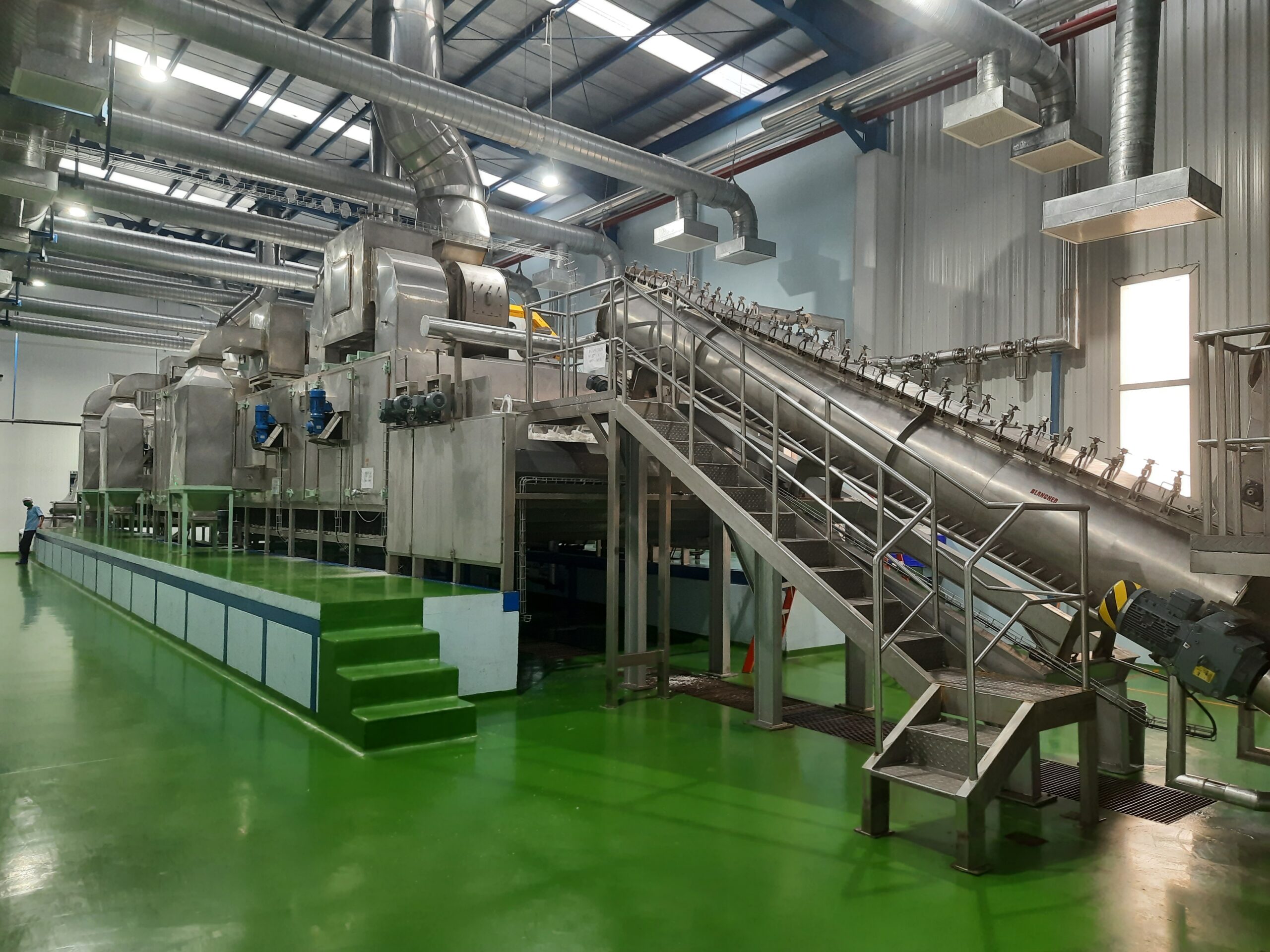
Specifically, this equipment is engineered for continuous, high-volume processing of shredded, sliced, or toasted coconut flakes requiring long, controlled residence times without mechanical damage.
Band Dryer Process Flow:
-
Air Management: First, an overhead Exhaust Air / Scrubber system continuously removes saturated moisture.
-
Material Inlet (Left): Next, wet feed enters the continuous drying line.
-
Thermal Zones: Subsequently, material passes through Zone 1 (Pre-Dry) $\rightarrow$ Zone 2 (Main Drying) $\rightarrow$ Zone 3 (Finish Conditioning).
-
Conveyor Mechanism: Meanwhile, the system is driven continuously by a moving stainless-steel mesh / apron belt.
-
Material Outlet (Right): Finally, finished dried coconut discharges continuously into the cooling section.
-
Operational Mechanics: Initially, wet coconut meat is spread uniformly across a perforated continuous stainless-steel conveyor belt via an oscillating spreader. Subsequently, heated air passes vertically (up-draft and down-draft) through the bed across multiple independent thermal zones:
-
1 (Pre-Drying): First, this stage delivers fast surface evaporation under controlled air velocity to prevent thermal degradation.
-
2 (Main Drying): Next, it provides sustained heat transfer targeting deep internal bound water.
-
3 (Cooling/Conditioning): Finally, low-temperature ambient air stabilizes the product prior to packaging.
-
-
Primary Applications: Indeed, it handles high-volume Desiccated Coconut ($100\text{–}1,500\text{ kg/hr}$), sweetened coconut chips, shredded coconut, toasted slices, and copra.
-
Key Technical Specs: Furthermore, it includes multi-zone PID thermal loops, VFD speed regulation ($15\text{–}120\text{ min}$ residence time), food-grade SS304/SS316 perforated aprons, and integrated CIP internal washing headers.
B. Combination Fluid Bed Dryer (Tray + Fluidised Bed)
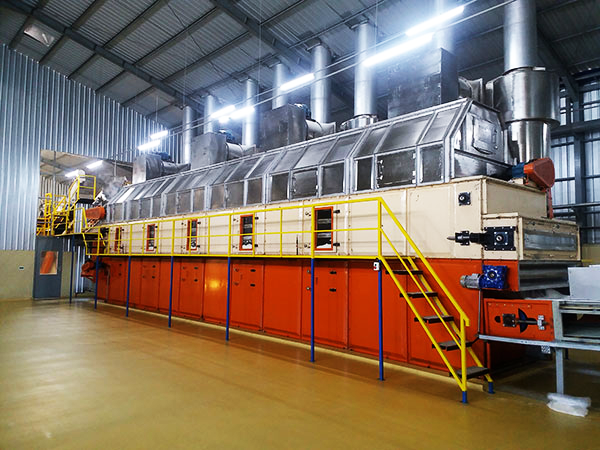
This multi-stage hybrid system was specifically engineered to solve the problem of surface case-hardening and clumping when drying high-fat, high-moisture coconut meat.
Combination Dryer Two-Stage Flow:
-
Stage 1 & Stage 2 (Top Tier): First, material enters the Multi-Layer Circulating Tray Circuit (Gentle Pre-Drying phase).
-
Interstage Transfer: Next, direct continuous transfer moves semi-dried material downward to the lower bed.
-
Stage 3 (Bottom Tier): Finally, material passes through the High-Velocity Fluidised Bed Zone (Uniform Moisture Equalization & Finishing).
-
Operational Mechanics:
-
Stage 1 & 2 (Tray Pre-Drying): Initially, wet coconut particles fall through multi-layer circulating trays. Here, gentle cross-flow warm air gradually reduces surface moisture, thereby preventing oil oxidation and clumping.
-
Stage 3 (Fluidised Bed Finish): Subsequently, semi-dried material discharges onto a bottom fluidising deck. At this stage, high-velocity hot air completely suspends individual particles to equalize internal moisture down to $<2.5\%$.
-
-
Primary Applications: Typically, it processes desiccated coconut flakes, toasted coconut chips, and specialized coconut copra. Capacities range up to $1,000\text{ kg/hr}$.
-
Key Technical Specs: In addition, it incorporates duplex cyclone dust recovery, SS316 air distribution plates, double-skin insulated enclosure, and HEPA air filtration AHU.
C. Industrial Spray Dryer Systems
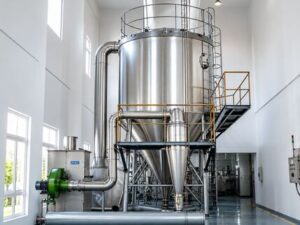
By comparison, industrial spray drying converts pumpable liquids, emulsions, and extracts into instant, free-flowing micro-powders within seconds.
Spray Dryer System Layout:
-
Feed Inlet: First, liquid feed enters via the Liquid Feed Inlet positioned at the top.
-
Atomization Core: Next, material passes through the high-speed Rotary Atomizer Wheel / High-Pressure Nozzle assembly.
-
Main Chamber: Simultaneously, the Hot Air Inlet directs heated air into the main Drying Tower chamber.
-
Air Exhaust & Recovery: Subsequently, air and fine particles exit into the Cyclone Separator for Fines Recovery.
-
Powder Discharge: Finally, finished powder exits via the Micro-Powder Outlet at the tower base.
-
Operational Mechanics: Initially, liquid feed (coconut milk, emulsified VCO, or clarified coconut water) is atomized into micro-droplets ($10\text{–}200\ \mu\text{m}$) via a high-speed rotary wheel ($10,000\text{–}25,000\text{ RPM}$) or high-pressure nozzle. Upon entering the hot air chamber ($150^\circ\text{C}\text{–}220^\circ\text{C}$ inlet), surface moisture evaporates instantly while the droplet core remains cool due to rapid latent heat absorption.
-
Primary Applications: For example, it processes coconut milk powder, microencapsulated VCO powder, and soluble coconut water powder. Capacities range from $10\text{ kg/hr}$ to $2,000+\text{ kg/hr}$.
-
Key Technical Specs: Furthermore, it features co-current air dispersion, integrated fluid bed agglomerator/cooler, explosion relief venting, and sanitary mirror polish ($\text{Ra} < 0.4\ \mu\text{m}$) with full CIP capability.
D. Vibratory Fluid Bed Dryer (VFBD)
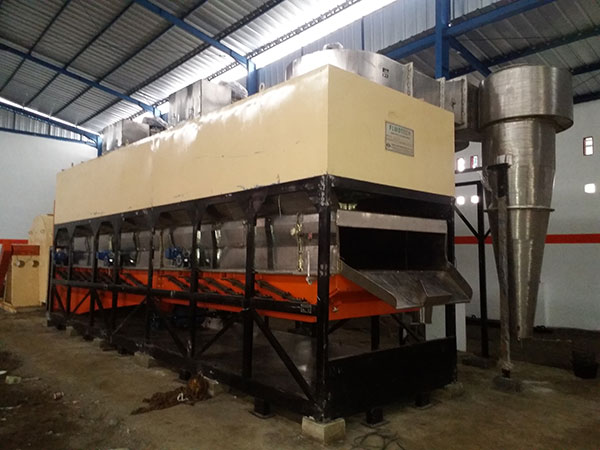
Unlike static beds, the Vibratory Fluid Bed Dryer combines low-velocity fluidisation with linear mechanical vibration to gently process fragile or sticky granular coconut products.
Vibratory Fluid Bed System Layout:
-
Air Supply: First, heated air enters from the Hot Air Inlet evenly positioned at the bottom.
-
Product Inlet (Left): Next, wet feed enters the continuous processing bed via the Product Inlet.
-
Drying Deck: Meanwhile, material travels across the perforated Stainless Steel Fluidized Bed Plate.
-
Product Outlet (Right): Subsequently, dried product is continuously discharged.
-
Drive Mechanism (Bottom): Finally, heavy-duty Vibratory Motors drive the bed via Linear Throw Motion.
-
Operational Mechanics: Initially, out-of-balance electric vibrators impart a continuous linear throw motion to the perforated bed deck. Consequently, this mechanical force moves the coconut bed forward while low-velocity hot air passes through the perforations to fluidise the material. In turn, vibration eliminates channeling and reduces required air velocity by 30%–50%.
-
Primary Applications: Specifically, it processes fine and medium-grade Desiccated Coconut (Junior models: $250\text{–}300\text{ kg/hr}$; Super Jumbo models: $850\text{–}1,000\text{ kg/hr}$), as well as bio-fertilizer coir granules.
-
Key Technical Specs: As a result, it guarantees plug-flow FIFO retention control, reduced dust carryover, and multi-temperature bed zones (drying + integrated cooling section).
Thermal Dehydration Equipment Comparison Matrix
| Dryer Type | Primary Coconut Applications | Operational Physics & Highlights | Key Technical Advantage |
| Band Dryer (Apron Belt) | High-volume Desiccated Coconut, coconut chips, threads, copra | First, a continuous perforated SS mesh conveyor operates with multi-zone recirculating hot air plenums. Consequently, it handles capacities up to $1,500\text{ kg/hr}$. | Furthermore, it provides gentle static-bed movement and independent multi-zone thermal control for long residence times. |
| Combination Fluid Bed Dryer | Desiccated coconut, toasted chips, copra | Initially, hybrid multi-tier tray pre-drying combines with a high-velocity fluidising deck. As a result, output reaches up to $1,000\text{ kg/hr}$. | Consequently, it prevents surface case-hardening and clumping via duplex cyclone fines recovery. |
| Industrial Spray Dryer | Coconut milk powder, VCO powder, Coconut water powder | First, high-speed rotary atomizers ($10,000\text{–}25,000\text{ RPM}$) create micro-droplets in hot air ($150^\circ\text{C}\text{–}220^\circ\text{C}$ inlet). Thus, drying occurs instantly. | As a result, instant flash vaporization converts liquid directly to microencapsulated powder in seconds. |
| Vibratory Fluid Bed Dryer (VFBD) | Fine & medium grade Desiccated Coconut, coir granules | Initially, linear vibratory throw motion combines with a low-velocity fluidising hot air deck ($250\text{–}1,000\text{ kg/hr}$). | In turn, 30%–50% lower air velocity cuts power draw, prevents particle attrition, and reduces dust carryover. |
Technical Specifications Summary
-
Turnkey Plant Capacities: First, processing ranges from 50 LPH to 5,000+ LPH (Liquids & Oils) | 10 kg/hr to 2,500 kg/hr (Powders & Solids).
-
Materials of Construction: Second, all surfaces utilize Sanitary SS304 / SS316 / SS316L (Mirror polished $\text{Ra} < 0.4\ \mu\text{m}$).
-
Electrical & Grid Specs: Third, plants run on 380V / 3-Phase / 50Hz (Fully China Grid Compatible).
-
Automation Architecture: Fourth, systems employ Siemens / Allen-Bradley PLC with SCADA / DCS Industrial Ethernet.
-
Certifications & Standards: Finally, equipment complies with CE, US-FDA, ISO 9001:2015, GB Standards, and SELO Pressure Vessels.
Conclusion: Engineering Next-Generation Coconut Processing Plants for China & Global Markets
In summary, as China’s demand for high-value coconut derivatives continues to accelerate, processing facilities must bridge the gap between heavy-duty raw nut throughput and ultra-sanitary, energy-efficient drying technologies. Ultimately, maximizing yields from desiccated coconut, virgin coconut oil, soluble powders, and value-added byproducts hinges on selecting machinery tailored to localized GB Standards, SELO compliance, and continuous multi-zone thermal loops.
From continuous band drying and microencapsulating spray dryers to low-emission vibratory fluid beds, engineered thermal efficiency is fundamentally the key to reducing operational expenditure while maintaining international food and pharma-grade purity ($\text{Ra} < 0.4\ \mu\text{m}$). Therefore, partnering with experienced turnkey manufacturers ensures your processing plant is built for 24/7 heavy-duty reliability, maximum product recovery, and complete SCADA/DCS automation.
Take the Next Step: Consult with Our Turnkey Engineering Experts
Whether you are scaling an existing coconut processing line in Hainan or Guangdong, upgrading your thermal dehydration circuits, or establishing a full-scale greenfield processing facility, our engineering team provides end-to-end support—from initial plant layout and process modeling to custom fabrication, installation, and SELO/GB compliance certification.
Get in touch today for customized technical specifications, layout designs, and commercial quotations.
Contact Information
-
Call / WhatsApp Us: +91 93300 77417 / +91 87774 75596
-
Email: commercial@foodtechprojects.com / mktg@coconutprojects.com
-
Websites: coconutprojects.com | foodtechprojects.com | gtidryers.com
-
Head Office: 10C, Sir William Jones Sarani (Middleton Row), Park Street, Kolkata – 700071, West Bengal, India