In bulk material processing, moisture removal is a critical step. Clearly, it directly impacts product quality, storage life, and transport costs. Consequently, selecting the right dehydration technology can make or break an industrial operation. Indeed, among the various thermal systems available today, the Rotary Drum Dryer remains the undisputed choice for high-capacity, continuous operations.
Ultimately, choosing the right equipment requires a deep understanding of how these systems function. Therefore, this comprehensive guide breaks down core engineering principles, industrial applications, and critical factors to consider when evaluating manufacturers.
What is a Rotary Drum Dryer?
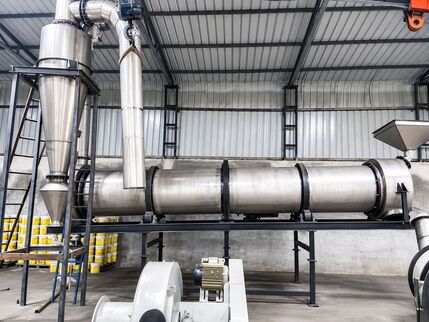
In essence, a rotary drum dryer is a continuous industrial drying system. It is engineered to reduce moisture in bulk solids, granules, and heavy materials. Specifically, the system consists of a large, slightly inclined rotating cylindrical drum.
Wet material travels through the interior. Meanwhile, it is repeatedly lifted and dropped by specialized internal plates known as lifting flights. Simultaneously, a continuous stream of heated air passes through the drum, rapidly evaporating surface and bound moisture. This mechanical cascading action ensures uniform thermal exposure for every single particle. Thereby, it successfully prevents wet pockets or uneven drying.
Core Engineering Configurations
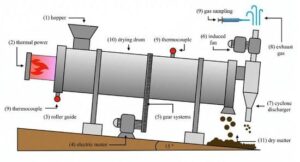
Industrial manufacturers build rotary dryers in several distinct configurations. Moreover, these design choices dictate how heat transfers to the product based on thermal sensitivities and material characteristics:
1. Co-Current vs. Counter-Current Airflow
-
Co-Current Flow: First, in a co-current system, both wet material and hot air enter the drum at the same end. As a result, the highest temperature air contacts the wettest material immediately. Undoubtedly, this is highly beneficial for heat-sensitive organic materials. Because rapid surface evaporation cools the product, it protects it from thermal degradation.
-
Counter-Current Flow: Alternatively, counter-current systems introduce hot air at the discharge end. This means the material and air travel in opposite directions. Consequently, the driest material meets the hottest air right before exiting. Thus, this configuration is exceptionally efficient for minerals and sand where achieving ultra-low residual moisture is the primary goal.
2. Direct-Fired vs. Indirect Heating
-
Direct-Fired Systems: In this case, flue gases from a burner mix directly with the material inside the drum. Naturally, this method offers the highest thermal efficiency. However, it is only suitable for materials that tolerate direct contact with combustion products.
-
Indirect Heating: On the other hand, some products cannot tolerate contamination. This includes food-grade ingredients or high-purity chemicals. Hence, for these applications, manufacturers utilize indirect heating. Here, steam, thermic fluid, or external gases heat the drum shell. Then, heat transfers purely via conduction and radiant energy.
Critical Parameters That Dictate Performance
When evaluating rotary drum dryer manufacturers, it is essential to realize that a dryer is not a static piece of hardware. Rather, it is a precisely balanced thermodynamic system. In fact, top-tier engineering firms focus on optimizing six critical process variables:
-
Inlet Air Temperature: Principally, it controls the overall evaporation rate and energy utilization.
-
Drum Rotation Speed: Furthermore, it directly influences the mechanical cascading frequency and material advancement speed.
-
Residence Time: The exact duration material stays inside the drum to reach target moisture thresholds.
-
Airflow Velocity: In addition, it must be perfectly balanced to carry away evaporated moisture without exhausting fine particles.
-
Internal Flight Geometry: Custom-shaped flights ensure a uniform curtain of falling material.
-
Materials of Construction: In short, systems require specific materials. This includes heavy-duty Mild Steel for aggregates, Stainless Steel (SS304/SS316) for hygienic applications, or abrasion-resistant liners for coarse minerals.
Comprehensive Industrial Applications
Because rotary drum dryers are highly adaptable, they serve a massive array of global industries:
Selecting a Manufacturing Partner
Certainly, investing in an industrial drying line is a long-term capital decision. Therefore, you should look for manufacturers that provide comprehensive engineering support, rather than just fabricating steel.
For instance, a reliable partner should offer thorough material drying studies and exact thermal load calculations. Likewise, they must provide integrated dust collection systems, such as cyclones, bag filters, or wet scrubbers, to ensure environmental compliance. Furthermore, robust after-sales support, mechanical warranties, and precision trunnion alignment services are vital. In conclusion, these factors successfully maximize equipment uptime over a multi-decade operational lifespan.
Connect with Engineering Experts
If you are planning a high-capacity thermal processing project, reach out directly to the specialized engineering teams at Genex Tech Industries LLP:
📧 Technical Inquiries: mktg@foodtechprojects.com
📞 Phone / WhatsApp Support: +91 93300 77417
🌐 Engineering Portals: Food Tech Projects | GTI Dryers