The global push for Compressed Biogas (CBG), clean biomass fuels, and organic fertilizers has made waste-to-value processing highly lucrative. However, raw materials like anaerobic biogas digestate, Liquid Fermented Organic Manure (LFOM), Phosphate Rich Organic Manure (PROM), and energy crops like Napier Grass share a critical operational hurdle. Specifically, they all suffer from excessive moisture content.
Raw agricultural inputs and organic waste streams can contain anywhere from 70% to 92% water. Unfortunately, handling materials with this much moisture leads to rapid microbial spoilage, inflated transportation costs, and blending inefficiencies. Furthermore, high moisture causes major downstream processing failures in your pellet mills or granulators.
Therefore, if you want to transform these volatile raw materials into shelf-stable, market-ready, and commercially transportable commodities, choosing the precise thermal drying technology is vital. Consequently, this comprehensive guide breaks down the specific equipment engineered by leading industrial dryer manufacturers to handle these demanding applications.
1. Solid Biogas Digestate & Bio-Fertiliser Dehydration
Primary Equipment: Industrial Triple-Pass Rotary Drum Dryers & Paddle Dryers
Solid digestate exiting a decanter centrifuge or screw press typically carries a heavy moisture load of 65% to 75%. Therefore, to process this material into a free-flowing commercial bio-fertilizer with a target moisture content of 10% to 12%, your factory needs a specialized thermal system. For this reason, the machinery must process highly fibrous, sticky materials continuously without clogging up production lines.
[Decanter/Screw Press Solid Input (65-75% MC)]
                    │
                    ▼
 ┌────────────────────────────────────────────────────────┐
 │       TRIPLE-PASS INDUSTRIAL ROTARY DRUM DRYER         │
 │                                                        │
 │ 🔄 Inner Pass: Rapid high-heat flash moisture removal  │
 │ 🔄 Middle Pass: Progressive deceleration & drying      │
 │ 🔄 Outer Pass: Low-velocity final moisture equalization│
 └────────────────────────────────────────────────────────┐
                    │
                    ▼
[Dry Free-Flowing Bio-Fertiliser Granulation Ready (10-12% MC)]
Deep-Dive into Rotary and Paddle Drying Mechanics

-
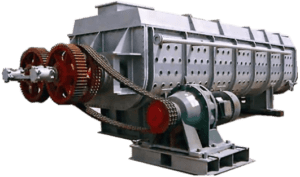
Concentric Triple-Pass Thermal Paths: To maximize your factory floor space, advanced rotary drum dryers utilize three concentric cylinders nested inside a single drum shell. First, the wet digestate enters the innermost cylinder where it meets high-velocity hot air for immediate flash drying. Next, as the material moves through the middle and outer cylinders, the temperature drops progressively. Meanwhile, the total retention time increases, ensuring deep, uniform moisture extraction without scorching the organic matter.
-
Custom Flight Geometry: Inside the rotating drum, specialized lifting flights line the interior walls. Engineering teams deliberately arrange these internal paddles in staggered patterns. Consequently, they continuously lift, cascade, and shower the material across the entire cross-section of the hot air stream, which drastically maximizes the overall heat transfer coefficient.
[IMAGE PLACEHOLDER: Heavy-Duty Industrial Triple-Pass Rotary Drum Dryer Inner Chamber Shell]
-
Breaking the Sticky Phase: As organic wastes drop in moisture, they inevitably pass through a highly viscous “sticky phase”. This phase can cause severe blinding and crusting on standard equipment surfaces. However, the aggressive tumbling action within a heavy-duty rotary drum mechanically breaks down these clusters.
-
The Alternative Paddle Design: For exceptionally high-density sludge cakes where tumbling isn’t sufficient, plant operators deploy an industrial paddle dryer instead. Clearly, the interlocking heated paddles of a paddle dryer apply direct contact heat transfer. Simultaneously, they shear the sticky material to prevent buildup and maintain an uninterrupted processing cycle.
2. Liquid Fermented Organic Manure (LFOM) Concentration
Primary Equipment: Industrial Co-Current Spray Drying Systems
Liquid Fermented Organic Manure (LFOM) serves as a potent organic liquid fertilizer because it is rich in bio-active nutrients, humic acids, and amino acids. Nevertheless, transporting heavy liquid over long distances is logistically expensive. Converting this liquid fermentate into a 100% water-soluble, concentrated powder dramatically unlocks global distribution and export potential.
Deep-Dive into Spray Drying Mechanics
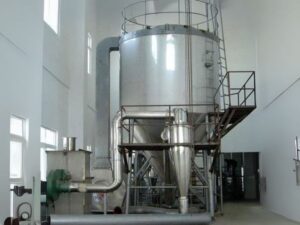
Because the vital organic compounds in liquid manure are highly heat-sensitive, prolonged boiling or traditional evaporative baking destroys the product’s commercial value. Industrial spray dryers completely solve this problem by executing instantaneous evaporation within milliseconds.
[IMAGE PLACEHOLDER: Industrial Spray Drying Tower System Configuration for Soluble Organic Concentrates]
-
Centrifugal Atomization: Initially, a feed pump forces the liquid manure through a high-speed rotary atomizer disk spinning at velocities up to 25,000 RPM. Alternatively, heavy-duty high-pressure nozzles can handle this task smoothly. Indeed, this intense mechanical shear breaks the liquid feed into a highly uniform, micro-fine mist, which expands the total surface area exponentially.
-
Co-Current Air Flow Configuration: Subsequently, this atomized mist enters the main drying chamber alongside a controlled hot air stream. Because the surface-area-to-volume ratio of the droplets is so massive, the moisture flashes off instantly. In fact, it typically takes less than 4 seconds.
-
Latent Heat Cooling Protection: As the water evaporates, it quickly absorbs the thermal energy as latent heat of vaporization. Consequently, the actual core temperature of the organic dry particles remains significantly lower than the surrounding air temperature. Thus, this process successfully safeguards the bio-active molecules from thermal degradation. Finally, the dry, soluble powder collects cleanly at the bottom cone via cyclone separators. In addition, for high-capacity operations, engineering teams seamlessly integrate these systems into complete food and agricultural processing turnkey plants.
3. Phosphate Rich Organic Manure (PROM) Conditioning
Primary Equipment: Heavy-Duty Rotary Dryers paired with Vibratory Fluidised Bed Dryers/Coolers (VFBD)
PROM production requires blending fine-ground rock phosphate with organic compost or digestate. After blending, a granulation drum or disc processes the mixture. The resulting granules are incredibly dense and hold high internal moisture. For this reason, operators must dry them meticulously to achieve the structural hardness required to prevent crushing during bulk automated field application.
Deep-Dive into Dual-Stage Drying & Conditioning Strategy
To maintain granule integrity and prevent thermal stress cracking, manufacturers deploy a specialized dual-stage drying process:
| Process Phase | Equipment Employed | Mechanical Workflow & Engineering Purpose |
| Stage 1: Bulk Dehydration | Heavy-Duty Single-Pass Rotary Dryer | Freshly formed wet PROM granules enter a heavy-duty rotary drum. The system utilizes low-to-medium heat over an extended retention time to slowly draw core moisture out to the surface without fracturing the outer shell of the granule. |
| Stage 2: Fluidised Cooling & Final Curing | Vibratory Fluidised Bed Dryer (VFBD) | The warm granules discharge into a horizontal fluidization chamber. Hot or ambient air forces upward through a precision-perforated distributor plate while mechanical vibratory motors oscillate the bed. |
[IMAGE PLACEHOLDER: Vibratory Fluidised Bed Dryer and Cooler Unit Processing Dense Granular Fertilizer]
-
The Fluidization Advantage for PROM: Ultimately, this setup suspends the granules mid-air in a fluid-like state, eliminating thermal localized pockets and achieving perfect final moisture equalization. Furthermore, suspending the granules on a gentle cushion of air prevents abrasive particle-on-particle friction. As a result, this process completely eliminates the creation of fine dust, creates a perfectly hardened granule, and successfully prevents caking and clumping inside commercial bags during warehousing.
4. Large-Scale Napier Grass & Biomass Processing
Primary Equipment: Multi-Layer Continuous Mesh Belt (Band) Dryers & Pneumatic Flash Dryers
Super Napier grass and hybrid biomass varieties represent exceptional feedstocks for biomass pellets, gasification plants, and CBG digesters. However, freshly chopped green biomass contains up to 80% moisture. If you want to feed this material into a pellet mill die or gasifier efficiently, you must slash moisture uniformly below 15% immediately post-harvest.
[Chopped Green Napier Grass Input (75-80% MC)]
                      │
                      ▼
┌──────────────────────────────────────────────────────────┐
│        MULTI-LAYER CONTINUOUS MESH BELT DRYER            │
│                                                          │
│ ➡️ Tier 1 (Top): Fresh biomass accepts initial heat      │
│ 🔄 Tier 2 (Mid): Controlled inversion of material bed    │
│ ➡️ Tier 3 (Bottom): Final gentle conditioning zone       │
└──────────────────────────────────────────────────────────┘
                      │
                      ▼
[Dry Biomass Ready for Pelletizing/Gasification (<15% MC)]
Deep-Dive into Multi-Layer Mesh Belt Dryer Mechanics
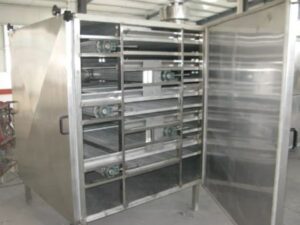
For high-volume chopped biomass, Multi-Layer Continuous Mesh Belt Dryers (also known as industrial band dryers or apron conveyor dryers) provide the most thermally efficient, non-destructive continuous processing pathway.
-
Continuous Conveyor Progression: First, a parsing feeder distributes the chopped Napier grass evenly onto a moving, high-grade perforated stainless steel mesh conveyor belt. The material then travels horizontally along the top deck, drops down onto a lower reversing deck, and continuously repeats the process across 3 to 5 layers.
-
Mechanical Bed Inversion: As the biomass naturally drops from one tier to the next, the conveyor layout completely inverts the material bed. This mechanical flipping action exposes damp inner layers directly to the air stream, guaranteeing 100% drying uniformity across the entire product batch.
[IMAGE PLACEHOLDER: Multi-Layer Industrial Continuous Band Dryer Processing Chopped Agricultural Biomass]
-
Zoned Updraft & Downdraft Air Flows: Modern mesh belt dryers divide the drying tunnel into distinct thermodynamic zones. Internal circulation fans force hot air vertically upward through the product bed in one zone (updraft) and downward in the next (downdraft). Therefore, this alternating airflow pattern eliminates uneven drying layers. Additionally, it prevents the volatile fine fibers of the grass from catching fire, preserving the full Gross Calorific Value (GCV) of the biomass. Alternatively, if you pre-mill the grass into a fine powder rather than chopping it, a high-velocity pneumatic flash dryer can perform instantaneous drying during pneumatic transit.
Heavy Engineering Standards for High-Yield Commercial Processing
When sourcing or designing industrial drying equipment for aggressive organic wastes and bulk agricultural biomass, cheap off-the-shelf machinery fails rapidly. Premium custom engineering stands apart through three foundational pillars:
1. High-Grade Corrosion-Resistant Metallurgy
Digestate, organic manures, and fermented liquids remain highly chemically aggressive because they contain volatile fatty acids, residual salts, and active ammonia complexes. Fortunately, fabricating all material contact zones from heavy-gauge SS304 or SS316 food-and-chemical-grade stainless steel prevents premature chemical pitting or structural fatigue. Consequently, this engineering choice dramatically extends the operational lifespan of your industrial plant.
2. Strategic Waste Heat Recovery (WHR) Integration
Thermal evaporation requires substantial energy. For this reason, advanced industrial dryers integrate directly into a facility’s existing energy infrastructure. For instance, in an operational CBG plant, engineers duct hot jacket water or high-temperature exhaust gases from the biogas generator engines directly into the dryer’s air intake heating system. This choice effectively slashes net fuel consumption down to near-zero, which reduces daily operating expenditures (OPEX) significantly.
3. Integrated PLC & SCADA Process Control Automation
Maintaining an exact, repeatable moisture percentage in your final product requires dynamic process control. Automated systems utilize real-time moisture analyzers at both the inlet and discharge chutes. These sensors feed data directly into a central PLC loop that automatically modulates variable frequency drives (VFDs). The PLC controls input feed pumps, conveyor belt speeds, fan velocities, and burner outputs. Therefore, if a batch of digestate or Napier grass arrives exceptionally wet, the system self-adjusts retention times instantly, ensuring perfect product consistency without manual intervention.
Conclusion
In summary, transforming heavy, high-moisture organic wastes and green biomass into standardized, high-value commercial commodities requires a precise blend of fluid dynamics, industrial thermodynamics, and robust mechanical engineering. Deploying standard, off-the-shelf machinery often leads to rapid component corrosion, severe clogging, and excessive energy costs that devastate plant profitability.
By selecting custom-engineered drying systems designed specifically for your input material’s unique physical properties—whether it is a sticky solid digestate, a heat-sensitive liquid fermentate, dense PROM granules, or fibrous chopped Napier grass—commercial processing facilities can maximize throughput, protect critical nutrient integrity, and achieve exceptional thermal efficiency.
Get in Touch for Custom Turnkey Engineering Solutions
Are you ready to scale up your waste-to-value or biomass processing plant? Contact our technical team today to discuss your project requirements, request a custom machinery layout, or schedule an equipment consultation.
-
🌐 Websites: www.gtidryers.com | www.foodtechprojects.com
-
📧 Email: mktg@foodtechprojects.com
-
📞 Call / WhatsApp: +91 93300 77417