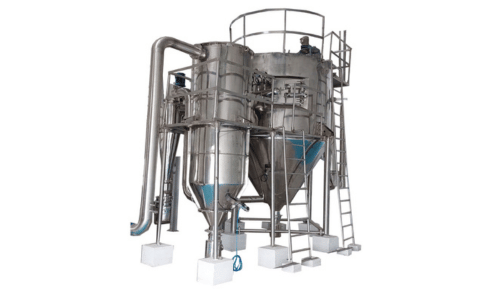
In modern industrial manufacturing, translating bulk liquid materials into stable, uniform, and high-value dry powders is a cornerstone operation. Consequently, from the instantized infant formula on supermarket shelves to advanced pharmaceutical compounds, delicate food flavors, and heavy-duty chemical catalysts, an advanced spray dryer stands as the ultimate, highly controllable solution.
However, implementing an industrial spray dryer is by no means a “one-size-fits-all” capital purchase. Instead, it represents a highly specialized exercise in thermodynamics, fluid dynamics, and powder engineering. Therefore, choosing the right spray dryer manufacturer is the single most critical decision determining your plant’s production efficiency, product quality, and long-term operational profitability.
What is Spray Drying? The Continuous Unit Operation
At its core, spray drying is a suspended particle processing (SPP) technique. Specifically, it is an engineered single-step, continuous unit operation that transforms a pumpable liquid feed—such as solutions, emulsions, or dense slurries—into a free-flowing powder instantly.
By maximizing the surface area of the liquid via atomization, moisture is evaporated in fractions of a second as droplets pass through a controlled hot-gas stream.
The Core Thermodynamic Principle: Ultimately, the rapid evaporation rate relies entirely on creating an ultra-high surface area. For a constant volume of liquid feed, breaking the stream into millions of spherical micro-droplets increases the total surface area exponentially. As a result, this design forces instantaneous thermal transfer and moisture evaporation without overheating the core product.
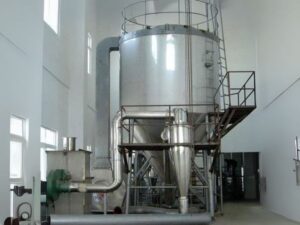
The Anatomy of an Industrial Spray Drying Plant
Furthermore, a premier manufacturer does not just deliver an isolated drying vessel; rather, they design an integrated, end-to-end industrial ecosystem consisting of several core sub-assemblies.
Fluid Delivery and Atomization Systems
-
Precision Feed System: This assembly comprises specialized feed tanks, inline filters, and high-pressure positive displacement or mono pumps. Accordingly, it works to deliver an uninterrupted, metered fluid flow directly to the atomizer.
-
Advanced Atomization Core: This component serves as the true heart of the system. Depending on the target physical properties of the final powder, manufacturers deploy three principal technologies:
-
Rotary Atomizers: These feature high-speed spinning discs running up to 25,000 RPM. Consequently, they are ideal for high-capacity setups, versatile particle sizes, and handling abrasive slurries.
-
Pressure Nozzles: These utilize high-pressure fluid energy to produce narrow particle size distributions. Thus, they are ideal for coarser powders requiring high sinkability or instant solubility.
-
Two-Fluid Nozzles: In contrast, these utilize compressed air or gas. For this reason, they are reserved for low-volume, highly precise experimental, R&D, or pilot batches.
-
Thermal Processing and Environmental Controls
-
The Drying Chamber: This structure is engineered from premium stainless steel, typically SS304 or SS316. Meanwhile, the internal geometry, cone angles, and straight-wall heights must be flawlessly calculated by the manufacturer to prevent “wall-sticking” while ensuring optimal particle retention time.
-
Air Heating Systems: Depending on utility availability, operating costs, and product sensitivity, these systems are customized. For instance, engineers utilize direct or indirect gas firing, electrical heaters, high-pressure steam radiators, or thermic fluid systems.
-
Powder Separation & Exhaust Cleaning: First, high-efficiency cyclone separators handle the primary powder recovery. Subsequently, sanitary bag filters or wet scrubbers clean the air to guarantee zero dust emissions and compliance with local environmental standards.
Plant Supervision Infrastructure
-
PLC / SCADA Automation: Finally, fully integrated digital control panels provide precise, real-time tracking. In this way, operators can constantly monitor critical process parameters (CPPs) like inlet/outlet temperatures, feed rates, air pressures, and draft metrics.
Industry-Specific Engineering Demands
Because different industrial sectors require highly distinctive capabilities, a versatile manufacturer must know how to tailor the machinery to meet these diverse challenges.
1. Food & Dairy Processing
In food applications, protecting nutritional attributes, native color, and structural properties—like solubility and bulk density—is crucial. Therefore, manufacturers targeting this space must provide strictly hygienic layouts featuring automated Clean-In-Place (CIP) systems to eliminate cross-contamination. Typical applications include milk powder, whey proteins, coffee extracts, encapsulated flavors, and instantized health beverages.
2. Value-Added Coconut Processing
Similarly, converting fresh coconut milk into Coconut Milk Powder or extracting Coconut Water Powder presents a highly niche engineering challenge. Because of the high fat and natural sugar content, these products easily stick and caramelize. To counter this, specialized manufacturers incorporate anti-stick cooling jackets on the drying chamber walls. In addition, they implement custom air sweeps to lower structural temperatures, thereby preserving the natural aroma and nutrients without scorching the product.
3. Pharmaceuticals & Nutraceuticals
On the other hand, drying Active Pharmaceutical Ingredients (APIs) mandates strict compliance with US FDA guidelines and cGMP regulations. To achieve this, manufacturers build specialized configurations like a closed-loop spray dryer plant using an inert nitrogen gas loop rather than air to dry solvent-bound molecules safely. As a beneficial side effect, this design ensures 100% solvent recovery and spark-free, explosion-proof operations.
4. Chemicals & Material Science
Alternatively, industrial applications processing pigments, detergents, battery materials, or advanced ceramics demand heavy-duty, wear-resistant designs. For that reason, top-tier manufacturers utilize tungsten carbide, sapphire, or diamond-lined nozzles to withstand long, abrasive production campaigns without eroding the internal geometry.
Critical Parameters Managed by Leading Manufacturers
To design the system properly, engineers must systematically evaluate several parameters that dictate final powder characteristics:
| Process Parameter | Industrial Standard Range | Impact on Final Powder Product |
| Inlet Temperature |
150°C to 220°C (Up to 400°C for chemicals) |
First, it drives the evaporation capacity and initial thermal shock. However, while higher temperatures maximize throughput, they also risk heat damage to sensitive proteins or sugars. |
| Outlet Temperature |
70°C to 100°C |
This acts as the single most critical parameter. Ultimately, it governs final residual moisture content, shelf-life stability, and final particle structure. |
| Atomizer Speed / Pressure |
100 to 400+ bar (Nozzles) |
Consequently, it directly influences mean particle diameter, bulk density, and instant reconstitution/sinking properties. |
How to Select the Right Spray Dryer Manufacturer
When selecting an engineering partner for a capital investment of this scale, look far beyond the basic equipment cost. Specifically, you should verify the following mandatory criteria:
-
Pilot Plant & Testing Infrastructure: First and foremost, a tier-one manufacturer always maintains an in-house pilot laboratory. Therefore, they should invite you to test your specific raw material slurry to establish a proof-of-concept. In doing so, you can accurately determine the exact drying curve, yield, and powder characteristics before building a full-scale plant.
-
Regulatory Compliance and Certifications: Furthermore, ensure the manufacturer works in strict compliance with international engineering frameworks. For example, they should hold recognized certifications such as ISO 9001:2015, CE Marking, and ASME / US FDA design specifications for product contact parts.
-
Energy Efficiency Solutions: Because of the latent heat of vaporization, spray drying is inherently energy-intensive. Nevertheless, top manufacturers stand out by integrating heat recovery systems (recuperators). These devices capture heat from the exhaust air stream to preheat incoming fresh air, thereby drastically reducing utility overheads and carbon footprints.
-
Scale and Turnkey Capabilities: Finally, ensure they have a verified track record of scaling up lines. They must be capable of moving from small pilot lines (10 kg/hr) up to high-volume industrial operations exceeding 2,000+ kg/hr evaporation capacities, while adjusting completely to your factory layout constraints.
Conclusion
In conclusion, an industrial spray dryer system is far more than a simple machine; it is the absolute heart of your production line. Partnering with an expert spray dryer manufacturer guarantees that your system is designed with the ideal balance of atomization energy, air dynamics, and thermal efficiency. Ultimately, by emphasizing custom engineering, extensive testing, and rigorous regulatory compliance, you transform an intensive industrial process into a highly optimized, automated, and profitable powder production ecosystem.
Contact Us
If you are ready to scale your production or wish to schedule a trial at our testing facility, please get in touch with our engineering team today:
-
📞 Call Us: +91 93300 77417
-
✉️ Email Us: mktg@foodtechprojects.com
-
🌐 Explore Our Technologies: