
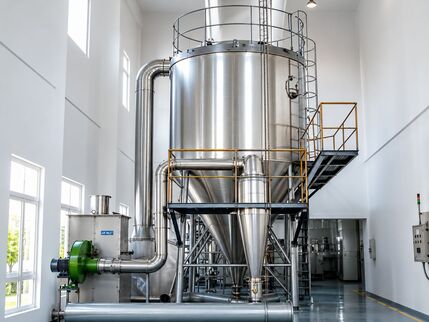
Modern coconut processing has evolved dramatically. Today, state-of-the-art facilities process raw coconut milk, fresh coconut water, and pure virgin coconut oil. They convert these liquids into high-value, shelf-stable, free-flowing powders. These premium powdered ingredients serve global food, beverage, nutraceutical, and cosmetic markets. At the center of this industrial evolution stands the industrial spray dryer. Indeed, spray drying offers precise control over particle size, bulk density, moisture levels, and powder solubility. Consequently, it represents the premier thermal processing technology for delicate, sugar-rich, and oil-laden coconut extracts.
Genex Tech Industries LLP (GTI) designs, builds, and installs custom industrial drying systems. Furthermore, GTI engineers build these systems specifically to satisfy strict operational requirements. They support commercial processing plants around the globe. This detailed technical guide examines operational mechanisms, control parameters, equipment hardware, and product applications. Additionally, this guide compares spray drying directly against alternative industrial drying methods. Thus, it helps factory managers optimize thermal efficiency, maximize output yield, and maintain uncompromised product quality.
1. The Evolution of Coconut Processing and the Need for Advanced Drying
In former times, commercial processors focused on crude copra, basic coconut oil, and traditional desiccated coconut flakes. Although those traditional commodities maintain steady global markets, they yield lower profit margins. Furthermore, they require heavy bulk handling and costly shipping volumes. Therefore, modern consumer demand accelerates toward functional foods, instant beverages, and clean-label dietary ingredients. As a result, forward-thinking manufacturers must convert bulky liquid extractions into concentrated dry powders.
However, liquid coconut extracts present very difficult technical challenges during moisture removal. Liquid coconut milk represents a complex oil-in-water emulsion. It is loaded with natural proteins, delicate sugars, and health-promoting medium-chain triglycerides (MCT). Whenever processing teams expose raw coconut milk or fresh coconut water to uncontrolled heat, severe thermal degradation occurs rapidly. Consequently, excessive heat causes protein denaturation, Maillard browning reactions, free fat separation, and the loss of natural volatile aromas.
Moreover, traditional batch drying equipment subjects liquid raw material to extended thermal exposure. Heavy tray dryers or heated drum dryers cause severe quality loss. As a direct result, older drying methods produce sticky, dark powders with poor solubility and burnt off-flavors. Fortunately, industrial spray drying completely overcomes these quality bottlenecks. By spraying atomized liquid droplets directly into a controlled hot air stream, moisture evaporates in a split second. Furthermore, this extremely fast evaporation produces an immediate cooling effect. Therefore, the internal temperature of each droplet stays remarkably low throughout the entire drying cycle. As a direct consequence, the resulting powder fully retains its natural protein structure, rich coconut flavor, creamy mouthfeel, and delicate nutritional values.
2. Core Working Principles of Industrial Spray Drying
The core operational principle of industrial spray drying centers on converting a continuous liquid feed stream into an air-suspended, bone-dry fine powder. Furthermore, the complete continuous process unfolds through four systematic processing stages. These stages include feed preparation, atomization, liquid-air contact inside the drying chamber, and final dry powder separation.
Feed Preparation and Concentration
First, operators must carefully adjust feed fluid properties before pumping liquid coconut milk, coconut water, or oil emulsions into the drying chamber. In fact, total solids (TS) concentration plays an enormously important role during this preliminary phase. If a plant feeds low-solids raw liquid directly into a spray dryer, thermal energy consumption spikes dramatically. Moreover, the process produces excessively fine, dusty particles. Therefore, experienced processing teams first route raw coconut milk through rising-film or falling-film evaporators. This step effectively increases total solids content to between 35 percent and 50 percent prior to atomization.
Furthermore, thorough homogenization represents an essential step for oil-bearing liquids. High-pressure homogenizers reduce oil droplet diameters down below 2 micrometers. As a direct result, natural plant proteins form a strong, protective membrane around every tiny oil droplet. Consequently, this protective encapsulation prevents surface fat buildup and eliminates clumping inside the dryer. Additionally, it protects the final packaged powder against oxidation and rancidity during storage.
Atomization
Next, atomization serves as the most critical action within the entire spray drying sequence. During atomization, specialized mechanical units break the continuous liquid feed line into billions of microscopic droplets. Indeed, this sudden mechanical breakdown creates a massive surface area expansion. This expansion enables almost instantaneous heat exchange and rapid mass transfer. Generally speaking, GTI spray drying systems incorporate two distinct atomization setups based on specific product goals:
-
Rotary Atomizers (High-Speed Wheel Systems): These high-performance units utilize a central disk wheel spinning at intense rotational speeds between 10,000 RPM and 25,000 RPM. As operators feed liquid onto the rotating disk, powerful centrifugal forces sling the liquid outward through tiny precision channels. This action instantly creates a uniform cloud of micro-droplets. Furthermore, operators can easily adjust the droplet size distribution simply by changing the motor speed. Thus, rotary atomizers handle massive industrial flow rates effortlessly while managing higher liquid viscosities with total reliability.
-
Pressure Nozzles (Hydraulic Atomization Systems): Instead of rotating wheels, hydraulic nozzle systems pump liquid feed under high pressure through exceptionally tiny orifice tips. Operational pressure ranges from 50 bar to 300 bar. Consequently, this high-pressure restriction shears the liquid stream into dense droplet sprays. Pressure nozzles generally form slightly larger, highly uniform droplet sizes. Therefore, they yield coarser, dust-free powders that possess superior bulk density and exceptional rehydration characteristics.
Contact and Drying in the Chamber
Immediately after atomization, the cloud of micro-droplets enters the main drying vessel. Here, it contacts a continuous stream of heated process air. Furthermore, the direction of air flow relative to the atomized spray establishes the thermal profile and residence time inside the vessel:
-
Co-current Flow Configuration: In this popular setup, the liquid spray and the hot process air enter from the top of the chamber together. They travel downward in the same direction. Consequently, the wettest liquid droplets meet the hottest incoming air right at the entrance. The immediate, rapid evaporation creates an evaporative cooling zone. This zone protects heat-sensitive proteins and delicate sugars from thermal damage. Then, as the drying particles travel downward, both air and product cool together simultaneously, preventing heat degradation.
-
Counter-current Flow Configuration: In contrast, counter-current systems introduce atomized liquid from the top while blasting hot air upward from the bottom. As a result, the drying particles experience longer total residence times inside the chamber. Therefore, counter-current setups offer outstanding thermal efficiency. This makes them particularly useful for non-sensitive, heavy industrial materials that require extremely low residual moisture levels.
-
Mixed Flow Configuration: By combining both co-current and counter-current concepts, mixed-flow chamber designs accommodate larger production outputs within compact factory footprints.
Separation and Collection
Finally, as moisture evaporates completely, light dry particles form. They travel toward the bottom of the drying vessel along with the exhaust air stream. Next, primary separation equipment collects the bulk dry powder at the base of the chamber and through high-efficiency mechanical cyclone separators. Afterwards, secondary separation units capture residual fine dust from the exhaust air. Stainless steel bag houses or advanced cartridge filters handle this stage. Consequently, this multi-stage separation setup ensures clean environmental stack emissions while boosting overall product yield up to 99 percent.
3. Specialized Spray Dryer Variants and Product Matchmaking
Different coconut products contain vastly different natural oils, natural sugars, and protein levels. Therefore, a single standard drying setup cannot fulfill every application. Selecting the correct spray dryer model remains crucial for overall facility profitability. Below, we examine the primary spray dryer variants engineered by GTI along with their ideal coconut processing applications.
Co-Current Spray Dryer
-
Best Suited Product Match: Delicate, sugar-heavy, and heat-sensitive liquids like Coconut Water Powder and standard Coconut Milk Powder.
-
Technical Operational Overview: Hot air and atomized liquid travel downward together in this co-current design. This guarantees that high-moisture droplets immediately contact the hottest air zone. Thus, instant surface drying takes place. This rapid drying protects delicate natural fruit sugars against caramelization and scorching.
-
Operating Parameters: Operators typically set inlet air temperatures between 160 degrees Celsius and 190 degrees Celsius. Meanwhile, they hold outlet air temperatures between 80 degrees Celsius and 90 degrees Celsius. Consequently, this thermal equilibrium maintains final powder moisture content reliably below 3.0 percent.
Multi-Stage Spray Dryer (Integrated Fluid Bed – IFB)
-
Best Suited Product Match: High-fat coconut formulas, including Virgin Coconut Oil (VCO) Powder and high-fat Coconut Milk Powder (containing 60 percent to 65 percent natural fat).
-
Technical Operational Overview: Standard single-stage spray dryers often encounter severe sticking problems when drying high-fat foods. Indeed, high fat levels lower the glass transition temperature. This causes warm particles to stick to the hot metal walls of the chamber. To solve this problem completely, a multi-stage spray dryer integrates a secondary fluid bed right into the conical bottom of the main tower. First, the spray partially dries inside the upper tower. Then, it falls gently onto the vibrating fluid bed surface. Next, secondary low-temperature air passes through the bed. This completes the drying cycle smoothly while cooling and agglomerating the powder.
-
Operating Parameters: Lower inlet temperatures combined with targeted fluid-bed cooling harden surface fats quickly. This process produces dense, non-sticky, instantly soluble powder granules.
Closed-Loop Spray Dryer with Nitrogen Gas
-
Best Suited Product Match: Highly sensitive, oxygen-vulnerable nutraceutical formulations, including Medium-Chain Triglyceride (MCT) Oil Powder.
-
Technical Operational Overview: Traditional open-loop drying systems utilize ambient atmospheric air. However, ambient air naturally contains oxygen and ambient moisture. When processing sensitive lipid formulations, ambient oxygen exposure triggers lipid oxidation. Therefore, GTI closed-loop systems replace ambient air with pure, inert nitrogen gas inside a completely sealed loop. As the nitrogen absorbs evaporated moisture, it passes through a chilled condenser unit. There, water vapors condense into liquid and drain away. Next, the dry nitrogen reheats and recirculates continuously back into the drying tower.
-
Operating Parameters: Operating continuously under an inert nitrogen blanket completely eliminates lipid oxidation. Furthermore, it preserves delicate natural active compounds and eliminates fine dust explosion hazards inside the plant.
Rotary Atomizer Spray Dryer vs. Pressure Nozzle Spray Dryer
-
Rotary Atomizer Systems: These systems serve large-scale Coconut Milk Powder processing facilities. They provide continuous, heavy-duty processing capability, evaporating up to 1,000+ kg/hr of moisture across multi-shift operational schedules.
-
Pressure Nozzle Systems: Conversely, pressure nozzle systems excel in specialty Virgin Coconut Oil Powder production. In this setting, operators require exact particle sizing, high bulk density, and dust-free packaging performance.
4. Technical Specifications, Operational Parameters, and Engineering Excellence
Operating an industrial spray dryer with high efficiency requires strict control over critical thermodynamic and mechanical parameters. Therefore, engineers at GTI facilities continuously monitor several essential operational parameters:
-
Inlet Air Temperature: Operators maintain inlet temperatures between 150 degrees Celsius and 220 degrees Celsius. This range matches the specific heat resistance of the feed emulsion. High inlet temperatures improve overall thermal efficiency. However, excessive heat can cause surface browning or burning.
-
Outlet Air Temperature: Operators strictly control outlet temperatures between 75 degrees Celsius and 95 degrees Celsius. In fact, the outlet temperature serves as the main feedback control loop. It automatically adjusts feed pump speed to ensure steady drying performance.
-
Feed Flow Control: Automated PLC controllers synchronize liquid feed pumps directly with air heating burners. This keeps outlet air temperatures consistent within a tight margin of plus or minus 1 degree Celsius.
-
Atomization Pressure / Rotor Speed: Controlling atomizer wheel speed or nozzle pump pressure directly regulates droplet dimensions. Higher rotor speeds yield smaller droplets, which speeds up surface evaporation. However, extremely fine particles can create dust handling issues if chamber dimensions are inadequate.
-
Airflow Distribution: Precision distribution plates sweep heated air evenly across the upper chamber interior. This design eliminates turbulent dead zones and prevents wet droplets from touching upper walls.
-
Final Powder Moisture Content: Automated control loops consistently hold final moisture levels between 2.0 percent and 4.0 percent for coconut milk and coconut water powders. This prevents microbial growth and powder caking over long storage periods.
Sanitation, Metallurgy, and Cleaning Standards
Food processors must comply with rigorous international hygiene standards. Therefore, GTI manufactures all product-contact components using food-grade stainless steel. Specifically, GTI uses heavy-gauge SS304 for structural support frames. Furthermore, GTI uses pure SS316 / SS316L stainless steel for liquid feed lines, atomizer shafts, drying chamber interiors, and cyclone separators. Interior metal surfaces undergo rigorous mirror-polishing treatment down to a smooth Ra finish below 0.4 micrometers. Consequently, this ultra-smooth interior surface eliminates microscopic pits where bacteria or burnt residue might accumulate over time.
Additionally, every GTI spray drying system includes integrated Clean-in-Place (CIP) cleaning skids. Automated CIP pumps deliver caustic washing solutions, acid sanitizing rinses, and hot purified water through high-pressure rotating spray balls. These spray balls sit inside the drying tower, cyclones, and air ducts. Therefore, operators clean the entire system thoroughly without manually dismantling heavy equipment. As a result, plants dramatically shorten changeover downtime while maintaining full compliance with ISO 9001:2015, CE, and US FDA manufacturing codes.
5. Detailed Product Profiles and Processing Protocols
Because raw coconut fractions exhibit diverse chemical structures, processing engineers apply specialized preparation protocols for each product line.
Coconut Milk Powder
Coconut milk contains natural fats, water, proteins, and carbohydrates. Operators manufacture premium coconut milk powder with a fat content ranging from 50 percent to 65 percent. First, they extract fresh liquid milk, screen out coarse fiber, and blend in food-grade carrier agents like maltodextrin or sodium caseinate.
These carrier agents raise the glass transition temperature of natural fruit sugars, which prevents sticky wall buildup inside the chamber. Next, high-pressure pumps force the mixture through a two-stage homogenizer at 200 bar, creating a super-fine emulsion.
Then, after pre-concentrating the fluid to 40 percent total solids, operators spray-dry the liquid using a multi-stage spray dryer. Consequently, the finished powder dissolves instantly in warm water, reconstituting rich, aromatic coconut milk with natural flavor and creaminess.
Virgin Coconut Oil (VCO) Powder
Virgin coconut oil contains rich amounts of beneficial lauric acid and medium-chain fatty acids. However, pure liquid oil cannot dry into a powder by itself. Therefore, processors utilize advanced microencapsulation. Specifically, operators mix virgin coconut oil into an aqueous solution containing specialized hydrocolloids, vegetable gums, or modified starches. Next, high-shear mixers and homogenizers create a tiny, stable oil-in-water emulsion. During spray drying, the protective carbohydrate shell dries rapidly around each micro-droplet of oil. This encapsulates the liquid lipid completely within a protective dry wall. As a result, this microscopic barrier shields oil against oxidation and moisture. It expands product shelf life from months to years while transforming pure oil into a free-flowing, dispersible powder for nutritional drinks and dietary supplements.
Coconut Water Powder
Fresh coconut water contains natural electrolytes, essential minerals, and natural sugars. Essential minerals include potassium and magnesium. However, its high concentration of low-molecular-weight sugars makes raw coconut water extremely hygroscopic. These sugars, including fructose and glucose, make it challenging to dry without melting. To dry coconut water successfully, GTI engineers utilize lower inlet temperatures combined with specialized multi-stage fluid-bed collection systems. Furthermore, operators introduce carrier agents like soluble dietary fibers or maltodextrin to bind natural sugars securely. Consequently, the resulting powder captures the original light flavor, natural sweetness, and essential electrolyte profile of fresh coconut water for instant sports drink applications.
6. Comprehensive Video Walkthrough of Industrial Spray Drying
Seeing actual industrial equipment layouts and live operational workflows helps factory engineers and prospective investors understand physical plant requirements. Therefore, you can examine real-time equipment operations, control panels, rotary atomizers, and automated powder discharge systems in this comprehensive video guide:
Watch the GTI Industrial Spray Dryer Video Walkthrough
This practical video demonstrates full continuous processing routines. It shows how liquid feed pumping, high-speed atomization, cyclone collection, and automated packaging systems integrate into a cohesive industrial facility.
7. Comparative Analysis: Spray Dryers vs. Alternative Drying Technologies
Industrial spray dryers serve as the premier technology for liquid coconut extracts. However, full-scale coconut factories often utilize other industrial drying setups for solid, shredded, or fibrous coconut fractions. Therefore, comparing these distinct drying systems helps plant engineers assign the correct equipment to each stage of processing.
| Feature / Performance Metric | Industrial Spray Dryer | Band Dryer (Conveyor Belt Dryer) | Combination Fluid Bed Dryer | Vibratory Fluid Bed Dryer (VFBD) |
| Primary Raw Feed Input | Free-flowing liquids, concentrated emulsions, and liquid slurries | Shredded coconut flakes, sliced coconut chips, and solid meat strips | Semi-solid granules, wet coconut residues, and moist press-cakes | Granular particles, pre-dried flakes, and uniform coconut shreds |
| Drying Mechanism | High-speed liquid atomization into hot air suspension | Continuous multi-tier belt transport under hot air circulation | Air fluidization combined with mechanical vibration | High-frequency vibration coupled with directional hot air |
| Ideal Product Application | Coconut milk powder, VCO powder, and coconut water powder | Desiccated coconut flakes, toasted coconut chips, and raw shreds | Medium-moisture coconut residue and processed coconut granules | Final drying and cooling of desiccated coconut particles |
| Thermal Efficiency Level | High (maximized via heat recovery and multi-stage beds) | High for continuous solid product beds | Excellent due to direct gas-solid surface contact | Superior for low-moisture surface moisture removal |
| Processing Residence Time | 3 to 30 seconds | 20 to 60 minutes | 5 to 15 minutes | 2 to 10 minutes |
| Finished Solubility Quality | Instantaneous, complete liquid rehydration | Non-soluble (intended for solid food consumption) | Moderate rehydration for food ingredient blends | Retains original solid cellular structure completely |
As this detailed comparison proves, industrial spray dryers remain completely irreplaceable when processing liquid coconut milk, coconut water, and oil emulsions. Meanwhile, continuous band dryers and vibratory fluid bed dryers dominate solid-state operations like desiccated coconut manufacturing.
8. Conclusion
Ultimately, the industrial spray dryer serves as a powerful engine driving profitability across modern coconut processing facilities. By rapidly converting perishable coconut milk, fresh coconut water, and virgin coconut oil emulsions into stable, soluble, and high-value powders, processing plants expand their commercial reach to global markets. Furthermore, Genex Tech Industries LLP combines advanced thermal engineering, durable food-grade stainless steel fabrication, automated PLC controls, and tailored processing protocols to deliver world-class spray drying systems. Therefore, whether establishing a new turnkey coconut plant or upgrading existing production lines, investing in GTI spray drying equipment guarantees reliable performance, long-term durability, and outstanding product quality.
Call to Action (CTA)
Are you planning to upgrade your coconut processing operations or launch a new commercial coconut powder production facility? Contact the technical engineering team at Genex Tech Industries LLP today to receive customized plant layout designs, capacity estimations, detailed technical specifications, and complete turnkey project guidance.
Head Office & Factory Contact Information
-
Head Office Address:
GENEX Tech Industries LLP
10C, Sir William Jones Sarani (Middleton Row), Park Street,
Kolkata – 700071, West Bengal, India
-
Direct Phone / WhatsApp Contact:
+91-97489 06968 | +91-93300 77417
-
Official Business Email:
mktg@foodtechprojects.com | sales@foodtechprojects.com
-
Official Company Websites: