1. Introduction: The Global & Indian Onion Dehydration Landscape
Consequently, the global food processing industry has witnessed a dramatic surge in demand for dehydrated onion products over the last decade. Furthermore, food processors, spice blenders, instant meal manufacturers, and quick-service restaurant (QSR) chains across the world increasingly favor onion flakes and powder over fresh onions. Therefore, understanding the engineering principles, machinery configurations, and regional production hubs involved in onion processing is crucial for modern agro-industrialists.
First and foremost, fresh onions contain approximately 85% to 90% water content by weight. As a result, fresh onions are prone to rapid microbial spoilage, post-harvest losses, significant transportation costs, and seasonal price volatility. In contrast, commercial onion dehydration reduces moisture content down to less than 4% to 5%. Because of this drastic moisture reduction, dehydrated onion flakes and powder achieve an extended shelf life of up to two years without needing chemical preservatives. Additionally, dehydrated products occupy significantly less storage volume, thereby reducing international logistics and freight expenses.
In this context, India plays a pivotal role in the international onion processing ecosystem. Indeed, India is the second-largest producer of onions globally. However, raw onion cultivation alone is insufficient to satisfy global industrial standards. To bridge this gap, modern industrial onion processing plants utilize highly specialized processing machinery, such as an integrated onion flakes and powder processing line. Furthermore, these plants transform raw, high-solid onion varieties into export-ready kibbled flakes, chopped bits, minced granules, and ultra-fine powders.
However, successful onion processing depends heavily on choosing the right machinery, maintaining precise thermodynamic controls, and locating processing facilities near high-density onion farming belts. In the following sections, we examine India’s major onion dehydration clusters, break down the step-by-step mechanical processing line, evaluate drying technologies, and highlight key international compliance standards.
2. Major Onion Dehydration & Processing Hubs in India
Location selection is paramount when establishing an onion flake and powder manufacturing facility. Specifically, because raw onions deteriorate quickly and incur high transport expenses, successful processing plants are positioned directly within or adjacent to major harvesting zones. In India, onion dehydration is strategically distributed across several key agricultural states, each offering distinct advantages in raw material availability, solid content, and processing infrastructure.
| State | Key Districts & Clusters | Hub Classification | Key Raw Material & Infrastructure Characteristics |
| Gujarat | Mahuva (Bhavnagar), Talaja, Gondal, Rajkot, Nadiad, Amreli | Dominant Processing Hub | High Total Soluble Solids (TSS) white onions; highest concentration of continuous dehydrators in India. |
| Maharashtra | Jalgaon, Nashik, Pune, Ahmednagar | Major Raw Material Supplier & Industrial Hub | Massive raw red/pink onion yields; home to major corporate processing plants (e.g., Jain Irrigation). |
| Madhya Pradesh | Indore, Sagar, Shajapur | Growing Processing Hub | Expanding acreage, excellent logistics network, high adoption of modern drying technology. |
| Rajasthan | Alwar, Jaipur, Sikar | Emerging Dehydration Cluster | Strong Rabi & Kharif crop integration; growing setup of small-to-medium flake facilities. |
| Karnataka | Belagavi, Bijapur | Regional Supplier & Processing Zone | Key supplier for South Indian culinary and domestic spice processing markets. |
2.1 Gujarat: The Capital of Indian Onion Dehydration (Mahuva Hub)
Undoubtedly, Mahuva in the Bhavnagar district of Gujarat stands as the undisputed heartland of India’s onion dehydration industry. In fact, Mahuva and its surrounding towns—such as Talaja, Gondal, Rajkot, Nadiad, and Amreli—collectively account for over 85% of India’s total dehydrated onion exports. Consequently, Mahuva is widely recognized as one of the world’s largest onion dehydration clusters, second only to California’s San Joaquin Valley.
Notably, there are several specific geographic and agronomical reasons why Mahuva dominates onion processing:
-
White Onion Cultivation: In particular, farmers in Mahuva and Talaja predominantly cultivate specific white onion varieties (such as V-12 and local white cultivars) engineered for high Total Soluble Solids (TSS). Specifically, these white onions possess a TSS rating of 14° to 18° Brix, compared to standard red onions which range between 10° and 12° Brix. As a direct result, higher TSS directly translates to higher final flake yields per ton of raw onion input.
-
Ideal Climatic Conditions: Similarly, the semi-arid, low-humidity coastal climate of Saurashtra during harvest season facilitates efficient drying operations and significantly reduces the thermal load on industrial dryers.
-
Industrial Ecosystem: Over three decades, Mahuva has systematically developed a comprehensive ecosystem of machinery fabricators, specialized labor, packaging suppliers, and export logistics providers dedicated to agro-processing.
2.2 Maharashtra: The Raw Material Powerhouse
While Gujarat leads in specialized white onion dehydration, Maharashtra represents India’s largest raw onion production belt. For instance, districts such as Nashik, Jalgaon, Pune, and Ahmednagar yield millions of metric tons of onions annually. Historically, Maharashtra focused primarily on fresh market distribution. However, over recent years, significant industrial processing infrastructure has emerged across the state.
Notably, Jalgaon hosts landmark processing facilities, including Jain Irrigation Systems Ltd., which operates large-scale, automated continuous belt dehydration lines. Furthermore, Nashik serves as a primary hub for raw red onion supply across Western India. Although red onions possess slightly lower TSS and higher sugar content than white onions, advanced low-temperature drying technologies nevertheless enable processors in Maharashtra to produce high-grade pink and red onion powders for domestic seasonings and culinary applications.
2.3 Madhya Pradesh, Rajasthan, & Karnataka: Emerging Industrial Clusters
Beyond Gujarat and Maharashtra, other Indian states are rapidly expanding their onion processing capabilities to meet growing national and global demand:
-
Madhya Pradesh (Indore, Sagar, Shajapur): Thanks to favorable agricultural policies and expanded irrigation networks, Madhya Pradesh has emerged as a premier onion-producing state. Consequently, processing units around Indore utilize modern multi-deck conveyer dryers to process surplus harvests, serving both domestic food manufacturers and export clients.
-
Rajasthan (Alwar, Jaipur, Sikar): Known for robust seasonal onion crops, North-Eastern Rajasthan is establishing an emerging dehydration cluster. As a result, regional processors are installing automated peeling and hot-air belt drying units to cater to North Indian spice markets.
-
Karnataka (Belagavi, Bijapur): Meanwhile, in South India, Karnataka acts as a vital bridge for raw onion supply and regional processing. Accordingly, processing units in Belagavi focus on custom dehydration solutions tailored to Southern culinary blends, curry pastes, and instant food formulations.
3. End-to-End Mechanical Processing Line: Step-by-Step Breakdown
Ultimately, transforming field-fresh onions into uniform, shelf-stable flakes and fine powder requires an integrated sequence of mechanical, thermal, and electronic processing steps on a turnkey onion flakes and powder processing line. Modern processing lines are systematically categorized into front-end raw preparation, primary dehydration, secondary milling, and automated packaging.
3.1 Raw Material Receiving & De-dusting
Initially, harvested onions arrive at the processing facility in mesh bags or bulk crates. Because raw onions carry field soil, dry outer skins, and organic debris, the first mechanical stage involves bulk handling and dry cleaning.
First, the onions are tipped into a heavy-duty receiving hopper equipped with a variable-frequency drive (VFD) feeder. Next, an inclined belt conveyor transports the bulbs into a rotating drum screen (de-duster). As the drum rotates, loose dirt, sand, and papery outer skins fall through perforated screens. Concurrently, high-velocity air blowers lift away lightweight husk debris before the onions proceed to washing.
3.2 Industrial Bubble Washing & Destoning
After preliminary de-dusting, onions undergo intensive wet cleaning to eliminate adhering soil particles, pesticides, and residual microbes. Standard industrial lines employ a two-stage washing system:
-
Hydro-Bubble Washer: Initially, onions drop into a stainless-steel water tank where high-pressure air blowers create turbulent water bubbles. Thus, this gentle agitation scrubs the surface of the onions without causing structural bruising.
-
Destoner & Submerged Washing: Concurrently, a dense-medium water separator forces stones, heavy mud clods, and foreign objects to sink to the bottom drain, while buoyant onions float toward the discharge conveyor. Subsequently, spray nozzles rinse the onions with clean sanitized water before they enter the peeling section.
3.3 Mechanical Peeling & Root Trimming
Peeling raw onions efficiently while minimizing edible yield loss represents one of the most critical mechanical challenges in an onion processing plant. Today, processors typically utilize two main peeling machinery technologies:
A. Continuous Pneumatic Air Peeling Machines
Pneumatic peelers use high-pressure compressed air jets to strip away outer onion skins without water. First, top-and-tail topping machines cut off the root and top stem of each onion bulb. Next, the topped bulbs pass through a rotating chamber where targeted compressed air nozzles blast away the loosened outer layers.
-
Advantages: Dry process, zero water pollution, produces clean dry skin waste, superior hygiene.
B. Mechanical Abrasive Roll Peelers
In contrast, abrasive peelers employ a series of counter-rotating rollers coated with silicon carbide abrasive grit. As onions travel along the rollers, gentle friction removes the outer skin layers while water sprays wash away the abraded peelings.
-
Advantages: High capacity handling, simple mechanical construction, lower capital expenditure.
Following automated peeling, onions pass along an inspection conveyor table. Here, trained operators manually trim residual roots, remove defective or diseased bulbs, and verify that only clean, pristine white or red bulbs advance to the slicing stage.
3.4 High-Precision Slicing & Dicing
To achieve uniform drying rates in the dehydrator, peeled onions must be sliced into precise, consistent thicknesses. Otherwise, uneven slices result in mixed drying quality: thin slices burn or brown prematurely, while thick slices retain excess core moisture, causing mold growth during storage.
For this reason, industrial slicing machines utilize high-speed rotary cutting heads equipped with razor-sharp SS316 stainless steel blades. Depending on requirements, the machinery can be adjusted to produce distinct cut geometries:
-
Flake Slices: Uniform transverse cuts ranging from 3.0 mm to 5.0 mm in thickness.
-
Diced Cubes: 6 mm × 6 mm or 10 mm × 10 mm chopped pieces for specialized instant soup formulations.
-
Minced Strips: Fine 2 mm strips for fast-rehydrating food mixes.
4. Dehydration & Drying Technology: Core Mechanical Engineering
Undeniably, dehydration is the heart of the entire processing plant. Moisture removal must be carefully engineered to preserve the volatile essential oils (primarily allyl propyl disulfide and diallyl disulfide) responsible for the characteristic pungent flavor and aroma of onions. Moreover, precise temperature control prevents caramelization of natural sugars, thereby maintaining the bright white or natural color of the product.
4.1 Multi-Stage Continuous Mesh Belt Dryers (Band Dryers)
For large-scale industrial plants (processing 20 to 100+ metric tons of fresh onions daily), continuous multi-stage mesh belt dryers represent the global industry gold standard. Specifically, these machines consist of multiple enclosed insulated drying tunnels through which perforated stainless steel mesh belts convey sliced onions.
Drying occurs progressively across three distinct thermal zones:
| Drying Stage | Temperature Range | Target Moisture Content | Thermodynamic & Chemical Process |
| Stage A (Initial High-Rate Drying) | 75°C to 85°C | 80% down to 30% | Rapid evaporation of surface water. High moisture protects onion tissue from scorching via evaporative cooling. |
| Stage B (Intermediate Drying) | 60°C to 70°C | 30% down to 10% | Internal moisture migrates to the surface. Air temperature is lowered to prevent non-enzymatic browning (Maillard reaction). |
| Stage C (Final Curing / Bin Dryer) | 45°C to 55°C | 10% down to < 4.0% | Slow, low-temperature moisture equalization in dehumidified curing bins to achieve equilibrium moisture content. |
Furthermore, air circulation within these dryers is carefully balanced using centrifugal supply fans and exhaust blowers. Hot air is forced vertically through the bed of sliced onions (up-draft and down-draft flow pattern), thereby ensuring uniform moisture removal across the entire width of the conveyor belt.
4.2 Detailed Breakdown of Core Dehydration Systems
Selecting the appropriate drying technology directly impacts plant footprint, energy consumption, and final product quality:
-
Mesh Belt Dryers (Conveyor Belt Systems): Engineered for continuous, low-temperature handling of sticky, granular, or high-moisture organic feeds. By passing warm air through perforated mesh belts, these multi-zone continuous systems ensure uniform moisture removal while preserving nutrient integrity and preventing thermal degradation.
Watch the dryer Video: GTI Mesh Belt Dryer -
Band Dryers: Ideal for uniform, medium-to-large scale continuous processing of bulk solids, agricultural byproducts, and industrial cakes. Features customizable residence times, multi-stage temperature zones, and gentle material transport to handle variable moisture profiles effectively.
Watch the dryer Video: GTI Band Dryer -
Combination Dryers: Designed for complex, hard-to-dry materials that require hybrid thermal mechanisms (such as direct hot air combined with indirect heated agitation or pre-evaporation stages). These systems handle high-viscosity or sensitive feeds in a single compact footprint, boosting overall throughput.
Watch the dryer Video: GTI Combination Dryer -
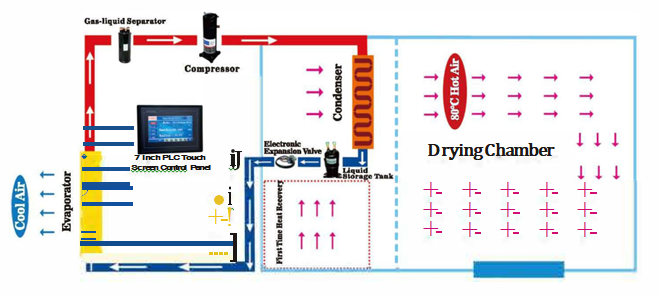
Energy-Saving Drying Machines (Heat Pump & Thermal Recovery Systems): Closed-loop heat pump dryers and waste-heat recovery configurations drastically cut operational costs by recycling latent heat from process exhaust. As a result, they deliver precise humidity control, lower carbon emissions, and minimize energy expenditure per unit of evaporated water. These dehumidification systems operate at lower temperatures (40°C to 50°C), preserving heat-sensitive flavor compounds and natural color while reducing electricity consumption by up to 40% compared to traditional electrical air heaters.

-
Vibratory Fluidized Bed Dryers (VFBD): VFBDs are primarily used for finishing semi-dried kibbled flakes. Hot air is blown upward through a perforated bed while mechanical vibration suspends the onion particles in mid-air. Consequently, this fluidization ensures rapid, homogeneous drying without clump formation.
Watch the dryer Video: GTI Vibratory Fluid Bed Dryer
5. Milling, Pulverizing, & Powder Production Systems
Once the dried onion flakes emerge from the final curing stage with a moisture content below 4%, they can either be packaged directly as dehydrated onion flakes (kibbled) or further processed into onion powder. Converting brittle flakes into fine, free-flowing powder requires specialized grinding machinery that minimizes heat generation.
5.1 Pin Mills & Impact Pulverizers
Conventional high-speed hammer mills can generate excessive frictional heat during grinding. Consequently, this heat melts natural sugars within the onion tissue, causing severe clogging, paste formation, and scorch discoloration. Therefore, modern onion powder plants utilize cryogenic pin mills or air-cooled impact pulverizers.
In a continuous pin mill, dried flakes enter a chamber containing counter-rotating discs fitted with intermeshing steel pins. As the discs rotate at high velocity, high mechanical impact shatters the brittle flakes into fine particles. Concurrently, a chilled air stream continuously passes through the grinding chamber. Thus, this forced air maintains temperatures below 35°C, preventing sugar caramelization and ensuring free-flowing powder output.
5.2 Dehumidified Sieving, Particle Grading, & Blending
After pulverizing, the onion powder passes through high-frequency gyratory sifters or rotary screeners. The screening system categorizes the output into standardized commercial particle sizes:
-
Kibbled / Large Flakes: 8 mm to 15 mm
-
Chopped / Chopped Flakes: 3 mm to 7 mm
-
Minced Granules: 1 mm to 3 mm (10 to 30 mesh size)
-
Granulated Powder: 30 to 60 mesh size
-
Fine Onion Powder: 80 to 100 mesh size (< 150 microns)
Meanwhile, oversized particles are automatically recirculated back to the pin mill for re-grinding. Subsequently, screened powders pass into batch ribbon blenders operating in climate-controlled cleanrooms. Here, natural anti-caking agents (such as food-grade silicon dioxide or tricalcium phosphate at 1% to 2% volumes) may be blended in if required by industrial clients to maintain free-flowing properties in humid environments.
6. Material Handling, Magnetics, & Quality Control Integration
Modern onion processing machinery must integrate comprehensive quality control and foreign body contamination prevention systems to satisfy stringent international food safety mandates.
6.1 Optical Color Sorting
Prior to packaging, dehydrated flakes pass through high-resolution trichromatic optical sorters. As flakes fall in a thin sheet past high-speed camera sensors, advanced computer vision algorithms inspect every particle. Consequently, if a flake exhibits discoloration, skin remnants, rot spots, or foreign material, high-speed pneumatic air ejectors blast the rejected particle out of the product stream within milliseconds.
6.2 Rare-Earth Magnets & Metal Detectors
To eliminate metallic contamination from harvesting tools or machinery wear, processing lines systematically incorporate multiple safety checkpoints:
-
High-Intensity Magnetic Grids: Rare-earth neodymium magnets (10,000+ Gauss) positioned under hopper discharges capture ferrous metal fragments.
-
Multi-Frequency Digital Metal Detectors: Conveyor-mounted metal detectors inspect packed bags, automatically triggering reject arms if ferrous, non-ferrous, or stainless-steel particles (down to 0.8 mm) are detected.
-
X-Ray Inspection Systems: Furthermore, premium export plants install inline X-ray scanners capable of detecting non-metallic contaminants such as glass, stones, high-density plastics, and rubber fragments.
7. Packaging Technologies: Preservation & Hygroscopic Stability
Dehydrated onion flakes and powder are extremely hygroscopic—meaning they rapidly absorb ambient atmospheric moisture. For example, if exposed to relative humidity above 45%, onion powder quickly absorbs water, clumps, darkens, and loses flavor. Consequently, secondary processing and packaging must occur within dehumidified, HVAC-controlled cleanrooms (maintained at < 40% RH and 20°C).
7.1 Industrial Bulk Packaging Systems
For international B2B commerce, dehydrated onion products are packaged in high-barrier multi-layer formats:
-
Inner Liner: Food-grade Low-Density Polyethylene (LDPE) or Aluminum Foil Laminate liner bags (ranging from 80 to 120 microns in thickness). These liners are heat-sealed under partial vacuum or nitrogen gas flushing to eliminate oxygen.
-
Outer Container: Heavy-duty corrugated fiberboard cartons (typically 14 kg to 25 kg capacity) or multi-ply kraft paper bags with woven polypropylene reinforcement.
-
FIBC Super Sacks: For high-volume industrial clients, 500 kg to 1000 kg Flexible Intermediate Bulk Containers fitted with moisture-proof aluminum foil inner liners are utilized.
8. International Compliance, Hygiene, & Food Safety Standards
To successfully export dehydrated onion products from regional hubs like Mahuva or Nashik to international markets (such as North America, Europe, Japan, and the Middle East), processing facilities must strictly adhere to international quality certifications and sanitary standards.
| Certification / Standard | Regulatory Authority / Scope | Key Technical Compliance Requirements |
| US FDA Certification | United States Food & Drug Administration | FSMA compliance, Hazard Analysis Critical Control Point (HACCP) registration, foreign supplier verification program. |
| BRCGS / FSSC 22000 | Global Food Safety Initiative (GFSI) | Comprehensive food safety management, strict zoning layout, mechanical traceability, audit trail controls. |
| ISO 22000 & ISO 9001 | International Organization for Standardization | Standardized quality management systems and operational safety practices across processing equipment. |
| Halal & Kosher | Islamic & Jewish Dietary Authorities | Sanitary equipment cleaning procedures, zero cross-contamination, dedicated processing line certification. |
| ASTA Quality Cleanliness | American Spice Trade Association | Strict limits on extraneous matter, ash content (< 5.0%), acid-insoluble ash (< 0.5%), and moisture (< 4.5%). |
Furthermore, international buyers require microbiological sterilization. However, because high heat degrades onion aroma, traditional steam sterilization can compromise quality. Therefore, export processing plants utilize cold pasteurization techniques, such as EtO (Ethylene Oxide) gas sterilization or Irradiation processing (Gamma / E-beam), conducted in certified off-site or inline facility units to guarantee total absence of Salmonella, E. coli, and mold spores.
9. Conclusion: Strategic Roadmap for Modern Onion Processing Investments
In summary, the industrial production of onion flakes and powder represents a high-value agro-processing opportunity that bridges agricultural output with global food manufacturing demand. While regional agricultural belts—anchored by the world-renowned Mahuva hub in Gujarat, along with Maharashtra, Madhya Pradesh, Rajasthan, and Karnataka—provide abundant raw material access, success ultimately depends on engineering excellence.
By investing in stainless-steel automated washing, pneumatic air peeling, precise temperature-controlled multi-stage dryers, cryogenic milling systems, and rigorous optical and magnetic screening on a full onion flakes and powder processing line, processors can consistently achieve international grade standards. Furthermore, maintaining strict climate controls during packaging ensures long-term product stability, preserving color, pungency, and aroma for international markets. As global demand for convenient, clean-label, dehydrated food ingredients continues to expand, modern automated onion processing facilities stand poised to deliver high returns on investment while elevating regional agro-industrial capabilities to a global benchmark.
Ready to Scale Your Waste-to-Value & Commercial Drying Operations?
Whether you are converting organic waste, municipal sludge, digestate, or specialized food products into high-value market commodities, selecting the optimal thermal dehydration system is critical to your plant’s efficiency and ROI. GENEX Tech Industries LLP engineers turnkey processing systems optimized for thermal efficiency, low utility consumption, and consistent moisture control.
Get in Touch with Our Thermal Engineering Experts
Let’s optimize your processing efficiency and transform your bulk materials into standardized, revenue-generating products. Contact our engineering team today for custom sizing, site trials, and full system integration.
-
Email: mktg@foodtechprojects.com | sales@foodtechprojects.com
-
Phone / WhatsApp: +91-97489 06968 | +91-93300 77417
-
Websites: www.foodtechprojects.com | www.gtidryers.com
-
Head Office Address: GENEX Tech Industries LLP, 10C, Sir William Jones Sarani (Middleton Row), Park Street, Kolkata – 700071, West Bengal, India