
Managing industrial wastewater residual solids undoubtedly represents a critical operational challenge for manufacturing plants across India. Consequently, facilities in the chemical, pharmaceutical, textile, paper, and municipal sectors are fundamentally shifting how wastewater treatment residues are processed. Historically, industrial facilities viewed Effluent Treatment Plant (ETP) and Sewage Treatment Plant (STP) sludge merely as unavoidable waste. As a direct result, plants simply dewatered sludge mechanically and transported it directly to landfills. However, Central Pollution Control Board (CPCB) and State Pollution Control Board (SPCB) environmental regulations have tightened dramatically over recent years. Furthermore, disposal tariffs at Common Hazardous Waste Treatment, Storage, and Disposal Facilities (TSDF) have escalated rapidly. Therefore, this traditional approach is no longer financially viable.
Additionally, the nationwide implementation of Zero Liquid Discharge (ZLD) frameworks has transformed sludge drying into an essential operational requirement. Indeed, thermal sludge drying now serves as a primary driver for operational cost reduction, risk mitigation, and resource recovery. By systematically converting wet, hazardous sludge cakes into dry, stable solids, industrial facilities dramatically cut waste volume. As a consequence, plants slash disposal expenses while simultaneously recovering valuable secondary thermal energy and mineral resources.
1. Regulatory and Economic Drivers of Modern Sludge Drying
To fully understand why thermal sludge drying is indispensable, one must examine the complex operational challenges of untreated sludge cakes. When ETP and STP systems process industrial effluent, the resulting liquid sludge routes to primary mechanical dewatering equipment. For instance, plants commonly utilize filter presses, decanter centrifuges, or multi-disk screw presses. Consequently, these mechanical separation technologies remove surface water to yield a semi-solid sludge cake.
Nevertheless, mechanical dewatering faces strict physical limitations. Specifically, mechanical compaction cannot overcome capillary forces or chemical bonds trapping bound, interstitial, and intracellular water inside the sludge matrix. As a direct result, mechanically dewatered sludge cake discharging from filter presses typically retains high moisture levels between 65% and 85%.
Financial and Operational Burdens of High-Moisture Sludge
-
Excessive Transportation Costs: Freight charges for hazardous waste transport are calculated purely on gross wet weight. Therefore, transporting sludge with 80% moisture content means paying freight for four tons of water for every single ton of dry solids.
-
Escalating TSDF Disposal Fees: Tipping fees and incinerator entry tariffs at authorized facilities are levied on a per-ton wet mass basis. Thus, high moisture content directly increases operational disposal expenses.
-
Severe Handling and Safety Hazards: High-moisture sludge cake is inherently sticky, thixotropic, and prone to rapid biological decay. Subsequently, stored wet sludge releases foul odors, volatile organic compounds (VOCs), and hazardous gases while causing material handling bottlenecks in hoppers.
-
Incompatibility with Energy Recovery: Waste-to-energy projects and cement kiln co-processing facilities strictly enforce maximum moisture limits below 15% to 20%. Hence, high-moisture sludge smothers combustion flames and reduces thermal performance, rendering it unusable as secondary fuel.
In sharp contrast, deploying an engineered thermal sludge dryer targets these operational challenges directly at the source. By applying controlled heat transfer, a thermal dryer evaporates bound interstitial and intracellular water efficiently. Accordingly, it reduces initial 65% to 85% moisture levels down to a dense, handleable dry mass containing just 5% to 15% residual moisture.
Volume and Mass Reduction Breakdown
| Operational Parameter | Mechanically Dewatered Cake | Thermal Dryer Processed Solids | Net Process Savings |
| Moisture Content (%) | 80% Moisture | 10% Moisture | 70% Absolute Moisture Reduction |
| Solid Content (%) | 20% Solids | 90% Solids | 4.5x Solid Concentration Increase |
| Total Mass (100 Tons Feed) | 100 Tons Gross Wet Weight | 22.2 Tons Gross Dry Weight | 77.8% Net Weight Reduction |
| Physical Bulk Volume | 110 Cubic Meters | 24.5 Cubic Meters | 77.7% Net Volume Reduction |
| TSDF Disposal Expenses | High Base Cost | Proportional Mass Cost | Up to 78% Direct Cost Savings |
| Material Physical State | Pasty, Sticky Slurry | Free-Flowing Pellets or Granules | Transformed Handling Profile |
Furthermore, this 75% to 80% volumetric reduction directly lowers plant operational expenses. In most industrial ETP and ZLD installations, the capital expenditure required for a high-efficiency thermal sludge dryer is fully recouped within 8 to 18 months. Ultimately, direct savings in TSDF disposal fees and hazardous waste transportation costs deliver rapid return on investment.
2. Sludge Profiles Across Key Industrial Sectors
Industrial sludge is certainly not a uniform material. On the contrary, sludge matrices vary considerably across manufacturing sectors in terms of physical consistency, sticky thermal zones, chemical aggressiveness, abrasiveness, and volatile contamination. Consequently, selecting the optimal sludge dryer requires a deep technical understanding of the specific industrial sludge profile.
ETP Sludge (Effluent Treatment Plant Residuals)
Effluent Treatment Plant sludge represents the primary solid waste generated from biological aeration basins, chemical precipitation tanks, and primary clarifiers in general manufacturing facilities.
-
Moisture Profile: Raw feed ranges from 70% to 85% moisture; target dried product is 10% to 15% moisture.
-
Physical & Chemical Characteristics: ETP sludge contains a complex mix of heavy metal hydroxides, inorganic coagulant residues (such as alum, polyaluminum chloride, and ferric chloride), unreacted polymers, and biological flocs. As a result, as moisture evaporates during thermal drying, ETP sludge enters a highly viscous “sticky phase” between 45% and 60% moisture content.
-
Optimal Dryer Selection: High-torque Paddle Dryers and industrial Rotary Drum Dryers excel here. Specifically, their mechanical agitation breaks through sticky agglomerates cleanly.
STP Sludge (Sewage Treatment Plant Residuals)
Sewage Treatment Plant sludge consists of bio-solids derived from primary settling and secondary activated sludge treatment of domestic, commercial, and municipal wastewater streams.
-
Moisture Profile: Dewatered feed ranges from 75% to 85% moisture; target dried product is 5% to 10% moisture.
-
Physical & Chemical Characteristics: STP sludge is rich in organic matter, nitrogen, phosphorus, and cellular biomass. Consequently, it exhibits significant biological activity, producing offensive odors and biogenic gases if left unconditioned. Furthermore, complete pathogen destruction is essential for safe agricultural reuse or land application.
-
Optimal Dryer Selection: Continuous low-temperature Mesh Belt Dryers and industrial Band Dryers are ideal. In particular, low-temperature convection preserves nitrogen values while safely pasteurizing pathogens without degrading bio-solids.
Industrial ZLD Sludge & Crystallizer Residues
Zero Liquid Discharge (ZLD) systems utilize high-recovery Reverse Osmosis (RO) followed by Thermal Evaporators (such as Multiple Effect Evaporators or Mechanical Vapor Recompression) and Agitated Thin Film Dryers (ATFD) or Crystallizers. As a result, the final residual waste is a concentrated inorganic salt cake.
-
Moisture Profile: Feed slurry ranges from 55% to 75% moisture; target dried product is 3% to 8% moisture.
-
Physical & Chemical Characteristics: Highly corrosive and rich in sodium chloride, sodium sulfate, calcium chloride, and residual organic COD. Accordingly, ZLD sludge is extremely hygroscopic, abrasive, and prone to severe scale formation on heated thermal transfer surfaces.
-
Optimal Dryer Selection: Heavy-duty indirect Paddle Dryers or continuous Vibratory Fluidised Bed Dryers constructed from high-grade alloys (SS316L, Duplex 2205, or Hastelloy) are preferred to prevent thermal scaling and corrosive wear.
Chemical Industry Sludge
Chemical manufacturing effluents produce complex, multi-component sludge matrices containing synthetic organic intermediates, spent catalysts, heavy metal salts, and residual solvents.
-
Moisture Profile: Dewatered cake ranges from 60% to 80% moisture; target dried product is 5% to 10% moisture.
-
Physical & Chemical Characteristics: Highly toxic, highly variable in pH levels, prone to volatile off-gassing, and often volatile or explosive in dust form.
-
Optimal Dryer Selection: Hermetically sealed indirect Paddle Dryers operating under nitrogen blanketing or specialized thermal systems ensure safe volatile containment.
Pharmaceutical Industry Sludge
Generated from fermentation broth residues, API synthesis waste streams, and chemical process ETP systems.
-
Moisture Profile: Dewatered cake ranges from 65% to 82% moisture; target dried product is 5% to 10% moisture.
-
Physical & Chemical Characteristics: Highly organic, biologically active, and containing active pharmaceutical ingredients (APIs) alongside solvent traces. Therefore, pharmaceutical sludge requires strict containment to prevent air contamination and thermal degradation of volatile active compounds.
-
Optimal Dryer Selection: Fully enclosed indirect Paddle Dryers or specialized fluid bed systems ensure complete hygiene and volatile organic containment.
Textile Industry Sludge
Generated during textile wet processing, indigo dyeing, reactive printing, mercerization, and finishing operations.
-
Moisture Profile: Mechanically dewatered cake ranges from 70% to 85% moisture; target dried product is 10% to 15% moisture.
-
Physical & Chemical Characteristics: Highly colored, rich in heavy metals (such as chromium, copper, and zinc), synthetic dyes, fixatives, and fibrous micro-lint. Consequently, textile sludge becomes extremely dense, fibrous, and sticky during mid-phase drying.
-
Optimal Dryer Selection: High-torque Paddle Dryers, multi-pass Mesh Belt Dryers, or multi-stage Band Dryers perform best. In continuous belt systems, hot air passes through the porous textile cake on moving mesh belts without mechanical entrainment of fine fibers.
Paper & Pulp Industry Sludge
Derived from wood fiber pulping, de-inking, primary clarification, and biological secondary treatment units in paper mills.
-
Moisture Profile: Dewatered cake ranges from 55% to 75% moisture; target dried product is 10% to 15% moisture.
-
Physical & Chemical Characteristics: High concentration of cellulosic short fibers, kaolin clay fillers, titanium dioxide, and lignin residues. Thus, paper sludge possesses a high calorific fuel value when dried properly, making it ideal for boiler co-combustion.
-
Optimal Dryer Selection: High-capacity Rotary Drum Dryers or continuous multi-stage Band Dryers are optimal. The mechanical cascading action in a rotary drum breaks down fibrous paper sludge into uniform pellets optimized for co-firing in boilers.
3. Core Thermal Sludge Drying Technologies
To select the right sludge drying system, engineering teams must systematically evaluate primary commercial drying technologies: Paddle Dryers, Mesh Belt & Band Dryers, Rotary Drum Dryers, and Fluidised Bed Drying Systems. Each system utilizes distinct heat transfer mechanisms, airflow patterns, and mechanical agitation dynamics.
Process Selection Sequence
-
Dewatered Wet Sludge Cake: Initially enters the drying system at 65% to 85% moisture content.
-
Thermal Sludge Dryer Selection: Subsequently chosen based on mechanical viscosity, volatile emissions, and capacity requirements.
-
Dryer Configurations:
-
Paddle Dryer (Conduction): Ideal for sticky, toxic, and high-volume chemical cake.
-
Mesh Belt Dryer & Band Dryer (Convection): Ideal for temperature-sensitive and low-dust cake.
-
Rotary Drum Dryer (Convection/Conduction): Ideal for high-volume, fibrous, and abrasive mass.
-
Combination Fluid Bed Dryer & Vibratory Fluidised Bed Dryer (Fluidization): Ideal for granular, crystalline ZLD salts and free-flowing solids.
-
-
Dried Sludge Solids: Finally discharges cleanly at 5% to 15% final moisture content.
A. Hollow Paddle Dryer (Indirect Contact Conduction)
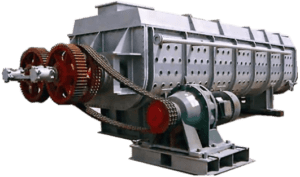
The Hollow Paddle Dryer represents the industry standard for indirect, thermal contact drying of sticky, cohesive sludge cakes. Specifically, it consists of a horizontal W-shaped trough equipped with dual or quad counter-rotating shafts. Furthermore, mounted along these shafts are hollow, wedge-shaped paddles that overlap during rotation.
Process Sequence
-
Heating Media Inflow: Saturated steam or hot thermic fluid enters the outer jacketed trough and the hollow rotating shafts continuously.
-
Agitation & Mixing: Simultaneously, counter-rotating dual shafts spin the wedge-shaped paddles slowly. Consequently, this action shears and lifts the incoming wet sludge feed.
-
Thermal Transfer: As a result, the wet sludge makes direct contact with the heated surfaces inside the jacketed W-trough chamber.
-
Vapor Extraction: Meanwhile, off-gasses and vaporized moisture exit through an overhead exhaust, whereas dried sludge discharges cleanly from the end of the trough.
Heat Transfer & Mechanical Operation
Thermal energy is transferred entirely by conduction. Specifically, heating media—such as saturated steam (3 to 10 bar) or hot thermic fluid (150°C to 220°C)—circulates continuously inside the outer jacketed trough, through the hollow shafts, and directly into the interior cavity of the wedge-shaped paddles. Consequently, nearly 100% of the interior surface area acts as an active heat exchanger.
As counter-rotating shafts turn slowly (typically between 10 and 40 RPM), overlapping wedge-shaped paddles shear, lift, and mix the wet sludge cake continuously. This intense mechanical mixing is critical because it continually exposes fresh wet sludge to heated paddle surfaces. As a result, it prevents thermal crusting and breaks through the viscous sticky phase (45% to 60% moisture). Furthermore, the wedge shape exerts a self-cleaning mechanical action, clearing sticky buildup from opposing paddles automatically during rotation.
Key Engineering Metrics
-
Thermal Efficiency: Exceptionally high, consuming between 650 kcal and 750 kcal of thermal energy per kilogram of water evaporated.
-
Sweep Air Requirement: Very low. Because hot air is not used as the primary heat source, air is introduced strictly at low velocities to sweep out vaporized water molecules. As a consequence, dust collection systems can be sized significantly smaller.
-
Moisture Range Capability: Accepts raw feed from 80% moisture down to a dried final product of less than 5% moisture.
B. Continuous Mesh Belt Dryer / Band Dryer (Direct Forced Convection)
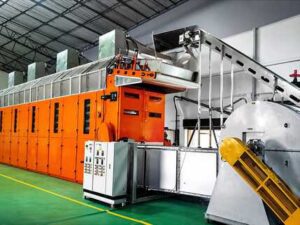
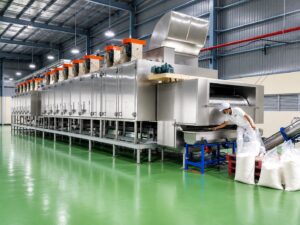
Continuous Mesh Belt Dryers and industrial Band Dryers utilize forced thermal convection to dry sludge gently and uniformly without mechanical agitation. Specifically, wet sludge cake is continuously extruded onto a porous, stainless steel mesh belt that moves smoothly through multiple insulated heating zones.
Process Sequence
-
Extrusion Feed: Initially, raw wet sludge extrudes into uniform strands onto a moving perforated mesh or apron belt.
-
Zoned Thermal Drying: Next, the product belt carries sludge through sequential drying zones (Zone 1: Pre-Dry, Zone 2: Main Drying, Zone 3: Cooling).
-
Air Circulation: Simultaneously, hot air or dehumidified air passes through the perforated belt while moist air exhausts to an external condenser.
-
Product Discharge: Finally, free-flowing, dried pellets or granules discharge continuously at the end of the belt.
Process Dynamics & Air Distribution
Before entering the dryer, wet sludge cake passes through an engineered mechanical granulator or extruder. Consequently, this reformats sticky cake into uniform noodles, pellets, or porous strands. As a direct result, it dramatically increases the surface area exposed to thermal airflow. Subsequently, the extruded sludge forms a uniform, porous bed (typically 50 mm to 150 mm thick) on the moving mesh belt.
Hot air (ranging from 80°C to 140°C)—generated by indirect steam coils, hot water heat exchangers, or heat pumps—is forced through the moving product bed. Accordingly, moisture evaporates smoothly from the surface without disturbing the physical structure of the extruded strands. Furthermore, multi-pass configurations turn the product over gently without creating fine dust.
Key Engineering Metrics
-
Process Temperature Range: Operates cleanly at lower temperatures (between 70°C and 120°C). Therefore, it is ideal for integration with low-grade plant waste heat, hot water, or heat pump systems.
-
Dust Generation: Near zero, because the product bed remains stationary relative to the mesh belt during transport.
-
Energy Performance: Heat pump integrated belt dryers achieve impressive thermal performance, requiring minimal electrical energy per ton of water evaporated.
C. Industrial Rotary Drum Dryer (Direct / Combined Convection)
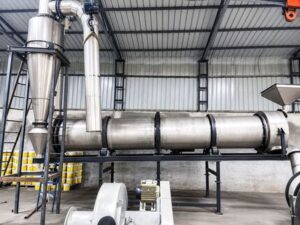
The Industrial Rotary Drum Dryer is a high-capacity, heavy-duty drying system engineered for continuous processing of large sludge volumes. Specifically, the system consists of a long, inclined, rotating cylindrical shell mounted on heavy support trunnions and driven by a girth gear arrangement.
Process Sequence
-
Inflow & Burner Feed: Hot air from a burner or hot gas generator introduces at the inflow chamber alongside wet sludge feed.
-
Cascading Cylinder Flow: Meanwhile, material travels down an inclined rotating cylinder shell fitted with internal lifting flights. Consequently, these flights repeatedly scoop and drop the sludge.
-
Exhaust & Separation: Subsequently, exhaust air carrying evaporated moisture passes out through a cyclone or bag filter system.
-
Discharge: Ultimately, uniformly dried solids discharge continuously from the lower end of the drum.
Flight Dynamics & Cascading Flow
Inside the rotating cylinder shell, specially engineered lifting flights are welded along the inner wall in strategic patterns. As the drum rotates (at speeds between 3 and 12 RPM), these flights scoop up wet sludge from the bottom bed. Subsequently, they carry it upward along the shell and shower it downward through the high-velocity hot gas stream. As a result, this continuous cascading curtain maximizes heat and mass transfer between hot gas and suspended sludge particles.
To manage sticky ETP sludge, rotary drum systems often incorporate a dry product back-mixing loop. Specifically, a fraction of fully dried product (at 10% moisture) blends with incoming wet sludge (at 80% moisture) in a pug mill prior to entering the drum. Consequently, this lowers initial feed moisture below 40%, bypassing the sticky phase entirely and preventing drum wall buildup.
Key Engineering Metrics
-
Evaporative Capacity: Extremely high, ranging from 1,000 kg/hr to over 15,000 kg/hr of water removal in a single drum.
-
Mechanical Reliability: Designed for heavy-duty industrial service, featuring thick alloy steel shells, hardened trunnion rollers, and simple mechanical linkages.
-
Operating Air Temperature: Accommodates high inlet air temperatures (from 250°C up to 550°C), resulting in rapid thermal drying.
D. Advanced Fluidised Bed Drying Systems (Fluidization & Vibration Mechanics)
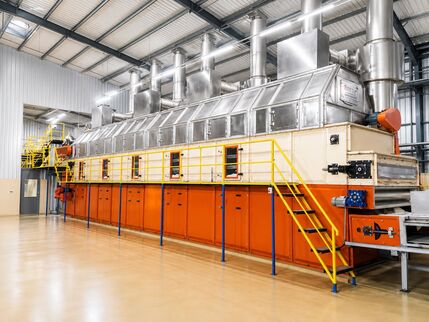
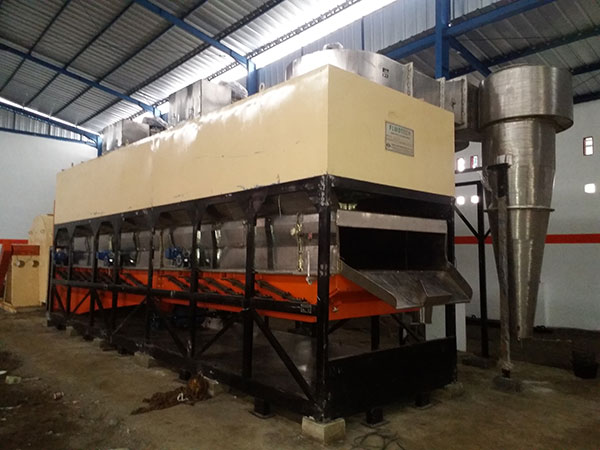
For granular sludge streams, crystalline ZLD salts, and pre-conditioned semi-dry particles, Advanced Combination Fluid Bed Dryers and continuous Vibratory Fluidised Bed Dryers provide exceptional thermal mass transfer rates.
Process Dynamics & Fluidization Physics
In a fluidised bed system, process gas passes upward through a perforated distributor plate supporting the wet sludge solids. When the upward velocity of hot air balances the gravitational pull on the particles, the solid bed enters a state of dynamic “fluidization,” behaving like a boiling liquid. Indeed, every individual sludge granule is surrounded completely by hot air, producing ultra-fast thermal evaporation rates.
In a Vibratory Fluidised Bed Dryer, mechanical vibration motors impart directional vibratory energy to the dryer bed alongside fluidizing air. As a result, this mechanical vibration helps transport sticky, heavy, or wide particle-size distributions smoothly across the drying deck without channel formation or localized clumping. Meanwhile, a Combination Fluid Bed Dryer integrates internal heating surfaces (such as steam tubes or plates) within the fluidized bed, combining conduction and convection heat transfer to drastically cut hot air volume and exhaust gas treatment costs.
Key Engineering Metrics
-
Thermal Mass Transfer: Superior heat transfer coefficients due to direct, 360-degree gas-to-particle contact.
-
Product Quality: Delivers highly uniform moisture distribution across granular solids and ZLD crystallizer residues.
-
Footprint Efficiency: Compact vertical design maximizes evaporative output per square meter of floor space.
4. Comprehensive Technology Selection Matrix
To help engineering teams select the optimal drying system, the following decision matrix matches key operational parameters against primary sludge drying technologies:
| Selection Criteria | Paddle Dryer | Mesh Belt Dryer / Band Dryer | Rotary Drum Dryer | Vibratory Fluidised Bed / Combination Fluid Bed |
| Primary Heat Transfer | Indirect Conduction | Direct Forced Convection | Direct / Indirect Hybrid | Direct Convection + Internal Conduction |
| Thermal Efficiency | High (650–750 kcal/kg) | Moderate to High | Moderate (800–900 kcal/kg) | Exceptional (Fluidized State) |
| Sticky Phase Handling | Excellent (Self-cleaning) | Requires Extrusion Pre-forming | Requires Back-Mixing Loop | Moderate (Best with Granular/Pre-conditioned Feed) |
| Dust & Fine Generation | Minimal | Near Zero | Moderate to High | Controlled via Cyclones / Bag Filters |
| Exhaust Gas Volume | Very Low | High | Very High | Reduced in Combination Systems |
| Footprint Requirement | Compact | Long Horizontal Layout | Large Longitudinal Layout | Compact Vertical Footprint |
| Best Suited Sludge Types | Chemical ETP, ZLD Solids, Pharma, Sticky Cakes | STP Bio-solids, Textile, Food & Agro, Fibrous Sludge | Paper Pulp, High-Volume ETP, Mining, Heavy Minerals | ZLD Crystalline Salts, Granular Biomass, Pre-conditioned Cakes |
5. Integrating Thermal Sludge Dryers into Zero Liquid Discharge (ZLD) Infrastructure
Integrating a thermal sludge dryer into a plant’s Zero Liquid Discharge (ZLD) framework creates a highly efficient, closed-loop waste treatment network. Rather than operating as standalone units, thermal sludge dryers function as the final moisture removal stage in modern industrial ETP and ZLD plants.
Closed-Loop ZLD Integration Steps
-
Raw Industrial Effluent: First enters primary ETP and membrane treatment (RO system). Clean recovered water routes directly back to plant operations.
-
Thermal Concentration: Next, concentrated RO reject passes to thermal evaporators (MEE / MVR systems), releasing clean distillate back to plant utilities.
-
Mechanical Dewatering: Subsequently, the resulting wet salt slurry passes through mechanical dewatering units (filter press or ATFD), outputting a wet cake at 65% to 85% moisture.
-
Thermal Sludge Drying: Afterwards, the dewatered cake enters a thermal sludge dryer (Paddle Dryer, Mesh Belt Dryer, Rotary Drum Dryer, or Combination Fluid Bed Dryer), evaporating residual bound water.
-
Dual Discharge Streams:
-
Vapor Condensate: Routed back to the ETP head for 100% complete water recovery under ZLD mandates.
-
Dry Solids: Discharged at 5% to 15% moisture for re-use, co-processing, or minimized TSDF disposal.
-
6. Sustainable Co-Processing and Circular Economy Opportunities
Beyond achieving environmental compliance, thermal sludge drying enables industrial facilities to generate new revenue streams and support circular economy initiatives. By reducing sludge moisture content to under 15%, dried industrial biosolids convert from costly hazardous waste into valuable secondary raw materials.
Resource Recovery Pathways
High GCV Bio-Solids & Paper Sludge
-
Processing Application: Cement Kiln Co-Processing & Boiler Secondary Fuel.
-
Environmental Impact: Thermally dried sludge from paper, textile, and biological ETP systems exhibits significant calorific value (ranging from 2,500 kcal/kg to 4,000 kcal/kg dry mass). Consequently, cement manufacturers accept dried sludge as a secondary fuel substitute for coal. Meanwhile, the inorganic ash fraction integrates directly into the clinker matrix.
Inorganic Chemical & Mineral Sludge
-
Processing Application: Eco-Brick Manufacturing, Clay Blending & Construction Aggregates.
-
Environmental Impact: Dried inorganic ETP sludge from ZLD chemical plants blends into clay brick formulations, fly-ash blocks, and road sub-base aggregates. As a consequence, this permanently locks up heavy metals within structural ceramic matrices.
Sewage Bio-Solids & Organic ETP Sludge
-
Processing Application: Nutrient-Rich Soil Conditioner & Controlled Agricultural Bio-Solids.
-
Environmental Impact: Thermally dried, pathogen-free STP sewage sludge contains high levels of bio-available nitrogen, phosphorus, and organic matter. When dried using low-temperature Mesh Belt Dryers or Band Dryers, these nutrient-dense granules function as rich soil conditioners for forestry and non-food crop agriculture.
Conclusion & Actionable Implementation Plan
The economic and regulatory drivers surrounding industrial wastewater residual management are undoubtedly clear. Continuing to store, transport, and dispose of high-moisture sludge cake at TSDF facilities creates severe operational, financial, and compliance risks for modern industrial facilities. Consequently, implementing high-efficiency thermal sludge dryers—whether indirect Paddle Dryers, continuous Mesh Belt Dryers, heavy-duty Rotary Drum Dryers, multi-stage Band Dryers, or advanced Vibratory Fluidised Bed Dryers—delivers a proven engineering solution. As a result, it reduces waste volume by up to 80%, dramatically lowers operational costs, and ensures long-term environmental compliance.
Turnkey Project Execution Plan
To ensure a smooth transition from wet sludge disposal to high-efficiency thermal drying, engineering teams should follow a structured three-phase execution plan:
-
Phase 1: Analytical Sludge Characterization & Pilot Testing
-
First, measure baseline parameters: Feed moisture %, bulk density, calorific value (GCV), pH, and sticky phase transitions.
-
Then, conduct pilot drying trials at manufacturer testing facilities to verify thermal kinetics and energy requirements.
-
-
Phase 2: Thermal Integration & System Engineering
-
Next, evaluate available plant utilities (e.g., waste steam, thermic fluid, hot water, or waste heat recovery loops).
-
Subsequently, select the optimal dryer technology (Paddle Dryer, Mesh Belt Dryer, Rotary Drum Dryer, Combination Fluid Bed Dryer, or Band Dryer) based on sludge characteristics, footprint constraints, and budget.
-
Finally, design integrated vapor condensation and dust collection systems.
-
-
Phase 3: Turnkey Procurement, Commissioning & Operations
-
Partner with an experienced engineering manufacturer capable of delivering ISO-certified, CE-compliant drying systems.
-
Execute site installation, utility integration, automated PLC balancing, and operational training.
-
Contact Information & Engineering Support
At GENEX Tech Industries LLP (GTI Dryers), we bring extensive engineering expertise to the design, manufacture, and deployment of custom-built thermal sludge dryers and turnkey Zero Liquid Discharge infrastructure across India and international markets. Furthermore, our engineering team provides end-to-end support—from initial laboratory sludge testing and thermal balancing to complete manufacturing, installation, and commissioning.
| Contact Details | Company Information |
| Company Entity | GENEX Tech Industries LLP |
| Head Office Address | 10C, Sir William Jones Sarani (Middleton Row), Park Street, Kolkata – 700071, West Bengal, India |
| Factory Address | Jalan Industrial Complex, Gate No. 1 / Right Lane 1, Biparnnapara, Jangalpur, Howrah – 711411, West Bengal, India |
| Direct Phone / WhatsApp | +91-97489 06968 | +91-93300 77417 |
| Official Email | mktg@foodtechprojects.com | sales@foodtechprojects.com |
| Official Websites | www.foodtechprojects.com | www.gtidryers.com |