
The industrial corridor across North East India—spanning Assam, Meghalaya, Tripura, Nagaland, Manipur, Mizoram, Arunachal Pradesh, and Sikkim—represents a rapidly growing manufacturing hub. Consequently, regional facilities expand rapidly in active pharmaceuticals, tea and spices processing, fine chemicals, agro-commodities, and waste-to-value biomass management. As a direct result, these processing plants require reliable thermal processing and moisture removal infrastructure consistently.
Furthermore, industrial scalability heavily relies on this thermal backbone. Because moisture control directly governs product stability, bulk density, and shelf life, processors simply cannot rely on standard off-the-shelf equipment. Instead, custom systems engineered by pioneers like GENEX Tech Industries LLP provide precise thermodynamic control. Specifically, they operate through specialized divisions like Food Tech Projects and GTI Dryers. Ultimately, continuous processing lines deliver high energy efficiency, maximum yield, and export compliance while reducing labor overhead significantly.
1. Thermodynamic Fundamentals & Industrial Applications
First and foremost, thermal dehydration relies primarily on targeted heat and mass transfer to strip water. In addition, understanding these principles ensures process efficiency.
Moisture Classification in Drying Theory
In drying theory, moisture falls into two main categories:
-
Unbound Moisture: Specifically, this refers to water that exerts full vapor pressure. As a consequence, it evaporates freely from saturated material surfaces continuously, thereby keeping initial drying rates exceptionally high.
-
Bound Moisture: In contrast, bound moisture remains trapped inside cell walls or capillary lattices. Therefore, it requires significantly higher thermal energy to drive internal diffusion effectively, so heat input must be managed carefully.
Constant-Rate vs. Falling-Rate Kinetics
During the initial constant-rate period, surface water evaporates freely. As a result, ambient temperature, air velocity, and surface area govern this drying rate entirely, while liquid movement inside the solid plays a secondary role initially.
Subsequently, as surface moisture depletes, the system enters the falling-rate period. At this stage, internal diffusion to the surface becomes the primary limiting factor. Consequently, processors must use elevated thermal gradients or mechanical fluidization in order to prevent internal structural damage, scorching, or case hardening.
Regional Industrial Applications Across North East India
Across North Eastern production hubs, distinct industrial sectors require specialized thermal engineering strategies:
-
Pharmaceuticals & Formulation Clusters (Sikkim & Guwahati): For instance, systems require strict cGMP compliance and mirror-polished SS316L stainless steel in order to eliminate moisture safely without denaturing delicate active pharmaceutical ingredients (APIs).
-
Agro-Commodities, Tea, Spices & Bio-Resources (Assam, Meghalaya, Mizoram & Arunachal Pradesh): Similarly, processing plants require continuous systems like specialty leaf and spice dryers in order to lower high initial moisture levels in orthodox tea, lakadong turmeric, bird’s eye chilli, ginger, and agricultural residues.
-
Distillery Grain, Organic Waste & Industrial Sludge (Assam & Tripura): In addition, high-tonnage machinery strips water from spent wash, press mud, bio-fertilizer bases, and municipal/industrial sludge so as to support waste-to-value conversion.
2. Core Industrial Drying Technologies & Operating Principles
Refractance Window Dryer (RWD) Systems
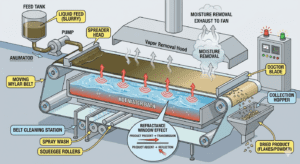
Above all, the Refractance Window Dryer enables continuous low-temperature dehydration. In practice, it handles liquid feeds, fruit purees, botanical extracts, herbal tea powders, and sensitive bio-compounds effortlessly.
Processing Sequence:
-
Feed Distribution: To begin with, liquid slurry enters via an automated sanitary positive displacement pump gradually.
-
Thin-Film Layering: Specifically, the spreader distributes liquid evenly onto a specialized heat-transparent belt, thereby maintaining film thickness strictly between 0.5 mm and 1.5 mm.
-
Conductive Transfer: Simultaneously, thermal energy transfers conductively from hot water floating beneath the belt directly into the wet film.
-
Vapor Evaporation: As a result, rapid evaporation releases water vapor into a top-mounted exhaust hood under gentle negative pressure.
-
Chilling & Harvesting: Ultimately, material passes over an integrated cooling zone, causing the chilled film to become brittle and fracture against a doctor blade cleanly.
Vibratory Fluid Bed Dryer (VFBD) Systems
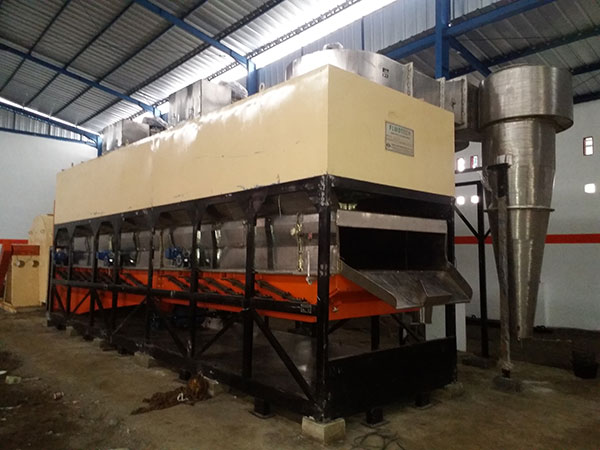
In addition to this, systems engineered like the vibratory fluidised bed dryer (or vibratory fluid bed dryer) combine controlled vibration with positive pneumatic fluidization. Consequently, they dry granular, crystalline, or shredded materials without particle degradation.
VFBD Processing Sequence:
-
Feed Entry: First, wet granular material enters via a rotary airlock smoothly.
-
Fluidization: Next, hot air passes through a perforated plate in order to suspend the material.
-
Vibration: Meanwhile, twin motors oscillate the frame for smooth, continuous conveying.
-
Mass Transfer: As a result, suspended particles undergo rapid mass and heat transfer.
-
Output: Finally, conditioned granules exit cleanly via an integrated cooling zone.
Standard VFBD Machine Configurations:
-
Junior VFBD: 250 kg/hr to 300 kg/hr finished output.
-
Standard VFBD: 500 kg/hr to 550 kg/hr finished output.
-
Jumbo VFBD: 700 kg/hr to 800 kg/hr finished output.
-
Super Jumbo VFBD: 850 kg/hr to 1,000 kg/hr finished output.
Continuous Industrial Spray Drying Systems
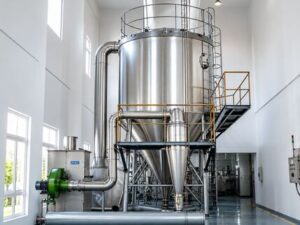
Moreover, industrial spray dryer installations—also available as foodtech spray dryers—turn liquid solutions, emulsions, and suspensions into uniform powders within a single step.
Key Process Highlights:
-
Precision Atomization: Specifically, rotary disks spinning at up to 25,000 RPM break liquid into millions of micro-droplets (20 to 150 microns).
-
Instantaneous Vaporization: As a direct consequence, high surface area allows hot air to flash-evaporate moisture within milliseconds inside the main tower.
-
Powder Harvesting: Subsequently, cyclones and sanitary bag filters harvest fine powder cleanly while exhaust air passes through wet scrubbers safely.
Rotary Drum Dryer Systems
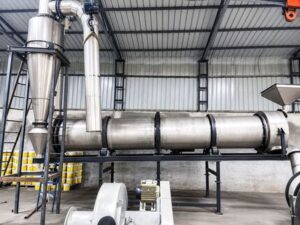
In comparison, systems like the industrial rotary drum dryer, sourced through an expert drum dryer manufacturer or foodtech rotary drum dryer, provide heavy-duty drying for bulk solids, mineral ores, agricultural residues, and industrial sludge.
Specifically, inside an inclined rotating cylinder, custom steel flights lift wet material and shower it continuously through high-velocity hot gas. Consequently, this cascading curtain maximizes surface area exposure in order to drive rapid moisture loss during high-tonnage runs.
3. Comprehensive Specialized Thermal Dehydration Technologies
As mentioned earlier, specialized thermal designs adapt to unique material parameters across North Eastern manufacturing facilities:
Continuous Conveyor & Belt Systems
-
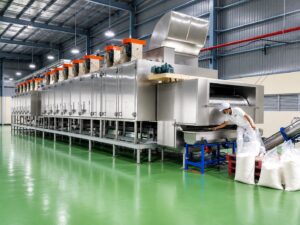
Band Dryer: For instance, industrial band dryer units provide multi-stage thermal zoning for food, chemicals, and bio-aggregates.
-
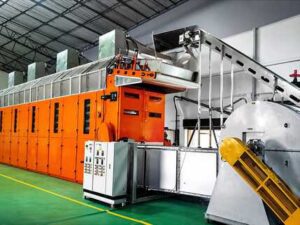
Mesh Belt Dryer: In addition, high-capacity mesh belt dryer systems process dehydrated vegetables, spices, bamboo shoots, and agricultural biomass pellets uniformly.
Indirect & Contact Thermal Processing
-
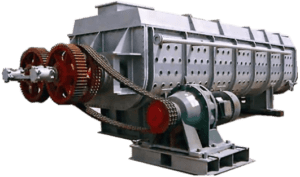
Paddle Dryer: On the other hand, operating through an industrial paddle dryer or specialized foodtech paddle dryer, dual counter-rotating shafts feature hollow heated paddles. As a result, they deliver high indirect thermal efficiency for drying chemical sludges and filtration cakes.
-
Continuous Thin Film Dryer: Likewise, engineered specifically as a continuous thin film dryer, this unit handles high-viscosity pastes and heat-labile active compounds under precise vacuum conditions.
-
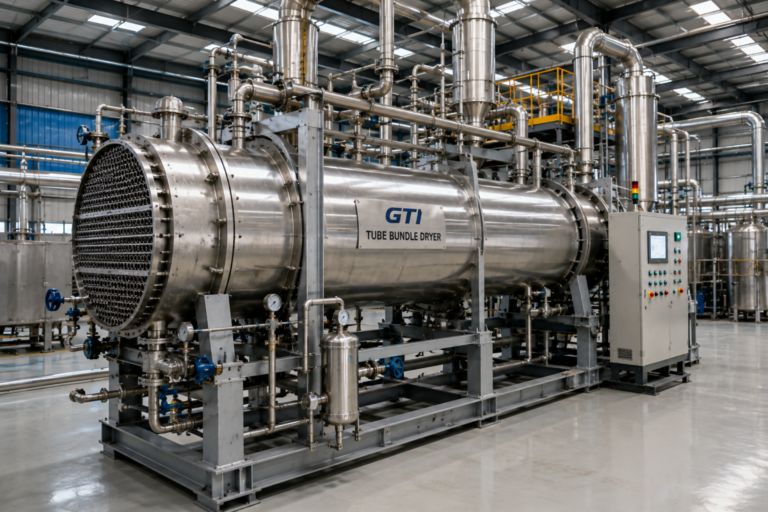
Tube Bundle Dryer: Furthermore, modern tube bundle dryer units provide indirect steam heating with superior energy conservation for grain distillery (DDGS) and starch processing lines.
Dehumidification & Flash Pneumatic Systems
-
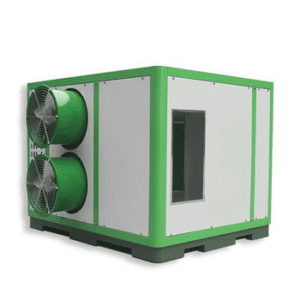
Heat Pump Dryer: Meanwhile, systems like the heat pump dryer use closed-loop dehumidification in order to capture and recycle latent heat, making them ideal for high-value herbs, specialty teas, and botanicals at low operating temperatures.
-
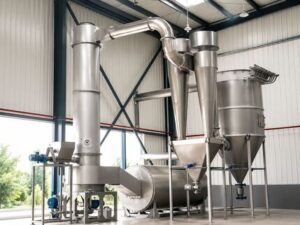
Flash Dryer: By contrast, utilizing rapid pneumatic conveying, the flash dryer drives rapid moisture reduction in starches, mineral powders, and biopolymers within seconds.
-
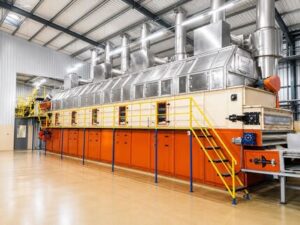
Combination Fluid Bed Dryer: In addition to this, engineered as a combination dryer or combination fluid bed dryer, this system manages complex drying curves for sticky or heat-sensitive compounds.
-
General Industrial Machinery: Overall, high-efficiency configurations rely on core dryer design fundamentals tailored for demanding production schedules.
4. Food, Dairy, Protein & Commodity Dehydration Systems
To begin with, processing agricultural products and specialty crops requires sanitary configurations that protect structural integrity, nutritional value, and color profile.
AGRO & FOOD DEHYDRATION PIPELINE

Fresh Produce --> Washing --> Slicing/Milling --> Thermal Drying

Raw Dairy/H2O --> Evaporation --> Spray/Fluid Bed --> Fine Powder
Food Ingredients & Produce Processing
-
Food Drying Systems: In fact, advanced food drying systems maintain strict hygienic standards for general food processing lines.
-
Food Ingredient Dryers: Specifically, specialized food ingredient dryers preserve functional solubility, aroma, and mouthfeel across blended formulations.
-
Vegetable Dehydration Systems: Furthermore, high-throughput vegetable dehydration systems process garlic, ginger, king chilli, and bamboo shoots with minimal color loss.
-
Fruit Drying Systems: Similarly, industrial fruit drying systems treat pineapples, oranges, jackfruit slices, purees, and fruit rolls gently under controlled moisture profiles.
-
Spice Dehydration Systems: In addition, dedicated spice drying systems preserve volatile essential oils in turmeric, cardamom, ginger, and chillies.
-
Starch Drying Infrastructure: Finally, heavy-duty starch drying systems process cassava, maize, and tapioca starches flash-pneumatically.
Dairy, Casein & Protein Powder Processing
-
Dairy Powder Drying: Regarding dairy operations, comprehensive dairy powder drying setups convert liquid milk streams into free-flowing, non-caking powders.
-
Dairy Ingredient Drying: Additionally, advanced dairy ingredient drying lines process specialty milk fats, permeate, and infant formula bases.
-
Protein & Whey Processing: Moreover, specialized units for dairy protein drying, high-purity whey powder drying, and lactose drying prevent protein denaturation and control crystallization.
-
Casein Drying Systems: In particular, purpose-built casein drying systems manage the viscous characteristics of acid and rennet casein fractions.
-
Protein Powder Systems: Ultimately, high-efficiency protein powder drying systems handle plant-based and dairy-derived protein isolates smoothly.
5. Specialized High-Value Crop Processing & Dehydration Systems
Undoubtedly, North East India produces some of the world’s most potent cash crops—including high-curcumin Lakadong turmeric, pungent Nadia ginger, high-ASTA Bird’s Eye chilli, Assam/Sikkim teas, and queen pineapples. Consequently, converting these raw harvests into shelf-stable, export-grade products demands targeted process flows and exact thermal profiles using advanced fruits & veg processing machinery.
1. Ginger Processing Systems
-
Core Focus: High-capacity powder production, essential oil distillation, oleoresin extraction, and maximum retention of active bio-compounds (gingerol and shogaol) via specialized ginger processing machines.
-
Process Flow: Bubble Washer $\rightarrow$ Mechanical Peeling $\rightarrow$ Precision Slicing $\rightarrow$ Industrial Thermal Drying $\rightarrow$ Pulverizing & Vibro-Sieving $\rightarrow$ Optional Solvent/Steam Distillation (Oil & Oleoresin lines).
-
Drying Technologies:
-
Mesh Belt / Industrial Band Dryer: For instance, this system provides high-capacity continuous dehydration of fresh ginger slices efficiently.
-
Refractance Window Dryer (RWD): In contrast, this offers thermal-sensitive drying engineered for premium extract preservation without degradation.
-
-
Value-Added Products: Dehydrated ginger flakes, fine ginger powder, steam-distilled ginger oil, and concentrated oleoresin.
2. Turmeric Processing Systems
-
Core Focus: Preservation of high curcumin levels, retention of bright natural yellow color, and uniform moisture removal across thick rhizomes using targeted turmeric processing machines.
-
Process Flow: Raw Rhizome Washing & Destoning $\rightarrow$ Steam Boiling / Curing $\rightarrow$ Industrial Dehydration $\rightarrow$ Mechanical Polishing $\rightarrow$ Pulverizing & Vibro-Sieving $\rightarrow$ Solvent Extraction (Curcumin & Oleoresin).
-
Drying Technologies:
-
Refractance Window Dryer (RWD): Low-temperature drying specifically designed to eliminate thermal degradation of delicate curcuminoids.
-
Mesh Belt & Band Dryers: Meanwhile, these offer scalable continuous drying for bulk raw rhizome processing.
-
-
Value-Added Products: Standardized turmeric powder, turmeric essential oil, turmeric oleoresin, and pharmaceutical-grade curcumin extract.
3. Tea Drying & Processing Systems
-
Core Focus: Precise moisture reduction down to ~2–3%, thermal stabilization following oxidation/fermentation, and delicate aroma retention utilizing a high-efficiency tea drying system.
-
Process Flow: Withering $\rightarrow$ Rolling / CTC Cutting $\rightarrow$ Controlled Fermentation (Black Tea) $\rightarrow$ Primary Thermal Drying $\rightarrow$ Sorting & Grading $\rightarrow$ Extraction & Atomization (Powders & Extracts).
-
Drying Technologies:
-
Fluid Bed Tea Dryer & Vibro Fluid Bed Dryer: Continuous hot-air fluidization ensuring rapid, uniform moisture removal without charring tea leaves or CTC granules.
-
Conveyor / Band Dryer: Furthermore, this allows scalable continuous drying for bulk Orthodox, Green, Oolong, and Black teas.
-
Spray Dryer: In addition, it flash-evaporates liquid tea concentrates into instant tea powders, green tea catechins, and polyphenols.
-
Heat Pump / Tray Dryer: By comparison, this provides low-temperature dehumidified drying for white teas, delicate herbal infusions, and flower teas.
-
-
Value-Added Products: CTC & Orthodox black teas, green tea, instant iced tea powder, tea extract powders (EGCG/polyphenols), and tea waste biomass pellets.
4. Chilli Processing Machinery
-
Core Focus: Retention of high ASTA color values, preservation of capsaicin (pungency level), and dust-controlled pulverized powder production using integrated chilli processing machinery.
-
Process Flow: Raw Cleaning & Destoning $\rightarrow$ Leaf & Stem Removal $\rightarrow$ Controlled Dehydration $\rightarrow$ Coarse Crushing (Hammer Mill) $\rightarrow$ Fine Pulverizing $\rightarrow$ Static Fluidized Bed Moisture Stabilization $\rightarrow$ Optional Oil Blending & Vibro Sieving.
-
Drying Technologies:
-
Band / Apron Dryer & Rotary Dryer: Specifically, these handle bulk moisture reduction while controlling thermal exposure to protect natural red pigments.
-
Vibratory / Static Fluidized Bed Dryer: On the other hand, this ensures post-grinding moisture stabilization to prevent clumping and maximize export shelf life.
-
-
Value-Added Products: Paprika flakes, export-grade red chilli powder, oleoresin extraction feedstock, and oil-blended chili mixes.
5. Pineapple Processing & Dehydration Lines
-
Core Focus: High-sugar juice recovery, uniform slicing/coring, pulp extraction, and low-temperature slice drying without caramelization using complete fruits & veg processing machinery.
-
Process Flow: Sorting & Washing (Bubble/Brush Washer) $\rightarrow$ Automatic Peeling, Coring & Slicing $\rightarrow$ Juice/Pulp Extraction (Screw Press/Pulper) $\rightarrow$ Blanching / Dehydration $\rightarrow$ Packaging.
-
Drying Technologies:
-
Heat Pump Dryer / Mesh Belt Dryer: As a result, precise humidity and low-temperature control dry pineapple rings and dices cleanly.
-
Spray Dryer: Likewise, it converts clarified pineapple juice into free-flowing, instant pineapple juice powder.
-
Refractance Window Dryer (RWD): Furthermore, it preserves natural flavors, vibrant color, and heat-sensitive Vitamin C in fruit purees and fruit leathers.
-
-
Value-Added Products: Dehydrated pineapple rings & dices, pineapple pulp/puree, concentrated juice, and instant pineapple juice powder.
Regional Commodity Technical Specification Matrix
| Processing Line | Primary Washer / Pre-Treatment | Primary Dryer Technology | End Product Formats |
| Ginger | Bubble Washer & Mechanical Peeler | Mesh Belt / RWD / Band Dryer | Flakes, Powder, Oil, Oleoresin |
| Turmeric | Destoner Washer & Steam Curing Unit | Refractance Window Dryer / Mesh Belt | Export Powder, Curcumin Extract, Oleoresin |
| Tea | Controlled Withering & Rolling / CTC | Fluid Bed / Vibro Fluid Bed / Spray Dryer | Loose Leaf, CTC Granules, Instant Tea Powder |
| Chilli | Rotary Dry Cleaner & Stem Remover | Band Dryer / Static Fluid Bed Dryer | Flakes, ASTA-Grade Powder, Oleoresin Feedstock |
| Pineapple | Brush Washer & Automatic Peeler/Corer | Heat Pump Dryer / RWD / Spray Dryer | Dried Rings, Powder, Puree, Juice Concentrate |
6. Turnkey Botanical, Coconut & Specialized Agro Processing Plants
In terms of industrial scope, integrations cover specialized value-addition plants, extending from regional North Eastern botanical extraction to global commercial fruit and crop product processing. Consequently, full operational efficiency is achieved cleanly.
Turnkey Botanical, Date & Agro Facilities
-
Date Processing Plants: For example, turnkey date syrup, date paste & date powder processing plant units handle high-sugar raw materials continuously without caramelization.
-
Herbal & Botanical Processing: In addition, plants convert extracts of medicinal plants, bamboo, and endemic flora into soluble powders using low-temperature vacuum and refractance technologies.
Comprehensive Coconut Processing Infrastructure
-
Desiccated Coconut Machinery: Specifically, complete desiccated coconut machinery processing plant units deliver hygienic shredding and drying.
-
Virgin Coconut Oil & Derivatives: Furthermore, comprehensive virgin coconut oil machinery, specialized virgin coconut oil (VCO) powder processing plant units, and medium chain triglyceride (MCT) oil processing plant setups process high-purity lipids.
-
Coconut Milk & Powder Lines: In line with this, specialized coconut milk machinery processing plant and coconut milk powder processing plant infrastructure ensure stable fat emulsification.
-
Coconut Water & Extract Systems: Additionally, automated coconut water extraction machine units paired with a coconut water powder processing plant convert liquids into instant powders.
-
By-Product & Bio-Energy Processing: Finally, turnkey lines including a coconut paring oil processing plant, coconut fibre machinery coir processing plant, and a turnkey coconut biodiesel plant optimize zero-waste processing.
7. Animal Feed, Aquafeed & Grain Drying Technologies
As a rule, livestock, poultry, and aquaculture operations across North East India rely heavily on low-moisture feed storage in order to suppress fungal toxins and mold growth under humid weather conditions.
FEED PROCESSING TECHNOLOGY

Raw Grains/Slurry --> Extrusion/Pelleting --> Thermal Conditioning

Moisture Reduction (To <10%) --> Cooling Zone --> Feed Packaging
Feed Processing Applications
-
Animal Feed Dehydration: First of all, robust animal feed agro drying equipment processes bulk agricultural residues into stable feed rations.
-
General Feed Drying: Furthermore, high-capacity feed drying systems optimize energy usage across pelletized feeds.
-
Poultry Feed Lines: In addition, dedicated poultry feed drying machines keep mash and crumble feeds free-flowing.
-
Aquaculture Feed Systems: Similarly, advanced fish feed drying units treat floating and sinking aquafeed pellets gently so as to prevent structural cracking.
-
Grain Conditioning Systems: Above all, high-tonnage grain dryers protect harvested paddy, corn, and mustard against post-harvest moisture losses.
8. Chemical, Synthetics, Polymers & Advanced Materials
On the other hand, precision chemical processing demands tight temperature envelopes, inert atmospheres, and explosion-proof electrical fittings.
Fine Chemical & Synthetic Drying Systems
-
Chemical Drying Infrastructure: In particular, heavy-duty chemical drying systems eliminate residual solvents safely.
-
Fine Chemical Systems: Moreover, specialized fine chemical drying equipment handles high-purity inorganic salts and delicate synthesis intermediates.
-
Specialty Chemical Lines: Additionally, engineered specialty chemical drying units process hazardous or reactive compounds under sealed inert gas loops.
-
Catalyst Thermal Processing: Furthermore, purpose-built catalyst drying setups preserve exact micro-pore geometry and active surface area.
-
Pigments & Colorants: In contrast, sanitary pigment dryers process organic and inorganic dyes cleanly without batch-to-batch cross-contamination.
Polymers, Resins & Fine Synthetics
-
Polymer Processing: In the same way, advanced polymer drying systems remove surface moisture and internal bound moisture from polymer chips and powders.
-
Resin Dehydration: Consequently, heavy-duty resin drying systems maintain uniform melt viscosity prior to downstream extrusions.
9. Heavy Minerals, Mining, Ores & Commodities
In contrast to food processing, mineral dehydration across North East India involves handling abrasive, high-density bulk materials under demanding operating schedules.
MINERAL DEHYDRATION PIPELINE

Heavy Ore Feed --> Rotary Flight Showering --> Direct Thermal Drop

Cyclonic Separation --> Dust Filtration --> Bulk Mineral Discharge
Mining & Mineral Applications
-
Industrial Systems: To illustrate, heavy-duty mineral industrial drying systems process coarse ores, limestone, coal fines, and industrial concentrates.
-
Mineral Powder Processing: Furthermore, high-throughput mineral powder drying equipment prevents fine particles from caking during bulk handling.
-
Ore Thermal Processing: Additionally, industrial ore drying systems strip water from heavy mineral concentrates efficiently.
-
Rare Earth Dehydration: In addition to this, precision rare earth and mineral thermal processing and dehydration systems maintain exact temperature profiles for high-value strategic minerals.
Bulk Commodities & Industrial Minerals
-
Clay Drying Infrastructure: For example, specialized clay drying systems treat plastic clays, bentonite, and kaolin without clump formation.
-
Gypsum Processing: Similarly, heavy-duty gypsum dryers drive off surface water prior to wallboard manufacturing or calcination.
-
Sand & Metal Powders: Finally, high-capacity sand drying systems, precision metal powder drying setups, and continuous salt drying systems ensure moisture removal under continuous operation.
10. Biomass, Bio-Fuels, Wood & Renewable Energy
In order to convert forestry and agricultural waste into energy-dense fuels, plants must lower moisture levels below 10% economically.
Renewable Fuel Systems
-
Biomass Thermal Processing: Consequently, high-capacity biomass drying and continuous biomass renewable energy drying convert crop residues and bamboo biomass into clean fuel sources.
-
Biomass Fuel Dehydration: In addition, efficient biomass fuel drying units process paddy straw, rice husk, and bagasse prior to gasification.
-
Pellet & Sawdust Systems: Furthermore, high-volume pellet drying installations paired with heavy-duty sawdust drying systems prepare material for uniform pelletization.
-
Wood Chip Dehydration: Likewise, heavy-duty wood chip dryers handle large, irregular timber and forestry particles efficiently.
11. Environmental Waste, Sludge Remediation & Circular Economy
Because environmental regulations require manufacturing plants to reduce waste volume, facilities must convert sludges into manageable materials.
ENVIRONMENTAL REMEDIATION FLOW

Hazardous Sludge Feed --> Indirect Paddle Heating --> Mass Drop (80%)

Solvent Recovery Vapor --> Clean Solid Discharge --> Value By-Product
Waste Remediation Infrastructure
-
Environmental Waste Systems: To begin with, comprehensive waste environmental drying infrastructure handles municipal and industrial waste streams.
-
Industrial Sludge Management: As a consequence, heavy-duty industrial sludge drying systems reduce disposal tonnage dramatically.
-
Paper Mill Sludge Handling: In addition, specialized paper mill sludge dryer machines strip water from fibrous sludge cakes.
-
Municipal & Sewage Remediation: Furthermore, high-efficiency municipal sludge dryers and continuous sewage sludge drying systems convert hazardous sludge into bio-fertilizers.
-
Organic Waste Dehydration: Ultimately, advanced organic waste drying installations process organic waste into stable soil conditioners.
12. Technical Equipment Selection Matrix
| Dryer Technology | Primary Feed State | Operating Temperature Range | Heat Transfer Mechanism | Ideal Applications |
| Refractance Window (RWD) | Liquid, Purees, Slurry | 50°C – 70°C | Conductive / Radiant | Purees, Botanical Extracts, Bio-compounds |
| Vibratory Fluid Bed (VFBD) | Granules, Shreds, Crystals | 60°C – 160°C | Convective / Fluidized | Agrochemicals, Tea, Grains, Spices |
| Spray Dryer | Liquid, Emulsion, Solution | 150°C – 350°C | Convective / Flash | Dairy, APIs, Pigments, Plant Protein |
| Rotary Drum Dryer | Bulk Solids, Sludge, Ores | 120°C – 500°C | Direct Convective | Minerals, Spent Grain, Biomass, Sludge |
| Paddle Dryer | Paste, Cake, Sludge | 80°C – 220°C | Indirect Conductive | Chemical Sludge, Hazardous Waste |
| Mesh Belt Dryer | Slices, Biomass, Pellets | 50°C – 140°C | Convective Multi-pass | Dehydrated Vegetables, Spices, Herbs |
13. Deep Engineering Selection Framework
During process design, selecting the optimal thermal dehydration equipment requires evaluating core physical and chemical parameters systematically. Therefore, engineers follow a structured logic flow.
Selection Logic Flow
Physical Feed State = Liquid / Slurry:
 ├── Heat-Sensitive Feed ──> Choose: Refractance Window Dryer (RWD).
 └── Standard Feed ─────────> Choose: Continuous Spray Dryer.

Physical Feed State = Granules / Shreds / Crystals:
 ├── Gentle Handling Needed ─> Choose: Vibratory Fluid Bed Dryer (VFBD).
 └── High-Tonnage Bulk ─────> Choose: Rotary Drum Dryer / Tube Bundle Dryer.

Physical Feed State = Sludge / Paste / Wet Cake:
 ├── Solvent Recovery Required ──> Choose: Paddle Dryer.
 └── Rapid Moisture Flash ───────> Choose: Flash Dryer.
14. Energy Efficiency, Waste Heat Recovery & Decarbonization
Because water vaporization requires ~2,260 kJ per kilogram of water, optimizing thermal efficiency directly reduces operational overhead and carbon footprint. As a result, sustainable design becomes vital.
EXHAUST WASTE HEAT RECOVERY SEQUENCE:

Warm Exhaust Gas --> Cyclone Particulate Filter --> Air-to-Air Heat Exchanger --> Pre-heated Intake Air --> Main Burner (Reduced Fuel Load)
-
Air-to-Air Heat Exchangers: Specifically, these units extract energy from exhaust air to preheat intake air, thereby reducing fuel consumption by 15% to 25%.
-
Variable Frequency Drives (VFDs): In addition, dynamic motor speed controls on supply and exhaust fans match airflow to material loading continuously.
-
Thermal Insulation Enclosures: Consequently, high-density rockwool and ceramic fiber panels minimize heat loss through shell surfaces effectively.
15. Regulatory Compliance, Hygiene & cGMP Standards
Above all, processing plants in pharmaceutical, food, and nutraceutical sectors must eliminate dead zones and prevent microbial growth. Indeed, strict adherence ensures full compliance.
-
cGMP & US FDA Compliance: Specifically, contact surfaces constructed from mirror-polished SS316L stainless steel ($R_a < 0.4\ \mu\text{m}$) prevent material buildup and cross-contamination.
-
Automated CIP Systems: In addition, integrated spray balls enable full automated washing and sanitization without dismantling equipment.
-
Dust Control & Emission Limits: Consequently, high-efficiency sanitary bag filters keep particulate emissions below local environmental limits ($< 10\ \text{mg/Nm}^3$).
16. Operational Troubleshooting & Maintenance
| Operational Symptom | Probable Cause | Technical Remedy |
| Uneven Final Moisture | Non-uniform feed thickness or distribution | Recalibrate feed pump or adjust spreader blade gap |
| High Exhaust Temperature | Insufficient material feed rate or low air velocity | Increase feed rate or adjust VFD fan speed |
| Product Scorching / Degradation | Thermal gradient too high during falling-rate period | Reduce inlet air temperature or increase belt speed |
| Dust Carry-Over in Exhaust | Excess air velocity or worn filter media | Lower fan draft velocity or replace bag filter media |
17. Custom System Design & Turnkey Execution
Pilot Testing --> Mass & Energy Balance --> CAD Modeling Layout --> Custom Fabrication --> Site Installation & Commissioning
Turnkey Execution Workflow
-
Material Testing & Rheology Analysis: To begin with, pilot testing determines specific drying curves, thermal sensitivity thresholds, and equilibrium moisture content empirically.
-
System Mass & Energy Balance: Subsequently, engineers compute precise mass and heat balances in order to select the optimal heating medium (steam, thermal oil, hot water, or gas).
-
Custom Fabrication: Following this, equipment is built using certified food-grade stainless steel with specialized structural reinforcements.
-
Turnkey Site Installation: Ultimately, complete mechanical, electrical, and control integration ensures seamless startup and commissioning.
Partnering with Industry Experts
In summary, optimizing thermal drying operations across food, pharmaceutical, chemical, and waste management sectors requires a partner who understands process engineering, thermal dynamics, and hygienic manufacturing standards. With over four decades of global engineering excellence, GENEX Tech Industries LLP designs, manufactures, and commissions custom industrial drying machines and turnkey plants built for long-term performance.
Whether launching a new processing line, upgrading existing dryers to reduce energy consumption, or expanding output capacity, our engineering team provides end-to-end technical support from pilot testing to final site commissioning.
Contact Our Process Engineering Experts Today
Get in touch with our team to discuss your specific material parameters, request process testing, or receive a customized project quote:
-
Email: mktg@foodtechprojects.com | sales@foodtechprojects.com
-
Phone / WhatsApp: +91-97489 06968 | +91-93300 77417
-
Websites: www.foodtechprojects.com | www.gtidryers.com
-
Head Office Address: GENEX Tech Industries LLP, 10C, Sir William Jones Sarani (Middleton Row), Park Street, Kolkata – 700071, West Bengal, India