Section 1: Introduction and State of the Industry
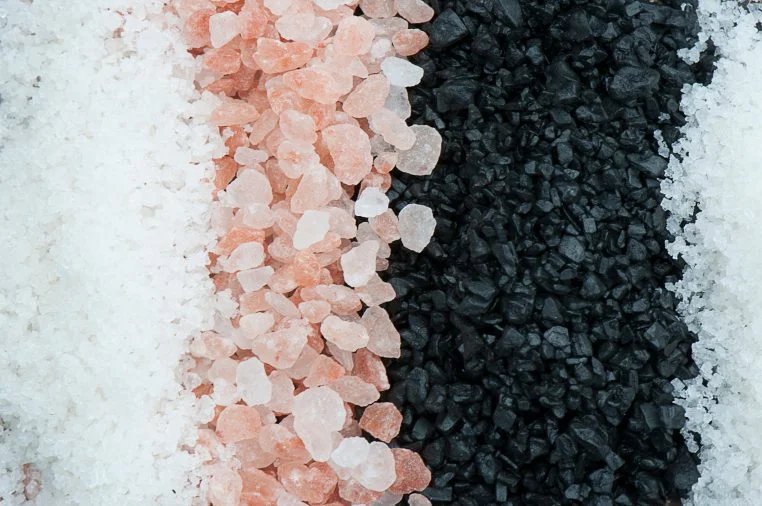
Global chemical manufacturing relies heavily on processing bulk inorganic chemicals and inorganic salts. These essential compounds include sodium carbonate (soda ash), sodium bicarbonate, ammonium sulfate, ammonium nitrate, potassium chloride, magnesium sulfate, calcium carbonate, titanium dioxide, silica, and synthetic zeolites.
Consequently, manufacturers use them to produce glass, fertilizers, detergents, paper, pharmaceuticals, and construction materials. Because facilities produce these items in massive volumes, companies continuously require reliable, continuous, and energy-efficient processing equipment.
The Role of Thermal Drying in Chemical Processing
For example, liquid-solid separation processes take place immediately after chemical synthesis, crystallization, or precipitation. To accomplish this initial separation, facilities commonly use centrifuges, vacuum filters, or filter presses to dewater materials.
As a result, these steps yield damp filter cakes, wet crystalline beds, or thick slurries. However, operators cannot package, store, or transport wet intermediates directly. Therefore, thermal drying acts as the necessary bridge between raw chemical synthesis and commercial packaging.
[Synthesis / Crystallization] ➔ [Centrifugation / Filtration] ➔ [Thermal Drying] ➔ [Packaging / Transport]
Energy Requirements and Material Variations
Because thermal drying requires significant energy input to vaporize liquid moisture, plant operators actively seek industrial dryer manufacturers focused on fuel efficiency, zero product loss, and uniform particle quality. In addition, every inorganic compound features distinct physical and thermal characteristics:
-
Fragile Crystals: For instance, compounds like ammonium sulfate break easily and consequently require gentle pneumatic handling.
-
Cohesive Filter Cakes: On the other hand, materials like precipitated calcium carbonate or synthetic silica form sticky pastes that instead require high-shear dispersion.
In response, engineering leaders like GENEX Tech Industries LLP design specialized equipment to meet these process challenges. Specifically, they combine advanced aerodynamics, thermal modeling, and automation to manufacture high-capacity rotary drum dryers, vibratory fluidised bed dryers, pneumatic flash dryers, spin-flash dryers, and combination systems.
Section 2: Fundamental Principles of Thermal Drying for Inorganic Solids
At its core, thermal drying combines heat transfer and mass transfer between hot gas and wet solids. Furthermore, heat moves efficiently from the gas medium to the solid via convection, conduction, or radiation. Simultaneously, liquid vaporizes from the particle surface and moves into the exhaust gas stream.
    Convective Heat Input (Hot Air/Gas)
                   │
                   ▼
┌──────────────────────────────────────┐
│        Wet Inorganic Solid           │ ──► Mass Transfer (Water Vapor)
└──────────────────────────────────────┘
The Two Primary Drying Regimes
-
The Constant-Rate Drying Period: During this initial phase, moisture fully saturates the solid surface. Moreover, thermal energy evaporates surface water at a steady rate corresponding to the wet-bulb gas temperature. As a result, rotary drum and flash dryers excel during this stage.
-
The Falling-Rate Drying Period: Subsequently, moisture recedes into the particle core. Meanwhile, internal mass transfer slows down, and particle temperatures begin to rise accordingly. Thus, equipment with adjustable residence times—such as vibratory fluidised bed dryers—works best during this secondary phase.
Drying Rate
    ▲
    │  ┌───────────────────────┐  <-- Constant-Rate Period
    │  │                       │
    │  │                       └───────────┐  <-- Falling-Rate Period
    │  │                                   └───────┐
    └──┴───────────────────────────────────────────┴──► Time / Process Duration
Evaluating Material Characteristics
Prior to selecting drying machinery, process engineers systematically evaluate several critical feed conditions:
-
First, the feed state (wet crystals, pasty filter cake, or slurry).
-
Second, the overall production capacity (1 metric ton per hour up to 50+ tons per hour).
-
Third, thermal sensitivity and corrosive properties.
-
Finally, the target final moisture level (typically between 0.05% and 2.0%).
Section 3: Comprehensive Breakdown of Major Industrial Dryer Types
3.1 Rotary Drum Dryers
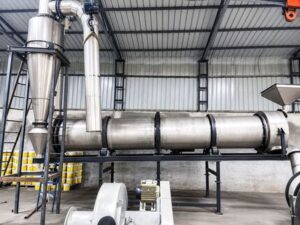
To begin with, rotary drum dryers efficiently handle heavy-duty processing of bulk minerals, crystalline salts, and agricultural granules. Structurally, a large cylindrical shell mounts onto trunnion rollers at a slight 1° to 5° downward slope.
Working Mechanism
First, wet feed enters the upper end of the drum through a screw feeder. Next, as the shell rotates at 2 to 12 RPM, custom internal flights scoop and drop the material continuously. Consequently, this motion forms a curtain of falling solids through the longitudinal hot air stream. Ultimately, the gentle slope and drum rotation transport the material smoothly toward the discharge point.
Wet Feed In ──►  ┌───────────────────────────────┐
                 │ █   █   █   (Lifters)   █   █ │ ──► Hot Air Stream
                 └───────────────────────────────┘
                                                   └──► Dry Product Out
Key Structural Features
-
Custom Flight Designs: Specifically, radial, spiral, or shower-curtain lifters prevent un-mixed dead zones.
-
Support Assemblies: Additionally, heavy forged steel riding rings (tires), thrust rollers, and girth gears support high structural loads.
-
Flexible Air Configurations: In turn, designers supply co-current systems for heat-sensitive products or, alternatively, counter-current layouts for maximum heat transfer efficiency.
Primary Advantages
-
Above all, it handles massive processing capacities ranging from 2 TPD to over 100 TPD.
-
Furthermore, it tolerates broad variations in feed moisture, bulk density, and particle size.
-
As a result, it delivers long operational life with minimal maintenance downtime.
3.2 Vibratory Fluidised Bed Dryers (VFBD)
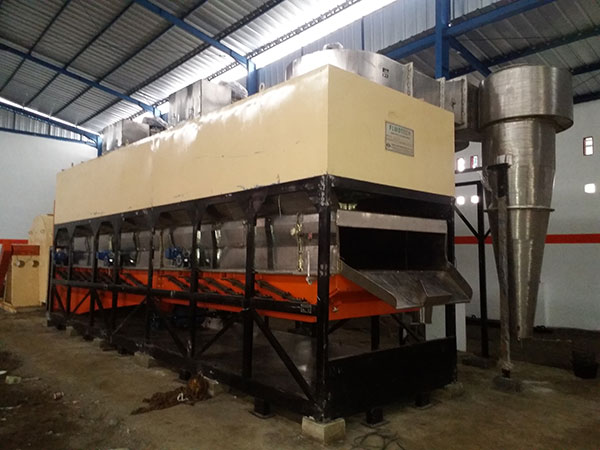
Similarly, Vibratory Fluidised Bed Dryers gently dry fragile crystals, granules, and uniform powders that require precise temperature control.
Working Mechanism
Initially, material feeds onto a perforated plate inside a rectangular chamber. Then, heated air blows upward through the perforations at velocities that lift and suspend the particles in a fluidised state. Meanwhile, twin out-of-balance electric motors apply directional vibration to the bed frame. Consequently, this vibration conveys sticky or heavy particles smoothly along the deck, effectively eliminating localized hot spots.
           Exhaust Air Out
                  ▲
    ┌──────────────────────────┐
    │  ~ ~ ~ (Fluidised Bed) ~ │ ◄── Wet Material In
    ├──────────────────────────┤
    │  ••••••••••••••••••••••  │ ◄── Perforated Plate
    └──────────────────────────┘
                  ▲
           Hot Air Air Supply
Key Structural Features
-
Laser-Cut Distributor Plates: In particular, precision hole patterns prevent weeping while simultaneously ensuring uniform air flow.
-
Multi-Zone Temperature Systems: In addition, separate heating zones dry the material, whereas a final fluidised cooling section reduces salt temperatures prior to packaging.
-
Stainless Steel Construction: Likewise, polished SS304 or SS316 contact parts prevent product contamination.
Primary Advantages
-
First, it delivers exceptional thermal efficiency through complete air-to-particle contact.
-
Second, it prevents crystal attrition and edge chipping.
-
Therefore, it reduces final product moisture levels below 0.1% reliably.
3.3 Pneumatic Flash Dryers
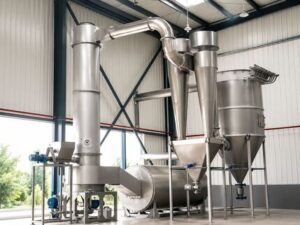
In contrast, Pneumatic Flash Dryers offer rapid, continuous moisture removal for light powders and free-flowing inorganic crystals.
Working Mechanism
First, wet material enters a vertical riser pipe directly into a high-velocity hot air stream (15 to 30 m/s). Immediately, the thermal air stream entrains, disperses, and transports the particles upward. Due to intense surface contact, surface water evaporates in a mere 0.5 to 3 seconds. Finally, primary cyclones and baghouse filters collect the dry, fine powder.
Exhaust Air ──► [Cyclone Filter] ──► Dry Powder Collection
                        ▲
                        │ (Upward Riser Pipe)
                        │
Wet Feed ──► [High-Velocity Hot Air Duct]
Key Structural Features
-
Streamlined Riser Ducts: Specifically, specific pipe lengths maintain pneumatic transport without letting solids settle.
-
Dosing Systems: Meanwhile, twin-screw feeders or venturi injectors deliver consistent wet material feeds.
-
Static Mechanical Layout: Furthermore, the drying pipe contains no internal moving parts, which subsequently reduces wear and maintenance costs.
Primary Advantages
-
Consequently, it removes moisture almost instantaneously.
-
Besides, short residence times prevent thermal degradation.
-
In addition, it occupies minimal floor space due to its vertical layout.
3.4 Spin-Flash Dryers
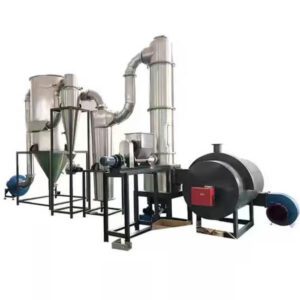
Alternatively, Spin-Flash Dryers transform sticky, high-viscosity filter cakes, pastes, and precipitates directly into fine powders without requiring pre-drying or back-mixing.
Working Mechanism
First, a variable-speed feed screw pushes wet filter cake into a cylindrical drying chamber. Next, a high-speed mechanical agitator (rotor) at the conical base crushes and disintegrates dense material lumps. Simultaneously, hot air enters tangentially to create a swirling vortex. Furthermore, an internal classifier ring near the top allows fine, dry particles to escape while reflecting damp agglomerates back down into the grinding zone.
                 Dry Powder Out (To Cyclone)
                             ▲
                 ┌───────────────────────┐
                 │   [Classifier Ring]   │
                 │                       │
Wet Cake In ──►  │   🌀 Swirling Air 🌀   │
                 │                       │
                 │     [Rotor Agitator]  │ ◄── Tangential Hot Air
                 └───────────────────────┘
Key Structural Features
-
Heavy-Duty Agitator Assemblies: For instance, high-torque, wear-resistant blades chop thick cakes continuously.
-
Tangential Air Plenums: In turn, this creates a swirling airflow that speeds up convective evaporation.
-
Adjustable Classifiers: Consequently, it precisely controls final powder fineness and moisture levels.
Primary Advantages
-
Indeed, it handles dense filter press cakes directly without requiring back-mixing.
-
In addition, it combines disintegrating, drying, and particle sizing in a single step.
-
Thus, its compact vertical design reduces footprint requirements.
3.5 Combination Dryers
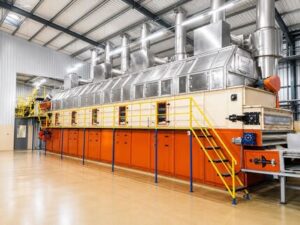
Finally, Combination Dryers integrate two distinct drying methods—such as multi-stage tray drying followed by a fluidised bed section—into one continuous plant.
Working Mechanism
Initially, the upper section uses gentle tray or belt drying to evaporate high surface moisture without scorching the product. Thereafter, partially dried particles drop into an integrated fluidised bed section. Here, targeted air jets finish the drying process and polish the final particles to exact specifications.
Key Structural Features
-
Multi-Stage Zones: Specifically, independent temperature controls optimize each stage of drying.
-
Heat Recovery Systems: Furthermore, it recovers thermal exhaust from the fluidised bed to preheat primary stages.
Primary Advantages
-
As a result, it provides fine control over bulk density and residual moisture.
-
Thus, it is ideal for complex inorganic hydrates that fracture easily under thermal shock.
Section 4: Technical Deep-Dive: Specific Products and Optimal Dryer Selection
4.1 Sodium Carbonate (Soda Ash – Na2CO3)
-
Material Properties: First, Solvay-process or trona-refined soda ash enters as a crystalline cake containing 5% to 15% moisture.
-
Operating Conditions: In turn, it requires continuous high-temperature gas (250°C to 400°C inlet; 110°C to 140°C outlet). Target moisture: < 0.1%.
-
Recommended Dryer: Rotary Drum Dryer.
-
Justification: Because of high tonnage rates (20 to 50+ tons/hour), plants require rugged rotary drums to handle heavy structural loads continuously.
4.2 Sodium Bicarbonate (NaHCO3)
-
Material Properties: In comparison, these are temperature-sensitive crystals with 3% to 8% surface water that decompose above 60°C to 70°C.
-
Operating Conditions: Therefore, low inlet temperatures (70°C to 90°C) maintain product temperatures below 60°C. Target moisture: < 0.05%.
-
Recommended Dryer: Vibratory Fluidised Bed Dryer (VFBD).
-
Justification: As a result, gentle fluidisation prevents crystal breakage and thermal degradation, while integrated cooling zones safeguard product quality.
4.3 Ammonium Sulfate ((NH4)2SO4)
-
Material Properties: Likewise, these are free-flowing, crystalline fertilizer grains with 2% to 6% moisture that are highly friable under heavy impacts.
-
Operating Conditions: Accordingly, inlet air is set at 140°C to 180°C and outlet air at 75°C to 90°C. Target moisture: < 0.2%.
-
Recommended Dryer: Vibratory Fluidised Bed Dryer.
-
Justification: Consequently, fluidised air beds protect crystal edges from mechanical crushing, thereby preserving required size distributions.
4.4 Ammonium Nitrate (NH4NO3)
-
Material Properties: On the other hand, these are highly hygroscopic, thermally sensitive prills with 1% to 3% surface moisture that undergo phase changes at 32°C and 84°C.
-
Operating Conditions: Thus, inlet temperatures are held strictly between 110°C and 130°C. Target moisture: < 0.1%.
-
Recommended Dryer: Multi-Zone Vibratory Fluidised Bed Dryer.
-
Justification: Specifically, precision multi-zone heating prevents thermal shocks and crystal breakdown across phase transitions.
4.5 Potassium Chloride (Muriate of Potash – KCl)
-
Material Properties: In contrast, this material consists of coarse, highly abrasive cubic crystals with 4% to 8% moisture.
-
Operating Conditions: Therefore, high inlet temperatures (300°C to 550°C) maximize thermal efficiency. Target moisture: < 0.1%.
-
Recommended Dryer: Direct-Fired Rotary Drum Dryer.
-
Justification: As a result, heavy-duty rotary drums lined with abrasion-resistant steel handle high capacities (30 to 80 TPD) reliably.
4.6 Magnesium Sulfate (Epsom Salt – MgSO4·7H2O)
-
Material Properties: Furthermore, clear needle-like crystals contain 3% to 7% surface moisture, where overheating strips bound hydrate water.
-
Operating Conditions: Hence, mild inlet air temperatures (50°C to 65°C) keep product temperatures under 45°C. Target moisture: < 0.2% (Surface Water Only).
-
Recommended Dryer: Low-Temperature Vibratory Fluidised Bed Dryer.
-
Justification: In this way, precise low-temperature air streams remove surface water while retaining constitutional water of crystallization.
4.7 Calcium Carbonate (PCC / GCC – CaCO3)
-
Material Properties: Meanwhile, Precipitated Calcium Carbonate forms dense, sticky filter cakes with 20% to 40% moisture.
-
Operating Conditions: Consequently, inlet temperatures run between 200°C and 350°C. Target moisture: < 0.3%.
-
Recommended Dryer: Spin-Flash Dryer.
-
Justification: Because of high-speed rotor agitators, sticky cakes disintegrate continuously to prevent bed blinding.
4.8 Titanium Dioxide (TiO2)
-
Material Properties: Similarly, this pasty filter cake contains 30% to 50% moisture with sub-micron primary particles.
-
Operating Conditions: Accordingly, high inlet air temperatures (250°C to 450°C) are required. Target moisture: < 0.2%.
-
Recommended Dryer: Spin-Flash Dryer.
-
Justification: Therefore, intense mechanical shear disperses pasty feed instantly, protecting pigment whiteness through rapid drying times.
4.9 Synthetic Silica (Precipitated Silica)
-
Material Properties: In addition, high-moisture, gelatinous filter cakes carry 50% to 70% water.
-
Operating Conditions: Thus, inlet air is operated at 350°C to 600°C. Target final moisture: 1.0% to 3.0%.
-
Recommended Dryer: Spin-Flash Dryer.
-
Justification: As a result, high rotor shear mechanically fluidises gelatinous silica cakes, evaporating moisture in seconds while retaining porosity.
4.10 Synthetic Zeolites (Molecular Sieves)
-
Material Properties: Finally, fragile, wet filter cakes present with 35% to 50% water content.
-
Operating Conditions: For this reason, inlet temperatures are set between 180°C and 300°C. Target surface moisture: < 1.0%.
-
Recommended Dryer: Pneumatic Flash or Spin-Flash Dryer.
-
Justification: Consequently, rapid air dispersion dries zeolites instantly without crushing internal porous structures.
Section 5: Technical Reference Matrix
| Chemical Substrate | Feed State | Inlet Moisture (%) | Final Target Moisture (%) | Inlet Temp (°C) | Outlet Temp (°C) | Recommended Dryer |
| Soda Ash | Crystalline Cake | 5% – 15% | < 0.1% | 250°C – 400°C | 110°C – 140°C |
|
| Sodium Bicarbonate | Wet Crystals | 3% – 8% | < 0.05% | 70°C – 90°C | 45°C – 55°C |
|
| Ammonium Sulfate | Granules | 2% – 6% | < 0.2% | 140°C – 180°C | 75°C – 90°C |
|
| Ammonium Nitrate | Prills / Granules | 1% – 3% | < 0.1% | 110°C – 130°C | 60°C – 70°C |
|
| Potassium Chloride | Cubic Crystals | 4% – 8% | < 0.1% | 300°C – 550°C | 90°C – 110°C |
|
| Magnesium Sulfate | Crystalline Needles | 3% – 7% | < 0.2% (Surface) | 50°C – 65°C | 35°C – 45°C |
|
| Calcium Carbonate | Viscous Cake | 20% – 40% | < 0.3% | 200°C – 350°C | 90°C – 110°C |
|
| Titanium Dioxide | Pasty Cake | 30% – 50% | < 0.2% | 250°C – 450°C | 100°C – 120°C |
|
| Precipitated Silica | Gelatinous Cake | 50% – 70% | 1.0% – 3.0% | 350°C – 600°C | 110°C – 130°C |
|
| Synthetic Zeolites | Wet Cake | 35% – 50% | < 1.0% | 180°C – 300°C | 95°C – 110°C |
|
Section 6: Advanced Engineering, Energy Optimization, and Compliance
6.1 Heat Recovery Strategies
Because energy costs represent up to 80% of drying overheads, manufacturers deploy three main energy recovery systems:
-
Gas Recirculation: First, recirculating up to 70% of warm exhaust air back to the heat source.
-
Air Heat Exchangers: Second, recovering thermal energy from exhaust streams to preheat fresh combustion air.
-
Indirect Steam Tubes: Third, using internal steam coils in rotary drum shells to deliver conduction drying with low air consumption.
6.2 Air Quality and Environmental Controls
However, drying fine salts inevitably creates airborne dust. To mitigate this, integrated filtration systems ensure low stack emissions:
-
Primary Cyclones: To begin with, capturing 95% to 98% of entrained coarse solids.
-
Pulse-Jet Baghouses: Next, PTFE-lined filter bags retain sub-micron dust particles below 5 to 10 mg/m³.
-
Wet Scrubbers: Finally, Venturi scrubbers clean soluble salt residues or acidic exhaust gases before stack discharge.
6.3 Corrosion Management & Automation
In addition, corrosive inorganic salts strictly require specialized structural materials. Accordingly, designers build contact areas using SS316L, 2205 Duplex Stainless Steel, or ceramic linings. Furthermore, automated PLC/SCADA systems continuously match fuel inputs to real-time exhaust temperatures and feed moisture metrics.
Section 7: Why Choose GENEX Tech Industries LLP
Ultimately, GENEX Tech Industries LLP brings over 40 years of thermal engineering expertise to global chemical plant installations.
      Over 40 Years Experience
                 │
                 ▼
┌──────────────────────────────────┐
│    GENEX Tech Industries LLP     │ ──► ISO 9001, CE, FDA Certified
└──────────────────────────────────┘
                 │
                 ▼
  Turnkey Plants & Pilot Testing
Key Partner Strengths:
-
Complete System Lineup: Specifically, offering unbiased machine selection across Rotary, Fluidised Bed, Flash, and Spin-Flash dryers.
-
Pilot Testing: In addition, conducting material trials and capacity modeling to verify process sizing.
-
Certified Manufacturing: Furthermore, building heavy-duty equipment adhering to ISO 9001:2015, CE, US FDA, and international engineering standards.
-
Turnkey Execution: Above all, delivering complete projects from engineering design to on-site commissioning and automation support.
Section 8: Conclusion and Contact Information
In summary, selecting the correct industrial dryer ensures long-term operational efficiency, minimal fuel consumption, and consistent salt quality. Whether your facility processes massive salt volumes or cohesive filter cakes, GENEX Tech Industries LLP provides custom engineering tailored to your process demands.
-
Email: mktg@foodtechprojects.com | sales@foodtechprojects.com
-
Phone / WhatsApp: +91-97489 06968 | +91-93300 77417
-
Websites: www.foodtechprojects.com | www.gtidryers.com
-
Head Office: 10C, Sir William Jones Sarani (Middleton Row), Park Street, Kolkata – 700071, India