
1. Introduction & Modern Industry Overview
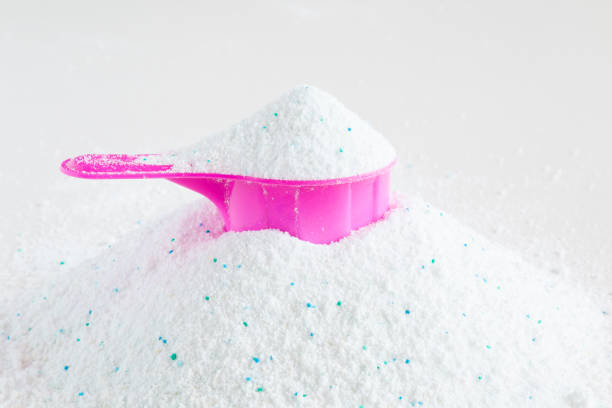
First and foremost, the global manufacturing sector for synthetic cleaning agents is massive. Specifically, it includes household washing powders, laundry detergents, industrial surfactants, and builder chemicals. As a matter of fact, this sector represents one of the largest continuous chemical processing industries worldwide. Consequently, commercial viability depends heavily on thermal drying infrastructure. In particular, design and performance directly impact thermal efficiency, throughput capacity, and finished product quality. For this reason, converting liquid slurries, pastes, and filter cakes into free-flowing powders is a core operation. Ultimately, this process requires precise moisture management to ensure instant solubility.
To begin with, active surfactant ingredients include neutralized Linear Alkylbenzene Sulfonic Acid (LABSA). In addition, they include Alpha Olefin Sulfonates (AOS), Sodium Lauryl Sulfate (SLS), and Sodium Lauryl Ether Sulfate (SLES). Furthermore, foundational inorganic builder salts like Sodium Sulfate are also common. Naturally, these materials display distinct physical properties, thermal decomposition thresholds, and moisture-binding kinetics. Therefore, selecting the ideal industrial dryer is paramount. For example, options include Spray Drying Towers, Vibratory Fluidized Bed Dryers (VFBD), Rotary Drum Dryers, or Combination Systems. In short, proper selection achieves optimal plant efficiency and product quality.
At the same time, modern chemical processing facilities face strict environmental regulations and high thermal energy costs. As a result, equipment must achieve thermal energy efficiencies exceeding 70% to 80%. Simultaneously, manufacturers must maintain exhaust particulate emissions strictly below 10 mg/Nm³. For instance, controlling product parameters requires precise operation. Above all, engineers must control drying air temperatures, nozzle spray pressure, vibration frequencies, and airflow velocity. In this article, we provide an in-depth engineering evaluation of industrial drying machinery.
2. Rheology & Dehydration Kinetics of Detergent Ingredients
To start with, process engineers must analyze the physical chemistry and rheological behavior of surfactant feeds. In addition, they must evaluate viscosity curves and thermal degradation profiles. Indeed, understanding how moisture evolves allows equipment manufacturers to optimize thermal performance.
2.1 LABSA-Neutralized Surfactant Slurries
To illustrate, LABSA is the foundational anionic surfactant used in commercial washing powders globally. Neutralizing it with sodium hydroxide or sodium carbonate creates Sodium Alkylbenzene Sulfonate (LAS). Subsequently, this surfactant is combined inside a high-shear crutcher vessel. Furthermore, it is mixed with builders like Sodium Tripolyphosphate (STPP) or Zeolites. Likewise, fillers like Sodium Sulfate and alkaline agents like Sodium Silicate are also added.
Initially, the crutcher slurry contains 35% to 48% moisture by weight. Besides this, the slurry exhibits non-Newtonian pseudoplastic flow characteristics. At room temperature (25°C), slurry viscosity can exceed 10,000 cPoise. Obviously, this high viscosity makes fine atomization nearly impossible. However, preheating the slurry inside jacketed vessels to 65°C–85°C drops viscosity significantly. As a result, viscosity falls to approximately 1,200 cPoise to 1,800 cPoise. Next, high-pressure pumps deliver slurry to spray nozzles at 35 bar to 70 bar. In the end, the drying process must reduce final moisture to 1.5%–3.0% without burning the surfactant.
2.2 Sodium Sulfate Drying Dynamics
Meanwhile, sodium sulfate acts as an essential filler and moisture absorber in laundry powders. Additionally, it is produced on a massive industrial scale as an independent crystal.
In general, wet sodium sulfate cake from centrifuges or filters carries 6% to 14% surface moisture. However, detergent-grade sodium sulfate requires final moisture levels strictly below 0.05% to 0.10%. Furthermore, sodium sulfate exhibits a distinct phase transition at 32.4°C. At this point, anhydrous sodium sulfate converts into decahydrate (Glauber’s salt) in excess water. Therefore, the drying process must rapidly elevate material temperatures above 40°C to 80°C. In order to achieve this, rapid heating ensures complete moisture release without lump formation. Typically, hot air temperatures inside fluid beds or rotary dryers range from 120°C to 250°C.
2.3 Heat-Sensitive Surfactants: AOS, SLS, and SLES
On the other hand, specialty organic surfactants like AOS, SLS, and SLES are widely used in high-performance detergents. Similarly, they are common in syndet bars and concentrated liquid-to-powder products. Consequently, these organic compounds are susceptible to thermal hydrolysis, charring, and severe foaming.
For example, drying an AOS or SLS liquid feed from 60%–70% starting moisture down to under 1.5% requires strict thermal control. Specifically, inlet hot air temperatures must be held between 130°C and 160°C. Meanwhile, internal product temperatures must never exceed 70°C to 80°C. As a result, flash drying, thin-film drying, or low-temperature spray drying is essential. Ultimately, these methods prevent surfactant breakdown and discoloration.
3. Comparative Technical Matrix of Industrial Detergent Dryers
First of all, selecting the optimal dryer requires evaluating feed physical states, thermal sensitivities, and production capacities. Below is an engineering comparison matrix detailing the primary operational parameters for industrial detergent drying machinery.
| Dryer Technology | Primary Feed Physical Form | Starting Moisture (%) | Final Moisture (%) | Operating Inlet Temp (°C) | Throughput Range (Tons/Hr) | Best Suited Application / Product |
| Spray Dryer Tower | Liquid Slurry / Viscous Paste | 35% – 55% | 1.0% – 3.5% | 250°C – 380°C | 1.0 – 50.0 | Standard heavy-duty washing powders, LABSA slurries, hollow-bead powders. |
| Vibratory Fluid Bed Dryer | Wet Crystals / Granules / Pellets | 5% – 15% | 0.05% – 0.50% | 110°C – 180°C | 0.5 – 25.0 | Sodium Sulfate crystals, post-spray tower cooling, agglomerated granules. |
| Rotary Drum Dryer | Coarse Solids / Chemical Cakes | 8% – 25% | 0.10% – 1.0% | 150°C – 450°C | 2.0 – 40.0 | Bulk sodium sulfate, inorganic fillers, raw mineral drying. |
| Combination Dryer | Extruded Noodles / Paste / Granules | 20% – 40% | 0.50% – 1.50% | 100°C – 160°C | 0.25 – 5.0 | Heat-sensitive organic surfactants, enzyme-enriched detergent granules. |
4. Industrial Spray Drying Towers: System Mechanics and Operation
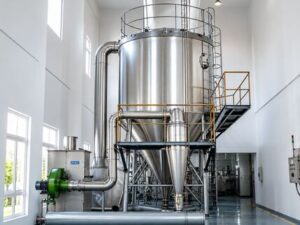
In general, spray drying represents the core continuous technology used globally for manufacturing synthetic washing powders. Furthermore, industrial spray drying towers convert liquid slurries directly into hollow, free-flowing spherical particles. Above all, these low-density particles exhibit excellent instant solubility in cold water.
4.1 Slurry Homogenization and High-Pressure Pumping Systems
Initially, raw ingredients are blended in a steam-jacketed crutcher vessel at 65°C to 80°C. Specifically, ingredients include LABSA, sodium hydroxide, STPP, zeolites, sodium silicate, and sodium sulfate. Subsequently, the slurry (38% to 45% moisture) passes through high-capacity inline magnetic filters. In addition, vibrating screens remove unmixed particles and grit.
Next, a heavy-duty triplex or quintuplex plunger pump forces the warm slurry under high pressure. For instance, operating pressures range from 35 bar to 70 bar. Following this, stainless steel delivery lines move the slurry to the top of the spray drying tower. There, specialized swirl nozzles atomize the slurry into millions of micro-droplets. Consequently, these droplets range from 150 microns to 600 microns in diameter.
4.2 Counter-Current Thermal Dynamics and Hollow Particle Formation
Simultaneously, direct-fired air heaters deliver hot air into the tower’s lower section at 280°C to 360°C. In counter-current towers, hot air ascends while atomized droplets descend under gravity.
As a result, rapid flash evaporation occurs upon contact. Immediately, surface water evaporates, creating a porous outer crust on each falling droplet. Meanwhile, water trapped inside the droplet heats rapidly and expands into steam. Because of this, steam blows the droplet outward into a hollow bead before escaping through micro-pores. Consequently, bulk density drops to between 0.28 g/cc and 0.45 g/cc. Ultimately, this process delivers the light texture required for commercial washing powders.
4.3 Operating Parameters and Performance Indicators
-
Evaporation Capacity: To begin with, industrial towers range from 1,000 kg/hr to over 30,000 kg/hr of water removal.
-
Thermal Efficiency: In addition, systems typically operate between 65% and 75%. Furthermore, integrating exhaust heat recovery systems increases efficiency.
-
Final Product Moisture: Meanwhile, operators maintain moisture between 1.5% and 3.0% by adjusting outlet air temperature (95°C–110°C) and stroke rate.
-
Dissolution Profile: Lastly, powders achieve over 98.5% dissolution within 15 seconds in 20°C water due to hollow-bead morphology.
5. Vibratory Fluidized Bed Dryers (VFBD) for Crystalline Salts
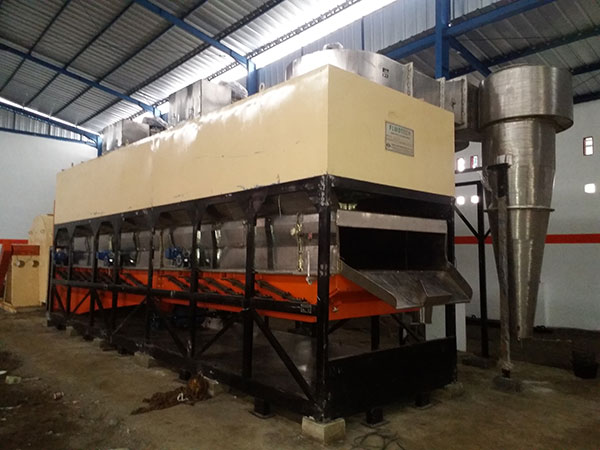
While spray drying towers excel at processing liquid slurries into hollow powders, Vibratory Fluidized Bed Dryers (VFBD) are optimal for crystalline materials. Specifically, they handle inorganic salts, post-spray tower cooling, and agglomerated granules.
5.1 Principles of Vibration Mechanics and Air Fluidization
In a VFBD, wet material is fed continuously onto a perforated stainless steel deck. For example, this includes centrifuge-discharged sodium sulfate or extruded surfactant noodles. Meanwhile, two eccentric vibrating motors impart controlled directional oscillations to the deck. In particular, motor frequencies range between 12 Hz and 24 Hz.
Concurrently, heated air flows upward through deck perforations at velocities between 0.8 m/s and 1.8 m/s. As a result, the combination of mechanical vibration and airflow suspends material particles in a fluid-like state. Therefore, each granule is individually surrounded by hot air. Thus, this maximizes heat and mass transfer efficiency.
5.2 Dehydration and Integrated Cooling of Sodium Sulfate
When drying crystalline sodium sulfate, starting moisture levels (6% to 10%) must drop below 0.05%. Indeed, sodium sulfate crystals break down easily under harsh impact. Fortunately, the gentle conveying motion of a vibrating bed prevents particle attrition and dust formation.
Specifically, hot air enters the initial bed drying zone at 140°C to 170°C, evaporating surface moisture rapidly. As material moves down the deck, it enters a dedicated cooling zone. Next, ambient or chilled air (20°C to 25°C) lowers the product temperature. Consequently, discharged sodium sulfate exits below 40°C, thereby preventing caking during packaging operations.
5.3 VFBD Operating Advantages and Parameters
-
Gentle Product Transport: First, vibratory motion ensures uniform transport without aggressive mechanical degradation.
-
Integrated Multi-Zone Processing: Second, systems combine heating, drying, conditioning, and final cooling within a single machine footprint.
-
Low Dust Carryover: Third, controlled air velocities reduce fines entrainment by up to 40% compared to non-vibrating beds.
-
High Thermal Efficiency: Finally, thermal efficiencies reach 75% to 83% due to direct contact heat transfer in the fluidized phase.
6. Heavy-Duty Rotary Drum Dryers for Inorganic Chemical Builders
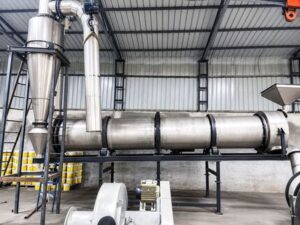
In comparison, Rotary Drum Dryers are heavy-duty systems widely used for processing high-tonnage inorganic builders. In particular, they process raw minerals and coarse sodium sulfate where continuous 24/7 reliability is required.
6.1 Structural Mechanical Engineering and Flight Dynamics
Fundamentally, a Rotary Drum Dryer consists of an inclined rotating steel cylinder. Trunnion rollers support the shell, which is driven by a girth gear and pinion drive. Generally, the inclination ranges from 2 degrees to 5 degrees. As a result, gravity assists forward material movement as the shell rotates at 3 RPM to 12 RPM.
Internally, the drum features custom lifting flights. As the drum rotates, these flights scoop up wet material. Subsequently, they shower it continuously through the hot gas stream, thereby creating a dense curtain of falling particles.
6.2 Co-Current vs. Counter-Current Processing Configuration
In practice, rotary dryers can be engineered in two distinct airflow configurations:
-
Co-Current Flow: In this setup, hot inlet air (300°C to 500°C) enters at the same end as the wet feed. Consequently, rapid evaporation occurs while material is wet and cool, thus preventing thermal damage. Therefore, this setup is ideal for heat-sensitive mixtures.
-
Counter-Current Flow: Conversely, dry material encounters the hottest incoming air at the discharge end. As a result, this maximizes thermal efficiency and achieves extremely low residual moisture (below 0.02%). Hence, it is suitable for non-combustible inorganic salts like raw sodium sulfate.
6.3 Rotary Drum Performance Metrics
-
Massive Throughput Capacity: First of all, single drum installations handle up to 50 tons per hour of wet material continuously.
-
Tolerance for Variable Feed: In addition, systems are highly forgiving of fluctuations in moisture content, particle size, and feed rate.
-
Heavy-Duty Mechanical Resilience: Most importantly, units are constructed from heavy carbon steel or stainless steel alloys (SS304/SS316) for long service life.
7. Advanced Combination Drying Systems for Temperature-Sensitive Active Organics
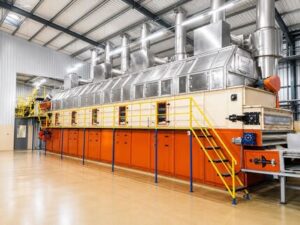
In contrast, specialty surfactant formulations require gentle, controlled drying conditions. For instance, these include enzyme-enriched granules, concentrated LABSA flakes, and polymer-surfactant complexes. Above all, gentle processing prevents active ingredient breakdown or discoloration. Therefore, Combination Drying Systems provide an ideal process path for these applications.
7.1 Staged Thermal System Architecture
Generally speaking, a Combination Dryer integrates two or more distinct thermal mechanisms within a single cohesive system. Typically, this involves an initial tray or belt drying section followed by an integrated fluid-bed finishing section.
During Stage 1, wet paste or extruded noodles (25% to 35% moisture) are distributed across multi-pass trays or belts. Next, gentle warm air at 80°C to 110°C removes surface moisture slowly, thereby preventing surface glazing or skin formation.
Subsequently, in Stage 2, the partially dried material enters a fluidized bed section. There, high-velocity air equalizes internal moisture, gradually stripping away bound water until final moisture drops below 0.80%.
7.2 Product Quality Metrics and Protection
By avoiding high thermal peaks, Combination Dryers preserve active surfactant concentrations above 97.5%. As a result, they prevent heat-induced discoloration or chemical breakdown. Furthermore, final product bulk density can be controlled between 0.50 g/cc and 0.70 g/cc. Ultimately, this meets compact high-density detergent powder specifications.
8. Application Mapping Guide: Best Dryer for Every Detergent Product
In order to provide a clear process selection guide, the table below maps specific compounds to their optimal drying technology along with key operating parameters.
| Product / Chemical Compound | Primary Recommended Dryer | Secondary Alternative Dryer | Operating Temperature Parameters | Key Technical Reason |
| Standard Washing Powder (LABSA-neutralized slurry) | Spray Dryer Tower | Combination Dryer (for compact powders) |
Inlet: 300°C – 360°C Outlet: 95°C – 110°C |
Forms hollow spherical beads with high cold-water solubility and low bulk density. |
| Sodium Sulfate (Inorganic Builder Crystal) | Vibratory Fluid Bed Dryer | Rotary Drum Dryer |
Inlet: 130°C – 160°C Product: < 40°C |
Prevents crystal degradation, achieves <0.05% moisture, includes integrated cooling. |
| Alpha Olefin Sulfonate (AOS) & SLS Powders | Spray Dryer (Low Temp Design) | Continuous Thin Film Dryer |
Inlet: 130°C – 150°C Outlet: 70°C – 80°C |
Protects active organic surfactants from thermal degradation and hydrolysis. |
| Enzyme-Enriched Compact Granules | Combination Dryer | Vibratory Fluid Bed Dryer |
Inlet: 75°C – 95°C Product: < 45°C |
Multi-stage low-temperature drying preserves delicate biological enzyme activity. |
| Raw Industrial Minerals & Heavy Fillers | Rotary Drum Dryer | Standard Fluid Bed Dryer |
Inlet: 350°C – 500°C Outlet: 110°C – 130°C |
Handles massive bulk tonnages, coarse particles, and variable feed moisture. |
9. Plant Process Auxiliaries, Heat Recovery, and Emissions Scrubbing
In addition to core machinery, a complete detergent drying installation relies on sophisticated auxiliary systems. Indeed, these systems ensure high energy efficiency, environmental compliance, and safe plant operation.
9.1 Air Heating Infrastructure and Heat Recovery Cycles
First, industrial drying installations utilize direct gas combustors, light oil burners, or steam heat exchangers. Furthermore, modern plants integrate air-to-air heat exchangers. Specifically, these units recover waste heat from dusty exhaust streams to preheat incoming ambient air. Consequently, this setup reduces overall fuel consumption by up to 15% to 22%.
9.2 Exhaust Gas Cleanup and Environmental Compliance
At the same time, environmental standards require thorough dust collection from exhaust air streams. First, exhaust gases pass through multi-cyclone separator banks to capture coarse fines (above 10 microns) at 95% efficiency. Subsequently, pulse-jet bag filters or wet venturi scrubbers remove ultra-fine dust down to below 10 mg/Nm³. As a result, this ensures full compliance with atmospheric environmental regulations.
9.3 Automation Protocols and Safety Systems
Finally, modern detergent dryers are managed by integrated PLC and SCADA automation systems. Continuously, sensors monitor inlet temperatures, exhaust humidity, feed pump pressures, bed pressure drops, and safety vents. In operations processing organic surfactant dusts, potential explosion risks exist. Therefore, automated nitrogen purging and rapid explosion suppression systems ensure complete operational safety.
10. Conclusion and Call to Action
To sum up, manufacturing high-grade synthetic detergents requires selecting thermal drying equipment engineered specifically for each product’s characteristics. On one hand, Spray Drying Towers remain unmatched for producing low-density, highly soluble washing powders from liquid LABSA slurries. On the other hand, Vibratory Fluidized Bed Dryers excel at dewatering crystalline salts like sodium sulfate. Specifically, they provide precise multi-zone temperature control and minimal dust creation. Meanwhile, Rotary Drum Dryers deliver continuous 24/7 reliability for heavy-tonnage processing. In comparison, Combination Dryers provide gentle multi-stage thermal protection for heat-sensitive active ingredients and enzymes.
In conclusion, by partnering with an experienced process equipment manufacturer, chemical producers can optimize thermal efficiency. Ultimately, they can also reduce operating costs, increase plant throughput, and maintain high product quality standards.
GENEX Tech Industries LLP — Your Process Drying Partner
GENEX Tech Industries LLP (along with Food Tech Projects) is a premier global manufacturer of industrial drying systems. Specifically, we produce turn-key detergent processing plants, spray dryers, fluid bed dehydrators, rotary drum dryers, and specialized chemical thermal machinery. Backed by over four decades of engineering expertise, we design, manufacture, and commission high-performance drying plants tailored to your exact process parameters.