Introduction to Modern Coconut Processing and Drying Technologies
Global Market Dynamics & Consumer Demand
In recent years, the global market for high-quality coconut derivatives has experienced unprecedented growth across all major sectors. As a result, consumer preferences are shifting decisively toward natural, wholesome, and nutrient-rich foods. Consequently, industrial food manufacturers systematically incorporate processed coconut into many everyday products. Today, bakery brands, confectionery producers, commercial kitchens, beverage companies, and cosmetics firms rely heavily on these versatile ingredients. In addition, functional food brands regularly seek premium coconut powders to enhance their nutritional product lines.
Key Quality Requirements for High-Fat Coconut
Within this rapidly expanding global market, High-Fat Desiccated Coconut Powder (HFDCP) stands out as a premium commercial ingredient. However, manufacturing high-fat coconut powder requires extraordinarily strict quality control and precise moisture regulation. Furthermore, processors must carefully preserve the natural flavor, pristine white color, and delicate oil integrity of the raw coconut kernel throughout the entire operation. Meanwhile, international buyers continuously demand higher microbiological standards and longer shelf lives.
Technological Advancements Over Traditional Drying
Achieving these exacting technical standards on a large commercial scale necessarily requires advanced thermal processing equipment. Consequently, traditional sun drying methods completely fail to satisfy modern export standards and international food safety rules. In addition, rudimentary batch dryers often cause severe product contamination, uneven heat distribution, and highly inconsistent moisture profiles. Furthermore, they frequently lead to localized burning, rapid oil oxidation, and serious hygiene issues. Because of this, progressive processors are replacing outdated machinery with modern, automated continuous systems.
GENEX Engineering Expertise & Global Standards
To overcome these critical industrial challenges, GENEX Tech Industries designs and builds world-class continuous drying solutions. Their engineering innovations primarily center on their flagship Band Dryer (Apron Type Dryer). Indeed, this specialized equipment has transformed how processors handle delicate, high-fat food items.
With over four decades of engineering expertise, GENEX leads the machinery industry in designing, manufacturing, and commissioning complete turnkey processing plants. They proudly serve clients across Asia, Africa, and international markets. Moreover, all GENEX drying systems hold ISO 9001:2015 NABCB accreditation, CE compliance, and US FDA certification. As a result, these machines deliver unmatched operational reliability, high energy efficiency, and sanitary food-grade design. Therefore, investing in GENEX technology gives processors a distinct competitive edge in demanding international markets.
This comprehensive guide thoroughly explores the engineering mechanics and technical parameters of industrial band dryers for high-fat desiccated coconut. Furthermore, it details the complete lineup of industrial dryers that GENEX manufactures. Therefore, this guide helps you discover precisely which dryer best suits your specific coconut processing needs.
The Critical Importance of Drying in High-Fat Desiccated Coconut Production
The High-Fat Matrix Challenge
Factory workers manufacture desiccated coconut from the fresh white kernel of mature coconuts. When workers grate and dry the coconut meat, the resulting product naturally retains a high proportion of essential plant fats. In fact, high-fat variants typically contain between 60% and 68% natural fat. Because of this exceptionally high oil content, thermal treatment requires extraordinary precision.
Key Hurdles in Processing High-Fat Gratings
Processing oil-rich botanical materials introduces several unique thermodynamic and mechanical hurdles. As a direct consequence, plant operators must carefully manage every single stage of the heating process:
-
Thermal Sensitivity: High heat easily discolors coconut oil and natural plant sugars. Therefore, operators must maintain precise temperature control to preserve the bright white appearance that international buyers demand. Otherwise, product values drop significantly.
-
Moisture Migration: Freshly grated coconut meat enters the drying chamber with an input moisture level between 50% and 55%. However, international export standards demand a final moisture threshold of 3% to 5%. Thus, multi-stage heat transfer is essential to prevent surface baking or outer crust formation. Furthermore, gradual moisture release ensures internal structural stability.
-
Oil Retention vs. Leakage: Improper airflow or aggressive mechanical agitation forces natural oils to leak onto conveyor surfaces. Consequently, this leads to product loss, rancidity, sticky machinery buildup, and severe thermal inefficiency. In contrast, gentle drying locks the fats safely inside the particle cellular structure.
-
Microbial Safety: Consumers eat desiccated coconut directly in ready-to-eat snacks, chocolates, and baked goods. As a result, processors must maintain sanitary processing environments 24 hours a day. Moreover, strict temperature zones eliminate harmful pathogens without damaging fragile nutrients.
The Continuous Band Dryer as a Solution
To address every single one of these variables, modern processing facilities rely on continuous Band Dryers (Apron Type Dryers). Engineers specifically design these specialized thermal systems to process oil-rich botanical matrices safely, cleanly, and efficiently. In summary, the band dryer acts as the foundational heart of the high-fat coconut processing facility.
Deep Dive into the GENEX Industrial Band Dryer (Apron Type Dryer)
1. Overview and Design Philosophy
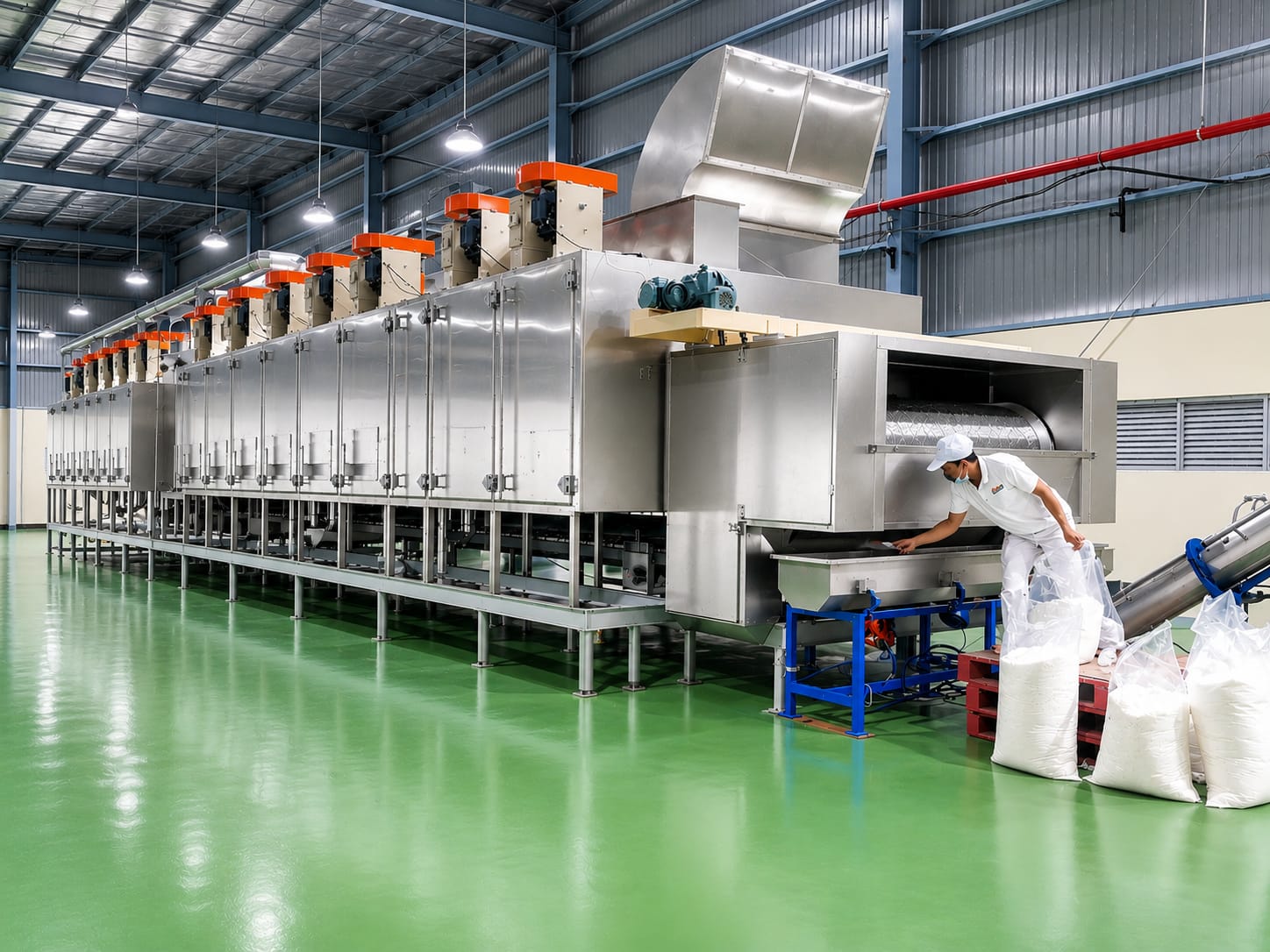
The GENEX Band Dryer (Model: BD SS) operates as a multi-stage, continuous convective drying system. GENEX specifically engineered this machine to gently and uniformly reduce moisture in high-fat coconut gratings. Furthermore, the core design philosophy focuses on gentle product handling, precise residence time control, optimized airflow distribution, and uncompromising food-grade hygiene. Accordingly, every structural detail reflects world-class sanitary engineering principles.
2. Detailed Working Principle
The operational cycle of the GENEX Coconut Band Dryer follows a precision-engineered continuous thermal process:
-
Feeding Stage: Upstream grating and blanching machines continuously feed freshly prepared coconut gratings into the dryer. Then, a custom-designed feeding mechanism spreads the material evenly across the moving stainless steel conveyor belt. As a result, the bed depth remains perfectly uniform across the entire belt width.
-
Multi-Zone Drying Chambers: Next, as the continuous belt advances, the product passes through multiple independent drying zones. Each zone manages specific thermal gradients. Thus, moisture evaporates smoothly and progressively from the core of the coconut particles outward. Simultaneously, this multi-zone setup prevents thermal shock.
-
Controlled Air Circulation: Meanwhile, steam, thermic fluid, or indirect hot air generators supply clean heat to the system. Precision-calibrated blowers force this hot air uniformly through the porous coconut bed. Consequently, moisture evaporates rapidly without blowing fine particles away or causing oil separation.
-
Discharge and Cooling: Finally, upon completing its transit through the drying chambers, the dried coconut reaches the discharge conveyor. Here, automated controls maintain the final moisture content strictly between 3% and 5%. Finally, the system continuously transfers the material to downstream cooling and packing lines.
3. Comprehensive Technical Specifications
For plant designers, project engineers, and operations managers, understanding the exact parameters of the GENEX Band Dryer helps ensure accurate capacity planning:
-
Processing Capacity: Ranges from 250 kg/hr to 2000+ kg/hr of finished output.
-
Input Moisture Content: Handles freshly grated coconut at ~50% to 55% moisture.
-
Output Moisture Content: Regulates moisture precisely down to 3% to 5% (with strict control mechanisms maintaining a maximum threshold of 3%).
-
Mode of Operation: Features continuous belt drying built for 24×7 heavy-duty industrial operation.
-
Heating Media Options: Offers flexible configurations including Steam, Thermic Fluid, or Hot Air Generators.
-
Automation & Control: Utilizes advanced PLC and SCADA systems with touch-screen human-machine interfaces. These tools provide automated temperature profiling, belt speed regulation, and data logging. Additionally, GENEX offers semi-automatic options.
-
Material of Construction: Incorporates premium SS304 or SS316 stainless steel across all product-contact surfaces. Therefore, it guarantees absolute compliance with international food safety standards.
4. Key Engineering Features
-
Multi-Stage Temperature Control: Allows operators to establish custom temperature curves across different drying zones. As a result, this prevents thermal shock and preserves delicate aromatic compounds.
-
Uniform Airflow Distribution: Specialized plenum designs balance static pressure and air velocity perfectly. Consequently, this eliminates wet spots or over-dried patches across the entire conveyor belt.
-
Adjustable Belt Speed: Variable frequency drives (VFDs) control the conveyor belt speed. Therefore, operators gain absolute mastery over residence time based on initial moisture variations.
-
Low Heat Loss Insulated Chambers: High-density insulation encased in heavy-gauge stainless steel cladding minimizes thermal leakage. Thus, it significantly reduces overall energy consumption per kilogram of finished product.
-
Dust-Free & Hygienic Environment: Fully enclosed housings prevent ambient dust contamination. Furthermore, integrated dust collection systems effectively capture fine airborne particulates.
-
Custom Feeding & Discharge Systems: Tailored screw feeders and vibratory spreaders prevent product jamming. Hence, they ensure smooth, uninterrupted material flow at all times.
5. Advanced Construction & Customization Options
To suit diverse plant layouts and operational requirements, GENEX provides numerous custom engineering modules:
-
Multi-Pass Belt Configuration: Stacks multiple conveyor tiers vertically within a compact footprint. Thus, it optimizes factory floor space while maintaining high product residence times. In addition, it significantly reduces total structural length.
-
Advanced Air Treatment Systems: Integrates high-efficiency cyclones, wet scrubbers, and air filtration units. Consequently, these systems purify exhaust air streams and recover fine product particles.
-
Heat Recovery Systems: Waste heat exchangers capture thermal energy from exhaust streams to preheat incoming fresh air. As a result, this drastically reduces overall fuel and power consumption. Indeed, facilities report substantial utility savings annually.
-
Clean-In-Place (CIP) Options: Automated sanitation headers streamline washdown procedures between production runs. Therefore, plant teams minimize downtime while maintaining stringent microbiological controls.
Visualizing Coconut Drying Technology
To fully appreciate how these industrial systems operate in real-world manufacturing environments, you can examine the operational video walkthroughs below. These videos show GENEX drying and processing equipment running in active production facilities:
-
Watch the industrial band dryer setup and operational workflow here: GENEX Band Dryer Video
-
Explore comprehensive coconut powder processing and drying machinery in operation here: Coconut Powder Processing Video
These visual references highlight the seamless integration, robust stainless steel fabrication, and continuous automated performance that define GENEX machinery.
Comparative Analysis: GENEX Industrial Dryers and Their Ideal Product Applications
While the Band Dryer remains the gold standard for high-fat desiccated coconut, different coconut derivatives require specialized thermal processing equipment. In fact, selecting the correct dryer ensures high product quality, maximum energy efficiency, and strong operational profitability. Otherwise, using incorrect drying methods can ruin delicate product batches.
The breakdown below details the complete spectrum of dryers that GENEX manufactures. Furthermore, it specifies exactly which dryer best suits each distinct coconut product.
1. Band Dryer (Apron Type Dryer)
-
Design Mechanism: Moves a continuous perforated conveyor belt through compartmentalized thermal drying zones.
-
Best Suited For: High-Fat Desiccated Coconut Powder (Fine, Medium, and Coarse grades), Low-Fat Desiccated Coconut, Coconut Chips, Coconut Threads, Flakes, and Copra Drying.
-
Why It Excels Here: High-fat coconut gratings suffer physical damage and release oil if machines agitate them aggressively. However, the stationary bed on a moving band allows gentle, uniform convective drying without breaking delicate flakes or squeezing out natural oils. Moreover, it serves as the primary choice for preparatory drying in Virgin Coconut Oil (VCO) production lines.
2. Combination Fluid Bed Dryer
-
Design Mechanism: Integrates fluidization principles with multi-stage drying and cooling zones in a hybrid frame.
-
Best Suited For: Free-flowing granular coconut powders, specific medium-to-low-fat desiccated coconut fractions, and specialty coconut granules.
-
Why It Excels Here: Combination fluid bed systems deliver exceptionally high heat transfer rates. As a result, they achieve rapid moisture evaporation within a smaller equipment footprint. In addition, they provide exceptional processing efficiency for lower-fat materials.
3. Spray Dryer
-
Design Mechanism: Atomizes liquid feeds into a fine spray that contacts a hot air stream, instantly evaporating moisture to form fine powders.
-
Best Suited For: Coconut Milk Powder, Coconut Water Powder, and soluble coconut beverage bases.
-
Why It Excels Here: Belt dryers and fluid bed dryers cannot process liquid emulsions. Therefore, spray drying offers the only viable industrial method to convert liquid coconut milk or coconut water into stable, instantly soluble, free-flowing powders. Consequently, it locks in natural dairy-like coconut flavors immediately.
4. Vibratory Fluid Bed Dryer (VFBD)
-
Design Mechanism: Mounts a fluid bed dryer on heavy-duty industrial springs driven by vibratory motors. It mechanically propels solid particles forward while suspending them on an upward cushion of heated air.
-
Best Suited For: Uniform crystalline or granular coconut products, coconut fibers, post-drying cooling of desiccated coconut flakes, and low-moisture specialty fractions.
-
Why It Excels Here: Controlled mechanical vibration prevents bed channeling and eliminates stagnant dead zones. Consequently, it excels at handling products with complex particle size distributions that require gentle, predictable movement.
The Complete Turnkey Coconut Processing Ecosystem
A band dryer does not operate in isolation. In fact, to produce export-grade desiccated coconut powder, factory engineers must integrate the drying stage smoothly into a synchronized processing line. Accordingly, GENEX Tech Industries provides complete turnkey engineering solutions that cover every single phase of coconut processing:
-
Coconut Dehusking & Deshelling Machines: Heavy-duty mechanical units remove outer husks and hard shells safely with minimal kernel breakage. As a result, raw material yields remain high.
-
Paring & Washing Systems: Specialized peeling mechanisms strip away the brown inner seed coat from the white coconut kernel. Consequently, this guarantees a pristine, snow-white final powder. In addition, multi-stage washing systems remove residual surface impurities.
-
Blanching Systems: Controlled hot-water or steam blanching units deactivate native enzymes. As a result, this treatment stabilizes the product against browning and extends shelf life. Furthermore, it reduces overall microbial loads dramatically.
-
Grinding & Grating Machines: Precision industrial graters and mills shred the blanched kernel into fine, medium, or coarse particles with uniform mesh distributions. Thus, downstream drying occurs with maximum uniformity.
-
Band / Fluid Bed Dryers: Continuous thermal processing units reliably reduce product moisture from ~55% down to 3%-5%. In doing so, they create stable, export-ready ingredients.
-
Cooling & Packing Systems: Post-drying fluid bed coolers bring warm coconut down to room temperature before automated packaging machinery handles the material. Thus, this step prevents moisture re-absorption inside the package. Simultaneously, it preserves freshness over long storage periods.
-
Specialized Extraction and By-Product Plants: Complete machinery lines produce Virgin Coconut Oil (VCO), Coconut Milk Powder, Coconut Water Powder, Medium Chain Triglyceride (MCT) Oil, Coconut Biodiesel, Coconut Fiber, and Coconut Paring Oil. Therefore, processors can fully utilize every part of the coconut nut.
Operational Advantages, Energy Efficiency, and Economic Viability
Investing in a high-capacity industrial band dryer from GENEX yields substantial economic and operational advantages for food processing enterprises:
-
Drastic Reduction in Fuel and Power Consumption: GENEX band dryers achieve exceptional thermal efficiency through advanced thermodynamic modeling and insulated chamber designs. Consequently, this directly lowers utility costs per kilogram of finished product. In fact, long-term operating overhead drops significantly.
-
Uncompromised Product Quality and Export Compliance: Maintaining a final moisture content between 3% and 5% prevents thermal scorching and stops microbial growth. Therefore, processors effortlessly pass stringent international export inspections and food safety audits (meeting US FDA and CE standards). As a result, overseas expansion becomes much simpler.
-
Labor Optimization and 24×7 Reliability: Automated PLC/SCADA control panels minimize the need for manual operator intervention. Operators monitor temperatures, airflow rates, and belt speeds easily from a centralized control desk. Thus, the system guarantees consistent batch repeatability during continuous 24-hour manufacturing cycles. Furthermore, mechanical downtime is drastically reduced.
-
Maximized Oil Retention: Because high-fat desiccated coconut derives significant commercial value from its rich natural oil content, gentle convective drying remains critical. As a result, natural oils stay locked inside the cellular structure rather than breaking down into free fatty acids. In summary, overall product value remains at its absolute peak.
Transition Matrix and Technological Overview
| Technology / Parameter | Industrial Band Dryer | Combination Fluid Bed Dryer | Spray Dryer | Vibratory Fluid Bed Dryer |
| Primary Material Form | Solid gratings, flakes, chips | Free-flowing granules, powders | Liquid emulsions & liquids | Granules, fibers, crystals |
| Ideal Input Moisture | 50% to 55% | 20% to 35% | Liquid slurry feed | 10% to 20% |
| Target Output Moisture | 3% to 5% | 3% to 4% | 2% to 3% | 2% to 4% |
| Product Agitation | Zero (Stationary Bed) | Moderate Fluidization | Atomized Droplets | Controlled Vibration |
| Main Advantage | Preserves high fat & white color | High thermal transfer rate | Instant powder transformation | Prevents bed channeling |
Detailed Step-by-Step Processing Analysis
Phase 1: Raw Material Preparation
First, workers dehull and deshell raw coconuts carefully. Next, operators pare off the brown testa. Afterward, the clean white kernel passes through washing and blanching stages to ensure total microbiological safety. In this way, raw kernel contamination is completely prevented.
Phase 2: Comminution and Sizing
Furthermore, automated conveyors transfer the blanched kernel directly to precision grating machinery. Here, mechanical blades reduce the material into exact particle sizes (fine, medium, or coarse). Consequently, uniform particle sizing guarantees equal heat distribution during the subsequent drying phase. In addition, exact sizing improves overall product presentation.
Phase 3: Continuous Thermal Drying
In this stage, the wet gratings move smoothly through the multi-zone GENEX Band Dryer. Because controls precisely regulate airflow and temperature in each individual zone, the machine removes moisture gently. Meanwhile, the coconut retains its full natural fat content and bright white color without scorching. As a result, final quality targets are met consistently.
Phase 4: Cooling, Screening, and Packaging
Finally, a dedicated cooling system lowers the dried coconut to ambient room temperature. Then, vibrating screens grade the material for uniform particle size before conveying it to automated vacuum packing units. As a result, the packaged product achieves maximum shelf stability, superior flavor retention, and premium export quality. In summary, the entire process operates without manual contamination risks.
Comprehensive Conclusion
The production of high-fat desiccated coconut powder demands sophisticated engineering. Ultimately, commercial success in this competitive global market hinges on the reliability, precision, and hygiene of your factory’s drying infrastructure. Therefore, choosing an experienced equipment partner is the most important decision a factory manager can make.
GENEX Tech Industries combines over forty years of dedicated engineering expertise with modern manufacturing practices. Backed by rigorous quality certifications (ISO 9001:2015, CE, US FDA), GENEX delivers world-class industrial machinery. From their flagship Band Dryer (Apron Type Dryer) to specialized spray dryers and complete turnkey processing lines, GENEX supplies the foundational technology required for sustainable, highly profitable, and export-grade manufacturing operations. Consequently, clients worldwide rely on GENEX to power their processing expansion.
For industrial project planners and agro-processors looking to build or upgrade a coconut processing facility, partnering with GENEX guarantees technical support, custom plant design, and long-term operational excellence.
Call to Action & Corporate Contact Information
Are you planning a new Desiccated Coconut Powder Plant? Or are you expanding your current processing capacity and upgrading your thermal drying equipment? The engineering and technical consultation team at GENEX stands ready to assist you today with capacity planning, equipment selection, customized plant layouts, and complete turnkey project execution.
Contact GENEX Tech Industries today to request detailed equipment pricing, technical data sheets, and personalized plant consultation services:
Head Office Address:
GENEX Tech Industries LLP
10C, Sir William Jones Sarani (Middleton Row), Park Street,
Kolkata – 700071, West Bengal, India
Direct Phone / WhatsApp Contact:
+91-97489 06968 | +91-93300 77417
Official Business Email:
mktg@foodtechprojects.com | sales@foodtechprojects.com