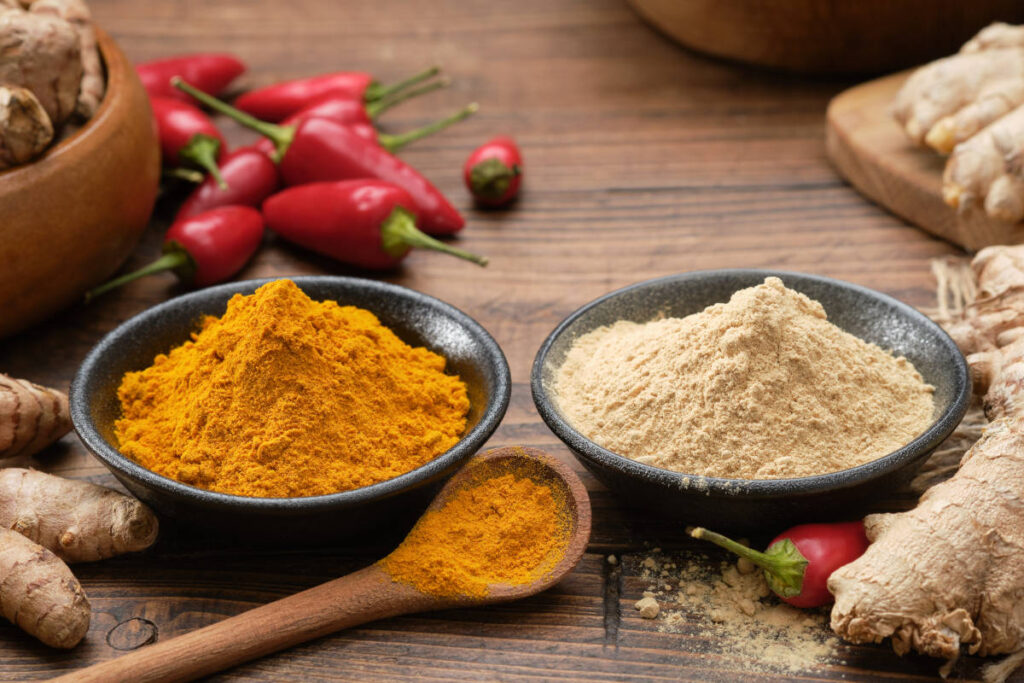
In the modern global marketplace, the botanical and spice processing sector is currently undergoing a major structural transformation. Furthermore, global demand for active phytochemicals—specifically gingerols in ginger (Zingiber officinale) and curcuminoids in turmeric (Curcuma longa)—has surged dramatically across nutraceutical, pharmaceutical, and commercial food processing industries. Today, the global ginger market is valued at over $6.01 billion. Simultaneously, the global turmeric market continues to expand steadily due to growing clean-label health formulations.
In terms of global production, India proudly produces over 75% of the world’s turmeric. Additionally, India holds a massive, dominant share of global ginger output. However, despite these high yields, post-harvest losses remain a major problem. Furthermore, traditional open-sun drying risks, thermal degradation, and volatile oil losses present constant challenges for commercial processors.
Therefore, transitioning away from crude agricultural drying methods toward automated, precision-controlled thermal dehydration has become an absolute necessity for producing export-quality ginger and turmeric. Ultimately, commercial processors must retain bioactive compounds. They must also preserve natural vibrant color and eliminate microbial contamination while concurrently managing operational energy costs.
The Chemical & Physical Physics of Dehydrating Rhizomes
To begin with, both ginger and turmeric are complex underground rhizomes. They feature dense cellular walls, high initial moisture contents, and highly sensitive thermo-labile active compounds. Consequently, understanding their exact physical behavior during thermal dehydration is critical for engineering efficient industrial machinery.
Moisture Dynamics & Dehydration Targets
- Fresh Harvesting State: To start with, freshly harvested ginger and turmeric rhizomes naturally contain between 78% and 85% initial moisture content.
- Target Dried State: Eventually, for long-term storage, oleoresin extraction, or grinding into fine powders, processors must systematically reduce this moisture content. Specifically, they must drop it down to a safe target level of 6% to 8%.
- Water Activity ($a_w$): Most importantly, effective thermal dehydration must lower the overall water activity level below 0.60. As a direct result, this critical threshold prevents microbial proliferation. Furthermore, it stops mold formation and completely halts enzymatic degradation over time.
Bioactive Sensitivity & Thermal Thresholds
In addition to moisture management, traditional high-temperature hot-air drying often causes significant quality loss due to thermal damage:
- Curcumin Degradation: For instance, curcuminoids give turmeric its characteristic golden-yellow color and bioactivity. However, continuous exposure to temperatures above 65°C over extended periods degrades curcumin rapidly. Consequently, this thermal damage turns the product dark brown. As a result, it substantially reduces its pharmaceutical value.
- Gingerol to Shogaol Conversion: Similarly, ginger’s natural pungency stems primarily from gingerols. When subjected to excessive heat, these delicate gingerols convert rapidly into shogaols and volatile sesquiterpenes. As a consequence, this conversion dramatically alters the natural flavor profile. In addition, it diminishes therapeutic properties.
- Volatile Oil Retention: Furthermore, both rhizomes contain valuable essential oils such as zingiberene and turmerone. These oils have strict evaporation thresholds. Therefore, maintaining controlled low-to-medium temperature drying profiles is essential. In doing so, processors avoid losing these aromatic compounds.
Pre-Treatment & Processing Workflow
Before fresh rhizomes enter the main dehydration chamber, they must undergo systematic preparation. This pre-treatment ensures uniform moisture transfer. Furthermore, it maximizes total thermal efficiency during the drying cycle:
- Fresh Harvesting: Initially, workers harvest raw rhizomes directly from agricultural fields. At this stage, they contain approximately 80% to 85% initial moisture content.
- Washing & Desanding: Subsequently, because rhizomes grow underground, they carry heavy soil loads. Therefore, high-pressure water sprayers and rotary drum washers thoroughly cleanse the intricate folds of the roots. As a result, they completely remove dirt and foreign impurities.
- Polishing & Peeling: Next, depending on the desired final specification, an optional peeling stage removes the tough outer skin prior to further processing.
- Boiling & Blanching (Turmeric Specific): Meanwhile, raw turmeric rhizomes undergo controlled steam boiling or hot-water blanching for 45 to 60 minutes. As a direct result of this step, starches gelatinize effectively. Consequently, the natural yellow color sets uniformly throughout the core. Furthermore, wild surface yeast and microbes are completely eliminated.
- Precision Slicing & Flaking: Afterwards, drying intact whole rhizomes requires prolonged periods, often lasting 30 to 48 hours. Moreover, this slow process leads to internal core spoilage. Therefore, modern facilities utilize high-speed mechanical slicers. These units cut the roots into uniform 2mm to 5mm slices or flakes. Consequently, this step vastly increases the surface-area-to-volume ratio for rapid moisture evaporation.
- Thermal Dehydration: Following preparation, the uniform slices pass continuously into specialized drying equipment. There, moisture levels are systematically dropped down to 6% to 8%.
- Cooling & Packaging: Finally, technicians condition and cool the dried material to ambient temperatures. Thereafter, they seal it immediately into high-barrier, moisture-proof packaging.
Industrial Drying Technologies for Ginger & Turmeric
Selecting the appropriate industrial drying equipment depends heavily on the physical state of the raw feed, such as whole rhizomes versus sliced flakes. Furthermore, total throughput requirements and the intended final end-use play a major role in this decision.
1. Multi-Pass Continuous Industrial Band & Belt Dryers
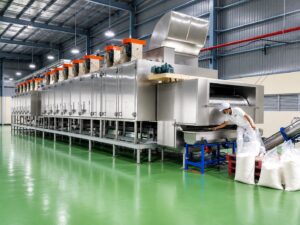
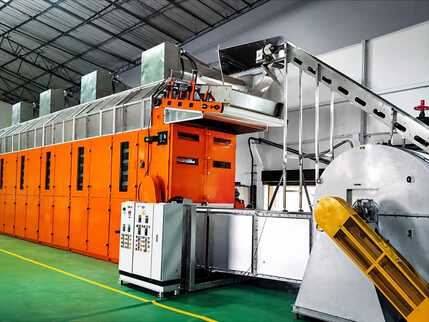
For high-volume, continuous processing of sliced ginger and turmeric, Multi-Pass Continuous Band Dryers and Mesh Belt Dryers serve as the primary industry standard.
Process Mechanics
In this continuous system, wet sliced rhizomes enter via an automated oscillating conveyor feeder. This unit evenly spreads a uniform layer across a perforated stainless steel (SS304/SS316) continuous belt. As a result, the product moves smoothly through distinct thermal zones in a multi-tier arrangement:
- Top Belt (Zone 1): First, wet slices containing roughly 80% moisture enter the uppermost tier. Here, high-velocity airflow at 65°C performs rapid primary surface dehydration.
- Middle Belt (Zone 2): Next, as the product reaches the end of the top run, it cascades and flips downward onto the second tier. In this zone, a moderate air temperature of 55°C pulls bound internal moisture from the cellular matrix to the surface.
- Bottom Belt (Zone 3): Subsequently, the semi-dry material cascades onto the final lower tier. In this final phase, gentle finishing air at 45°C carries out precise moisture equalization. Consequently, the machine continuously discharges dry flakes at a uniform 6% to 8% target moisture content.
Multi-Zone Thermal Control
- Zone 1 (Initial Stripping): Initially, high hot-air volumes at 60°C to 65°C rapidly remove surface water. In doing so, the system prevents case hardening, which is the unwanted hardening of the outer cellular skin.
- Zone 2 (Intermediate Drying): Afterwards, moderate temperatures between 50°C and 55°C steadily extract bound moisture as internal diffusion rates begin to decline.
- Zone 3 (Finishing & Cooling): Eventually, lower air temperatures at 40°C to 45°C safely bring final moisture levels down to specification. Meanwhile, the zone simultaneously cools the product prior to discharge.
Core Advantages
- Continuous, fully automated 24/7 processing capability requiring minimal manual intervention.
- Precise multi-zone thermal management that safeguards heat-sensitive curcuminoids and essential volatile oils.
- Cascading flips between belt tiers that continuously expose new surface areas, thereby completely eliminating wet spots or uneven drying.
2. Low-Temperature Industrial Heat Pump Dryers
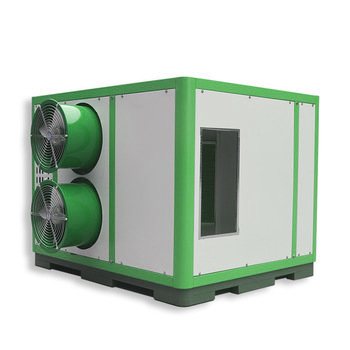
When preserving high-value essential oils, volatile flavor compounds, and natural vibrant color is the highest absolute priority, Industrial Heat Pump Dryers offer a remarkably energy-efficient, closed-loop thermal drying solution.
Operating Principle
Unlike traditional open-vented systems, heat pump drying operates on a completely closed-loop refrigeration cycle. Thus, it avoids venting hot, moisture-laden air into the outside atmosphere. Specifically, fans continuously extract moist air from the main drying chamber. They route this air directly across an evaporator coil. At this stage, the air cools below its dew point. As a result, water vapor condenses into liquid and drains away safely.
Thereafter, the cold, dehumidified dry air flows across a condenser coil. This coil reheats the air to the target processing temperature. Finally, this warm, dry air recirculates back into the drying chamber to continuously pull moisture from the product bed.
Key Capabilities
- Low-Temperature Dehydration: Operates with exceptional control at low drying temperatures strictly between 35°C and 50°C.
- Mechanically Dehumidified Air: Because air is dried mechanically before re-entering the chamber, high evaporation rates are maintained even at lower processing temperatures.
- Exceptional Energy Efficiency: The system reclaims latent heat from condensing moisture. Thereby, it reduces overall electricity consumption by 40% to 60% compared to conventional direct electrical hot-air units.
- Aroma & Color Preservation: Most notably, the sealed closed-loop design traps volatile aromatic compounds. Consequently, it fully preserves the rich natural aroma profile of gingerols and turmerones.
3. Vibratory Fluidized Bed Dryers (VFBD)
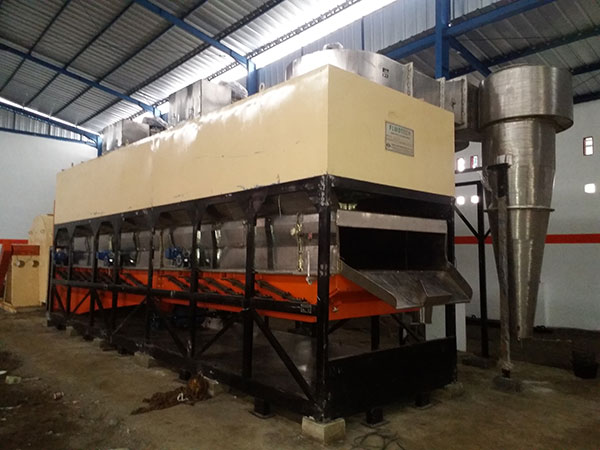
For processing pre-cut ginger or turmeric granules, small bits, or pre-dried coarse particles, Vibratory Fluidized Bed Dryers deliver remarkably fast heat and mass transfer.
Operating Principle
Inside a vibratory fluidized bed dryer, powerful supply fans force heated air upward through a perforated distributor plate. Concurrently, heavy-duty eccentric motors apply controlled mechanical vibration to the entire bed assembly. Consequently, this combination of directional vibration and upward airflow suspends the spice particles in mid-air. As a result, the fluidized particles behave similarly to a boiling liquid.
Core Advantages
- Intense Heat Transfer Rates: Because heated air completely surrounds every single particle on all sides, drying cycles complete in minutes rather than hours.
- Uniform Moisture Distribution: This technology completely eliminates localized hot spots. Thus, it ensures every particle achieves the target 6% moisture level with high consistency.
- Gentle Mechanical Action: Furthermore, controlled mechanical vibration prevents particle collision damage. As a result, it keeps fragile dried ginger and turmeric granules structurally intact.
4. Combination Fluidized Bed Dryers
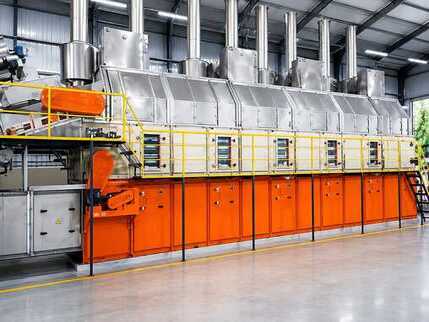
To handle raw feed materials featuring varying moisture levels or sticky surface characteristics, Combination Fluidized Bed Dryers integrate multiple thermal drying mechanisms into a single continuous plant layout.
Process Strategy
This hybrid configuration strategically combines an initial continuous band or tray pre-drying stage with an integrated fluidized bed finishing section:
- Primary Stage (Band/Tray Zone): Initially, high-moisture wet slices containing roughly 80% water enter the initial belt zone. There, the system evaporates surface water rapidly and stabilizes particle structure.
- Secondary Stage (Fluid Bed Zone): Subsequently, the semi-dried flakes, now at 20%–25% moisture, transfer directly into the fluidized bed section. In this zone, rapid final drying reduces moisture down to 6%.
As a direct result of this hybrid configuration, processors achieve lower overall energy consumption. Furthermore, they reduce total equipment footprint and completely prevent product clumping during early drying phases.
5. Refractance Window (RW) Drying Systems
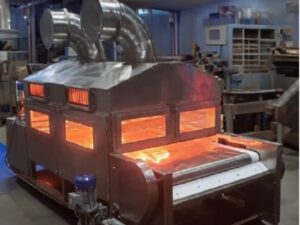
For processing liquid extracts, purees, or concentrated botanical suspensions of ginger and turmeric, Refractance Window Dryers represent an advanced, state-of-the-art thin-film thermal drying technology.
Thermal Mechanism
Refractance Window technology harnesses circulating hot water below the boiling point, typically 90°C to 95°C. This water transfers thermal energy rapidly through a specialized, heat-transparent conveyor membrane.
- First, an automated applicator spreads wet slurry or puree as a thin film (1mm to 2mm thick) onto the moving belt.
- Next, thermal energy transfers rapidly via direct thermal conduction and infrared radiation through the belt interface.
- Consequently, moisture evaporates rapidly within minutes. Meanwhile, the actual internal temperature of the product remains low, typically below 60°C to 70°C.
Benefits for Active Bioactives
- Extremely short thermal exposure times preserve heat-sensitive curcuminoids, gingerols, and key vitamins.
- Delivers premium, instantly soluble dry powders featuring exceptional natural color and flavor retention.
- Offers substantially lower capital investment and reduced operating costs in comparison to freeze drying.
6. Industrial Rotary & Batch Tray Dryers
For drying whole un-sliced rhizomes, smaller batch runs, or specialized organic processing, industrial rotary units and high-capacity tray drying cabinets remain widely utilized across the industry.
- Rotary Dryers: Ideal for bulk drying of whole, boiled turmeric rhizomes. The continuous tumbling action inside a heavy-duty rotating drum ensures uniform exposure to hot air currents over extended cycles.
- Industrial Tray / Cabinet Dryers: Particularly useful for small-to-medium batch processing, R&D trials, or specialty organic processing lines that require strict batch isolation and easy sanitary washdowns.
Comprehensive Dryer Selection Guide
To assist plant engineers in choosing the right equipment, the matrix below pairs specific raw feed formats with their corresponding ideal drying technology:
| Feed Form / Material | Recommended Dryer Technology | Key Processing Parameters | Primary Application |
| Sliced Rhizomes (2–5mm) | Industrial Band / Belt Dryer | Multi-zone 45°C–65°C air, continuous multi-tier belt | Continuous, high-volume export flake production |
| High-Essential-Oil Slices | Heat Pump Dryer | Closed-loop 35°C–50°C dehumidified air | Premium nutraceutical & essential oil grade flakes |
| Granules & Coarse Bits | Vibratory Fluidized Bed Dryer | Fluidized bed with mechanical vibration | Rapid drying of pre-cut bits and ground particles |
| Variable Moisture Granules | Combination Fluid Bed Dryer | Integrated belt pre-drying + fluid bed finishing | High-efficiency continuous processing lines |
| Liquid Puree & Extracts | Refractance Window Dryer | Short thermal contact, thin-film radiation | Soluble powders, oleoresins, high-curcumin extracts |
| Whole Boiled Rhizomes | Industrial Rotary Dryer | Tumbling hot-air cylinder, continuous or batch | Bulk processing of intact whole turmeric rhizomes |
Modern Dehydration Systems vs. Traditional Sun Drying
Furthermore, evaluating modern industrial thermal drying against traditional open-sun drying clearly demonstrates major advantages across all key operational metrics:
| Parameter | Traditional Open Sun Drying | Modern Industrial Dehydration |
| Drying Time | 15 to 30 Days | 3 to 8 Hours |
| Final Moisture Uniformity | Highly Variable (10% – 18%) | Extremely Precise (6% – 8% ± 0.5%) |
| Curcumin/Gingerol Retention | Significant Losses (UV Degradation) | Maximum Retention (Controlled Temp) |
| Weather Dependency | Extreme Risks (Rain/Cloud Spoilage) | Fully Independent (24/7 All-Weather) |
| Microbial Hygiene | High Risk of Aflatoxins & Dust | Hygienic SS304/SS316 Sealed System |
| Footprint Efficiency | Requires Extensive Solar Yards | Compact Industrial Factory Floor Space |
Key Engineering Considerations for Spice Drying Lines
When planning and designing a commercial ginger or turmeric dehydration facility, plant managers must evaluate several critical engineering factors:
- Heating Medium Flexibility: Modern industrial drying systems can be customized to utilize steam heat exchangers, thermic fluid heaters, indirect gas burners, electric heaters, or hybrid heat pump units. Thus, choice depends on localized fuel costs and energy availability.
- Material Construction: Furthermore, all product-contact surfaces must be manufactured strictly from food-grade Stainless Steel (SS304 or SS316). Consequently, they feature hygienic welds, smooth internal radii, and full clean-in-place (CIP) accessibility.
- Air Filtration & Hygiene: In order to satisfy strict international export criteria such as FDA, EU, and FSSAI guidelines, supply air must pass through multi-stage HEPA filtration units. As a result, the system completely eliminates airborne dust and microbial contaminants.
- Thermal Insulation: Finally, heavy-duty mineral wool or polyurethane insulation around all drying enclosures significantly minimizes radiant heat loss. Consequently, this insulation lowers overall fuel consumption and maintains safe, comfortable working temperatures inside the plant.
Turnkey Dehydration Solutions & Engineering Expertise
GENEX Tech Industries LLP specializes in designing, manufacturing, and commissioning custom industrial drying machinery for spice processors, agro-exporters, and food manufacturers globally.
Whether you are seeking to upgrade an existing spice processing facility or install a greenfield continuous dehydration plant, GTI Dryers delivers customized engineering solutions. These solutions are designed for high energy efficiency, maximum bioactive compound retention, and long-term operational profitability.
To learn more about our complete range of advanced drying systems, visit foodtechprojects.com and gtidryers.com.