In modern industrial processing, moisture removal is rarely a simple afterthought. Instead, it is a vital thermal step that governs shelf life, microbial safety, bulk density, and product quality. Furthermore, global manufacturing continues to scale rapidly across food, pharmaceuticals, chemicals, agriculture, and biomass recovery. As a result, traditional batch tray dryers and static ovens can no longer keep pace with modern output demands. Consequently, partnering with an experienced Continuous Band Dryer Machine Manufacturer has become a top priority for plant owners and process engineers.
Moreover, choosing the right dehydration system involves far more than comparing basic dimensions or heating capacities. Specifically, a poorly matched dryer causes case hardening in diced vegetables and oil oxidation in high-fat coconut. Likewise, excessive heat can ruin sensitive herbal extracts or inflate fuel bills across a 24-hour cycle. Conversely, a precision-engineered continuous band dryer—also known as an apron or belt dryer—delivers controlled, multi-zone drying. In fact, it achieves this with gentle handling and high thermal efficiency.
Throughout this comprehensive guide, we explore every detail of continuous band dryer technology, engineering design, and thermal data. In addition, we explain which specific dryer configuration works best for different industrial products. Finally, we show how GENEX Tech Industries LLP, a premier Band Dryer Manufacturer and global supplier of Industrial Band Dryers, builds turnkey dehydration plants tailored to exact process needs.
1. Understanding the Continuous Band Dryer: Core Definition and Operating Principles
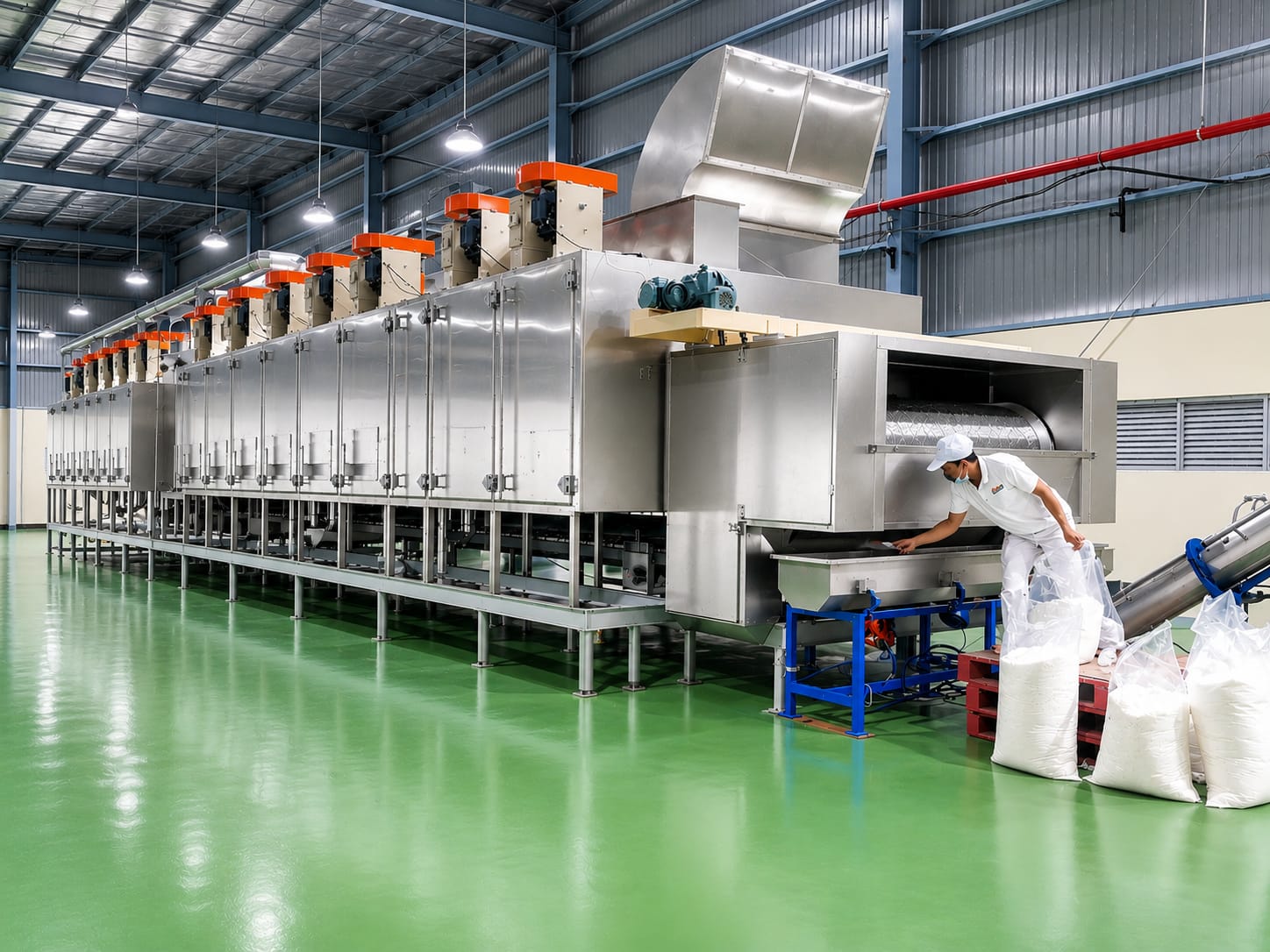
To begin with, a Continuous Band Dryer is an automated, horizontal dehydration machine designed for continuous industrial duty. Specifically, it removes free and bound moisture from wet solids, granules, slices, flakes, pellets, or fibrous mats. Meanwhile, a perforated metal belt or hinged stainless-steel apron conveyor carries the product through an insulated drying chamber.
Unlike rotary dryers, a band dryer does not tumble the material aggressively. Similarly, unlike fluid bed dryers, it does not require narrow particle sizes to achieve fluidization. Instead, the material rests gently on the moving conveyor surface during transit. As a result, mechanical breakage, dust generation, and product attrition drop to near zero. At the same time, conditioned hot air passes either upward through the bed or across the top surface.
The Step-by-Step Continuous Drying Cycle
To understand why leading factories rely on multi-zone band dryers, let us examine each stage of the drying process. Clearly, every phase plays a distinct role in achieving uniform moisture removal.
Stage 1: Uniform Product Feeding and Bed Leveling
First, wet material enters the inlet hood through an oscillating belt feeder, vibrating spreader, or inclined screw conveyor. Immediately afterward, an adjustable leveling rake spreads the wet mass into a uniform bed depth. Typically, this bed depth ranges from 25 mm to 150 mm, depending on particle shape and air permeability. However, without an even bed, hot air bypasses dense spots and channels through thin areas. Consequently, uneven spreading leads directly to inconsistent final moisture.
Stage 2: Entry into Zone 1 (Constant-Rate Drying Phase)
Next, the perforated conveyor carries the leveled product bed into the initial drying zone. Here, surface moisture is abundant and ready to evaporate quickly. Therefore, the system applies higher air temperatures, often between 85°C and 130°C for sturdy agricultural crops. On the other hand, for heat-sensitive items, Zone 1 operates safely between 60°C and 75°C. Meanwhile, air velocities reach 1.5 to 3.0 meters per second. Furthermore, rapid surface evaporation keeps the actual product temperature close to the wet-bulb temperature. Thus, high initial heat transfer occurs without scorching the product.
Stage 3: Progression Through Intermediate Zones (Falling-Rate Phase)
Subsequently, the product moves into Zones 2, 3, and beyond. At this point, free surface moisture disappears, and internal moisture must migrate from the particle core to the surface. Accordingly, each zone features internal baffles, dedicated circulation blowers, and separate heat exchangers. In these middle stages, operators step down air temperatures progressively. For example, air may drop from 95°C in Zone 1 to 80°C in Zone 2 and 65°C in Zone 3. Ultimately, this gradual reduction prevents surface crusting while allowing internal moisture to escape smoothly.
Stage 4: Controlled Exhaust and Partial Air Recirculation
Simultaneously, circulating air absorbs moisture from the product bed, raising its relative humidity. However, exhausting 100% of this warm air would waste massive amounts of fuel. Instead, the damper system vents only 15% to 35% of moisture-laden exhaust air. Meanwhile, it recirculates the remaining 65% to 85% back through the heating coils. Consequently, thermal efficiency improves dramatically while maintaining the exact vapor pressure gradient needed for steady drying.
Stage 5: Integrated Cooling Zone and Continuous Discharge
Finally, the last section of the band dryer often functions as an integrated cooling zone. Specifically, ambient or chilled air reduces the product temperature down to 30°C to 38°C before discharge. Moreover, cooling prevents moisture condensation inside downstream packaging bags and halts residual cooking. At the discharge end, a doctor blade, rotary brush, or gentle vibrating chute transfers the finished goods onto takeaway conveyors.
For a clear visual walkthrough of how an industrial apron and band dryer runs in real production, watch this overview from GENEX Tech Industries LLP:Apron Dryer / Band Dryer Machine | Industrial Continuous Dryer
2. Structural Anatomy and Engineering Architecture of an Industrial Band Dryer
When evaluating a Continuous Band Dryer Machine Manufacturer, engineers must look closely beneath the outer cladding. Naturally, two dryers may look similar from the outside, yet their internal engineering determines real-world durability. Specifically, long-term reliability under 24×7 continuous operation relies on structural rigidity, insulation, airflow balance, and sanitation.
2.1 Heavy-Duty Tubular Chassis and Insulated Enclosure
At the core of a high-performance band dryer sits a rigid tubular steel or stainless-steel frame. Accordingly, engineers design this chassis to absorb thermal expansion and contraction across thousands of operating cycles. Furthermore, the chamber walls, roof, and floor use double-skinned modular panels. In particular, these panels contain high-density rockwool or mineral wool insulation, typically 75 mm to 100 mm thick with a density of 64 to 96 kg per cubic meter. As a result, exterior wall temperatures stay within 5°C to 10°C of ambient room temperature. Thus, this design minimizes radiant heat loss and keeps the factory floor safe for operators.
2.2 Conveyor Belt and Perforated Apron Options
The conveyor mechanism runs continuously inside a warm, humid chamber while supporting heavy wet loads. Therefore, choosing the right belt design is vital for mechanical longevity:
-
Perforated Stainless Steel Apron Plates: First, these conveyors use interlocking SS304 or SS316 plates mounted on heavy-duty side roller chains. Specifically, each plate features precision-punched holes measuring 1.5 mm to 4.0 mm in diameter, creating 20% to 35% open area. Moreover, side guards attached directly to the plates stop product from spilling into the chain tracks. Consequently, apron dryers excel with heavy, dense, sticky, or fibrous items like cassava shreds, coconut gratings, and wood chips.
-
Woven Wire Mesh Belts: Secondly, manufacturers weave these belts from stainless-steel wire in balanced or rod-reinforced patterns. In addition, they provide 40% to 65% open area for maximum airflow permeability. Accordingly, mesh belts work best for lighter, uniform goods like vegetable slices, snack pellets, noodles, and herbs.
-
Modular Food-Grade Polymer Belts: Thirdly, for specialized low-temperature lines operating below 85°C, polypropylene or acetal modular belts offer lightweight performance. Furthermore, their smooth surfaces provide easy release for tacky food products.
2.3 Multi-Zone Airflow Engineering: Up-Draft, Down-Draft, and Cross-Flow
Equally important is how heated air moves through the product bed. In a single-direction airflow system, the bottom layer dries faster than the top layer, creating uneven moisture. Therefore, to eliminate this issue, an expert Continuous Band Dryer Manufacturer engineers alternating airflow paths across zones:
-
Up-Draft Circulation (Bottom-to-Top): First, hot air enters below the perforated belt and flows upward through the bed. Consequently, this upward flow gently lifts dense materials, preventing compaction and boosting heat transfer.
-
Down-Draft Circulation (Top-to-Bottom): Conversely, hot air flows downward through the product layer. As a result, this downward pressure holds lightweight items—such as herbs, leaves, or thin flakes—firmly on the belt so they do not blow away.
-
Alternating Multi-Zone Airflow: Finally, combining up-draft in Zone 1, down-draft in Zone 2, and up-draft in Zone 3 equalizes drying rates. Thus, final moisture stays uniform within ±0.5% to ±1.0% across the entire bed depth without mechanical turners.
2.4 Thermal Energy Sources and Heating Systems
Depending on utility availability and local fuel costs, industrial band dryers support several heating options:
-
Indirect Steam Heating: First, finned-tube heat exchangers made from stainless steel or copper-aluminum fins deliver clean, accurate heat. Meanwhile, modulating control valves regulate steam pressure smoothly. Therefore, steam remains the top choice for food, dairy, and pharmaceutical plants where flue-gas contact is strictly forbidden.
-
Thermic Fluid (Hot Oil) Heating: Secondly, some processes require drying temperatures between 120°C and 220°C without high-pressure steam boilers. In these cases, closed-loop thermic fluid radiators deliver stable, high-temperature heat transfer.
-
Indirect Hot Air Generators (Gas, Diesel, Biomass, or LPG): Thirdly, multi-pass heat exchangers allow plants without central boilers to achieve 82% to 88% thermal efficiency. Crucially, combustion gases stay completely separated from the clean process air stream.
-
Direct Gas-Fired Burners: Next, for non-food industrial, mineral, or biomass applications, modulating line burners heat the process air directly. Consequently, direct firing achieves 95% to 98% thermal transfer efficiency.
-
Electric Heating Banks: Finally, ideal for pilot units, cleanrooms, or facilities using renewable power, thyristor-controlled electric heaters regulate temperature within ±0.5°C.
2.5 Automation, PLC/SCADA Integration, and CIP Sanitation
Finally, modern continuous band dryers replace manual guesswork with closed-loop automation. Specifically, Variable Frequency Drives (VFDs) adjust the main conveyor motor smoothly, setting residence times from 10 minutes to over 180 minutes. Similarly, VFDs control circulation and exhaust fan speeds to balance chamber pressure. Meanwhile, PT100 RTD temperature sensors and humidity transmitters feed real-time data into a central PLC and HMI/SCADA panel. Furthermore, food and pharma dryers include Clean-in-Place (CIP) spray nozzles, sloped drain pans, and belt-washing brushes. In addition, wide swing-out doors provide full access for fast washdowns between production runs.
3. Comprehensive Technical Specifications and Performance Benchmarks
To help engineering teams during initial plant sizing and feasibility studies, the table below lists standard technical specifications. Importantly, all parameters remain fully customizable through GENEX Tech Industries LLP:
| Engineering Parameter | Standard Technical Specification / Range | Customization & Engineering Notes |
| Equipment Classification | Continuous Multi-Zone Band / Apron / Belt Dryer | Available in Single-Pass, Multi-Pass (2, 3, or 5-Tier), and Modular designs |
| Evaporation & Throughput Capacity | 100 kg/hr up to 10,000 kg/hr (10 TPH) | Sized according to initial moisture %, target moisture %, and bulk density |
| Effective Belt / Apron Width | 600 mm to 3,000 mm | Standard modular widths: 1,000 mm, 1,500 mm, 2,000 mm, and 2,500 mm |
| Active Drying Chamber Length | 4 meters to 45+ meters | Built using 2-meter or 3-meter bolted and welded modular sections |
| Number of Independent Zones | 1 to 10+ Thermal Zones | Each zone includes a dedicated fan, heater, damper, and temperature loop |
| Operating Temperature Range | 45°C to 220°C | Low-temp dehumidified mode (45°C–65°C) available for bio-active materials |
| Product Residence Time | 8 minutes to 240 minutes | Continuously variable via VFD-driven main conveyor gearmotor |
| Airflow Velocity Through Bed | 0.8 m/s to 3.5 m/s | Engineered to match particle terminal velocity and bed pressure drop |
| Contact Material Metallurgy | SS304, SS316, or SS316L | Heavy-duty Mild Steel (MS) with high-temp coating available for non-food |
| Thermal Insulation Thickness | 75 mm to 125 mm Rockwool | Prevents thermal bridging and keeps outer walls cool and safe |
| Heating Media Compatibility | Steam, Thermic Fluid, Hot Air Generator, Gas, Electric | Exhaust heat-recovery coils can be integrated to cut fuel consumption |
| Automation & Control Architecture | Manual / Semi-Auto / Full PLC + HMI / SCADA | Includes recipe storage, alarm logs, and live moisture/temperature trends |
| Global Quality & Compliance | ISO 9001:2015, CE, US FDA Compliant Materials | Engineered and built in India to meet strict international export standards |
4. Which Dryer Is Best for Which Product? An Application-by-Application Selection Guide
Plant investors frequently ask: “Which specific dryer model is best suited for our raw material?” Because moisture binding, fat content, sugar levels, and particle shapes vary widely, no single setting fits every product. Below is a detailed guide matching specific materials to their ideal continuous dryer design, complete with realistic process metrics.
4.1 High-Fat Desiccated Coconut Powder and Coconut Chips
Coconut processing is undoubtedly one of the most delicate applications in food dehydration. Specifically, fresh white coconut gratings enter with 45% to 52% moisture and 60% to 68% natural oil content (dry basis). However, drying above 85°C oxidizes coconut oil rapidly, causing yellowing, rancidity, and aroma loss.
-
Best Dryer Choice: Multi-Zone Perforated SS316 Apron Band Dryer with alternating up/down airflow and an integrated cooling zone.
-
Optimal Process Data:
-
Initial Moisture: 48% – 50%
-
Target Final Moisture: Below 2.5% to 3.0%
-
Zone Temperature Profile: Zone 1 at 75°C – 80°C, Zone 2 at 70°C – 75°C, and Zone 3 at 65°C, followed by cooling down to 32°C.
-
Residence Time: 25 to 35 minutes at a bed depth of 40 mm to 60 mm.
-
To see an actual high-fat desiccated coconut continuous band dryer running in a commercial facility, watch this installation video by GENEX Tech Industries LLP:High Fat Desiccated Coconut Powder Band Dryer | Continuous Industrial Drying System
4.2 Dehydrated Vegetables: Onion Flakes, Garlic Slices, Carrot Dices, and Potato Shreds
Vegetables naturally hold 75% to 88% cellular water alongside natural reducing sugars. Consequently, high heat during late drying stages triggers non-enzymatic browning, turning white onion or garlic yellow.
-
Best Dryer Choice: Multi-Stage Stainless Steel Mesh Belt Dryer (3-Stage or 5-Stage Configuration). First, a high-speed, shallow-bed stage removes 70% of surface water rapidly. Next, slower, deeper-bed finishing bands allow internal moisture to diffuse gently without scorching.
-
Optimal Process Data:
-
Onion & Garlic Slices: Initial moisture 80% – 85% reduced to 4.0% – 5.0%. Specifically, Stage 1 runs at 75°C – 80°C, Stage 2 at 60°C – 65°C, and Stage 3 at 50°C – 55°C. Overall, total residence time spans 3.5 to 5 hours.
-
Blanched Carrot & Potato Dices: Initial moisture 82% – 86% reduced to 5.0% – 6.0%. Meanwhile, temperatures step down from 95°C to 65°C over 60 to 90 minutes.
-
4.3 Spices, Herbs, and Leafy Botanicals: Chilli, Ginger, Turmeric, Moringa, and Seaweed
Whole chillies, ginger slices, turmeric fingers, moringa leaves, and seaweed require gentle thermal treatment. Otherwise, excess heat destroys volatile essential oils, natural pigments, and hydrocolloid gel strength.
-
Best Dryer Choice:
-
First, for Moringa Leaves, Culinary Herbs, and Seaweed: Choose a Down-Draft Perforated Belt Band Dryer. Specifically, downward airflow keeps lightweight leaves flat on the belt at low temperatures.
-
Second, for Whole Chillies, Sliced Ginger, and Turmeric: Choose a Heavy-Duty Multi-Pass Apron Band Dryer with high-static-pressure blowers to penetrate thick beds.
-
-
Optimal Process Data:
-
Moringa & Leafy Herbs: Initial moisture 72% – 78% reduced to 6.0% – 8.0% at 48°C – 55°C for 45 to 75 minutes (preserves over 90% of natural chlorophyll).
-
Sliced Ginger & Turmeric: Initial moisture 78% – 82% reduced to 8.0% – 10.0% at 60°C – 68°C over 2.5 to 4 hours.
-
Red Seaweed (Carrageenan Source): Initial moisture 85% – 90% reduced to 12% – 14% at 65°C – 75°C.
-
4.4 Extruded Snack Pellets, Pet Food Kibble, Noodles, and Vermicelli
Extruded snack pellets, pet food kibble, and non-fried noodles need precise humidity control alongside heat. Otherwise, drying too quickly traps internal moisture, causing steam pressure that cracks or warps the product.
-
Best Dryer Choice: Humidity-Controlled Multi-Zone Wire Mesh Band Dryer fitted with automated exhaust dampers or steam conditioning nozzles.
-
Optimal Process Data:
-
Extruded Snack Pellets: Initial moisture 26% – 32% reduced to 9.5% – 11.0%. Specifically, the dryer operates at 65°C – 85°C with 45% to 65% relative humidity in early zones over 35 to 60 minutes.
-
Pet Food Kibble: Initial moisture 24% – 28% reduced to 8.0% – 10.0% at 105°C – 125°C for 20 to 30 minutes, followed by belt cooling.
-
4.5 Pharmaceutical Granules, Herbal Extracts, and Nutraceutical Powders
Pharmaceutical and nutraceutical plants demand zero cross-contamination and strict protection for heat-sensitive active compounds.
-
Best Dryer Choice: CIP-Enabled SS316L Sanitary Band Dryer with HEPA-filtered intake air (99.97% efficiency at 0.3 microns) and dehumidified air conditioning.
-
Optimal Process Data:
-
Wet Granulations & Herbal Extracts: Initial moisture 25% – 40% reduced to 1.5% – 3.5% at 45°C to 65°C over 30 to 60 minutes.
-
4.6 Specialty Chemicals, Resins, Pigments, and Catalysts
Chemical filter cakes, catalyst pellets, synthetic resins, and pigments often contain corrosive salts or tightly bound moisture.
-
Best Dryer Choice: Heavy-Duty Perforated Apron Band Dryer built from corrosion-resistant SS316L or Titanium-stabilized steel. Additionally, an upstream mechanical pre-former extrudes pasty filter cakes into uniform 3 mm to 6 mm strips to boost bed porosity.
-
Optimal Process Data:
-
Extruded Filter Cakes & Pigments: Initial moisture 35% – 55% reduced to 0.5% – 2.0% at 110°C to 200°C over 25 to 50 minutes.
-
4.7 Biomass, Wood Chips, Sawdust, Digestate, and Recycled Plastics
In renewable energy and recycling facilities, drying wet wood chips, digestate, or washed plastic flakes raises heating value and improves pelletizing.
-
Best Dryer Choice: Low-Temperature Waste-Heat Recovery Band Dryer utilizing warm water or exhaust air (75°C – 95°C) from adjacent boilers or engines.
-
Optimal Process Data:
-
Wood Chips & Sawdust: Initial moisture 45% – 55% reduced to 10% – 12% at 80°C – 110°C over 20 to 40 minutes, cutting VOC emissions sharply compared to rotary drums.
-
5. Comparative Analysis: Continuous Band Dryer vs. Alternative Industrial Dryers
Before committing capital expenditure, engineers often compare band dryers with rotary drum, fluid bed, and batch tray dryers. Accordingly, the table below summarizes key operational differences:
| Evaluation Metric | Continuous Band / Apron Dryer | Rotary Drum Dryer | Vibratory Fluid Bed Dryer | Batch Tray Dryer |
| Product Handling & Attrition | Extremely Gentle (stationary on belt; less than 1% breakage) | High tumbling action; heavy breakage and dust generation | Moderate agitation via air fluidization and vibration | Static on trays, but high manual handling damage |
| Particle Size Flexibility | Very Broad (1 mm granules up to 100 mm slices, fibers, and cakes) | Broad, though fine powders cause high dust carryover | Narrow (requires uniform 0.2 mm to 10 mm free-flowing granules) | Broad, suited for small-scale batches |
| Residence Time Control | Exact & Adjustable (10 min to 240+ min via VFD belt speed) | Hard to control precisely; varies with particle size | Short to medium (typically 3 to 25 minutes) | Long (typically 6 to 24 hours per batch) |
| Thermal Efficiency | High (65% – 82%) via multi-zone recirculation and insulation | Moderate (50% – 65%); higher exhaust heat losses | High (60% – 75%) for surface moisture removal | Low (25% – 40%); repeated heating of chamber walls |
| Floor Space Footprint | Moderate to Large (multi-pass tiers cut footprint by 40% – 60%) | Large horizontal length required | Compact footprint for given throughput | High floor area per ton of finished output |
| Labor & Automation | Fully Automated (24×7); 1 operator monitors multiple lines | Automated continuous operation | Automated continuous operation | Labor Intensive; requires manual tray loading and unloading |
| Cleaning & Changeover | Easy with built-in CIP spray bars and large access doors | Difficult internal cleaning due to lifting flights | Moderate; requires removing air distributor plates | Slow, manual tray washing |
Consequently, whenever a product is fragile, sticky, fibrous, or requires staged drying over 15 minutes, a Continuous Band Dryer provides superior control and quality.
6. Single-Pass vs. Multi-Pass Band Dryers: Optimizing Plant Footprint and Process Control
When working with a Band Dryer Manufacturer, engineers must select between a Single-Pass and a Multi-Pass (Multi-Tier) layout.
Single-Pass Continuous Band Dryer
In a single-pass system, one conveyor band runs straight from the wet feed inlet to the dry discharge end inside a single horizontal chamber.
-
Key Advantages: First, zero internal drop transfers protect fragile items like potato chips, brittle snacks, or sticky cakes from breaking or smearing. Second, operators can inspect and wash the single belt plane easily.
-
Best For: Fragile snacks, sticky extruded pastes, and facilities with generous floor length.
Multi-Pass (3-Tier or 5-Tier) Continuous Band Dryer
Conversely, in a multi-pass system, three or five conveyor bands stack vertically inside one insulated housing. First, wet material enters the top band, travels across, and drops gently onto the second band moving in reverse. Subsequently, this cascading path repeats until the dried product exits at the bottom.
-
Key Advantages: First, vertical stacking reduces required factory floor space by 45% to 65% for equal residence times. Second, each gentle drop turns the product bed, breaking up minor lumps and exposing fresh surfaces to hot air. Third, shared insulated walls lower capital cost and reduce heat loss per ton of water removed.
-
Best For: Whole chillies, sliced root vegetables, diced fruits, pet food kibble, wood chips, and high-capacity plants with limited floor space.
7. Energy Efficiency, Heat Recovery, and Operating Cost Optimization
Thermal drying consumes 15% to 25% of total energy in food and chemical factories. Therefore, modern band dryer engineering prioritizes reducing specific energy consumption per kilogram of evaporated water.
Accordingly, leading manufacturers like GENEX Tech Industries LLP build four proven energy-saving features into their continuous band dryers:
-
Precision Exhaust Humidity Control: First, high-temperature humidity sensors in the exhaust ducts link directly to motorized dampers. As a result, the PLC holds exhaust air at 60% to 75% relative humidity, cutting fuel usage by 12% to 18%.
-
Air-to-Air Heat Exchanger Recuperators: Second, warm exhaust air leaving at 65°C to 85°C passes through a stainless-steel heat recuperator. Consequently, this unit preheats incoming fresh air from 25°C up to 50°C – 60°C before main heating, reducing boiler load by 10% to 15%.
-
Variable Frequency Drives (VFDs) on All Process Blowers: Third, instead of throttling fans with mechanical dampers, VFDs adjust motor speed directly to match bed resistance. Consequently, electrical fan power consumption drops by 20% to 35%.
-
Cascading Zone Air Reuse: Fourth, dry, warm air from the final zones (Zones 3 and 4) routes forward into Zone 1 as preheated makeup air. Ultimately, this cascading design maximizes the moisture-carrying capacity of every cubic meter of heated air.
8. Key Criteria for Selecting a Reliable Continuous Band Dryer Machine Manufacturer
Purchasing an industrial dehydration line is a 15-to-25-year capital investment. Thus, buyers must look beyond upfront equipment price to evaluate engineering capability and lifecycle support:
-
In-House R&D and Pilot Testing Facilities: First, a reliable manufacturer tests your exact raw material before finalizing dryer dimensions. Specifically, pilot trials measure moisture diffusivity, shrinkage ratios, bulk density shifts, and scorching limits accurately.
-
Complete In-House Fabrication & Quality Certifications: Second, choose manufacturers certified under ISO 9001:2015 quality systems. Furthermore, verify CE safety compliance and US FDA-compliant stainless steel contact parts (SS304 / SS316L).
-
Custom Process Integration (Turnkey Capability): Third, band dryers perform best when integrated seamlessly with upstream washers, slicers, blanchers, and feeders, plus downstream coolers, sifters, grinders, and packing machines.
-
Proven Global Installations & Spare Parts Availability: Fourth, confirm successful installations across export markets and verify fast local access to replacement chains, sprockets, bearings, and control components.
9. Why Global Processors Choose GENEX Tech Industries LLP
With over 40+ years of combined manufacturing and thermal engineering experience, GENEX Tech Industries LLP (operating globally via www.foodtechprojects.com and www.gtidryers.com) ranks among India’s foremost manufacturers and exporters of continuous band dryers and turnkey dehydration plants.
What Sets GENEX Band Dryers Apart?
-
Tailor-Made Multi-Zone Engineering: First, engineers custom-build every GENEX dryer around your specific material properties, capacity targets (100 kg/hr to 10 TPH), floor layout, and fuel choice.
-
100% In-House Precision Manufacturing: Second, at their heavy-engineering facility in Howrah, West Bengal, India, every machine undergoes strict weld checks, airflow balancing, insulation testing, and factory acceptance trials before shipment.
-
Hygienic, Export-Grade Construction: Third, units feature smooth SS304 and SS316 contact parts, CIP washdown readiness, and internationally trusted PLC/SCADA automation hardware.
-
End-to-End Turnkey Project Execution: Finally, from initial product trials and 3D plant layouts to installation, commissioning, operator training, and spare parts supply, GENEX provides single-source accountability.
10. Troubleshooting Common Industrial Band Drying Challenges
Even a well-designed dehydration line requires proper parameter tuning to handle seasonal variations in raw materials. Therefore, understanding how to diagnose and resolve common drying issues ensures uninterrupted plant efficiency and consistent batch quality.
10.1 Preventing Case Hardening in Thick Vegetable and Fruit Slices
Case hardening occurs when excessive initial air temperature dries the outer skin of a product too rapidly. Consequently, this hard outer crust traps internal moisture inside the core, slowing down overall evaporation and causing spoilage during storage.
-
Engineering Solution: First, lower the air temperature in Zone 1 by 10°C to 15°C while increasing relative humidity slightly via exhaust damper modulation. Second, ensure uniform slicing thickness upstream so all pieces dry at an identical rate.
10.2 Eliminating Uneven Moisture Across the Belt Width
Sometimes, product discharged from the center of the conveyor contains higher moisture than material along the outer edges. Typically, this happens due to poor feeder distribution or air bypassing along the side seals.
-
Engineering Solution: First, recalibrate the oscillating spreader or leveling rake to maintain an exact, uniform bed height from edge to edge. Second, inspect the side silicone or stainless-steel air baffles to prevent hot air from leaking around the product bed.
10.3 Controlling Sticky or High-Sugar Product Adhesion on Belts
Materials rich in natural sugars or starches—such as blanched sweet potato, mango slices, or herbal extracts—often stick to metal belts during the initial drying stage. As a result, product buildup blocks air perforations and reduces thermal transfer.
-
Engineering Solution: First, apply a food-grade non-stick PTFE mesh overlay or select a modular polymer belt for low-temperature zones. Second, install an automated rotary nylon brush and air-knife scraper at the discharge pulley to keep perforations completely clear.
11. Conclusion and Next Steps
Ultimately, upgrading from batch trays to an automated Continuous Band Dryer improves both production economics and product consistency. By combining gentle conveyor transport with multi-zone temperature control, alternating airflow, and smart heat recovery, continuous band dryers help processors achieve 24×7 high-capacity output with uniform final moisture.
However, every raw material exhibits unique drying behavior, thermal sensitivity, and bed permeability. Therefore, achieving peak performance starts with thorough engineering consultation and empirical drying trials.
Ready to Upgrade or Build Your Continuous Drying Line?
Whether you are launching a new dehydration facility, expanding capacity, or replacing an outdated batch oven, the engineering team at GENEX Tech Industries LLP can support your project with:
-
Customized Product Drying Trials & Moisture Analysis
-
Exact Dryer Capacity & Thermal Load Calculations
-
2D/3D Plant Layout & Process Flow Engineering
-
Detailed Technical Proposals & Competitive Turnkey Quotations
Contact our thermal engineering and sales specialists today to discuss your drying requirements:
Head Office Address: GENEX Tech Industries LLP 10C, Sir William Jones Sarani (Middleton Row), Park Street, Kolkata – 700071, West Bengal, India
Direct Phone / WhatsApp Contact: +91-97489 06968 | +91-93300 77417
Official Business Email: mktg@foodtechprojects.com | sales@foodtechprojects.com
Official Company Websites:www.foodtechprojects.com | www.gtidryers.com