Introduction to the Coir Processing Industry
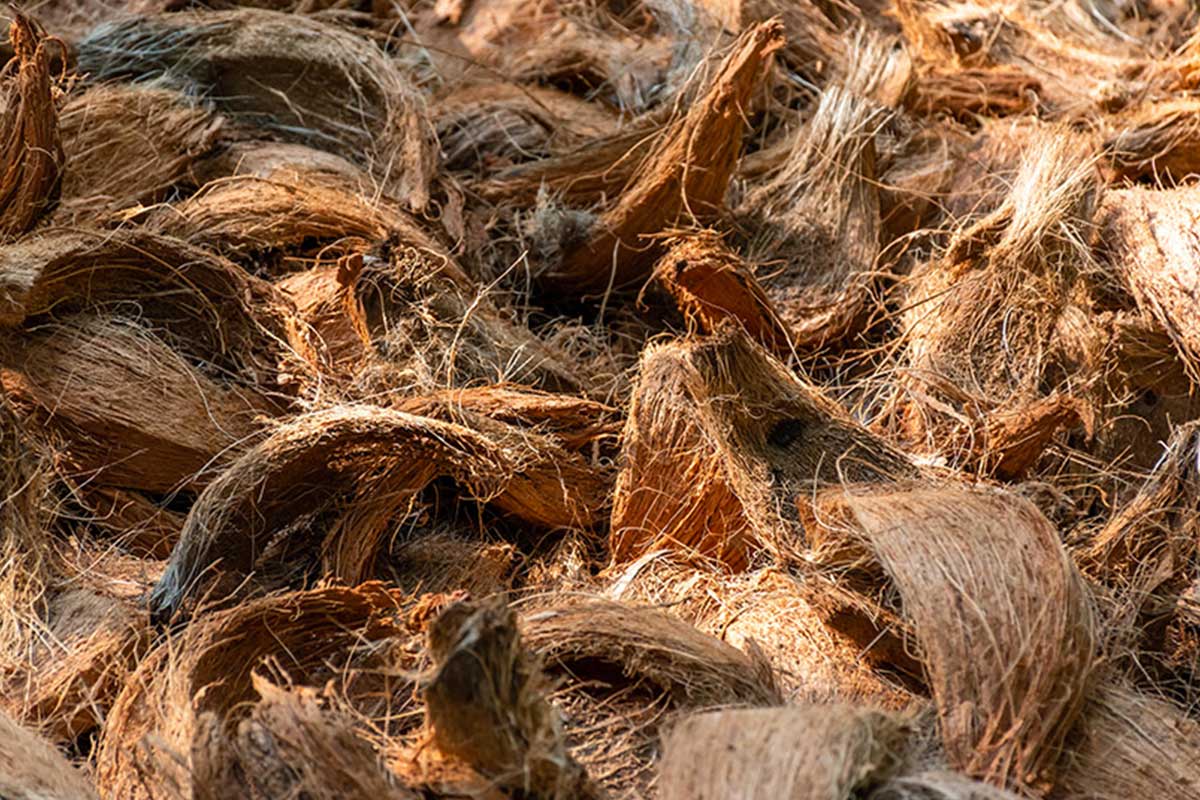
Historically, agricultural markets valued the coconut palm primarily for its edible kernel, fresh water, and high-grade oil. However, within modern agro-industrial processing frameworks, coconut husks represent an equally lucrative commercial frontier. For many decades, plantation managers treated raw husks as bulky agricultural waste. Consequently, workers discarded husks in open fields or burned them inefficiently. Today, through advanced engineering and automated systems, factories convert these raw materials into highly profitable industrial products. Therefore, forward-thinking manufacturers, agri-business leaders, and export enterprises aggressively invest in modern coconut fibre machinery and complete coir processing plants.
Genex Tech Industries (GTI Group) drives this worldwide technological advancement continuously. By manufacturing robust, high-efficiency, and fully automated processing equipment, Genex Tech Industries empowers factory owners to maximize fibre extraction yields significantly. Furthermore, these modern systems eliminate labor bottlenecks and dramatically improve final product quality. This technical guide thoroughly examines every operational, mechanical, and commercial dimension of Genex Tech Industries coir processing infrastructure. Moreover, it details exact drying mechanisms, operational parameters, and target market applications explicitly. As a direct result, prospective plant owners can make confident, highly profitable investment decisions.
Environmental Drivers and Sustainable Growth
In addition, global environmental policies now actively discourage synthetic plastic packaging and non-biodegradable materials. Consequently, international industrial demand for sustainable natural fibres continues to surge rapidly. Because coir fibre offers exceptionally high tensile strength, microbial resistance, and natural elasticity, it stands out as an ideal replacement for synthetic alternatives across multiple global sectors. Furthermore, processing facilities generate zero net waste during operation, as every fraction of the coconut husk serves a distinct commercial purpose. Ultimately, establishing a modern coir facility allows business owners to capture high profit margins while simultaneously contributing to the global green transition.
Understanding Coir Fibre Extraction and Processing
Coir extraction involves a continuous mechanical and thermal sequence that converts raw coconut husks into clean, graded, and market-ready industrial commodities. Specifically, modern facilities execute this transformation through several structured, sequential phases:
-
Husk Preparation and Mechanical Crushing: Raw husks arrive from local farms carrying high moisture levels and dense structural bonds. Before operators feed husks into extraction units, specialized machinery cuts and crushes the outer shells. Consequently, the raw material opens up and accepts downstream processing far more effectively.
-
Defibering and Fibre Extraction: High-speed mechanical defibering units process the crushed husks immediately. Heavy-duty rotating drums beat the fibrous matrix continuously. As a result, the machinery cleanly separates valuable long brown and white coir fibres from the surrounding organic pith.
-
Mechanical Screening and Pith Separation: Once the extraction drums process the raw material, integrated rotary screens receive the mixed output. These mechanical screeners separate loose coir pith (coco peat) from long, clean fibre strands quickly. Consequently, the plant yields two distinct commercial products simultaneously.
-
Fibre Cleaning and Thermal Moisture Regulation: Extracted coir fibres retain significant internal moisture after initial separation. Therefore, conveying systems transport wet fibres into industrial drying equipment. These dryers lower internal moisture content down to a target range between 10% and 15%. As a direct result, the finished coir resists fungal decay during long overseas transport.
-
Hydraulic Compaction and Export Packaging: Finally, high-pressure baling presses and block-making units compress the dried coir fibres and coco peat into dense blocks. Consequently, shipping managers maximize container loads and minimize ocean freight expenses.
Throughout every stage of this integrated processing workflow, Genex Tech Industries equipment guarantees smooth material flow. Furthermore, optimized drive assemblies lower overall electrical power consumption while preserving the natural tensile strength of the coir fibres.
Complete Lineup of Genex Tech Industries Coir Processing Machinery
A successful coir processing enterprise requires a synchronized network of specialized industrial equipment. Genex Tech Industries designs, builds, and delivers a complete range of heavy-duty machinery for high-capacity industrial operations:
1. Coconut Husk Cutter
Initially, plantation workers load whole husks or dense husk piles into heavy-duty coconut husk cutters. These machines utilize hardened alloy steel cutting knives that slice tough husks into uniform geometric fractions. Consequently, downstream crushing machinery receives a consistent feed rate without jam-ups.
2. Husk Crusher and Disintegrator
Immediately following the cutting phase, high-speed conveyors transport raw material into heavy industrial husk crushers. These robust units smash the dense outer husk layers, breaking down the tough lignified matrix. As a result, the equipment loosens the natural bonds holding coir fibres and coco peat together.
3. Coir Fibre Extraction Machine (Defibering Machine)
The mechanical defibering machine represents the primary engine of every coir processing plant. Genex Tech Industries engineers these units with high-torque rotating drums and specially treated steel beating pins. Consequently, the machinery strips long, high-quality fibres away from internal husk tissues while maintaining maximum strand length.
4. Rotary Screener and Pith Separator
To isolate fine coir dust and pith from raw extracted fibres, operators route material through dynamic mechanical screeners and pneumatic separators. As a result, the plant produces pure coir fibre on one discharge line while collecting high-grade coco peat on a secondary line.
5. Fibre Cleaning Machine
Following primary screening, residual dust and fine short fibres often adhere to long coir strands. Therefore, specialized fibre cleaning machines brush and filter the coir thoroughly. Consequently, the final output meets strict international quality grades required by premium spinning mills.
6. Industrial Thermal Drying Systems (Rotary Dryers and Flash Dryers)
Controlling moisture remains vital for preventing mold, decay, and product degradation during long-term storage. Genex Tech Industries incorporates continuous rotary drum dryers and pneumatic flash dryers specifically calibrated for coir’s unique thermal properties.
7. Coir Pith Block Making Machine
For separated coco peat, heavy-duty hydraulic block-making presses compress loose, dusty pith into dense, uniform blocks or briquettes. Consequently, exporters reduce cargo bulk significantly, ensuring optimum transport efficiency across global shipping routes.
8. Heavy-Duty Fibre Baling Press
Long brown and white coir strands enter vertical hydraulic baling presses. These systems exert massive force to compress loose fibres into tightly bound, rectangular export bales secured with steel or plastic strapping.
9. Conveyor Systems and Integrated Dust Extraction
To maintain a safe, clean, and dust-free factory environment, Genex Tech Industries integrates enclosed belt conveyors, heavy screw augers, and high-capacity cyclone dust collectors across the entire processing facility.
10. Centralized PLC Control Panel
Modern industrial plants demand total operational visibility. Therefore, Genex Tech Industries installs intuitive programmable logic controller (PLC) automation panels. As a result, operators monitor motor loads, thermal levels, belt speeds, and output rates in real time from a centralized touch-screen interface.
Detailed Breakdown of Industrial Coir Machinery
To understand how Genex Tech Industries machinery achieves unmatched operational longevity, engineers must evaluate each machine component individually. In this section, we examine the precise mechanics, operational dynamics, and construction advantages of each major unit in the processing line.
Mechanical Husk Cutter Parameters
Husk cutters process incoming raw material right at the intake zone. When operators unload truckloads of mixed green or dried coconut husks, these materials present wide variations in physical dimensions. Genex Tech Industries husk cutters feature dual-counter-rotating shafts armed with heat-treated carbon-steel teeth. As the shafts rotate, they grab incoming husks forcefully and shear them into uniform pieces measuring roughly 50 to 100 millimeters. Furthermore, heavy flywheels store rotational kinetic energy, enabling the cutter to slice through thick, fibrous husks without motor stalling or thermal overload.
Heavy-Duty Disintegrator Mechanics
Once husk pieces leave the cutter, they drop directly into the disintegrator hopper. Disintegrators employ high-speed impact hammers mounted on a dynamically balanced central rotor. When the rotor spins at elevated revolutions per minute, the swinging hammers strike the husk fragments against heavy internal breaker plates. Consequently, this intense impact fractures the woody cell walls within the husk without cutting or damaging the internal coir fibres. Moreover, integrated bottom screens allow properly crushed material to fall through onto transfer belts while retaining oversized fragments for secondary impact.
Advanced Defibering Cylinder Technology
Defibering represents the critical mechanical step where raw husk matrix becomes commercially valuable coir fibre. Genex Tech Industries defibering machines feature heavy-duty steel drums equipped with hundreds of hardened, replaceable steel spikes. As crushed husk material feeds into the drum housing, the high-speed spikes comb, beat, and strip the fibrous mass repeatedly. Specifically, the machine separates long mattress fibres and bristly coir strands from the softer pith tissue cleanly. In addition, adjustable clearance gates allow plant operators to modify drum-to-plate spacing on the fly, allowing precise tuning for varying husk varieties and moisture levels.
Rotary Screening and Pneumatic Pith Classification
Extracted material exiting the defibering drum contains a high percentage of loose coco peat mixed with coir fibres. Therefore, the material passes into a long, inclined rotary trommel screener. The trommel screen features heavy wire mesh or perforated steel plates. As the drum rotates, gravitational forces tumble the material continuously. Fine coco peat particles fall through the mesh openings onto an underlying collection conveyor. Simultaneously, long coir fibres remain inside the drum, tumbling forward toward the discharge chute. Furthermore, secondary pneumatic blowers lift fine dust particles out of the main stream, directing air-borne particulates into high-efficiency cyclone collectors.
Thermal Drying Engineering: Rotary Drum Dryers vs. Pneumatic Flash Dryers
Thermal processing forms a vital bridge between mechanical extraction and export packaging. If coir contains excessive water, mold spores proliferate rapidly inside sealed shipping containers. Conversely, if dryers overheat the fibre, coir strands lose natural elasticity and become brittle. Genex Tech Industries manufactures two primary drying technologies tailored to specific coir fractions:
Rotary Drum Dryers
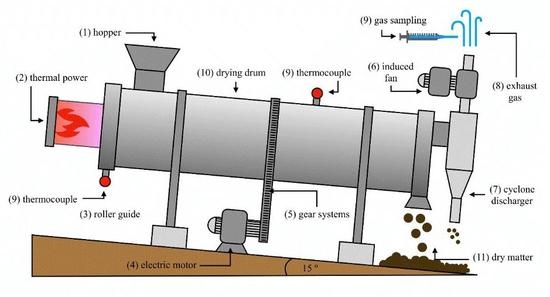
Best Suited For: Long coir fibres, high-moisture loose coco peat, and heavy bulk material feeds.
-
Operational Mechanism: Rotary drum dryers consist of a long, slightly inclined steel cylinder rotating on heavy trunnion rolls. Fuel burners supply clean hot air into the drum intake. As the cylinder rotates, internal flight plates lift wet coir material and shower it continuously through the hot airstream.
-
Core Operational Advantages: Rotary dryers excel at processing high-volume material streams with variable moisture inputs. The long residence time inside the drum allows heat to penetrate deep into wet fibre cores evenly. Consequently, operators reduce moisture levels from initial wet states down to target 10% to 15% thresholds without scorching external surfaces.
Pneumatic Flash Dryers
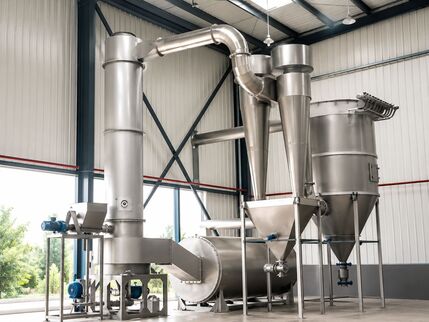
Best Suited For: Fine coir dust, lightweight pith powder, and short coir micro-fibres.
-
Operational Mechanism: Flash dryers utilize high-velocity hot air ducts to lift and transport lightweight material pneumatically. Wet pith particles enter the hot air stream and travel upward through vertical drying columns. Because fine pith particles feature an immense surface-area-to-mass ratio, moisture evaporates almost instantaneously during flight.
-
Core Operational Advantages: Flash dryers provide extremely fast drying cycles, minimal thermal stress, and a compact vertical footprint. Furthermore, integrated cyclone separators extract dried pith powder out of the airstream cleanly, dropping finished product directly into storage hoppers or block-making presses.
Machine Selection Guide for Specific Coir Derivative Processing
To assist plant managers in configuring their production lines, the following reference table matches specific coir raw materials and derivatives with their optimal drying technology and downstream processing equipment:
| Coir Material / Derivative | Primary Processing Goal | Recommended Drying Technology | Optimal Final Moisture Level | Downstream Packaging Equipment |
| Long Mattress Fibre | Remove surface water; retain tensile strength | Rotary Drum Dryer | 12% to 15% | High-Pressure Hydraulic Baling Press |
| Bristle / Stiff Coir Fibre | Preserve strand elasticity; prepare for spinning | Low-Temperature Rotary Drum Dryer | 10% to 13% | Hydraulic Fibre Baler |
| Horticultural Coco Peat | Dehydrate loose pith for export volume reduction | Pneumatic Flash Dryer / Rotary Dryer | 10% to 14% | 5 kg Block / 650 g Briquette Press |
| Coir Dust & Micro-Fibres | Rapid drying for fuel briquettes or filler mass | High-Velocity Pneumatic Flash Dryer | 8% to 12% | Automatic Bagging / Compression Unit |
| Mixed Raw Husk Fractions | Pre-dry crushed husk before fine defibering | Continuous Heavy-Duty Rotary Dryer | 15% to 18% | Secondary Defibering Drum |
Comprehensive Technical Specifications of Genex Tech Industries Coir Plants
Engineering teams and project consultants require exact technical parameters when designing plant layouts, calculating utility loads, and constructing factory foundations. Genex Tech Industries provides fully customizable equipment specifications to match local site requirements:
| Parameter | Industrial Specification Range |
| Plant Production Capacity | 500 kg/hr to 10,000+ kg/hr (modular, scalable expansion) |
| Primary Raw Material Input | Raw green, semi-dry, or fully dry coconut husks |
| Primary End Products | Brown Coir Fibre, White Coir Fibre, Coir Pith (Coco Peat) |
| Material of Construction (MOC) | Heavy structural Mild Steel (MS) with optional Stainless Steel (SS) product contact zones |
| Total Electrical Power Requirement | 20 kW to 200 kW (dependent upon capacity and automation level) |
| Automation Architecture | Semi-Automatic or Fully Automatic PLC-Controlled with VFD Drives |
| Integrated Thermal Dryer Type | Direct-Fired Rotary Drum Dryer or Pneumatic Flash Dryer |
| Target Final Product Moisture | 10% to 15% relative moisture content |
| Operating Drying Temperature Range | 80 degrees Celsius to 180 degrees Celsius (fully adjustable) |
| Civil Foundation Footprint | Custom-engineered layouts tailored to specific factory dimensions |
Technical Plant Layout and Workflow Integration
Building an efficient coir facility requires careful spatial planning and logical material routing. When raw husks arrive at the factory gates, workers unload them into open storage yards adjacent to the primary cutter feed hoppers. Arranging equipment in a linear, logical sequence minimizes material handling costs and eliminates internal transport bottlenecks.
[Raw Husk Storage Yard]
          │
          ▼
 [Coconut Husk Cutter] ──► [Husk Crusher / Disintegrator]
                                      │
                                      ▼
                        [Coir Defibering Machinery]
                                      │
                                      ▼
                        [Rotary Screener / Separator]
                                 ├───► (Long Fibres) ──► [Fibre Cleaning] ──► [Rotary Drum Dryer] ──► [Fibre Baling Press]
                                 │
                                 └───► (Coir Pith)   ──► [Flash / Rotary Dryer] ──► [Pith Block Press]
In a standard Genex Tech Industries turnkey installation, heavy belt conveyors elevate chopped husk material directly into the disintegrator intake. After initial crushing, enclosed transfer conveyors deliver the loosened matrix to parallel defibering drums. This modular arrangement allows plant operators to run multiple defibering lines simultaneously while feeding them from a single high-capacity crushing unit.
Following extraction, split conveyor lines route coir fibres and coco peat along separate processing paths. Fibres pass through cleaning machines and rotary dryers before entering hydraulic baling presses. Simultaneously, coir pith moves through flash dryers toward automatic block-making machines. Integrated dust extraction pipes run overhead along both lines, pulling fine particulates away from working zones and exhausting clean air outside the building.
Raw Material Buffer Management and Warehousing Logistics
Furthermore, plant designers must strategically position raw material storage hoppers to handle seasonal supply spikes smoothly. Because harvesting schedules vary depending on local weather patterns, having ample raw husk inventory ensures continuous factory operations. Additionally, placing finished product storage areas directly adjacent to loading bays drastically reduces fork-lift travel distance. Consequently, warehouse managers load export containers far faster, lowering logistics overhead significantly while protecting compressed bales from humidity.
Quality Control, Moisture Metrics, and Export Standards
International buyers of coir fibre and coco peat enforce strict technical standards. Therefore, processing facilities must implement rigorous quality control measures throughout the manufacturing process to guarantee commercial acceptance in overseas markets.
Managing Fiber Length and Purity
Spinning mills and geotextile manufacturers demand specific fibre lengths. High-grade bristle fibre typically requires length profiles exceeding 150 millimeters, whereas mattress fibre ranges between 50 and 150 millimeters. Genex Tech Industries defibering machines allow operators to adjust drum speeds and beating pin configurations precisely. Consequently, operators minimize strand breakage, maximizing the percentage of premium long fibres. Furthermore, integrated cleaning units remove sand, silica, and short waste fibers, ensuring final impurity levels remain under 3% by weight.
Precision Moisture Regulation
Moisture testing forms a crucial quality control step before final packaging. Standard international trade contracts require coir fibre moisture levels to sit strictly between 10% and 15%. If moisture exceeds 15%, fungal spores grow during ocean transport, discoloring the fibre and weakening its tensile strength. Conversely, if moisture drops below 9%, coir strands become brittle and break during spinning or weaving. Genex Tech Industries drying systems feature automated moisture sensors and feedback loops. These sensors regulate burner thermal output automatically, maintaining uniform output moisture regardless of ambient atmospheric variations.
Coco Peat Electrical Conductivity (EC) and pH Standards
Horticultural growers who import coco peat pay close attention to Electrical Conductivity (EC) and pH metrics. Raw coconut husks near coastal areas often contain natural sodium and potassium salts. If coco peat exhibits high EC levels (above 1.5 milliSiemens per centimeter), sensitive plant roots burn. Therefore, advanced coir processing plants wash raw pith with clean fresh water before thermal drying. Genex Tech Industries supplies integrated pith washing and dewatering screws that drop EC levels below 0.5 milliSiemens per centimeter, producing premium, low-EC horticultural coco peat suitable for international commercial greenhouses.
Comprehensive Maintenance Guidelines for Coir Equipment
Industrial coir processing involves heavy impact, continuous abrasive friction, and airborne dust. Therefore, establishing a disciplined preventative maintenance schedule ensures long equipment life, prevents costly unplanned downtime, and preserves high operational efficiency:
Daily Preventative Tasks
-
Inspect Defibering Pins: Check beating pins on defibering drums daily for wear, looseness, or bending. Replace worn pins immediately to maintain uniform extraction efficiency.
-
Clear Dust Filters: Clean high-efficiency dust collection bags and cyclone discharge hoppers to maintain optimal airflow across factory floors.
-
Monitor Bearing Temperatures: Touch or measure thermal signatures on main drive bearings across cutters, disintegrators, and fan units to spot overheating early.
Weekly Preventative Tasks
-
Check Drive Belt Tension: Inspect V-belts and timing chains across all conveyor drives and drum motors. Retension slack belts to prevent slippage and energy loss.
-
Grease Heavy Bearings: Apply high-temperature industrial grease to trunnion roll bearings, drum shafts, and crusher pillow blocks according to manufacturer specifications.
-
Inspect Cutter Blades: Examine carbon-steel cutter blades for dull edges. Sharpen or rotate modular blade edges to maintain clean husk slicing.
Monthly and Seasonal Tasks
-
Calibrate Thermal Sensors: Recalibrate digital thermocouples and moisture probes located inside rotary dryers and flash drying ducts to maintain heating accuracy.
-
Inspect Hydraulic Systems: Check fluid levels, oil filters, and hose connections on hydraulic baling presses and pith block-making machines. Replace hydraulic fluid annually.
-
Examine Structural Frame Integrity: Inspect heavy steel base frames, motor mounts, and trommel screen supports for stress cracks or loose anchor bolts caused by continuous vibration.
Global Market Applications for Coir Fibre and Coco Peat
The commercial viability of a coir processing venture rests upon robust, multi-industry demand for processed coir products worldwide. Consequently, enterprise owners who install Genex Tech Industries machinery gain direct access to expanding global markets:
-
Agricultural and Horticultural Substrates: Coco peat serves as a world-class soil conditioner, seed-starting medium, and hydroponic grow bag substrate. Its natural porous structure retains water efficiently while providing exceptional root zone aeration.
-
Mattress, Furniture, and Upholstery Manufacturing: Mattress makers needle-punch and rubberize brown coir fibres to produce firm, breathable, and orthopedic mattresses, executive furniture cushions, and automotive seating.
-
Ropes, Twine, and Marine Cordage: Spinning mills convert long, clean coir strands into high-tensile ropes and twines. These natural cordage products resist saltwater corrosion, making them ideal for marine and agricultural uses.
-
Geotextiles and Environmental Erosion Control: Civil engineers deploy woven coir blankets, mats, and mesh logs along railway embankments, riverbanks, and construction sites to stabilize topsoil while vegetation establishes roots naturally.
-
Automotive Interiors and Sustainable Packaging: Automobile manufacturers utilize compressed coir pads for door panel insulation and seat cushioning. Furthermore, eco-conscious packaging firms replace synthetic foams with biodegradable coir packaging molds.
-
Lucrative Global Export Markets: Agricultural regions across North America, Europe, Australia, and the Middle East import massive volumes of compressed coco peat blocks and baled coir fibre, offering reliable foreign exchange returns for factory owners.
Infrastructure Expansion and Environmental Restoration
Moreover, rising environmental awareness globally forces construction and landscaping companies to move away from synthetic geotextile mats. Instead, civil engineers specify natural coir netting due to its high tensile strength and complete biodegradability. Over time, as coir mats naturally break down on riverbanks or slopes, they deposit organic matter directly into the soil, nourishing newly planted native flora. As a direct result, municipal contractors increasingly favor coir-based solutions for public infrastructure projects, expanding domestic and international order pipelines for coir plant operators.
Key Advantages of Partnering with Genex Tech Industries
Selecting an experienced machinery manufacturer directly dictates the operational profitability and long-term success of an agro-industrial facility. Genex Tech Industries offers distinct engineering and service advantages:
-
Superior Fibre Extraction Yields: Optimized drum geometry and beating pin placement maximize long-fibre yield per ton of raw husk, turning potential waste into high-margin inventory.
-
Heavy Industrial Build Quality: Heavy-gauge structural steel, reinforced bearing housings, and premium alloy contact surfaces ensure machines withstand continuous, high-stress operations for years.
-
Optimized Energy Consumption: High-efficiency electric motors, variable frequency drives (VFDs), and insulated thermal drying ducts lower power consumption per ton of processed material.
-
Turnkey Project Delivery: Genex Tech Industries handles the entire project lifecycle—from plant layout planning and custom equipment fabrication to site installation, commissioning, and comprehensive operator training.
-
Certified Quality Standards: Operating under ISO 9001:2015 management systems with CE and US FDA compliant fabrication standards, Genex Tech Industries delivers internationally verified equipment quality.
Conclusion
Transforming raw coconut husks from low-value agricultural waste into high-demand industrial commodities represents an extraordinary commercial opportunity. By deploying Genex Tech Industries coconut fibre machinery and fully automated coir processing plants, enterprise owners secure a strong competitive edge in expanding global markets. Furthermore, through advanced defibering mechanics, precise rotary and flash drying systems, and intelligent PLC automation, Genex Tech Industries ensures high output efficiency, superior product quality, and rapid return on investment. Therefore, investing in a modern coir processing facility with Genex Tech Industries establishes a solid foundation for sustainable, long-term industrial growth.
Call to Action and Corporate Contact Information
Are you preparing to build a new coconut fibre processing facility or upgrade your existing coir manufacturing infrastructure? Contact the engineering team at Genex Tech Industries today for customized plant designs, technical consultations, and detailed cost estimates.
Head Office Address:
GENEX Tech Industries LLP
10C, Sir William Jones Sarani (Middleton Row), Park Street,
Kolkata – 700071, West Bengal, India
Direct Phone / WhatsApp Contact:
+91-97489 06968 | +91-93300 77417
Official Business Email:
mktg@foodtechprojects.com | sales@foodtechprojects.com
Official Company Websites: