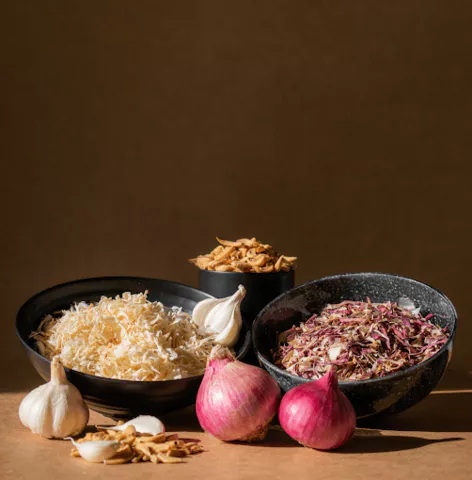
Establishing a commercially viable, high-yield onion dehydration plant or garlic powder processing plant requires far more than purchasing an isolated industrial dryer. It demands a fully integrated, turnkey engineering architecture designed to handle severe biological variables, preserve delicate flavor chemistry, and maintain strict thermal efficiency.
Fresh onions (Allium cepa) and garlic (Allium sativum) consist of approximately 85% to 88% water. Transforming these high-moisture agricultural crops into shelf-stable, export-grade dehydrated onion flakes, minced granules, or fine garlic powders requires removing thousands of liters of moisture per hour while simultaneously preserving heat-sensitive volatile organosulfur compounds—principally allicin in garlic and precursor alliinase systems in onion.
As a leading global onion dehydration plant manufacturer and industrial drying specialist, GENEX Tech Industries LLP (GTI) delivers fully automated, end-to-end processing lines. This comprehensive technical guide details raw material pre-treatment, advanced multi-stage drying physics, downstream milling, precise classification, and modern packaging technologies required to run a high-margin dehydration operation.
1. Raw Material Receiving, Sorting, and Pre-Treatment Operations
The quality of the final dehydrated product is directly proportional to the physical and chemical state of the raw bulb entering the plant. Raw material pre-treatment eliminates non-combustible soil, stones, outer papery skins, and damaged tissue before the product reaches the thermal processing zone.
The sequential flow of pre-treatment operations moves systematically through distinct stages:
-
Raw Material Inspection and Dumping: Fresh produce is unloaded into receiving hoppers designed to cushion the initial impact and prevent mechanical bruising.
-
Dry Cleaning and Mechanical De-stoning: Vibratory and rotary air systems strip heavy debris and field stones from the incoming batch.
-
Automated Top-and-Tail Cutting: Precision double-blade aligners cut away root plates and top necks with minimal yield loss.
-
Abrasive or Water-Jet Peeling and Root Removal: Outer layers are stripped away using compressed air or high-pressure water jets.
-
Optical Sorting and Defect Inspection: High-speed cameras inspect bulbs to discard rotten or discolored units.
-
Precision Slicing, Dicing, or Chopping: Mechanical slicers cut the bulbs into precise, uniform geometries required for even drying.
-
Chilled Water Washing or Blanching: Surface starches are washed away under strictly controlled temperatures.
-
Air-Knife Dewatering Conveyor: High-velocity air knives strip surface water prior to thermal processing.
-
Feed to Continuous Dehydration System: Prepared raw cuts are continuously loaded onto the main drying conveyors.
Dry Cleaning, De-stoning, and Top-and-Tail Trimming
Freshly harvested onions and garlic carry significant field debris, including loose soil, mud, sand, and small stones. Raw bulbs pass through a heavy-duty rotary trommel screen paired with an air blow-off system to remove loose skins and dirt particles without bruising the bulb surface.
From the trommel screen, the material transitions to a vibratory de-stoning unit where density differentials separate stones and heavy foreign objects. Following dry cleaning, onions undergo mechanical top-and-tailing. Automated double-blade aligners position each onion horizontally, executing precise parallel cuts to remove the root plate and top neck with minimal yield loss (typically under 4% to 6%).
Peeling Machinery and Skin Separation Physics
Peeling constitutes one of the most critical mechanical operations in an onion flakes making machine line. Modern plants deploy three main peeling methods depending on throughput requirements:
-
Pneumatic Air-Peeling Systems: Highly preferred for high-volume commercial lines. Bulbs are scored longitudinally by micro-knives and passed through a high-pressure air blast chamber operating at 0.6 MPa to 0.8 MPa. The targeted air jets strip away the outer papery dry skins without using water, preventing premature enzyme activation and maintaining dry solid content.
-
Abrasive Roller Peelers: Utilize carborundum-coated rotating rollers coupled with internal spray nozzles. While effective for garlic cloves and smaller onion varieties, abrasive peeling generates higher solid waste (8% to 12% peel loss) and produces a wastewater stream that requires specialized effluent treatment.
-
Water-Jet & Hydro-Peeling: Employs high-velocity water jets to lift skins. Although gentle on the bulb flesh, it increases surface water loading, requiring additional energy during subsequent dewatering steps.
For garlic processing, the peeling sequence requires an extra step: clove separation (cracking). Whole garlic bulbs pass from the intake hopper into a mechanical clove cracker utilizing counter-rotating, soft-rubberized rollers operating at differential speeds. This cracks the outer bulb head open without crushing individual garlic cloves. The material then passes through a high-velocity air aspirator to remove loose husk skins before entering air-peeling chambers to yield clean, unbruised garlic cloves.
Optical Sorting and Quality Grading
Following peeling, the raw material travels along a food-grade PVC roller inspection belt. Highly automated facilities incorporate tri-chromatic optical sorting cameras equipped with Near-Infrared (NIR) sensors. These sensors inspect 360 degrees of the bulb surface at speeds exceeding 5 tons per hour, detecting internal rot, black mold (Aspergillus niger), sunburn greening, and residual skin fragments. Defective bulbs are discarded automatically using high-speed pneumatic ejector nozzles.
Slicing, Dicing, and Mincing
Uniformity in mechanical size reduction determines the drying kinetic uniformity inside the onion dryer. If slice thickness varies significantly, smaller pieces scorch while thicker slices retain high core moisture, creating microbial spoilage risks during storage.
-
Onion Slicing: Processed through centrifugal precision slicers equipped with micro-adjustable radial blades. Slice thickness is maintained between 3.0 mm and 4.5 mm. Thinner cuts (under 2.5 mm) collapse during thermal drying, restricting bed airflow, whereas thicker cuts (over 5.0 mm) prolong the falling-rate drying stage, increasing energy consumption per kilogram of evaporated water.
-
Garlic Slicing and Chopping: Whole garlic cloves are sliced into 1.5 mm to 2.5 mm cross-sections for garlic flakes, or processed through heavy-duty food-grade dicers to create 3 mm to 5 mm minced pieces.
Washing, Blanching, and Dewatering
-
Onion Pre-treatment: Sliced onions are not subjected to hot water blanching. Thermal blanching ruptures cell membranes, destroying the enzyme alliinase and washing away water-soluble fructans and sugars, which diminishes flavor intensity. Instead, onion slices pass through a rapid chilled-water wash (5°C to 8°C) containing controlled food-grade sanitizing agents to wash away surface starch and residual dirt, preserving total solids and pungent flavor profiles.
-
Garlic Pre-treatment: Garlic slices may undergo a brief ambient washing cycle to remove surface compounds that trigger browning.
Immediately following the washing stage, the wet slices pass over a multi-stage high-velocity air-knife dewatering conveyor. Twin high-pressure turboblowers strip free surface water from the slices, reducing the initial thermal load on the continuous dryer by 3% to 5%.
2. Chemical and Physical Dynamics of Onion & Garlic Dehydration

Understanding the thermodynamic behavior and biochemical reactions during dehydration is vital for optimizing dryer efficiency, preserving natural color, and retaining intense pungency.
The product undergoes three distinct thermodynamic phases during dehydration:
-
Phase 1: High Temperature, High Evaporation Rate (Constant Rate Zone): Fresh bulbs containing 85% to 88% initial moisture content undergo rapid surface water evaporation. Product temperature stays low due to latent heat cooling.
-
Phase 2: Moderate Temperature, Moisture Diffusion (First Falling Rate Zone): Internal water migrates outward through cell structures. Airflow velocity and humidity must be precisely controlled to avoid surface hardening.
-
Phase 3: Low Temperature, Final Moisture Removal (Second Falling Rate Zone): Bound water is slowly drawn off to achieve the target final moisture content of 4.0% to 5.0% for flakes or 3.0% to 4.0% for fine powders.
Drying Curves and Evaporation Kinetics
Dehydration occurs across three distinct physical phases:
-
Constant Rate Period: Surface water evaporates rapidly. The rate of drying is governed purely by external conditions: hot air velocity, temperature, and relative humidity. The surface temperature of the onion or garlic slice remains at the wet-bulb temperature of the drying air due to the latent heat of vaporization, keeping the product cool despite high inlet air temperatures (up to 85°C).
-
First Falling Rate Period: Free surface moisture dissipates, and moisture movement becomes governed by internal capillary forces and liquid diffusion within the plant cell walls. Product temperature begins to rise above the wet-bulb temperature.
-
Second Falling Rate Period: Water bound within the cell tissue slowly migrates to the surface via vapor diffusion. The drying rate drops dramatically, requiring lower drying air temperatures (50°C to 60°C) and extended residence times to avoid thermal degradation and scorching.
Aroma Retention Chemistry
The distinctive flavor profile of onions and garlic stems from enzymatic reactions that occur when plant tissue is crushed or damaged:
-
In Garlic: The precursor alliin (S-allyl-L-cysteine sulfoxide) comes into contact with the enzyme alliinase to form allicin (diallyl thiosulfinate), which produces garlic’s characteristic aroma and sharp taste.
-
In Onion: The enzyme alliinase acts on alk(en)yl-L-cysteine sulfoxides to yield pyruvate, ammonia, and lachrymatory factor (propanethial-S-oxide).
Both alliinase and its precursors are heat-sensitive. Exposure to temperatures exceeding 70°C during the middle and final stages of drying denatures the alliinase enzyme permanently, yielding a bland product lacking pungency. Furthermore, volatile organosulfur compounds evaporate easily under unheated or excessively high-temperature airflow. Advanced industrial dryers must maintain strict zone-based temperature profiles to preserve total pyruvic acid levels—the standard measure of onion and garlic pungency.
Preventing Maillard Reaction and Non-Enzymatic Browning
Onions contain high levels of reducing sugars (glucose and fructose, comprising up to 50% to 65% of total dry solids) alongside amino acids. When exposed to heat and moisture levels between 15% and 30%, non-enzymatic Maillard browning accelerates rapidly.
If drying air temperatures remain elevated in the intermediate drying zone, onion flakes transition from a clean, white-to-light-cream color to an undesirable dark yellow or brown hue. Maintaining precise psychrometric control, step-down temperature zoning, and uniform bed air distribution eliminates localized hot spots and prevents sugar caramelization.
3. Industrial Drying Technologies: Machinery Selection & Engineering Specs
Selecting the correct drying technology is the single most critical capital decision in an onion dehydration plant project. Different dryer designs cater to specific product geometries, output moisture targets, and throughput requirements.
Summary of Industrial Dryer Technologies
-
Multi-Stage Continuous Belt Dryer: Best for high-volume commercial lines producing flakes, slices, and kibbled products.
-
Vibratory Fluid Bed Dryer (VFBD): Best for mid-to-final drying stages of granules, minced pieces, and coarse cuts.
-
Refractance Window Dryer (RWD): Best for heat-sensitive purees, pastes, and premium soluble powders.
-
Infrared Rotary Dryer (IRD): Best for rapid surface pre-drying, de-agglomeration, and surface decontamination of chopped or diced cuts.
-
Industrial Spray Dryer: Best for liquid extracts, atomized purees, and instant soluble powders.
-
Industrial Paddle Dryer: Best for high-density slurries, peel waste recovery, and industrial by-product drying.
Continuous Multi-Stage Conveyor / Belt Dryers
Continuous multi-stage, multi-deck continuous belt dryers (conveyor dryers) serve as the backbone of high-capacity onion and garlic dehydration processing plants globally.
Working Principle and Construction
A continuous belt dryer consists of multiple thermally isolated drying zones housing continuous stainless steel perforated mesh or chain-plate conveyor belts. Wet onion or garlic slices are loaded onto the first belt via an oscillating belt feeder (spreader) to ensure a uniform bed thickness of 50 mm to 100 mm.
As the product moves through the cabinet, hot, filtered air is forced through the bed using alternating up-draft and down-draft circulation patterns. This alternating airflow prevents compaction and guarantees uniform moisture removal throughout the bed height.
The dryer is divided into separate thermodynamic stages:
-
Stage A (Primary High-Evaporation Zone): Operates at inlet temperatures of 80°C to 85°C with high velocity airflow. Surface moisture evaporates rapidly without elevating product temperature.
-
Stage B (Intermediate Falling Rate Zone): Temperatures drop to 68°C to 72°C. Moisture drops from 40% down to 12%. Air circulation is tuned to avoid blowing light, semi-dried flakes off the belt.
-
Stage C (Final Curing/Finish Zone): Temperatures are reduced to 50°C to 55°C with dehumidified air. Moisture content decreases from 12% to the final targeted 4.0% to 5.0%.
Airflow Psychrometry and Energy Recovery
Modern conveyor dryers incorporate multi-zone exhaust recirculation systems. High-enthalpy, low-humidity air from Stage C is redirected into Stage A, reducing fuel consumption by up to 22% to 28%. Heat exchangers powered by indirect steam, thermic fluid, or natural gas burners deliver clean heat without contaminating the product with combustion gases.
-
Primary Application: High-volume onion flakes, sliced garlic, minced garlic, and diced onion.
-
Why It Is Best: Unmatched capacity scalability (1 ton/hr to 10 tons/hr raw input), continuous automated operation, and precise zoned temperature profiling that maximizes energy efficiency and color preservation.
Vibratory Fluid Bed Dryers (VFBD)
Vibratory Fluid Bed Dryers (VFBD) utilize a combination of mechanical vibration and upward thermal airflow to fluidize granular products.
Fluidization Dynamics
The material rests on a perforated stainless steel distributor plate connected to eccentric vibrating motors. Hot air is blown upward through the plate perforations at a velocity matching the minimum fluidization velocity of the particles. The combined mechanical vibration and air drag force lift the onion granules, suspending them in a dynamic, fluid-like state.
Because every particle is fully surrounded by drying air, heat transfer rates are exceptionally high. Localized hot spots are completely eliminated, making VFBDs ideal for delicate intermediate-moisture granules.
-
Primary Application: Granulated onion, chopped/minced garlic, garlic coarse granules, and final-stage curing of kibbled flakes.
-
Why It Is Best: Prevents clumping and sticking of sugar-rich particles, provides uniform moisture reduction down to 3.5%, and preserves bright natural color.
Refractance Window Dryers (RWD)
Refractance Window Drying (RWD) is a continuous, low-temperature film-drying technology designed for heat-sensitive liquids, purees, and fine pastes.
Physics of Operation
A thin layer (1.0 mm to 2.0 mm) of garlic or onion puree is applied onto a moving, heat-transparent conveyor belt made of specialized infrared-transmitting polymer material. The underside of the belt floats on a circulating body of hot water maintained at 92°C to 95°C without boiling.
Thermal energy transfers rapidly through the belt into the wet slurry via conduction and radiation. The moisture in the puree acts as a “refractance window,” absorbing thermal energy directly. As the wet slurry dries into a thin film, the refractance window closes, drastically reducing further heat transfer and protecting the product from overheating.
-
Primary Application: Onion pulp, concentrated garlic paste, and high-value soluble powders.
-
Why It Is Best: Retains up to 92% to 95% of active allicin/pungency, preserves original white/cream color, and consumes up to 30% less energy than freeze drying while delivering comparable quality.
Infrared Rotary Dryers (IRD)
Infrared Rotary Dryers combine electromagnetic radiation (far-infrared wavelengths between 2.5 µm and 10 µm) with mechanical tumbling inside a rotating drum.
Radiative Heating Mechanics
Infrared energy penetrates directly into the outer surface layers of the onion or garlic tissue (1 mm to 3 mm depth), exciting water molecules directly without relying on air heat conduction alone. This triggers instantaneous surface moisture flash-off. The rotating flight geometry inside the drum continuously turns the product over, exposing fresh surfaces to the IR emitters.
-
Primary Application: Rapid pre-drying of fresh onion cuts, surface moisture stripping, and de-agglomeration of sticky dice before main belt drying.
-
Why It Is Best: Extremely rapid moisture evaporation rates, reduced initial drying footprint, and effective surface decontamination/microbial reduction prior to finish drying.
Industrial Spray Dryers
Spray drying converts liquid extracts or liquid purees into fine, free-flowing, instantly soluble powders.
Atomization and Moisture Evaporative Flash
Concentrated onion or garlic extract liquid is pumped at high pressure (15 MPa to 25 MPa) into a high-speed rotary atomizer operating at 15,000 to 22,000 RPM inside a tall drying tower. The liquid is atomized into millions of micro-droplets (20 to 150 microns).
These droplets contact a co-current stream of hot, sterile air entering at 160°C to 180°C. Evaporation occurs almost instantaneously (within 1.5 to 3.0 seconds). The latent heat of vaporization keeps the droplet core temperature below 60°C, preserving aroma compounds before the dry powder falls to the base of the cone for pneumatic collection.
-
Primary Application: Spray-dried micro-encapsulated garlic powder, soluble onion extract powders, and soup mix flavor bases.
-
Why It Is Best: Produces perfectly spherical, highly soluble powders with excellent rehydration profiles.
Industrial Paddle Dryers
Industrial Paddle Dryers are indirect, high-efficiency contact drying systems designed for dense, sticky, or high-solid materials.
Mechanical Heat Transfer
The dryer features a jacketed horizontal trough containing twin counter-rotating shafts fitted with overlapping wedge-shaped hollow paddles. Steam or thermal fluid circulates through both the outer jacket and the internal hollow paddles.
As the shafts rotate slowly, the dual-action paddles wedge into the material, scraping the heated walls and continuously renewing the contact surface. Heat transfers directly through the metal walls into the wet mass without requiring large volumes of sweep air.
-
Primary Application: Processing wet onion peel slurry, recovery of solid plant solids from wash-water effluent, and drying heavy garlic muds for animal feed or industrial usage.
-
Why It Is Best: High thermal efficiency (over 85%), minimal exhaust air volume requiring dust treatment, and capability to process heavy, sticky materials without fouling or clogging.
4. Comprehensive Engineering Comparison of Industrial Dryers
Evaluating performance parameters across drying platforms ensures the correct machinery is integrated into the turnkey plant architecture.
| Technical Parameter | Continuous Multi-Stage Belt Dryer | Vibratory Fluid Bed Dryer (VFBD) | Refractance Window Dryer (RWD) | Infrared Rotary Dryer (IRD) | Industrial Spray Dryer | Industrial Paddle Dryer |
| Primary Physical Feed | Fresh slices, dice, chopped pieces | Semi-dried kibble, granules, coarse cuts | Purees, thick slurries, wet pastes | Fresh dice, surface-wet cuts | Clarified liquid extracts, thin slurries | Heavy solid waste, peel slurry, cake |
| Thermal Energy Source | Indirect Steam / Thermic Oil / Gas Burner | Steam Heat Exchangers / Electric Coil | Hot Water Circulation Loop (92-95°C) | Far-Infrared Radiative Emitters | Direct/Indirect Gas Fired Air Heater | Indirect Steam / Thermal Oil inside Paddles |
| Operating Temp Range | 50°C to 85°C (Zoned) | 55°C to 75°C | 60°C to 70°C (Product Temp) | 80°C to 110°C (Surface Temp) | 160°C to 180°C (Inlet Air) | 100°C to 140°C (Jacket Temp) |
| Product Residence Time | 2.5 to 5.0 Hours | 15 to 45 Minutes | 3 to 7 Minutes | 5 to 15 Minutes | 2 to 5 Seconds | 45 to 120 Minutes |
| Thermal Efficiency | 65% – 75% | 75% – 85% | 80% – 88% | 70% – 80% | 50% – 60% | 85% – 92% |
| Final Product Form | Flakes, Large Cuts, Kibble | Granules, Minced Pieces | Crystalline Flakes, Flakes for Powder | Pre-dried Cuts, Decontam Dice | Soluble Fine Spherical Powder | Dry Industrial Powder / Pellets |
| Allicin / Aroma Retention | High (80% – 85%) | High (85% – 90%) | Exceptional (92% – 96%) | Moderate (70% – 80%) | Moderate (65% – 75%) | Low (Waste/Feed Grade) |
| Scalability | Up to 10+ Tons/Hr | Up to 5 Tons/Hr | Up to 2 Tons/Hr | Up to 3 Tons/Hr | Up to 2 Tons/Hr (Evaporative) | Up to 4 Tons/Hr |
5. Downstream Processing: Kibbling, Milling, Classification, and Conditioning
Once dehydrated onions and garlic emerge from the finish drying zone with a moisture content between 4.0% and 5.0%, they undergo downstream mechanical sizing, milling, and classification to produce distinct commercial product formats: flakes, kibbled pieces, granules, minced cuts, and fine powders.
The downstream processing sequence splits into two primary streams depending on the target product grade:
-
Flake Processing Stream: Dehydrated product output (4.0% to 5.0% moisture) passes directly through an air-swept inspection station, through inline metal detection, and directly into bulk flake packing systems.
-
Granule and Powder Stream: Material is fed into a coarse kibbler or impact crusher, then transferred onto a dehumidified vibratory deck screener.
-
Over-sized Particles (>3.0 mm): Routed to an air-classified pin mill or water-cooled hammer mill, then fed back into a multi-deck gyratory sifter.
-
Granules and Minced Products (0.5 mm to 2.5 mm): Discharged directly into the multi-deck gyratory sifter for final sizing.
-
Fine Dust / Fines (<0.15 mm): Collected via ultra-fine powder pneumatic collectors for standard powder blending.
-
Kibbling and Crushing
Cured, dried onion slices exit the belt dryer as large, brittle flakes. For non-flake applications, the material passes through a low-speed, dual-roll coarse kibbler. The counter-rotating fluted rollers fracture the large flakes into uniform kibbled pieces (3 mm to 8 mm) with minimal creation of unwanted fine dust.
Milling Equipment Selection
Transforming kibbled onion or garlic into specified granular mesh sizes or fine powders requires specialized milling technology designed to control heat generation:
-
Air-Classified Pin Mills: Ideal for producing high-purity garlic powder and onion powder. Pin mills feature high-speed rotating discs studded with steel pins that shatter material through high-velocity impact. An integrated air classifier continuously draws out fine particles that match the target micron size, preventing over-grinding.
-
Water-Cooled Hammer Mills: Used for high-throughput coarse and fine granule grinding. Because dried onion and garlic powders contain hygroscopic sugars that melt and cake if temperatures exceed 45°C, the hammer mill chamber is enclosed in a chilled-water cooling jacket (5°C circulating water). This jacket dissipates friction heat, maintaining cool product stream temperatures.
Multi-Deck Vibratory Sieving and Air Classification
Milled particles pass through closed, dust-tight multi-deck vibratory screeners or gyratory sifters equipped with ultrasonic mesh anti-blinding systems. Ultrasonic transducers vibrate the stainless steel wire cloth at high frequencies, preventing sticky onion particles from blinding the micro-openings.
| Commercial Product Grade | Particle Size Range (Mesh) | Particle Dimension (mm) |
| Large Flakes / Slices | Retained on 4 Mesh | > 4.75 mm |
| Kibbled / Chopped | 4 Mesh to 10 Mesh | 2.00 mm to 4.75 mm |
| Minced | 10 Mesh to 20 Mesh | 0.85 mm to 2.00 mm |
| Granules | 20 Mesh to 60 Mesh | 0.25 mm to 0.85 mm |
| Fine Powder | Passing 80 to 100 Mesh | < 0.15 mm to 0.18 mm |
Air aspirator columns situated at output discharge ports remove ultra-light skin fragments, chaff, and micro-dust from the granule stream, ensuring high bulk density and clean visual optics.
6. Environmental Controls, Product Conditioning, and Packaging
Dehydrated onion and garlic products are exceptionally hygroscopic. Once their moisture content drops below 5.0%, they rapidly absorb ambient moisture from surrounding air. If exposed to relative humidity levels above 35% at ambient temperatures, the sugars dissolve, causing severe product caking, clumping, darkening, and loss of free-flowing properties.
All downstream handling operations take place within a strictly controlled Dehumidified Cleanroom Environment maintained at 20°C to 22°C ambient temperature and 30% to 35% relative humidity. From this cleanroom, product is routed to two dedicated packaging options:
-
Bulk Packaging Line: Material is metered through an automatic multi-head weigher into aluminum-foil laminated liners, double-heat sealed, and cased in corrugated outer master cartons.
-
Retail Packaging Line: Material passes into nitrogen-flushed Form-Fill-Seal (FFS) machines or automated glass/PET jar filling lines fitted with induction foil cap sealers, checkweighers, and X-ray inspection stations.
Dehumidified Packaging Cleanroom Standards
All downstream milling, sieving, conveying, and packaging operations must be housed within an environmentally controlled cleanroom.
-
Temperature Control: Maintained strictly at 20°C to 22°C.
-
Relative Humidity (RH): Maintained at 30% to 35% RH using desiccant rotor dehumidification systems.
-
Air Filtration: Positive pressure airflow filtered through ISO 8 / Class 100,000 HEPA filtration units to eliminate airborne dust and microbiological spores.
Automated Packaging Technologies
-
Bulk Commercial Packaging: Dehydrated flakes and granules are filled into 14 kg to 20 kg multi-wall kraft paper bags or corrugated master cartons fitted with high-barrier 80 to 100-micron low-density polyethylene (LDPE) or aluminum foil laminated inner liners. After automated filling and vibration settling, the inner liners are vacuum-sealed or nitrogen gas-flushed before heat sealing to prevent moisture ingress during transoceanic shipping.
-
Retail Packaging Lines: Automated Form-Fill-Seal (FFS) machines package powders and granules into pouches, plastic jars, or glass containers. Nitrogen flushing reduces residual oxygen levels inside the package to below 1.5%, preventing lipid oxidation, color browning, and aroma loss over a 24-month shelf life.
-
Quality Inspection Interlocks: Integrated line inline systems include high-sensitivity multi-frequency metal detectors (capable of detecting 0.8 mm Ferrous, 1.0 mm Non-Ferrous, and 1.2 mm Stainless Steel) alongside 3D X-ray inspection systems that detect high-density glass, stone, or bone contamination in packed cartons.
7. Turnkey Utility Infrastructure, Energy Balances, and Operational Data
A turnkey dehydration facility requires balanced auxiliary utilities to sustain continuous, uninterrupted 24/7 manufacturing operations. Energy distribution flows across three main primary utilities:
-
Boiler and Steam Utility: Delivers 3 to 10 tons per hour of saturated steam at operating pressures of 0.8 to 1.2 MPa to drive primary heating coils.
-
Thermic Fluid Heater: Supplies closed-loop thermal oil circulating at temperatures up to 250°C for high-temperature indirect heating requirements.
-
Electrical Distribution Network: Features 440V, 3-Phase, 50/60Hz power distribution linked to a centralized PLC/SCADA Power Control Center (PCC).
Energy Requirements per Ton of Finished Output
Evaporating water from high-moisture agricultural crops requires substantial thermal and electrical energy input:
-
Thermal Energy Consumption: Approximately 1.1 to 1.4 kWh (equivalent to 3,800 to 4,800 kJ) of heat energy is required per kilogram of water evaporated, depending on heat recovery integration.
-
Electrical Energy Consumption: Approximately 120 kWh to 180 kWh per ton of dry finished product, driving fans, blowers, mechanical slicers, vibrating screens, and milling systems.
Steam vs. Direct Gas vs. Thermic Fluid Heating
-
Steam Heating Systems: Preferred in large-scale plants. Steam provides stable, precise temperature control across multi-zone belt dryers through modulating steam control valves. Condensed steam returns to the boiler feed tank, recovering sensible heat.
-
Direct/Indirect Gas Fired Systems: Highly economical in regions with low natural gas (NG) or liquefied petroleum gas (LPG) costs. Indirect heat exchangers are mandatory to prevent toxic combustion byproducts (NOx, SOx) from contacting the food product.
-
Thermic Fluid Heating: Operates at high temperatures under near-atmospheric pressure, eliminating the high-pressure hazards of high-pressure steam boilers.
Turnkey Plant Mass Balance Example (10 Tons/Hour Raw Onion Input)
To illustrate operational dynamics, consider a standard commercial turnkey plant designed by GENEX Tech Industries LLP:
-
Raw Onion Input Feed Rate: 10,000 kg/hr at 86% initial moisture content.
-
Total Dry Solids Input: 1,400 kg/hr dry solid mass.
-
Target Output Moisture Content: 4.5%.
-
Finished Product Output Mass: 1,466 kg/hr of dehydrated onion flakes/granules.
-
Total Water Evaporation Load: 8,534 kg/hr of water removed continuously.
8. Plant Layout, Sanitation, and Global Regulatory Standards
A modern turnkey facility must comply with stringent international food safety standards, including US FDA, CE Machinery Directives, ISO 22000, and HACCP certifications.
Material and personnel move through strict hygiene barriers across the facility layout:
-
Raw Receiving Area: Raw bulbs are dumped and dry-cleaned. Personnel pass through hygiene barriers and boot-wash stations before accessing the next zone.
-
Wet Processing Zone: Bulbs are washed, peeled, and sliced before entering the thermal drying enclosures.
-
Dehumidified Cleanroom Zone: Dried material exits the dryer into enclosed cleanroom areas for milling, sieving, and packing.
-
Warehouse and Shipping Area: Sealed corrugated master cartons pass through air-locks or pass-through windows directly into finished goods storage and export shipping bays.
Zoning and Hygiene Separation
The plant layout is strictly segregated into three hygienic risk zones to prevent cross-contamination:
-
Low-Risk Zone (Raw Receiving & Dry Cleaning): Handling of unwashed field produce, dirt removal, and top-and-tailing.
-
Medium-Risk Zone (Wet Processing & Slicing): Washing, chemical sanitization, peeling, and initial slicing under controlled washdown conditions.
-
High-Risk Zone (Post-Drying, Milling & Packaging): Enclosed, dehumidified, positive-pressure cleanroom environments where product is exposed post-drying. Direct staff access requires full cleanroom gowning, air showers, and sanitization stations.
Clean-in-Place (CIP) and Hygienic Machine Engineering
All food-contact surfaces across GTI dehydration plants are fabricated from food-grade Stainless Steel (AISI 304 or AISI 316L) with surface finishes polished to Ra surface roughness less than or equal to 0.8 microns to prevent bacterial adhesion.
Drying cabinets feature integrated Clean-in-Place (CIP) spray balls and sloping self-draining floors, allowing automated chemical washdown and hot water rinsing between production runs without manual dismantling.
9. Comprehensive Turnkey Project Execution by GENEX Tech Industries (GTI)
Partnering with GENEX Tech Industries LLP (GTI) delivers a complete, end-to-end engineering roadmap for establishing an advanced onion and garlic processing plant. GTI acts as a single-source technology partner, eliminating integration errors between disparate equipment suppliers.
Project execution follows six systematic implementation phases:
-
Feasibility & Raw Material Analysis: Evaluating local crop varieties, solid content, and seasonal supply dynamics.
-
Customized Civil & Plant Layout: Engineering 2D/3D plant layouts, piping schematics, and HVAC cleanroom plans.
-
In-House Precision Manufacturing: Fabricating stainless steel dryers, pre-treatment machinery, and milling units to CE/ISO standards.
-
Commissioning & Performance Testing: On-site mechanical assembly, electrical panel integration, and full-capacity performance trials.
-
Operator Training & SOP Transfer: Conducting hands-on staff training on thermal optimization, hygiene, and preventive maintenance.
-
Lifecycle Service & Spare Support: Providing ongoing technical assistance, spare parts delivery, and continuous software updates.
To explore customized industrial drying machinery, technical specifications, and detailed equipment profiles, explore our specialized engineering directories on our official engineering portals at www.gtidryers.com and www.foodtechprojects.com.
10. Turnkey Plant Investment & Operational Strategy Summary
Establishing a profitable onion dehydration plant or garlic powder processing plant relies on three fundamental pillars:
-
Strict Raw Material Selection: Processing raw bulbs with high initial soluble solids (greater than 14% Brix for onions) drastically reduces the thermal energy needed per kilogram of dry product.
-
Matched Drying Technology: Deploying continuous multi-stage belt dryers for high-capacity flakes, combined with vibratory fluid beds for granules or refractance window systems for premium pastes, maximizes product quality and yield.
-
Controlled Downstream Environment: Protecting dehydrated products inside dehumidified packaging cleanrooms guarantees long shelf life, bright color retention, and zero caking during export transit.
By combining advanced thermal engineering, robust stainless steel equipment construction, and intelligent SCADA process controls, GENEX Tech Industries LLP empowers processors worldwide to build highly efficient, sustainable, and high-margin food dehydration enterprises.
Commercial Enquiries & Turnkey Project Consultation
Contact our lead project engineering team today to request a comprehensive techno-economic feasibility report, schedule pilot-plant testing, or discuss your customized machinery requirements:
Head Office Address:
GENEX Tech Industries LLP
10C, Sir William Jones Sarani (Middleton Row), Park Street,
Kolkata – 700071, West Bengal, India
Direct Phone / WhatsApp Contact:
+91-97489 06968 | +91-93300 77417
Official Business Email:
mktg@foodtechprojects.com | sales@foodtechprojects.com
Official Company Websites: