
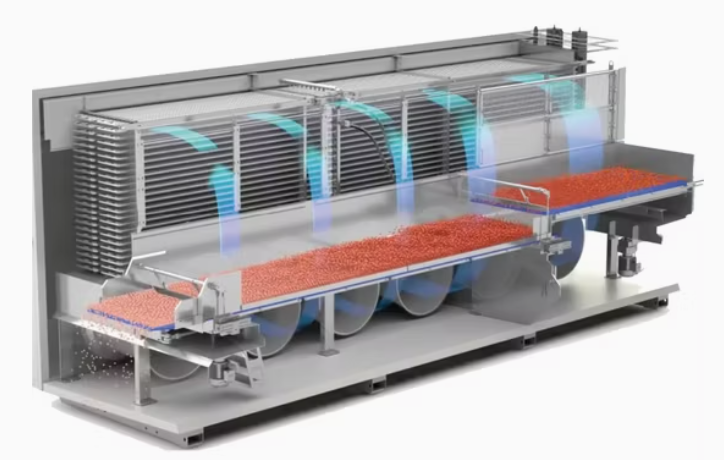
Global demand for high-quality frozen food products has grown rapidly in recent years. Modern consumers and commercial food businesses expect frozen fruits, vegetables, seafood, and meat to retain their natural flavor, color, texture, and nutritional value. Consequently, traditional bulk freezing methods often fail to meet these expectations. They produce large frozen blocks that take hours to thaw and lose significant moisture.
To overcome these challenges, commercial food processors rely on Individual Quick Freezing (IQF) technology. This advanced preservation technique freezes each food particle separately and rapidly. As a result, it creates a free-flowing product that is easy to portion, package, and store.
Furthermore, setting up a modern frozen food processing facility requires careful planning. Processors must focus on machinery selection, line layout, hygiene zoning, and utility management. Therefore, this complete technical guide explains how an IQF plant operates. It details every step from raw material preparation to final packaging and deep cold storage.
What is Individual Quick Freezing (IQF)?
Individual Quick Freezing is an ultra-rapid freezing process. It freezes individual food items independently rather than in a solid mass. Specifically, the core technical objective of IQF is rapid freezing. It passes the food product through the zone of maximum ice crystallization—between -1°C and -5°C—in minutes.
When food freezes slowly, water forms large, sharp ice crystals inside the cellular structure. These large crystals puncture delicate cell walls. Therefore, when the product thaws, the damaged cells leak internal moisture, cell sap, and natural sugars. Consequently, this results in heavy drip loss, mushy textures, and flavor degradation.
In contrast, IQF technology uses high-velocity freezing air at temperatures between -35°C and -42°C. Indeed, this extreme cold freezes internal moisture almost instantly. It forms millions of microscopic ice crystals. Because these microscopic crystals remain smaller than the cells themselves, cell membranes stay intact. Ultimately, when the frozen product thaws, it retains its natural firmness, original weight, natural juices, and fresh appearance.
Core Advantages of IQF Processing for Commercial Facilities
-
100% Free-Flowing Convenience: Individual items freeze separately without sticking together. Thus, end-users can pour out the exact weight required without thawing the entire package.
-
Minimal Product Drip Loss: Preserving the cellular structure reduces drip loss during thawing to between 2% and 4%. Conventional block freezing typically loses 8% or more.
-
Reduced Dehydration and Weight Loss: Rapid surface crust-freezing seals the food surface. Hence, it keeps moisture loss inside the freezer under 1.5%.
-
Superior Flavor and Nutrient Retention: Fast core freezing halts post-harvest metabolic decay. As a result, it preserves volatile aroma compounds, natural Brix levels, and heat-sensitive vitamins.
-
Extended Shelf Life for Global Export: IQF products maintain high quality for 12 to 24 months in cold storage at -18°C. Therefore, they are ideal for international trade.
Comprehensive Step-by-Step IQF Process Flow
A successful commercial IQF operation relies on an integrated sequence of pre-treatment, thermal handling, freezing, and automated packaging steps.
Step 1: Raw Material Receiving, Sorting, and Inspection
Initially, raw agricultural produce, fruits, or seafood arrive at the receiving dock. These raw materials contain field soil, leaves, stems, or size variations. First, the raw material feeds onto vibrating screen sorters and manual inspection conveyors. Furthermore, this initial sorting eliminates physical debris, oversized items, and damaged produce before processing begins. Meanwhile, quality controllers continuously inspect incoming raw stock.
Step 2: Multi-Stage Air-Bubble Washing
Next, sorted goods enter multi-stage air-bubble washing tanks. Submerged blowers force pressurized air through bottom manifolds to generate turbulent water movement. Additionally, this bubble agitation gently scrubs soil, dirt, and pesticides off delicate produce without bruising. Meanwhile, heavy particles settle into the bottom trap while floating debris is skimmed off continuously.
Step 3: Mechanical Size Reduction and Trimming
For root crops, vegetables, and fruits, uniform particle sizing is essential for even freezing. Subsequently, high-speed industrial dicers and slicers cut produce into consistent dimensions, such as 6mm, 10mm, or 12mm cubes, or uniform slices. Indeed, consistent geometry ensures that heat transfer rates remain identical across all pieces during blanching and freezing.
Step 4: Thermal Blanching for Enzyme Inactivation
Vegetables like green peas, sweet corn, diced carrots, and green beans contain active natural enzymes. These include peroxidase and polyphenol oxidase. If left unchecked, these enzymes break down plant tissues even at sub-zero temperatures. Subsequently, this leads to off-flavors, tough textures, and discoloration within a few months.
Passing produce through a continuous steam or hot water blancher at 85°C to 98°C for 60 to 180 seconds completely inactivates these enzymes. Additionally, blanching brightens natural green chlorophyll colors. It also reduces surface microbial counts by up to 99.9%.
-
Important Exception for Fruits and Berries: However, fresh fruits like strawberries, blueberries, raspberries, and mango cubes must never be blanched. High heat collapses fragile fruit cells. This causes immediate juice bleeding and loss of fresh flavor. Therefore, fruits bypass blanching entirely. They move directly from sanitizing wash tanks to pre-cooling.
Step 5: Hydro-Cooling and Chilled Bath Immersion
Immediately after blanching, hot produce passes into a hydro-cooler flume. This flume uses recirculating chilled water maintained at 2°C to 4°C. Furthermore, hydro-cooling rapidly extracts residual heat from the product core. It drops core temperatures below 10°C in a few minutes. As a result, this step prevents overcooking and maintains crispness.
Step 6: Vibratory Dewatering and Air-Knife Surface Drying
Before entering the freezing chamber, excess surface water must be removed. Otherwise, if wet produce enters an IQF tunnel, surface water instantly freezes into ice bridges. This binds individual pieces into large clumps. Therefore, high-frequency shaker screens combine with high-velocity air knives. They sweep away surface water droplets while leaving a microscopic natural moisture film.
Step 7: Fluidized IQF Tunnel Freezing
Afterward, dewatered produce moves directly into the IQF freezer module. Specifically, high-capacity fans force cold air upward through a perforated deck at -35°C to -42°C. Furthermore, the upward air stream lifts the food particles, suspending them in mid-air. Thus, cold air touches every surface simultaneously. Consequently, the core temperature drops to -18°C or colder within 3 to 12 minutes.
Step 8: Protective Glazing (Seafood and Poultry)
In contrast, high-value seafood products like prawns, shrimp, and fish fillets receive a protective ice glaze. As they leave the freezer, the frozen items pass under a fine mist of chilled water (1°C to 2°C). Consequently, this forms a micro-thin, protective ice layer over the surface. Ultimately, this ice glaze prevents oxidation, freezer burn, and surface drying during long-term cold storage.
Step 9: Automated Weighing, Packaging, and Metal Detection
Next, frozen IQF items drop into automated multihead weighers integrated with Vertical Form-Fill-Seal (VFFS) bagging machines. Multi-layer polyethylene films form strong moisture-barrier bags. In addition, food-grade nitrogen gas flushes into bags to displace oxygen before sealing. Finally, every finished bag passes through an inline metal detector and checkweigher to ensure safety and weight accuracy.
Step 10: Deep Cold Storage Maintenance
Lastly, operators stack sealed master cartons on pallets and transfer them to deep cold storage rooms. These rooms remain at a steady -18°C to -22°C. Thus, maintaining consistent temperatures without fluctuations prevents moisture migration and stops frost formation inside the packaging.
Primary Machinery Used in an IQF Processing Line
Operating a high-yield IQF line requires specialized, food-grade machinery. Manufacturers build this equipment using high-grade SS304 or SS316 stainless steel to allow easy Clean-in-Place (CIP) sanitation.
-
Air-Bubble Washing Machine: Features high-pressure air blowers, continuous water circulation, sediment collection traps, and an inclined discharge elevator.
-
High-Speed Industrial Dicer / Slicer: Equipped with interchangeable rotary blade assemblies designed to cut raw produce cleanly into uniform cubes, strips, or slices without crushing plant tissue.
-
Continuous Steam or Hot Water Blancher: Incorporates a variable-speed belt drive, digital temperature controllers accurate within ±0.5°C, steam injection manifolds, and an insulated hood.
-
Chilled Hydro-Cooler Flume: Uses recirculating water chilled by an external plate heat exchanger, complete with continuous water filtration to maintain hygiene.
-
Vibratory Dewatering Screen with Air Knives: Combines high-frequency vibration motors to shake off water droplets with high-pressure air blowers to sweep away surface film.
-
Fluidized Bed IQF Tunnel Freezer: Features variable-speed centrifugal blowers, perforated stainless steel decks, stainless steel evaporator coils, and an insulated Polyurethane Foam (PUF) enclosure.
-
Two-Stage Industrial Refrigeration Compressor Rack: Powered by high-efficiency Ammonia (R717) or Freon refrigeration units designed for continuous, low-temperature duty.
-
Multihead Weigher and VFFS Packaging Machine: Features touch-screen PLC controls, high-accuracy combination weigh heads, nitrogen gas flushing, and integrated date coding equipment.
Selecting the Right Freezing Tunnel Architecture
Choosing the correct IQF freezer design depends on factory space, throughput requirements, and the physical characteristics of your product line.
1. Fluidized-Bed IQF Freezers
Fluidized-bed freezers are engineered specifically for small, uniform, discrete produce. High-velocity fans direct cold air vertically upward through a perforated deck. This action lifts individual items so they hover and tumble like a boiling liquid.
-
Main Benefits: Delivers ultra-fast freezing rates, prevents product clumping, and ensures complete individual separation.
-
Best Suited For: Green peas, sweet corn kernels, diced carrots, diced onions, blueberries, and small peeled shrimp.
2. Linear and Multi-Pass Mesh-Belt IQF Tunnels
Linear belt tunnels feature horizontal mesh conveyor belts running through an insulated room. Directed air blowers push cold air downward and across the belt as the product travels along it. Meanwhile, multi-pass models stack two or three belts vertically to provide longer retention times within a shorter room length.
-
Main Benefits: Features a simple mechanical design, provides gentle product handling, and accommodates varying item sizes easily.
-
Best Suited For: Broccoli florets, cauliflower segments, sliced mushrooms, cut green beans, and strawberry halves.
3. Compact Spiral IQF Freezers
Spiral freezers use a continuous conveyor belt. This belt wraps helically around a central drive drum inside an insulated chamber.
-
Main Benefits: Uses vertical height to fit long belt travel inside a compact footprint, saving up to 60% of factory floor space.
-
Best Suited For: Fish fillets, whole prawns, chicken nuggets, meat patties, and prepared convenience foods.
Plant Layout, Hygiene Zoning, and Utility Planning
Designing a successful frozen food plant requires careful spatial organization. This layout prevents cross-contamination and controls utility costs.
Factory Hygiene Zoning
International food safety standards like HACCP require physical separation between processing stages:
-
Low-Risk Raw Zone: Handles raw material receiving, soil removal, dry sorting, and initial washing. Specifically, this area remains separate to prevent field dirt from entering the clean plant.
-
Medium-Risk Preparation Zone: Houses slicing, dicing, blanching, and hydro-cooling machinery. In addition, floors must feature anti-slip epoxy coatings and continuous drainage channels with a 2% slope for daily wash-downs.
-
High-Risk Cleanroom Packaging Zone: Contains the discharge end of the IQF tunnel, multihead weighers, and primary packaging units. Furthermore, this room operates under positive air pressure with filtered air units to keep airborne dust and microbes out of open packages.
Facility Utility Demands
-
Electrical Power Supply: IQF plants demand significant electricity to power refrigeration compressors, tunnel blowers, and packaging lines. Therefore, plants require dedicated step-down transformers alongside an automatic backup diesel generator sized for peak loads.
-
Process Steam Generation: Continuous steam blanchers require clean, dry saturated steam. Energy-efficient boilers equipped with water softeners supply this steam to prevent scale build-up.
-
Process Water Treatment (WTP): Washing, hydro-cooling, and equipment cleaning require large volumes of potable water. Thus, an on-site water treatment plant combining sand filters, softeners, and reverse osmosis (RO) units ensures process water quality meets food safety standards.
-
Effluent Treatment Plant (ETP): Equipment cleaning and washing generate high-BOD wastewater. Consequently, an on-site ETP with biological aeration and filtration is essential to satisfy environmental discharge regulations.
Conclusion
Establishing a commercial Individual Quick Freezing facility requires balancing multiple operational factors. Engineers must align raw material characteristics, thermal freezing science, machinery design, and plant hygiene zoning. By pairing precise pre-treatment steps like washing, sizing, blanching, and hydro-cooling with high-efficiency fluidized IQF tunnels, food processors can produce high-value, free-flowing frozen foods that satisfy strict international export standards. Ultimately, investing in the right line configuration reduces drip loss, cuts utility costs, and protects natural food quality from the farm all the way to the end consumer.
Partner with GENEX Tech Industries LLP for Turnkey Food Processing Projects
Are you planning to establish a new export-oriented IQF processing plant, expand your existing processing facility, or integrate energy-efficient processing machinery tailored to your product requirements?
GENEX Tech Industries LLP is a leading engineering manufacturer and project developer specializing in turnkey food processing plants, industrial dehydration machinery, spray drying units, multilayer conveyor dryers, and custom processing lines. Our engineering team delivers complete end-to-end support, including custom equipment design, factory layout engineering, precision fabrication, site installation, and operational commissioning.
Contact Our Engineering Sales & Project Team
To request technical specifications, discuss plant utility requirements, or schedule a technical consultation with our engineering team, reach out through our official contacts below:
-
Head Office Address:
GENEX Tech Industries LLP
10C, Sir William Jones Sarani (Middleton Row), Park Street,
Kolkata – 700071, West Bengal, India
-
Direct Phone / WhatsApp Contact:
+91-97489 06968 | +91-93300 77417
-
Official Business Email:
mktg@foodtechprojects.com | sales@foodtechprojects.com
-
Official Company Websites: