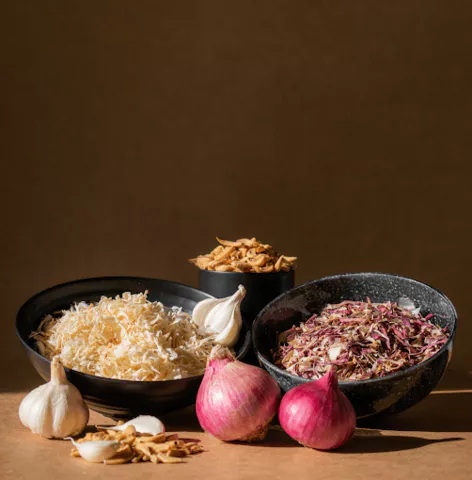
In the current global agricultural landscape, India has established a remarkably large onion and garlic processing ecosystem. Current market research estimates India’s dehydrated onion and garlic market at about US$170.6 million in 2025.
As a matter of fact, the nation stands firmly as the world’s second-largest producer of both crops. Consequently, India occupies a dominant position in international food supply chains.
However, fresh allium crops remain inherently perishable. They are naturally prone to significant post-harvest losses. Fresh onions contain approximately 85% to 88% moisture content. Meanwhile, raw garlic contains roughly 60% to 70% moisture content.
Due to these high water levels, raw bulbs deteriorate rapidly under normal atmospheric conditions. They suffer from severe fungal spoilage, unexpected sprouting, and continuous weight loss over short periods.
As a result of these post-harvest challenges, commercial dehydration has emerged as the most viable preservation method. It offers an economically lucrative and highly sustainable way to store these vital commodities over long durations.
Furthermore, post-harvest processing successfully transforms fresh bulbs into shelf-stable, value-added products. These include dehydrated kibbled onions, chopped garlic, onion flakes, garlic granules, and fine powders.
Therefore, modern food processors rely heavily on advanced industrial drying technologies. These systems retain natural aroma, pungent essential oils, original color, and key nutrients. At the same time, they systematically reduce moisture content down to safe storage levels of 4% to 6%.
In this comprehensive technical guide, we will thoroughly explore onion and garlic dehydration in India. We will examine the primary thermal drying machinery and evaluate precise performance metrics. Additionally, we will explicitly highlight which drying system is best suited for each distinct product category.
The Economics and Dynamics of India’s Onion and Garlic Processing Sector
In addition to domestic consumption, the global demand for dehydrated allium products is expanding at a steady compound annual growth rate (CAGR). For instance, international spice blenders, instant soup manufacturers, and ready-to-eat meal producers increasingly prefer dehydrated onion and garlic over fresh alternatives.
This preference stems largely from several key advantages. Dehydrated products offer standardized flavor intensity and zero microbial spoilage during long-distance shipping. Furthermore, they feature significantly reduced freight volume and an extended shelf life exceeding 12 to 24 months.
Typical Allium Processing Workflow
- Fresh Allium Harvest: To begin the overall operation, workers harvest raw onion and garlic bulbs from fields and transport them directly to the processing facility.
- Pre-Treatment & Preparation: Following arrival, technicians subject the raw bulbs to rigorous mechanical sorting, thorough washing, outer skin peeling, and precise slicing into uniform cuts.
- Primary Stage Dehydration: Subsequently, operators rapidly remove high initial moisture, bringing water levels down from 88% to roughly 25%–30%. They accomplish this step using heavy-duty continuous multi-pass mesh belt or conveyor dryers.
- Secondary Stage Finishing: Afterward, secondary finishing dryers target lower moisture levels. They safely reduce the content further from 25% down to the final target of 4%–6% by using specialized fluid bed, vibratory, or refractance window equipment.
- Sensing, Milling & Packaging: Finally, workers categorize the dried material, mill it into specified sizes, and immediately seal it into moisture-proof packaging. These sizes include kibbles, flakes, granules, or fine powders.
On the other hand, processing alliums like onions and garlic presents distinct thermal engineering challenges. Fresh onions contain delicate volatile sulphur compounds. These compounds are directly responsible for their characteristic pungency and aroma.
Similarly, garlic relies on complex enzyme-driven reactions to unleash its signature flavor profile upon consumption. Consequently, if operators expose fresh cuts to excessively high temperatures above 65°C to 70°C, these sensitive volatile compounds break down rapidly. This causes undesirable browning and significantly degrades the product’s total antioxidant activity.
Therefore, selecting the appropriate industrial dehydration system becomes an absolute necessity for maintaining market value and satisfying international quality standards.
Product Thermal Sensitivity Parameters
- Fresh Onion Slices: Initial Moisture: 85% – 88% | Target Moisture: 4% – 5% | Critical Max Temp: 60°C – 65°C
- Fresh Garlic Cuts: Initial Moisture: 60% – 70% | Target Moisture: 5% – 6% | Critical Max Temp: 55°C – 60°C
- Dehydrated Flakes: Initial Moisture: 10% – 12% | Target Moisture: 4% – 5% | Critical Max Temp: 50°C – 55°C
- Fine Powders: Initial Moisture: 6% – 8% | Target Moisture: 3% – 4% | Critical Max Temp: 45°C – 50°C
Detailed Analysis of Core Industrial Drying Systems
In order to achieve consistent production yields while maintaining high energy efficiency, modern food processors utilize specialized thermal dehydration machinery. Below is an exhaustive technical breakdown of the primary drying systems currently deployed across the Indian onion and garlic processing sector.
1. Continuous Multi-Pass Mesh Belt Dryers (Industrial Band Dryers)
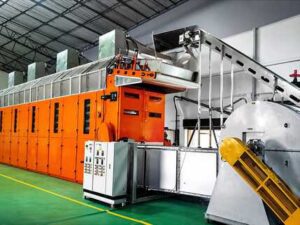
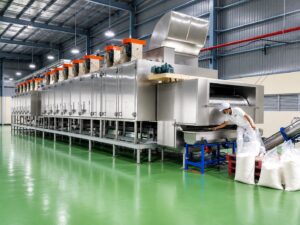
Continuous Multi-Pass Mesh Belt Dryers serve as the core backbone of high-tonnage onion and garlic dehydration facilities across India. Engineers also call these units Industrial Conveyor Band Dryers.
Primary moisture removal inherently requires handling massive daily volumes of wet raw feed. Therefore, automated conveyor systems offer the necessary continuous processing capacity required by large industrial setups.
Operational Flow of a Multi-Pass Mesh Belt Dryer
The continuous multi-pass drying process progresses through distinct thermal zones arranged from the material inlet down to final discharge:
- Inlet Feed: To start the cycle, wet onion slices containing approximately 88% moisture enter the top belt through an automated oscillating feeder system.
- Top Belt (Zone 1): Meanwhile, this initial zone operates with high airflow velocity at an elevated temperature of 65°C to swiftly execute primary surface moisture removal.
- Cascading Transition: As the product reaches the end of the upper run, it cascades and flips downward onto the middle conveyor level. This action mechanically redistributes the wet internal core of the slices.
- Middle Belt (Zone 2): Subsequently, the material travels along the second level at a moderate temperature of 55°C in order to extract intermediate internal moisture steadily.
- Cascading Transition: Once again, the partially dried product flips down to the bottom belt level for final phase moisture equalization.
- Bottom Belt (Zone 3): Eventually, the material moves through the third zone under a gentle finishing temperature of 45°C to safely finalize moisture removal without thermal scorching.
- Outlet Discharge: Ultimately, the stabilized dry onion flakes exit the machine continuously at a target moisture level of approximately 5%.
Working Principle & Operational Dynamics
Technically speaking, a multi-pass mesh belt dryer consists of several perforated stainless-steel conveyor belts. Engineers stack these belts vertically inside a heavily insulated thermal chamber.
An automated oscillating feeder spreads freshly sliced onions or minced garlic pieces evenly onto the top belt. As the top belt carries the material forward, the product tumbles downward onto the underlying belt. This lower belt moves in the opposite direction.
Consequently, this continuous cascading action automatically flips the product layers over. It breaks apart damp clumps and ensures that hot air interacts uniformly with all exposed surfaces.
Additionally, heavy-duty convective fans forcefully circulate hot air through the perforated wire mesh belts. In order to optimize thermal efficiency, control systems carefully partition the air temperature and velocity into independent zones:
- Inlet Phase: High air temperature (60°C to 65°C) combined with high air velocity rapidly evaporates free surface water without overheating the interior structure.
- Intermediate Phase: Moderate air temperature (50°C to 55°C) removes bound internal moisture as internal diffusion rates begin to decrease.
- Finishing Phase: Lower air temperature (45°C to 50°C) gently brings final moisture levels down to specification while completely preventing thermal browning.
Technical Capabilities & Specific Data Points
- Moisture Reduction Capability: Successfully reduces moisture from 88% down to roughly 6% to 8%.
- Processing Capacity: Standard industrial units generally handle between 500 kg/hour and over 5,000 kg/hour of wet feed input.
- Thermal Efficiency: Integrated heat recovery systems routinely recycle up to 35% of exhaust air, yielding significant fuel savings over time.
- Belt Speeds: Variable Frequency Drives (VFD) allow operators to fine-tune retention times anywhere between 2 hours and 6 hours depending on material characteristics.
Best Product Applications
- Onion: Most notably, this machinery is best suited for primary, high-volume dehydration of sliced white, red, and yellow onions into raw kibbles, minced pieces, and chopped cuts.
- Garlic: Similarly, it is ideal for continuous primary drying of peeled whole garlic cloves and coarsely sliced garlic pieces.
2. Combination Fluid Bed Drying Systems
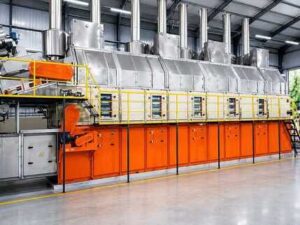
Combination Fluid Bed Dryers seamlessly unite static thermal drying principles with dynamic fluidization physics. As a result of this unique combination, this equipment easily processes sticky or high-moisture granular materials. These materials often form unwanted lumps under conventional static drying methods.
Operational Flow of Combination Fluid Bed Drying
- First, an operator feeds wet minced or granular raw material continuously into the upper inlet.
- Next, the material falls directly into the upper fluidization chamber. There, controlled upward hot air currents lift and suspend the individual particles in mid-air.
- Throughout this 360-degree heat transfer zone, suspended particles evaporate moisture evenly without sticking together or agglomerating into clumps.
- Finally, the dry, free-flowing granular product continuously exits through the lower outlet section.
Working Principle & Operational Dynamics
Inside a combination fluid bed dryer, high-pressure blowers force heated air upward through a specially engineered perforated distributor plate. The system maintains precise air velocities to lift the individual onion or garlic particles.
As a direct result, the bed of solid material enters a state of complete fluidization. Individual pieces behave similarly to a boiling liquid. Because hot air surrounds every single particle on all sides, overall heat transfer rates remain exceptionally high.
Furthermore, an integrated mechanical agitating section actively breaks up sticky raw feed before final fluidization occurs.
Technical Capabilities & Specific Data Points
- Moisture Reduction Capability: Efficiently drops moisture levels from 25% down to less than 4%.
- Temperature Control: Precise thermal regulation operates within a tight tolerance of ±1°C (typically set between 45°C and 55°C).
- Heat Transfer Co-efficient: Achieves thermal transfer rates up to 3 times higher than standard static tray drying equipment.
Best Product Applications
- Onion: Particularly effective for uniform secondary drying of onion granules, chopped onions, and small diced cuts.
- Garlic: Highly recommended for processing garlic granules, minced garlic, and coarse garlic meals where eliminating clump formation is mandatory.
3. Vibratory Fluidised Bed Dryers (VFBD)
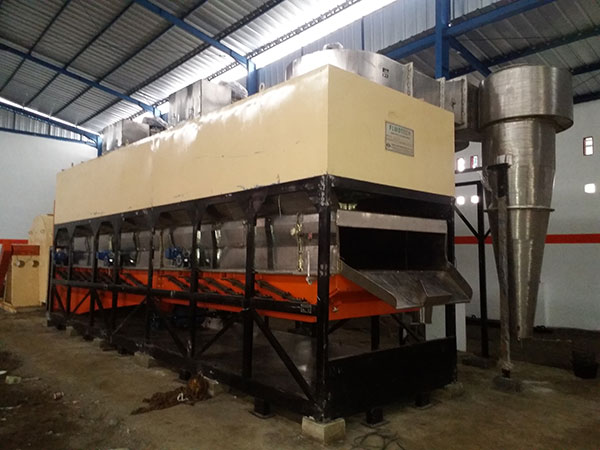
Vibratory Fluidised Bed Dryers (VFBD) significantly improve upon traditional fluid bed drying technology. They incorporate controlled mechanical vibration into the perforated drying bed assembly.
Therefore, this technology easily handles sticky, fragile, or non-uniform materials. These delicate products would otherwise fail to fluidize smoothly under air pressure alone.
Operational Flow of Vibratory Fluidised Bed Drying
- To begin, an operator loads semi-dried product onto the vibrating distributor plate deck at the inlet point.
- Simultaneously, mechanical eccentric motors generate controlled horizontal and vertical oscillations. These movements drive the product along a linear path.
- Meanwhile, conditioned hot air passes upward through the oscillating deck, gently floating the vibrating particles in mid-air.
- Eventually, the uniformly dried material reaches the discharge end. It exits the system without experiencing physical breakage or structural degradation.
Working Principle & Operational Dynamics
In a Vibratory Fluidised Bed Dryer, mechanical vibration motors impart precise linear movement across the perforated deck. As a consequence of this mechanical drive, the product moves smoothly forward in a predictable plug-flow manner.
This efficient movement occurs even when operators use lower upward air velocities. In turn, this gentle mechanical assistance prevents delicate onion flakes and fragile garlic pieces from breaking apart. It effectively eliminates unwanted dust or fine waste particles during the drying cycle.
Technical Capabilities & Specific Data Points
- Air Velocity Requirement: Uses up to 30% to 40% less air velocity in comparison to standard static fluid bed dryers.
- Temperature Range: Low-temperature operation maintained strictly between 40°C and 55°C to safeguard natural color and volatile oil content.
- Product Degradation: Reduces physical product attrition and structural breakage by over 80%.
Best Product Applications
- Onion: Outstanding for handling fragile onion flakes and delicate dehydrated onion rings where visual appearance is critical.
- Garlic: Ideal for drying high-value garlic flakes and sliced garlic where maintaining structural piece integrity directly affects commercial value.
4. Refractance Window Dryers
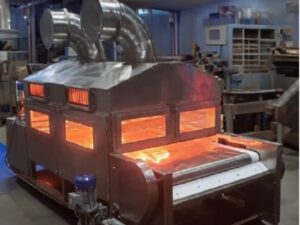
Refractance Window drying represents an innovative thermal energy transfer technology. It harnesses the refractive properties of water to dry heat-sensitive liquids, pastes, and slurries rapidly without boiling them.
Operational Flow of Refractance Window Drying
- Initially, an applicator spreads liquid onion or garlic paste as a thin film onto a transparent conveyor belt.
- Subsequently, the belt glides smoothly over a circulating hot water bath held strictly at 85°C to 90°C.
- As a result, thermal energy transfers rapidly through the thin belt via conductive and infrared radiation pathways directly into the wet paste film.
- Ultimately, rapid moisture evaporation transforms the wet slurry into a continuous dry sheet within minutes. Workers then scrape off this sheet for immediate milling into fine powder.
Working Principle & Operational Dynamics
During operation, an automated feeder applies the wet onion or garlic paste evenly as a thin film onto a continuous, heat-transparent polyester belt. Directly beneath this moving belt, a shallow bath of hot water circulates continuously at 85°C to 90°C.
Thermal energy moves directly through the belt membrane into the wet food layer via conduction and targeted infrared radiation. Notably, as long as moisture remains inside the food paste, rapid surface evaporation keeps the actual internal product temperature low (usually under 50°C to 60°C).
However, as soon as the material dries completely, the refractive window closes automatically. This stops further heat absorption and protects delicate active compounds from thermal degradation.
Technical Capabilities & Specific Data Points
- Drying Speed: Delivers extremely rapid processing with total retention times lasting only 3 to 5 minutes.
- Nutrient Retention: Consistently preserves up to 90% to 95% of original volatile flavor compounds, natural pigments, and active enzymes.
- Product Form: Accepts liquid slurry feeds containing 70% to 80% moisture and outputs solid dry sheets at 3% to 4% moisture.
Best Product Applications
- Onion: Exceptionally effective for processing onion purees, concentrated onion pastes, and highly soluble instant onion powders.
- Garlic: Ideally suited for garlic paste processing, concentrated garlic extracts, and premium instant garlic powders.
5. Heat Pump Dryers
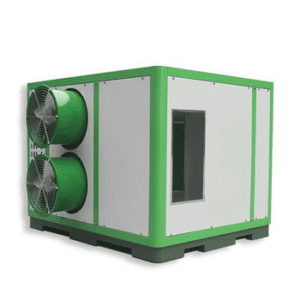
Heat Pump Dryers utilize a closed-loop refrigeration cycle to continuously dehumidify recirculated drying air. They do not vent hot air into the surrounding atmosphere. Consequently, this technology offers remarkable energy efficiency alongside precise low-temperature humidity control.
Operational Flow of Heat Pump Drying
- To begin, operators place loaded product trays inside a completely sealed, climate-controlled drying chamber.
- Next, warm, dry air circulates over the raw material, absorbing evaporated moisture from the product surfaces.
- Afterwards, this humid air passes through an internal dehumidifier unit. There, a refrigeration evaporator rapidly cools the air to condense water out.
- Finally, the system drains the extracted water away. It then reheats the dry air to 35°C–50°C before recirculating it back through the drying chamber.
Working Principle & Operational Dynamics
In a heat pump dryer, moist air leaving the drying chamber passes directly across an evaporator coil. This coil cools the air below its dew point. As a consequence, liquid water condenses out of the airstream and drains away.
The cold, dry air then passes over a condenser coil to absorb heat. System fans then recirculate this air back through the product bed. Because the entire system operates in a completely closed loop, drying occurs under controlled low-temperature conditions (30°C to 50°C) with precise relative humidity regulation throughout the cycle.
Technical Capabilities & Specific Data Points
- Energy Savings: Consumes up to 60% to 70% less electrical energy compared to traditional direct-electric or gas-fired thermal dryers.
- Temperature Control: Maintains consistent low-temperature environments between 30°C and 50°C.
- Color Preservation: Virtually eliminates thermal browning, consistently producing bright white dehydrated garlic and vibrant onion flakes.
Best Product Applications
- Onion: Best for premium white onion flakes and high-grade export products where maintaining a pure white appearance is required.
- Garlic: Perfect for high-value garlic slices and specialized garlic powders where preserving heat-sensitive active enzymes is mandatory.
Equipment Selection Matrix: Matching Machinery to Allium Products
To simplify plant design decisions, the following selection matrix pairs specific raw material inputs and target product formats with their corresponding ideal drying machinery:
- Fresh Sliced Onions: Target End Product: Dehydrated Kibbles & Flakes | Recommended Dryer: Continuous Multi-Pass Mesh Belt Dryer
- Wet Minced Garlic: Target End Product: Dehydrated Garlic Granules | Recommended Dryer: Combination Fluid Bed Dryer
- Fragile Onion Rings: Target End Product: Premium Whole Flakes | Recommended Dryer: Vibratory Fluidised Bed Dryer
- Fresh Garlic Paste: Target End Product: Instant Garlic Powder Sheet | Recommended Dryer: Refractance Window Dryer
- High-Grade Cloves: Target End Product: Low-Temp Premium White Slices | Recommended Dryer: Heat Pump Dryer
Comprehensive Technical and Economic Comparison
When selecting commercial drying machinery, factory engineers must carefully evaluate several factors. These include thermal efficiency, product quality yield, hourly production throughput, and physical space constraints.
System Performance Breakdown
- Continuous Belt Dryer: Capacity: 500 – 5,000 kg/hr | Temp Range: 45°C – 75°C | Moisture Stage: High (88% to 10%) | Thermal Efficiency: 65% – 75% | Degradation: Low
- Combination Fluid Bed Dryer: Capacity: 200 – 2,000 kg/hr | Temp Range: 40°C – 65°C | Moisture Stage: Mid-Low (25% to 4%) | Thermal Efficiency: 70% – 80% | Degradation: Moderate
- Vibratory Fluid Bed Dryer: Capacity: 100 – 1,500 kg/hr | Temp Range: 35°C – 60°C | Moisture Stage: Mid-Low (20% to 4%) | Thermal Efficiency: 75% – 85% | Degradation: Extremely Low
- Refractance Window Dryer: Capacity: 50 – 500 kg/hr | Temp Range: 85°C Water Bath | Moisture Stage: Direct Liquid Feed | Thermal Efficiency: 80% – 88% | Degradation: N/A (Paste/Liquid)
- Heat Pump Dryer: Capacity: 50 – 1,000 kg/hr | Temp Range: 30°C – 50°C | Moisture Stage: High to Low | Thermal Efficiency: 85% – 92% | Degradation: Zero
Processing Best Practices and Quality Optimization
In addition to selecting the appropriate equipment, achieving commercial success in onion and garlic dehydration requires strict adherence to quality control best practices throughout production:
- Pre-Treatment & Sorting: First and foremost, processors must select solid, high-quality bulbs with high total soluble solids (TSS > 15° Brix). Furthermore, workers must remove outer decayed layers and fungal spores completely before slicing.
- Uniform Slicing & Cutting: In addition, technicians must maintain consistent slice thickness between 3 mm and 5 mm. Careful slicing prevents physical bruising. In turn, this preserves volatile essential oils.
- Staged Thermal Dehydration: Moreover, applying higher temperatures during the initial phase rapidly evaporates free surface water. Thereafter, operators progressively lower temperatures in subsequent zones to protect delicate flavor profiles and natural color.
- Hygroscopic Handling & Packaging: Finally, technicians must cool finished dehydrated products in climate-controlled clean rooms with low relative humidity (< 40% RH). Workers should seal products immediately in high-barrier aluminum packaging to block ambient moisture absorption.
Strategic Manufacturing Partner: GENEX Tech Industries LLP
When investing in commercial onion and garlic dehydration equipment, selecting an experienced engineering partner is essential for long-term operational success. GENEX Tech Industries LLP is a premier Indian engineering manufacturer.
They specialize in custom-designed industrial belt dryers, continuous multi-pass conveyor systems, vibratory fluid bed units, refractance window dryers, and complete turnkey food dehydration processing lines.
Furthermore, GENEX Tech Industries LLP provides end-to-end engineering support. Their services range from initial plant layout design, thermal energy calculations, and precise equipment fabrication to field installation, plant commissioning, and ongoing global technical support.
Conclusion
In conclusion, India’s US$170.6 million dehydrated onion and garlic processing industry offers immense growth potential for forward-thinking food manufacturers. However, taking full advantage of this expanding market requires moving beyond traditional open-air drying methods and adopting state-of-the-art industrial dehydration machinery.
Whether your facility requires high-capacity continuous multi-pass mesh belt dryers for primary slicing operations, vibratory fluid bed dryers for delicate whole flakes, or cutting-edge refractance window systems for instant powders, choosing the right thermal processing system ensures superior color preservation, maximum essential oil retention, and exceptional long-term operational profitability.
Contact Information & Inquiries
Upgrade your onion and garlic processing operations with customized industrial engineering solutions designed specifically for high thermal efficiency and international quality standards. Reach out to GENEX Tech Industries LLP today for professional technical consultations, customized plant layouts, and comprehensive equipment pricing.
| Contact Details | Company Information |
| Company Entity | GENEX Tech Industries LLP |
| Head Office Address | 10C, Sir William Jones Sarani (Middleton Row), Park Street, Kolkata – 700071, West Bengal, India |
| Factory Address | Jalan Industrial Complex, Gate No. 1 / Right Lane 1, Biparnnapara, Jangalpur, Howrah – 711411, West Bengal, India |
| Direct Phone / WhatsApp | +91-97489 06968 | +91-93300 77417 |
| Official Email | mktg@foodtechprojects.com | sales@foodtechprojects.com |
| Official Websites | www.foodtechprojects.com | www.gtidryers.com |