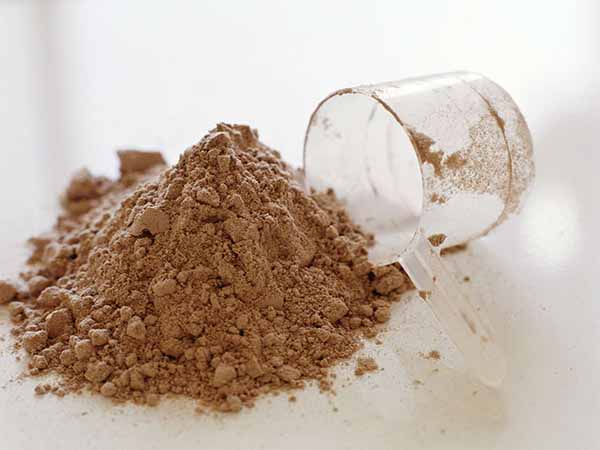
India’s protein market is expanding at an unprecedented rate. This growth is driven primarily by shifting consumer habits. Increased health awareness also plays a significant role. Furthermore, the remarkable expansion of dietary supplements and sports nutrition boosts this trend. Animal and dairy-derived proteins currently dominate the market. However, plant-based protein isolates and specialty nutritional powders are experiencing rapid growth. These products yield high margins. Consequently, industrial thermal dehydration technology sits at the absolute center of this expansion.
Producing high-grade protein powders requires rigorous process control. Operators must manage thermal degradation carefully. They must also control moisture content and powder bulk density. In addition, particle size distribution, dispersibility, and solubility demand precise handling.
As a leading manufacturer in India, GENEX Tech Industries LLP provides advanced drying systems. These systems are tailored specifically for whey protein and milk protein. They also process casein, soy protein, and pea protein efficiently. Furthermore, our systems handle general plant proteins, nutritional powders, and protein concentrates. This comprehensive technical guide explores industrial drying systems in detail. In addition, it covers application-specific equipment selection and thermal process parameters. Ultimately, it provides the operational methodologies required to achieve international quality standards.
1. The Expanding Protein Ecosystem in India
Market Dynamics & Shift Towards Powder Formulations
India’s dietary supplement and protein processing industry is undergoing a structural transformation. Historically, processors focused on liquid dairy streams. They also processed traditional agricultural products. However, the modern market demands shelf-stable formulations. These products must also be highly soluble and functional.
Key Stages in Protein Manufacturing
Therefore, the core protein manufacturing workflow follows a defined, step-by-step progression:
-
Raw Protein Feedstock Sourcing: Initially, processors source raw materials carefully. They select either Dairy Protein Streams or Plant Protein Sources. Dairy streams include whey, milk solids, and casein. Plant sources comprise soy, pea, pulses, and botanicals.
-
Industrial Processing & Refinement: Subsequently, filtration units process the liquid feeds. These systems perform concentration and membrane separation. As a result, they isolate pure protein fractions.
-
Thermal Dehydration: Next, operators route concentrated protein streams through specialized equipment. They utilize Spray Dryers or Vibratory Fluidised Bed Dryers. Alternatively, they run Mesh Belt Dryers or combination systems under tight controls.
-
Finished Powder Standardization: Ultimately, processing teams collect the end product. They verify that it meets strict quality benchmarks. Consequently, this step yields a soluble and non-denatured protein powder ready for B2B formulation.
Dominant Market Segments: Dairy vs. Plant Proteins
Moreover, market expansion is divided into two primary categories:
-
Dairy and Animal Protein Dominance: Specifically, whey protein concentrates (WPC60, WPC80) remain market pillars. Whey protein isolates (WPI90), milk protein concentrates (MPC), and caseinates also hold major shares. They form the backbone of sports and pediatric nutrition sectors. In addition, processing liquid whey from cheese production turns waste into profit. Thus, manufacturers create high-value protein powder from liquid waste.
-
Growth of Plant-Based and Alternative Proteins: Meanwhile, consumer preference for vegan food continues to rise. Demand for lactose-free and sustainable sources drives market growth as well. Processors extract these proteins from soy, yellow pea, mung bean, chickpeas, and seeds. Nevertheless, these alternative raw materials present unique viscosity characteristics. They also hold moisture tightly. Therefore, they demand customized drying strategies.
Thermal Sensitivity and Protein Denaturation
Proteins consist of complex macromolecules. These molecules are held together by delicate hydrogen bonds. Hydrophobic interactions and disulfide bridges also secure their structure. As a result, excessive heat damages these bonds during dehydration. The molecular structures unfold rapidly. Processors refer to this damaging process as denaturation.
Impact of Heat on Protein Functionality
Indeed, denaturation directly degrades critical functional properties:
-
Solubility & Dispersibility: To begin with, denatured proteins form insoluble aggregates. Consequently, these aggregates fail to rehydrate cleanly in liquid formulations.
-
Emulsification & Foaming Ability: Similarly, food systems require intact native structures. This structural integrity is essential when using proteins as functional emulsifiers.
-
Bulk Density & Particle Flowability: Likewise, the chosen drying method directly determines powder quality. It dictates whether the finished powder feels dense, fine, dusty, or free-flowing.
Consequently, selecting appropriate drying machinery involves more than simple moisture removal. Rather, it represents a careful balance of thermal retention and controlled evaporation. It also requires precise particle engineering.
2. Fundamental Dryers for Protein Powder Production
GENEX Tech Industries LLP engineers five core industrial drying technologies. These machines handle diverse feedstocks efficiently. They process low-viscosity liquid solutions smoothly. In addition, they handle sticky concentrates, moist cakes, and wet granules.
| Technology | Primary Material Form | Key Application |
| Spray Dryer | Low Viscosity Liquids | Soluble extracts, dairy streams, & isolates |
| Combination Dryer | Semi-Solid / Sticky Concentrates | Pastes, high-viscosity cakes, & heat-sensitive feeds |
| Vibratory Fluidised Bed Dryer | Granular / Crystalline Powders | Secondary drying, instantizing, & cooling |
| Mesh Belt Dryer | Wet Solids / Extrusions | Texturized proteins, flakes, & extruded bits |
| Band / Apron Dryer | Heavy Caked Material | High-throughput industrial pastes & organic press cakes |
A. Spray Drying Systems
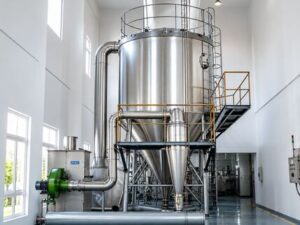
First and foremost, spray drying serves as the premier technology for liquid conversion. It converts pumpable liquids and slurries into free-flowing powders. This transformation occurs within a single continuous operational step. Mechanically, it operates as a Suspended Particle Processing (SPP) system.
Working Principle & Process Thermodynamics
-
Atomization: First, high-pressure pumps force the liquid protein feed through an atomizer. Operators use either a high-speed rotary disc or a pressure nozzle. This component shears the liquid stream into millions of micro-droplets. These droplets typically measure 20 to 200 microns in diameter. Consequently, this action dramatically increases the surface area. Thus, it maximizes heat and mass transfer.
-
Droplet-Air Contact: Next, these fine droplets enter the main drying chamber. There, they encounter a controlled stream of filtered hot air. Simultaneously, evaporation occurs almost instantaneously. This process takes place at the wet-bulb temperature. Because vaporization absorbs thermal energy, the particle temperature stays low. Therefore, it remains well below the hot air temperature. In this way, delicate protein structures avoid thermal denaturation.
-
Powder Separation: Finally, dry particles settle toward the conical base of the chamber. Meanwhile, moisture-laden exhaust air flows into cyclone separators. High-efficiency cyclones and secondary bag filters capture fine particles effectively.
Engineering Capabilities & Customization
Furthermore, GENEX Spray Dryers feature sanitary SS304/SS316 food-grade construction. They incorporate automated Clean-In-Place (CIP) nozzles as well. Additionally, integrated fluid bed bottoms enable multi-stage drying. This capability ensures superior agglomerated protein powder production.
B. Combination Dryers (Tray + Fluidized Bed)
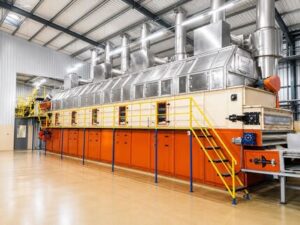
In contrast to single-stage units, the GENEX Combination Dryer offers a hybrid design. Engineers developed this staged solution specifically for semi-solid pastes. It also handles high-viscosity wet cakes and moist protein concentrates. These sticky materials often resist direct atomization in standard spray towers.
Working Principle & Process Flow
-
Stage 1 (Tray-Based Surface Drying): To start, operators spread the moist material evenly. They load stainless steel trays inside a circulating air chamber. Initially, gentle thermal conduction removes unbound surface moisture. Convective airflow also assists without forming a hard surface skin.
-
Stage 2 (Intermediate Moisture Reduction): Subsequently, trays progress through humidity-controlled internal zones. Lower-temperature airflow slowly draws trapped moisture outward. This process extracts water efficiently from the core of the particles.
-
Stage 3 (Fluidized Bed Finishing): Eventually, the semi-dried protein drops onto a perforated vibrating bed. High-velocity air fluidizes the particles thoroughly. Thereby, it equalizes moisture levels across every granule. Processors easily hit target specifications between 3% and 5%.
Process Advantages
As a direct benefit, this staged methodology prevents “case hardening.” Case hardening is a common defect where the exterior dries prematurely. Consequently, it seals moisture inside the core. Thus, this hybrid system ensures superior rehydration performance. Furthermore, it preserves natural color and protein bio-activity.
C. Vibratory Fluidised Bed Dryers (VFBD)
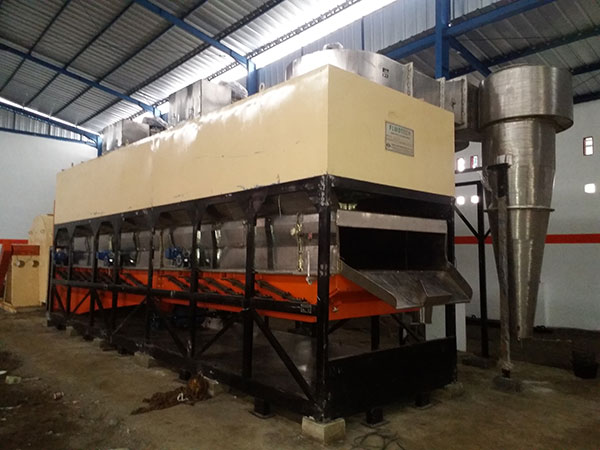
In addition, the Vibratory Fluidised Bed Dryer serves as an essential secondary system. It performs moisture removal, instantizing, and agglomerating efficiently. Furthermore, it cools powders, granules, and crystalline substances safely.
Mechanical Design & Fluidization
During operation, a mechanical feeder distributes wet protein powder onto a deck. This perforated stainless steel deck receives high-volume airflow from blowers. Air pushes upward through deck perforations at fluidization velocity. As a result, this action suspends solid particles in mid-air. The bed consequently behaves like a boiling fluid. Simultaneously, internal eccentric motors impart mechanical vibration. Therefore, this force drives the fluidized bed forward at a controlled velocity.
Advantages for Protein Powders
-
Uniform Heat Transfer: Above all, direct air-to-particle contact prevails throughout processing. Thus, the system eliminates hot spots and prevents localized scorching.
-
Agglomeration Control: Meanwhile, continuous mechanical vibration stops sticky powders from clumping. It prevents the formation of oversized, un-wettable lumps during dehydration.
-
Integrated Cooling: Additionally, operators can supply secondary zones with dehumidified cool air. This air reduces powder temperatures to ambient levels before packaging. Consequently, it prevents moisture condensation inside storage bags.
D. Mesh Belt Dryers
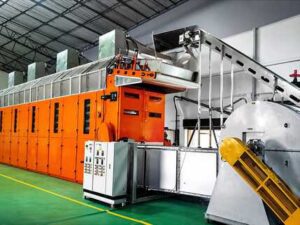
Furthermore, engineers design Mesh Belt Dryers for continuous processing. Also designated as continuous conveyor dryers, they suit high-volume applications. They dry extruded, granular, or fibrous protein concentrates efficiently.
Structural Architecture & Working Principle
-
Material Distribution: To begin, an oscillating feeder distributes the moist product. It places material onto a continuous woven stainless steel mesh belt. Consequently, this forms an even bed layer across the belt.
-
Multi-Zone Convective Thermal Processing: Next, the conveyor carries material through isolated drying modules. Notably, each module features independent controls. Operators adjust temperature, airflow velocity, and humidity separately. Hot air flows vertically through both the mesh belt and the product bed. It moves in alternating up-draft and down-draft patterns.
-
Continuous Discharge: Consequently, material progresses smoothly from inlet to discharge. It completes the drying cycle without undergoing aggressive mechanical agitation.
Key Benefits
Therefore, mesh belt drying works exceptionally well for fragile extrusions. It handles texturized plant protein granules (TVP) with high care. Furthermore, it preserves coarse protein flakes where particle shape is paramount.
E. Band / Apron Dryers
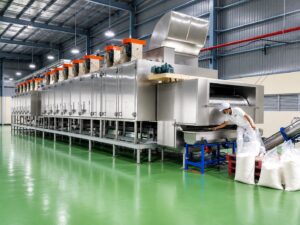
Conversely, heavy-duty Band Dryers handle robust, high-throughput applications. Also known as Apron Dryers, they process thick pastes and cake materials easily. They also handle heavy organic protein by-products reliably.
Engineering Design & Heavy Industrial Capability
Unlike fine mesh belts, Band Dryers utilize interlocking steel plates. These heavy-duty perforated plates attach securely to high-tensile drive chains. Therefore, this sturdy structure supports dense bed loads effectively. It operates continuously without sagging or warping under thermal stress.
Working Principle
The apron plate system conveys the moist protein mass through a chamber. High-velocity hot air passes continuously through the perforations. Thereby, it efficiently strips away evaporated moisture. In addition, Band Dryers often feature multi-pass arrangements. Material drops from an upper band down to a lower reversing band. Consequently, this design maximizes residence time while minimizing overall floor footprint.
3. Product-Wise Processing & Optimal Dryer Selection
Protein sources possess distinct chemical structures, viscosities, and fat contents. Heat sensitivities also vary across different feeds. Therefore, process engineers must match the correct technology to each feedstock. This precision preserves maximum solubility, functional capability, and overall yield.
| Protein Category | Primary Drying Technology | Secondary / Finishing Dryer |
| Whey Protein (WPC/WPI) | Spray Dryer | Vibratory Fluidised Bed Dryer |
| Milk Protein (MPC) | Spray Dryer | Vibratory Fluidised Bed Dryer |
| Native Casein | Spray Dryer | Vibratory Fluidised Bed Dryer |
| Acid / Rennet Casein | Combination Dryer / Mesh Belt Dryer | Vibratory Fluidised Bed Dryer |
| Soy Protein Isolate | Spray Dryer | Vibratory Fluidised Bed Dryer |
| Soy Protein Flakes | Mesh Belt Dryer | Vibratory Fluidised Bed Dryer |
| Pea Protein Concentrate | Spray Dryer | Vibratory Fluidised Bed Dryer |
| Textured Plant Protein | Mesh Belt Dryer / Band Dryer | Vibratory Fluidised Bed Dryer |
| Nutritional Blends | Spray Dryer / Combination Dryer | Vibratory Fluidised Bed Dryer |
A. Whey Protein Concentrates & Isolates (WPC & WPI)
Whey originates as a liquid byproduct of cheese and paneer production. It contains valuable functional proteins. These include beta-lactoglobulin, alpha-lactalbumin, bovine serum albumin, and immunoglobulins.
Processing Parameters & Best Dryer Choice
-
Primary Dryer: Spray Dryer integrated with a Vibratory Fluidised Bed Dryer bottom.
-
Process Flow: Liquid Whey Stream $\rightarrow$ Ultrafiltration / Diafiltration $\rightarrow$ Liquid Concentrate (30–45% Solids) $\rightarrow$ Industrial Spray Dryer $\rightarrow$ Vibratory Fluidised Bed Cooling / Instantizing $\rightarrow$ Premium WPC80 / WPI90 Powder.
-
Thermal Conditions: Processors maintain inlet air temperatures between 160°C and 185°C. Meanwhile, they keep outlet temperatures between 70°C and 80°C. In this way, precise outlet temperatures prevent protein denaturing. As a result, the process preserves cold-water solubility.
-
Powder Agglomeration: Secondary fluidization in a VFBD enables lecithin spraying. This process facilitates agglomeration for instantized whey powders (WPC80/WPI90). Consequently, it creates larger, dust-free particles that dissolve rapidly in shaker bottles.
B. Milk Protein Concentrates (MPC) & Whole/Skim Milk Powders
Milk Protein Concentrate (MPC) contains both casein and whey. It maintains their native ratio of 80:20. Hence, processing MPC requires careful heat control. This prevents insoluble complexing between beta-lactoglobulin and kappa-casein.
Processing Parameters & Best Dryer Choice
-
Primary Dryer: Multi-Stage Spray Dryer.
-
Process Dynamics: High-pressure nozzle systems operate between 150 bar and 250 bar. These nozzles atomize liquid milk concentrate into fine uniform sprays.
-
Key Operating Controls: Operators set inlet air between 170°C and 195°C. Meanwhile, they hold outlet air between 72°C and 78°C. In addition, technicians keep droplet size within tight tolerances (40 to 80 microns). Consequently, this prevents outer crust formation.
-
Finishing: Furthermore, a Vibratory Fluidised Bed Dryer removes final residual moisture. It reduces moisture from 8% down to under 4%. Simultaneously, it cools the powder to 25°C to avoid caking during storage.
C. Casein & Caseinates
Casein exists naturally in milk as insoluble micellar structures. Operators precipitate it via acid addition (acid casein) or enzymatic action (rennet casein). Alternatively, they convert it into soluble caseinates using alkali neutralization. These products include sodium, calcium, or potassium caseinates.
-
Soluble Caseinates (Sodium/Calcium): These high-viscosity liquids require Heavy-Duty Spray Dryers. Caseinate solutions remain extremely viscous even at low total solids (20% to 25%). Therefore, atomization requires high-speed rotary atomizers running at tip speeds above 120 meters per second.
-
Insoluble Casein Curd (Acid/Rennet Curd): Conversely, Combination Dryers or Mesh Belt Dryers handle moist dewatered cakes. Operators spread precipitated casein curd across a continuous mesh belt. Alternatively, they route it through a combination dryer. Warm air (60°C to 80°C) gradually removes moisture without yellowing or scorching the product.
D. Soy Protein Concentrates & Isolates (SPC & SPI)
Soy protein isolate (SPI) serves as a highly functional ingredient. It contains over 90% protein on a dry weight basis. However, processing soy requires handling viscous, gel-prone slurries.
Processing Parameters & Best Dryer Choice
-
Primary Dryer for SPI: Custom Industrial Spray Dryer. Soy protein slurries exhibit high viscosity at elevated temperatures. Therefore, facilities use high-pressure nozzle spray dryers. These units operate with inlet temperatures of 180°C to 210°C and outlet temperatures of 80°C to 90°C. Rapid moisture evaporation ensures high nitrogen solubility index (NSI) values.
-
Primary Dryer for Soy Protein Flakes / Meal: Mesh Belt Dryer or Band Dryer. On the other hand, multi-zone mesh belt or band dryers process defatted soy flakes. They also handle high-moisture TVP extrusions. Units use controlled zone temperatures (100°C down to 60°C) to achieve uniform drying.
E. Pea Protein Isolate & Pulse Proteins
Yellow pea protein isolate has emerged as a premier plant-based alternative. This popularity stems from its non-allergenic profile. Although pea protein slurries exhibit shear-thinning behavior, challenges remain. Specifically, they form thick gel layers if overheated during pre-concentration.
Processing Parameters & Best Dryer Choice
-
Primary Dryer: Tall-Form Spray Dryer paired with a Vibratory Fluidised Bed Dryer.
-
Process Execution: Yellow Pea Flour $\rightarrow$ Wet Extraction & Separation $\rightarrow$ Pea Protein Slurry (22–28% Solids) $\rightarrow$ Tall-Form Spray Dryer $\rightarrow$ Vibratory Fluidised Bed Cool Deck $\rightarrow$ Highly Dispersible Pea Protein. An extended fall height in tall-form chambers ensures complete drying of larger droplets. Consequently, this minimizes wall deposition.
-
Temperature Profiles: Operators maintain inlet air temperatures at 175°C to 195°C. Meanwhile, they keep outlet air temperatures between 75°C and 85°C.
-
Finishing Deck: Finally, output powder drops onto an integrated VFBD deck. There, moisture drops below 5%. Ultimately, this step yields a clean-tasting powder with high dispersibility.
F. Specialized Plant Proteins (Mung Bean, Chickpea, Hemp, Rice)
Specialty plant proteins often contain natural starches, fibrous residues, and oils. Therefore, they require tailored drying profiles. Proper adjustments prevent sticky chamber deposits.
Processing Parameters & Best Dryer Choice
-
Soluble Extracts & Isolates: Spray Dryer equipped with low-temperature dehumidified air sweep systems.
-
Fibrous Protein Meals & Concentrates: Combination Dryer (Tray + Fluidized Bed). Staged drying prevents starch gelatinization. It preserves native protein structure as well. Specifically, tray drying zones lower moisture to an intermediate level. After this phase, the fluidized bed zone finishes the powder without clumping.
G. Nutritional Powders, Infant Formulations & Protein Blends
Formulated nutritional powders combine protein bases with carbohydrates, fats, vitamins, and minerals. Common examples include infant formulas, sports hydration blends, and meal replacement powders.
Processing Parameters & Best Dryer Choice
-
Primary Dryer: Multi-Stage Spray Dryer with Integrated VFBD. Hygienic systems spray-dry formulated liquid emulsions. Fat-containing formulations are thermoplastic and prone to sticking. Therefore, cool air sweep systems blow continuously across chamber walls. Subsequently, the powder passes directly onto a vibratory fluidized bed for final drying, cooling, and instantizing.
4. Technical Performance & Engineering Parameters
Designing high-efficiency protein dryers requires balancing multiple thermodynamic variables. Mechanical parameters also require careful calculation. Consequently, the table below details key performance metrics across GENEX drying systems.
| Technical Parameter | Spray Dryer | Combination Dryer | Vibratory Fluidised Bed Dryer | Mesh Belt Dryer | Band / Apron Dryer |
| Primary Feed Form | Low/Medium Viscosity Liquids | High-Viscosity Pastes & Cakes | Wet Powders, Granules, Pellets | Extrusions, Flakes, Pieces | Heavy Pastes, Caked Solids |
| Inlet Air Temp Range | 150°C – 220°C | 60°C – 140°C | 50°C – 140°C | 60°C – 160°C | 70°C – 180°C |
| Outlet Air Temp Range | 70°C – 95°C | 40°C – 70°C | 35°C – 65°C | 45°C – 75°C | 50°C – 80°C |
| Target Final Moisture | 2.5% – 4.5% | 3.0% – 6.0% | 2.0% – 4.0% | 4.0% – 8.0% | 5.0% – 10.0% |
| Thermal Efficiency | 55% – 75% | 65% – 80% | 75% – 88% | 70% – 85% | 68% – 82% |
| Residence Time | 5 – 30 Seconds | 20 – 90 Minutes | 5 – 30 Minutes | 15 – 120 Minutes | 30 – 180 Minutes |
| Material Construction | SS304 / SS316 | SS304 / SS316 / MS | SS304 / SS316 | SS304 / SS316 / MS | SS304 / MS |
| Sanitation Rating | 3A / USDA / CIP | Hygienic Food | Food / Pharma | Industrial / Food | Heavy Industry |
5. Critical Operational Factors in Protein Dehydration
Executing high-efficiency protein drying requires precise operational management. Technicians must control thermodynamic, sanitary, and mechanical parameters throughout continuous production runs.
Specifically, overall process optimization relies on four main operational pillars:
-
Thermal Control: Managing inlet/outlet temperature ratios carefully. Maintaining latent heat balance during rapid evaporation is also critical.
-
Atomization Physics: Controlling droplet size distribution and spray angles. Regulating nozzle pressure and rotary disc tip speeds is equally essential.
-
Hygienic Design: Utilizing food-grade SS316 stainless steel contact surfaces consistently. Installing automated Clean-In-Place (CIP) systems ensures maximum purity.
-
Powder Recovery: Integrating high-efficiency cyclones and sanitary bag filters. Adding explosion mitigation loops protects facility infrastructure.
A. Thermal Efficiency & Heat Recovery Integration
Industrial thermal drying consumes significant energy. As a result, modern drying installations incorporate multiple heat recovery strategies. These additions minimize operational expenditure effectively:
-
Air-to-Air Heat Exchangers: Exhaust streams contain clean, moist waste heat. Exchangers use this energy to preheat incoming fresh air. Consequently, this system reduces fuel consumption by 15% to 25%.
-
Dehumidified Air Supply: Furthermore, pre-treating incoming process air with dehumidifiers lowers ambient humidity. Thus, it increases drying capacity significantly. It also enables lower inlet operating temperatures that protect sensitive proteins.
-
Chamber Insulation: In addition, double-walled drying chambers feature rockwool insulation. This construction minimizes radiant thermal losses to below 2% of total burner output.
B. Atomization & Droplet Science
In Spray Drying Systems, atomization directly determines powder characteristics. It establishes particle morphology, bulk density, and dissolution kinetics:
-
Rotary Atomizers: High-frequency inverter drives power rotary discs at 10,000 to 25,000 RPM. Consequently, this action breaks viscous plant protein slurries into uniform droplet clouds.
-
Pressure Nozzles: Alternatively, pressure nozzles operate at pressures up to 250 bar. They produce narrow droplet size distributions. Thus, they yield high-density, low-dust powders ideal for dairy protein isolates.
C. Hygienic Design & Clean-In-Place (CIP) Automation
Protein residues serve as prime growth media for microbial contaminants if left inside thermal equipment. Therefore, strict sanitation remains paramount across all processing plants.
-
Sanitary Construction: For this reason, manufacturers fabricate all contact surfaces from SS304 or SS316 stainless steel. Internal welds are ground smooth and polished to a mirror finish ($Ra < 0.4 \ \mu\text{m}$).
-
Automated CIP Systems: Meanwhile, integrated retractable spray balls deliver high-pressure wash cycles. They supply automated caustic and acid washes. Consequently, they thoroughly sanitize internal drying chambers without requiring manual entry or dismantling.
D. Powder Recovery & Dust Mitigation
Handling fine organic powders requires effective recovery systems. Facilities must implement stringent safety precautions alongside these recovery units:
-
High-Efficiency Cyclones: Custom-designed cyclone separators recover up to 98.5% of entrained powder particles from exhaust air streams.
-
Sanitary Bag Filters: Secondary reverse-jet bag houses capture remaining micro-fines. Thereby, they bring overall particle recovery efficiency above 99.9%.
-
Explosion Protection Systems: Because organic protein dusts are combustible, safety systems are mandatory. Engineers equip units with certified explosion-relief panels and spark detection systems. They also add inert gas ($\text{N}_2$) blanketing loops for solvent-based processes.
6. Comparative Selection & Summary Framework
Ultimately, selecting the optimal industrial dryer requires systematic evaluation. Engineers must assess feed material characteristics and final product specifications. Furthermore, they must factor in operational scale.
-
Liquid / Soluble Feeds: Select a Spray Dryer (Multi-Stage or Tall-Form).
-
Viscous Pastes / Moist Cakes: Select a Combination Dryer (Tray + Fluidized Bed).
-
Granular Materials / Extrusions: Select a Mesh Belt Dryer or Band Dryer.
-
Final Finishing & Cooling (All Lines): Pass the material through a Vibratory Fluidised Bed Dryer (VFBD).
Summary of Core Equipment Roles:
-
Spray Dryer (Multi-Stage / Tall-Form): The premier choice for liquid feeds, soluble concentrates, and high-purity isolates. Key applications include Whey Protein (WPC/WPI), Milk Protein (MPC), Soy Protein Isolate (SPI), Pea Protein Isolate, and liquid Caseinates.
-
Combination Dryer (Tray + Fluidized Bed): Ideal for high-viscosity pastes, wet cakes, and hydrolyzed plant proteins. It also excels at drying heat-sensitive herbal or nutraceutical concentrates prone to case hardening.
-
Vibratory Fluidised Bed Dryer (VFBD): The universal solution for secondary moisture removal, instantizing, agglomerating, and cooling. It handles granular powders, crystals, and spray-dried intermediate products smoothly.
-
Mesh Belt Dryer: Best suited for continuous, gentle drying of texturized plant proteins (TVP). It also handles protein extrusions, flakes, and fibrous agricultural by-products with high consistency.
-
Band / Apron Dryer: Engineered for heavy-duty, high-capacity industrial applications. It processes heavy organic protein cakes, sludges, and continuous 24/7 agricultural lines efficiently.
7. Conclusion & Turnkey Capabilities
In summary, India’s protein processing industry is entering an unprecedented high-growth era. However, meeting national and international quality standards requires modern engineering. Facilities must transition from basic batch dehydration to precise thermal drying systems. Whether facilities process dairy-derived whey and casein or expand into plant-based soy, pea, and specialty nutritional proteins, selecting the correct drying technology directly influences product yield. In addition, it dictates functional solubility and long-term operating profitability.
As a full-spectrum equipment manufacturer, GENEX Tech Industries LLP supports protein processors through every phase. We provide comprehensive guidance—from initial process evaluation and custom equipment design to fabrication, pilot testing, site commissioning, and lifetime technical support.
8. Direct Contact & Engineering Consultation
For technical consultations, pilot drying trials, capacity calculations, or formal proposals, reach out directly to our process engineering team:
| Contact Details | Company Information |
| Company Entity | GENEX Tech Industries LLP |
| Head Office Address | 10C, Sir William Jones Sarani (Middleton Row), Park Street, Kolkata – 700071, West Bengal, India |
| Factory Address | Jalan Industrial Complex, Gate No. 1 / Right Lane 1, Biparnnapara, Jangalpur, Howrah – 711411, West Bengal, India |
| Direct Phone / WhatsApp | +91-97489 06968 | +91-93300 77417 |
| Official Email | mktg@foodtechprojects.com | sales@foodtechprojects.com |
| Official Websites | www.foodtechprojects.com | www.gtidryers.com |