
India stands as an undeniable global leader in agricultural milk production. Specifically, during the financial year 2024–25, India produced approximately 247.87 million tonnes of raw milk. Consequently, India maintains its position as the largest national milk producer worldwide. Furthermore, this monumental volume represents a major opportunity for food processors across the country. However, liquid raw milk remains highly perishable. In fact, raw milk contains nearly 87% to 88% water. Therefore, untreated milk spoils rapidly at ambient tropical temperatures. As a result, immediate processing and efficient dehydration become essential. Consequently, industrial thermal drying transforms perishable liquid milk into shelf-stable milk powders. Subsequently, processors can balance seasonal supply surges effectively. Ultimately, this enables the production of high-value exportable dairy commodities.
Recent market research clearly confirms that dairy forms the dominant segment of India’s spray-dried food market. Consequently, adoption of specialized dairy ingredient drying solutions is accelerating rapidly across private dairies, state cooperatives, and multinational nutrition brands. Furthermore, urban population growth drives demand for instant milk powders. Similarly, the expansion of commercial bakery, confectionery, and infant formula sectors accelerates equipment investment. Consequently, high-capacity dehydration equipment has become essential for operational success.
Converting liquid milk into high-value solids requires advanced thermal machinery. Furthermore, processing heat-sensitive proteins or sticky lactose demands exact process temperature control. Therefore, selecting appropriate machinery is vital. Leading thermal engineering providers, such as GENEX Tech Industries LLP, design customized processing plants. Indeed, this detailed guide examines dairy powder manufacturing across India. Additionally, it details core drying equipment, performance metrics, and equipment selection strategies for specific dairy products.
The Economics and Industrial Growth of Dairy Drying in India
Over recent decades, India’s milk processing industry has transformed significantly. Historically, winter flush milk surpluses were often underutilized. This occurred primarily due to limited processing capacity. Consequently, dairy farmers faced major income fluctuations. Today, however, modern drying technology allows processors to convert excess liquid into milk solids efficiently. Furthermore, these solids remain stable for 12 to 24 months at standard room temperatures.
Key Drivers of the Indian Dairy Drying Market
-
Managing Production Surpluses: Processors manage 247.87 million tonnes of annual milk production. Consequently, plants handle winter flush surges where supply increases by up to 40%.
-
Growing Consumer Demand: Domestic consumption of instant Skimmed Milk Powder (SMP) continues to rise. Furthermore, demand for Whole Milk Powder (WMP) grows steadily across industrial food processing sectors.
-
Expansion of Functional Ingredients: Markets for specialized milk solids expand rapidly. Specifically, demand for Whey Protein Concentrate (WPC) and Whey Protein Isolate (WPI) is booming.
-
Expanding Global Exports: Indian processors increase exports of high-grade dairy powders. Consequently, brands expand their footprint across SAARC, Middle East, and Southeast Asian regions.
Furthermore, Indian processors are expanding beyond standard Skimmed Milk Powder (SMP) or Whole Milk Powder (WMP). Instead, plants produce specialized functional ingredients. In particular, these high-value product lines include:
-
Whey Protein Concentrates (WPC 35, WPC 60, WPC 80)
-
Whey Protein Isolates (WPI 90+)
-
Milk Protein Concentrates (MPC 70, MPC 85)
-
Native Caseinates and Micellar Casein
-
Crystalline Alpha-Lactose Monohydrate
-
Fat-Filled Milk Powders (FFMP) for cost-effective export markets
Selecting appropriate drying systems requires evaluating physical feed traits. For example, engineers analyze heat sensitivity, particle size distribution, and bulk density. Additionally, sticky-point temperatures and dissolution behavior dictate equipment configurations.
Core Technologies: Industrial Dairy Dryers Explained
To achieve high energy efficiency, processors install specialized drying systems. Furthermore, these machines protect biological value. Below is a detailed breakdown of core industrial processing systems:
-
Spray Dryer Systems: High-capacity towers using nozzle or rotary disk atomization.
-
Vibratory Fluidised Bed Dryer (VFBD): Vibratory bed systems for secondary drying, cooling, and agglomeration.
-
Combination Dryer Systems: Multi-stage integrated networks combining primary spray towers with internal and external fluid beds.
-
Flash Dryer / Pneumatic Drying Systems: High-velocity pneumatic systems designed for ultra-fast moisture flash-off.
-
Mesh Belt Dryer / Industrial Band Dryers: Continuous conveyor systems for low-impact, uniform thermal processing.
1. Spray Dryer Systems
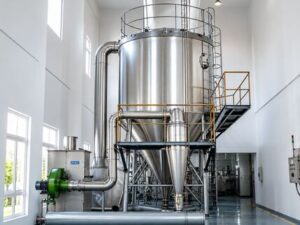
Undoubtedly, modern spray dryer technology remains the industry standard for processing milk powders. Furthermore, it excels at transforming liquid feeds into dry powders.
Process Workflow
-
Liquid Concentrate Feed: Concentrated liquid (45% to 52% Total Solids) is prepared. Subsequently, high-pressure pumps deliver feed to the atomizer head.
-
Atomization Phase: Rotary disk atomizers or nozzles disperse liquid feed. Consequently, liquid streams instantly form fine droplet clouds.
-
Hot Air Exposure: Process air heated to 160°C – 220°C contacts droplets. As a result, surface water evaporates instantly.
-
Powder Separation: Rapid evaporative cooling prevents powder degradation. Subsequently, cyclone separators and baghouse filters collect dry solids efficiently.
Operating Principle
Generally, a spray drying tower atomizes liquid feed into millions of micro-droplets. This process occurs inside a cylindrical drying chamber. Simultaneously, high-volume hot air flows through the chamber. Because atomized droplets feature a vast surface area, heat transfer occurs rapidly. Consequently, moisture evaporates almost instantaneously. Furthermore, evaporative cooling keeps particle temperatures far lower than hot air temperatures. Therefore, thermal damage to proteins and vitamins is effectively avoided.
Key Design Specifications & Features
-
Inlet Air Range: Configured between 160°C and 220°C depending on heat sensitivity.
-
Outlet Air Range: Maintained between 70°C and 95°C. Consequently, this controls final moisture and prevents scorching.
-
Atomization Options: High-speed rotary atomizers operate at 150 to 200 m/s peripheral speed. Alternatively, hydraulic nozzles operate at 150 bar to 280 bar pressure.
-
Separation Yields: Integrated cyclones achieve high collection rates. Furthermore, pulse-jet baghouse filters achieve recovery rates exceeding 99.5%.
-
Sanitary Construction: Systems feature full Clean-in-Place (CIP) nozzles. Additionally, stainless steel (SS316L) contact zones ensure hygienic operations.
2. Vibratory Fluidised Bed Dryer (VFBD)
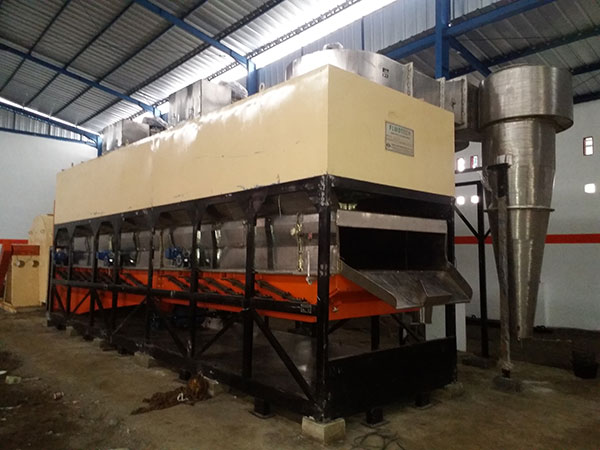
Spray dryers excel at bulk moisture removal. However, reducing final moisture from 8% down to 3% requires gentle handling. Therefore, secondary drying must avoid overheating powder particles.
Process Configuration
In a vibratory fluidised bed dryer, process air enters from a lower plenum chamber. Subsequently, air flows upward through a perforated deck plate. Meanwhile, dual unbalance motors vibrate the bed deck continuously. Consequently, powder fluidizes and conveys smoothly through processing zones.
Operating Principle
In practice, moist powder enters a perforated stainless steel deck. Twin unbalance motors vibrate this deck plate continuously. Simultaneously, heated process air passes upward through deck perforations. Upward air pressure and mechanical vibration combine effectively. As a result, powder particles act like a fluid.
Key Design Specifications & Features
-
Temperature Ranges: Operates from 60°C to 120°C in drying zones. Subsequently, final sections use chilled air (15°C to 20°C) for powder cooling.
-
Zoned Chambers: Incorporates distinct process zones in one continuous casing. Specifically, zones handle secondary drying, ambient cooling, and dehumidified conditioning.
-
Vibration Mechanics: Variable frequency drives adjust vibration amplitude (1 mm to 5 mm). Consequently, operators adjust retention time for varied bulk densities easily.
-
Agglomeration Capabilities: Systems integrate lecithin spraying nozzles. As a result, powder solubility in cold water increases significantly.
3. Combination Dryer Systems
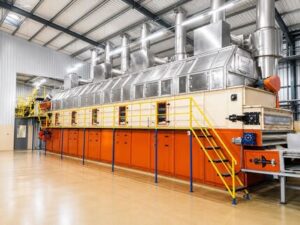
Integrated combination dryer networks represent advanced multi-stage dehydration engineering. Structurally, these systems merge primary spray drying towers with internal static beds and external fluid beds.
Process Sequence
-
Stage One (Spray Tower): High-temperature air removes bulk free water quickly. Consequently, product moisture drops from 50% down to 12% – 15%.
-
Stage Two (Static Internal Bed): Located at the chamber cone, a static bed receives moist powder. There, secondary drying reduces moisture to 6% – 8%. Meanwhile, fine particles recycle from cyclones to form agglomerated structures.
-
Stage Three (External VFBD): Finally, agglomerated powder enters an external VFBD. Gentle low-temperature air brings moisture below 3.5%. Subsequently, chilled air cools powder to 20°C for packaging.
Operating Principle
Dividing moisture removal across three distinct stages minimizes thermal stress. High-temperature evaporation is restricted to initial high-moisture stages. Meanwhile, lower-temperature fluid beds finish drying safely.
Key Design Specifications & Features
-
Thermal Savings: Lowers overall energy usage per kilogram of evaporated water. Specifically, multi-stage operation saves 20% to 30% energy over single-stage units.
-
Powder Quality: Consistently yields dust-free, porous, agglomerated granules. Consequently, powders dissolve instantly upon reconstitution.
-
Sticky Feed Handling: Highly effective for sticky feedstocks. For instance, whey, permeate, and high-fat milk formulations dry cleanly without wall deposits.
4. Flash Dryer / Pneumatic Dryer
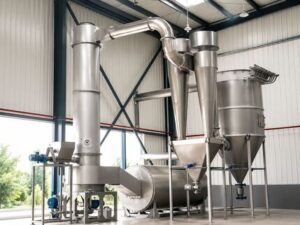
Processors frequently handle high-moisture filter cakes or coagulated dairy solids. In such scenarios, an industrial flash dryer provides rapid, space-efficient drying performance.
Process Flow
Initially, wet cake enters through a high-shear disintegrator feeder. Next, feed dispersion-injects into a high-velocity heated duct. This duct carries hot air moving at 180°C to 250°C. Total residence time remains under 4 seconds. Finally, high-efficiency cyclones separate dry particles.
Operating Principle
Fundamentally, pneumatic flash systems convey moist solids in high-velocity hot air streams. First, high-shear disintegrator feeders break up compressed wet cake. Consequently, fine fragments enter the air stream cleanly. Thermal evaporation occurs in 1 to 4 seconds. Finally, solids separate inside cyclone collectors.
Key Design Specifications & Features
-
Short Contact Time: Extremely fast residence time ranging between 1.0 and 4.0 seconds.
-
High Temperature Limits: Operates safely with high inlet air (180°C to 250°C). Flash cooling protects product quality during brief air exposure.
-
Compact Footprint: Vertical construction requires minimal floor area. Consequently, flash systems save space compared to horizontal belt units.
-
Target Feeds: Optimized for non-liquid feedstocks. Specifically, systems process dewatered acid casein curds, rennet casein, and isolated protein cakes effectively.
5. Mesh Belt Dryer / Industrial Band Dryer
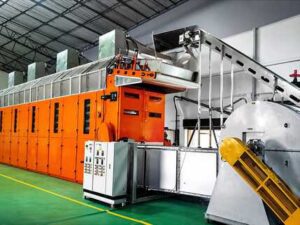
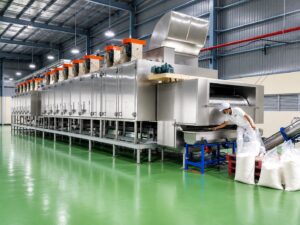
Specialized dairy formulations require gentle thermal handling. When material must remain completely stationary during drying, a continuous mesh belt dryer provides uniform drying control.
Process Flow
To begin, wet feed spreads evenly onto a perforated belt. This stainless steel conveyor belt advances through insulated drying chambers. As it moves, the bed encounters distinct heating, drying, and cooling air zones. Finally, dry intact solids discharge smoothly.
Operating Principle
In this system, wet material spreads onto a moving perforated stainless steel belt deck. This belt travels continuously inside an insulated tunnel. Simultaneously, hot air passes through the moving material bed in controlled patterns. Belt speeds are regulated precisely using Variable Frequency Drives (VFD).
Key Design Specifications & Features
-
Airflow Management: Bed height adjusts between 25 mm and 150 mm. Furthermore, reversible updraft and downdraft airflow patterns ensure uniform moisture removal.
-
Multi-Deck Options: Available in single-pass, 3-pass, or 5-pass conveyor designs. Consequently, multi-deck systems maximize drying area within compact footprints.
-
Zero Attrition: Prevents particle breakage and fine dust creation. This occurs because product remains completely stationary relative to the belt deck.
Technical Comparison Matrix & Selection Guide
Below is a detailed engineering matrix comparing drying technologies across feed types, operating parameters, and dairy applications:
| System Category | Primary Feed State | Inlet Temp Range | Moisture Shift (In -> Out) | Primary Applications | Core Operational Advantage |
| Spray Dryer (Single Stage) | Concentrated liquids (40%–50% Total Solids) | 180°C to 220°C | 55% -> 3.5% to 5.0% | Standard SMP, WMP, general dairy powder drying | High throughput, continuous operation, simple capital investment |
| Combination Dryer (Multi-Stage) | Concentrated sticky fluids, protein slurries | 160°C to 200°C | 50% -> 2.5% to 3.5% | Instant SMP/WMP, WPC 80, Infant Formula | Outstanding energy efficiency, dust-free agglomerated instant powder |
| Vibratory Fluidised Bed (VFBD) | Moist semi-dry powders, granules | 60°C to 120°C | 8% -> 2.0% to 3.0% | Secondary drying/cooling, Lecithinization | Precise temperature control, dustless handling, gentle cooling |
| Flash Dryer (Pneumatic) | Dewatered wet cakes, coagulated curds | 180°C to 250°C | 55% -> 10.0% to 12.0% | Acid Casein, Rennet Casein, protein precipitates | Ultra-fast flash evaporation, compact footprint, handles dense wet cakes |
| Mesh Belt Dryer | Extruded granules, pastes, structured solids | 70°C to 140°C | 40% -> 3.0% to 6.0% | Specialty milk snacks, malted dairy granules | Zero mechanical agitation, uniform bed drying, precise residence timing |
Application Breakdown: Matching Products to the Right Dryer
Product to Equipment Summary
-
Skimmed & Whole Milk Powder: Multi-Stage Spray Dryer + Integrated VFBD
-
Whey Protein (WPC / WPI): Dedicated dairy protein drying Multi-Stage Spray System
-
Casein Processing: High-Velocity casein drying systems / Flash Dryer
-
Lactose Crystallization: Specialized lactose drying Vibratory Fluid Bed Dryer
-
Non-Caking Whey Powder: Multi-Stage whey powder drying Spray System + Pre-crystallization Belt
-
Standard Dairy Powders: High-Throughput dairy powder drying Systems
1. Dairy Protein Drying (WPC, WPI, MPC, MPI)
Dairy proteins like Whey Protein Concentrate (WPC 35 to WPC 80) are heat-sensitive. Similarly, Whey Protein Isolate (WPI 90) and Milk Protein Concentrate (MPC) degrade under high temperatures. Excessive heat causes irreversible protein denaturation. Consequently, functional properties like solubility, emulsification, and foaming capability decrease rapidly.
-
Recommended Equipment: Multi-stage combination spray dryer paired with a low-temperature vibratory fluid bed dryer for dedicated dairy protein drying.
-
Processing Strategy: Moderate inlet air temperatures (160°C to 175°C) are maintained. Hydraulic nozzles atomize feed into uniform droplets. Subsequently, semi-dry powder moves into an integrated fluid bed. There, gentle drying preserves native protein structures cleanly.
2. Casein Drying Systems (Acid & Rennet Casein)
Casein is produced by precipitating skimmed milk using mineral acids, lactic acid, or rennet enzymes. Dewatering centrifuges separate liquid whey from coagulated casein curds. Consequently, this yields a sticky wet cake containing 50% to 60% moisture.
-
Recommended Equipment: Pneumatic flash dryer integrated with a high-shear disintegrator feeder for specialized casein drying systems.
-
Processing Strategy: Dewatered casein cake meters into a high-shear disintegrator. This unit breaks sticky lumps into small fragments. Subsequently, fragments inject into a hot air duct moving at 200°C to 220°C. Moisture evaporates within seconds during transport. Thus, systems deliver dry casein powder (<10% to 12% moisture) without heat discoloration.
3. General Dairy Powder Drying (SMP, WMP, FFMP)
Standard Skimmed Milk Powder (SMP) and Whole Milk Powder (WMP) represent high production volumes in India. Therefore, plants require continuous operational capacity, minimal downtime, and high thermal efficiency. Furthermore, processing equipment must meet sanitary standards.
-
Recommended Equipment: High-capacity multi-stage spray dryer with integrated lecithinization VFBD for bulk dairy powder drying.
-
Processing Strategy: Raw milk pre-concentrates in multi-effect evaporators up to 48% – 52% total solids. Subsequently, concentrate atomizes inside a co-current drying chamber. For instant whole milk powder, lecithin sprays onto powder inside the secondary fluid bed. Consequently, hydrophobic fat particles become cold-water dispersible.
4. Dairy Ingredient Drying (Permeates, Hydrolysates, Specialty Formulations)
Specialty dairy ingredients present unique processing challenges. For example, demineralized whey, whey permeate, and hydrolyzed milk proteins are hygroscopic. In particular, whey permeate contains high levels of amorphous lactose. This compound absorbs environmental moisture rapidly. Consequently, sticky deposits form on chamber walls, causing clogging and powder caking.
-
Recommended Equipment: Combination spray dryer fitted with pre-crystallization tanks and integrated fluid beds for advanced dairy ingredient drying.
-
Processing Strategy: Concentrated liquid feed undergoes controlled cooling and pre-crystallization prior to spray drying. This converts amorphous lactose into stable alpha-lactose monohydrate crystals. Subsequently, feed processes through a multi-stage spray dryer using low-humidity process air. Finally, secondary fluid bed conditioning delivers free-flowing powder.
5. Lactose Drying Systems
After extracting whey proteins, remaining liquids contain rich lactose reserves. Following crystallization in specialized tanks and centrifugal separation, wet lactose crystals remain. These crystals carry roughly 6% to 12% surface moisture.
-
Recommended Equipment: Vibratory fluidised bed dryer (VFBD) optimized for lactose drying.
-
Processing Strategy: Wet lactose crystals feed onto a perforated bed deck. Gentle upward hot air streams combined with mechanical vibration fluidize crystals safely. Zoned heating removes surface moisture without disturbing bound water. Ultimately, systems yield free-flowing alpha-lactose monohydrate crystals.
6. Whey Powder Drying
Raw cheese whey contains high lactose concentrations, mineral salts, and soluble proteins. Direct drying of raw whey creates severe operational problems. Specifically, amorphous lactose forms sticky deposits along drying chamber walls.
-
Recommended Equipment: Multi-stage combination spray dryer with pre-crystallization conditioning for effective whey powder drying.
-
Processing Strategy: Liquid whey concentrate undergoes controlled pre-crystallization. This process converts 70% to 80% of lactose into crystalline alpha-monohydrate. Next, feed atomizes in a low-temperature spray dryer tower. Secondary fluid beds finish crystallization completely. Consequently, systems yield stable, non-caking whey powder.
Energy Efficiency, Sanitation, and Industry Standards
Operating industrial dehydration systems requires high engineering standards. Specifically, plants must comply with sanitary requirements and energy efficiency guidelines. Thermal energy accounts for up to 60% of operating costs in dairy powder plants. Therefore, modern designs incorporate advanced heat recovery systems.
Core Engineering Innovations in Dairy Drying
-
Exhaust Energy Recovery: Air-to-air heat exchangers save 10% to 15% on plant fuel consumption.
-
Sanitary CIP Systems: 360-degree retractable spray nozzles ensure total bacterial safety.
-
Advanced Emission Filters: Sanitary pulse-jet baghouse filters maintain particulate emissions below 10 mg/Nm³.
-
PLC-SCADA Automation: Automated control of temperatures, feed rates, and airflows ensures uniform output quality.
Thermal Energy Recovery
Modern processing plants integrate air-to-air heat exchangers in exhaust air ducts. Consequently, hot exhaust air at 75°C to 85°C preheats incoming ambient process air. This transfer occurs before air enters main heaters. As a result, thermal fuel consumption drops by 10% to 15%.
Clean-in-Place (CIP) Sanitation
Food safety standards established by regulatory authorities mandate total cleanability. Therefore, advanced equipment incorporates automated CIP systems with motorized retractable spray nozzles. Automated cleaning cycles pump hot caustic and acid wash solutions through chambers, cyclones, fluid beds, and ductwork. Consequently, automated sanitation eliminates manual scrubbing and prevents bacterial contamination.
Air Emission Control
Environmental regulations demand strict dust emission control. As a result, modern drying plants utilize sanitary pulse-jet baghouse filters fitted with PTFE-membrane bags. Consequently, collection systems achieve powder recovery rates above 99.5%. Furthermore, exhaust emissions stay below 10 mg/Nm³ while recovering fine powder particles safely.
Why Partner with GENEX Tech Industries LLP?
India continues its trajectory toward becoming a primary global hub for specialized dairy solids. Therefore, choosing an experienced equipment manufacturing partner is essential. GENEX Tech Industries LLP is a leader in designing, manufacturing, and deploying industrial thermal drying systems tailored for dairy and food processing applications.
Core Strengths & Value Offerings
-
Decades of specialized thermal engineering expertise.
-
Custom equipment designs tailored directly to feed rheology.
-
Compliance with global sanitary, hygienic, and food safety standards.
-
Comprehensive turnkey services: design, fabrication, installation, and commissioning.
-
High energy efficiency and maximum powder recovery yields.
Turnkey Project Execution
GENEX Tech Industries LLP offers complete end-to-end engineering services. Specifically, technical capabilities include feed laboratory analysis, thermal balance calculations, custom manufacturing, site installation, system commissioning, and ongoing maintenance support.
Custom Process Engineering
Recognizing that different dairy feedstocks behave uniquely, GENEX customizes airflow dynamics, atomization systems, bed vibration parameters, and multi-stage configurations. Consequently, processing lines match exact feed characteristics—whether processing whole milk, heat-sensitive proteins, or sticky whey streams.
Hygienic Manufacturing Standards
All equipment fabricated by GENEX Tech Industries LLP utilizes food-grade stainless steel (SS304, SS316L). Furthermore, systems feature TIG welding, mirror-polished contact surfaces (Ra < 0.8 microns), and automated CIP integration. Consequently, processing lines guarantee full compliance with national and international hygienic regulations.
Conclusion & Call to Action
In conclusion, India’s monumental milk production volume—reaching approximately 247.87 million tonnes in 2024–25—presents unprecedented commercial growth opportunities for dairy cooperatives, private processors, and food ingredient manufacturers. Transforming liquid milk surpluses into high-value powders, functional protein isolates, and stable non-caking ingredients requires energy-efficient, custom-engineered thermal drying systems.
Whether you require a high-capacity multi-stage spray dryer for skimmed milk powder, a precise vibratory fluidized bed dryer for instant agglomeration, a high-velocity flash dryer for casein curds, or a custom combination dryer for sticky whey streams, selecting the right machinery ensures high product yields, optimal functional quality, and maximum operational profitability.
Partner with GENEX Tech Industries LLP to engineer state-of-the-art thermal drying systems custom-built for your processing needs. Contact our engineering specialists today to evaluate your process parameters or request a detailed technical proposal.
-
Head Office Address: 10C, Sir William Jones Sarani (Middleton Row), Park Street, Kolkata – 700071, West Bengal, India
-
Direct Phone / WhatsApp Contact: +91-97489 06968 | +91-93300 77417
-
Official Business Email: mktg@foodtechprojects.com | sales@foodtechprojects.com
-
Official Company Websites: www.foodtechprojects.com | www.gtidryers.com