

Executive Summary and Industrial Context
In modern chemical manufacturing, operators consistently utilize thermal processing. Solid inorganic compounds represent a critical production stage. Specifically, inorganic salts, hydrated compounds, and metal hydroxides possess complex thermal behaviors. Consequently, process engineers must convert wet feed stocks directly into free-flowing final products. Therefore, plants require carefully engineered drying systems.
Furthermore, materials such as copper sulfate, iron sulfate, and fine metal hydroxides introduce challenging traits. For example, these traits include high moisture retention, stickiness, heat sensitivity, and corrosive properties. In addition, processing conditions often vary due to upstream feed fluctuations.
As a result, selecting improper drying technology causes catastrophic failures. In particular, these failures include wall caking, equipment corrosion, and product thermal degradation. High energy wastage and off-spec moisture levels also occur. Thus, choosing the right system is paramount.
To overcome these challenges, plant managers rely specifically on specialized industrial dryers. In this guide, we explore four core drying technologies:
- Vibratory Fluidised Bed Dryers (VFBD)
- Rotary Drum Dryers
- Pneumatic Flash Dryers
- Hollow Paddle Dryers
Additionally, this guide provides technical comparative data and heat transfer dynamics. Clear recommendations allow engineers to select optimal equipment. Ultimately, this guide serves as an actionable roadmap for process optimization.
Technical Overview of the Feed Materials
Before analyzing specific equipment, operators must first understand feed stock properties. In this section, we categorize primary feed stocks in order to evaluate their distinct behaviors.
Regarding material categories, crystalline salts include copper sulfate pentahydrate and iron sulfate heptahydrate. On the other hand, amorphous precipitates consist of iron hydroxide and metal hydroxide sludges. Because these groups behave differently, their operational requirements contrast significantly.
1. Copper Sulfate Compounds
Initially, copper sulfate enters the dryer as a wet crystalline cake. Workers pass the material through crystallization and centrifugation. Typically, the cake carries surface moisture between 3% and 10%. However, its main characteristic lies in bound hydration water.
For instance, copper sulfate pentahydrate loses bound water at specific temperature steps:
- First, operators maintain bed temperatures below 60°C so that the salt retains pentahydrate form.
- Next, between 65°C and 110°C, thermal energy progressively forms trihydrate and monohydrate states.
- Finally, above 150°C to 200°C, complete dehydration yields anhydrous copper sulfate.
Therefore, the drying system must maintain strict process control. It evaporates surface water without stripping structural hydration water. In contrast, failing to control heat leads to unwanted chemical phase changes.
2. Iron Sulfate Compounds
Meanwhile, chemical plants commonly generate iron sulfate as a major byproduct. Titanium dioxide production and steel pickling liquor recovery produce large volumes. Specifically, it usually exists as heptahydrate (copperas) or monohydrate.
Owing to this origin, this material presents several processing challenges:
- High Thermal Sensitivity: First, iron sulfate heptahydrate melts in its own hydration water above 64°C.
- Oxidation Risk: Second, high air temperatures quickly oxidize ferrous iron into ferric states.
- Extreme Corrosiveness: Third, acidic residual liquor makes wet filter cake highly corrosive to standard steels.
Hence, engineers must design equipment that withstands chemical attack while managing tight temperature thresholds.
3. Specialized Sodium and Potassium Salts
Standard bulk facilities handle common sodium and potassium chloride. However, specialized salts require precise thermal control. Indeed, persulfates and metabisulfites are prone to thermal degradation.
Specifically, these compounds frequently exhibit:
- Narrow thermal decomposition limits (because they decompose above 50°C to 80°C).
- High solubility in surface water, which creates sticky liquid phases under incorrect heating.
- Hygroscopic properties, which demand controlled air cooling immediately after drying to prevent re-absorption.
As a result of these features, careful handling is necessary throughout the entire thermal processing cycle.
4. Metal Hydroxide Precipitates and Wet Cakes
In comparison, metal hydroxide precipitates differ structurally from crystalline salts. Heavy metal hydroxide sludges from wastewater neutralization fall into this category.
Consequently, they display clear physical properties:
- Gelatinous and Thixotropic Nature: Namely, high flow resistance when static, but rapid liquefaction under shear stress.
- High Initial Moisture Content: For example, surface and bound moisture normally range between 55% and 85%.
- Low Thermal Conductivity: Thus, very slow heat penetration occurs inside sticky agglomerates.
- Severe Caking Tendency: Additionally, pronounced sticking occurs along heated metal walls.
Core Industrial Drying Technologies
1. Vibratory Fluidised Bed Dryers (VFBD)
Working Principle and Engineering Mechanics
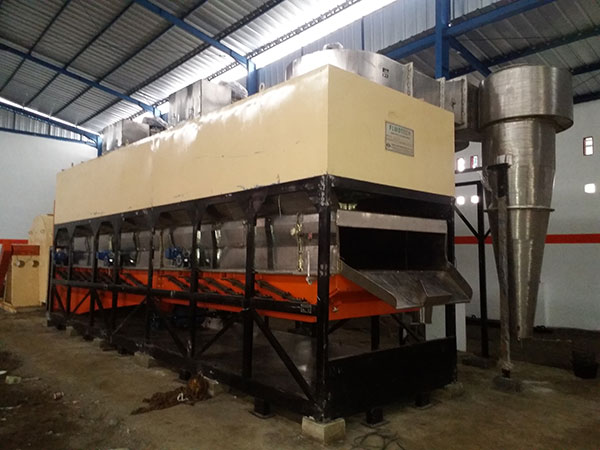
To begin with, a Vibratory Fluidised Bed Dryer combines convective hot air with mechanical vibration. Wet feed enters directly through the top inlet. Simultaneously, heated air flows upward from the bottom plenum chamber. Consequently, air passes through a perforated vibrating deck. Exhaust vapor exits through top ducts while dry product discharges finally at the far end. In this way, continuous fluidization occurs efficiently.
Fluidization Dynamics and Air Velocity
Standard static fluid beds often fail on crystalline salts. Irregular particle shapes or surface moisture cause localized channeling. Fortunately, mechanical vibration solves this problem effectively:
- For one thing, vibration breaks static particle bonds. Thereby, it allows smooth fluidization at lower air velocities.
- For instance, typical air velocities range from 0.8 m/s to 1.8 m/s.
- In addition, operators set vibration frequency between 12 Hz and 25 Hz. Vibration amplitude stays between 2 mm and 5 mm.
Thermal Efficiency and Operating Parameters
- Inlet Air Temperature: 70°C to 220°C (adjusted according to hydrate thermal limits).
- Thermal Efficiency: 65% to 78% when engineers incorporate exhaust heat recovery loops.
- Residence Time: In addition, operators control residence times from 5 to 45 minutes by adjusting weir gate height.
Best Applications for VFBD
In summary, Vibratory Fluidised Bed Dryers perform best for free-flowing crystalline materials. They deliver uniform drying without particle attrition.
- Copper Sulfate Pentahydrate Crystals: For example, the equipment retains crystal structure without chipping.
- Iron Sulfate Monohydrate Powder: Similarly, the system provides uniform moisture removal while keeping temperatures below decomposition levels.
- Specialized Sodium and Potassium Salts: Likewise, continuous motion prevents particle clumping through gentle bed agitation.
2. Rotary Drum Dryers
Working Principle and Mechanical Design
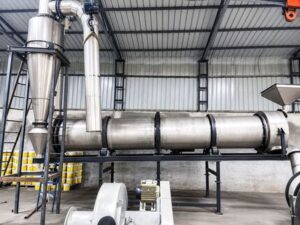
Alternatively, an industrial rotary drum dryer functions through a continuous flow path. Wet feed enters directly into the upper inlet of an inclined rotating shell. Simultaneously, hot air flows through the interior. Internal lifters shower wet solids continuously through the hot air stream. Consequently, moisture evaporates rapidly. Dried material travels gradually along the shell until it discharges finally at the lower end.
Direct vs. Indirect Heating Modes
- Direct-Fired Rotary Dryers: Here, hot air directly contacts falling material. Specifically, airflow can flow co-currently or counter-currently to meet process needs.
- Indirect Heated Rotary Dryers: Conversely, external burners heat the outer shell, or internal steam tubes heat the drum interior. Heat transfers conductively through tube walls. This design minimizes dust carryover in exhaust gas.
Process Capabilities and Engineering Parameters
- Drum Slope Angle: 2° to 5° downward inclination toward discharge.
- Thermal Efficiency: Direct mode achieves 55% to 70%. Whereas insulated indirect mode reaches up to 80%.
- Residence Time: Furthermore, these units offer long residence times, ranging from 15 to 90 minutes.
Best Applications for Rotary Drum Dryers
Overall, Rotary Drum Dryers excel at continuous, high-volume processing of robust inorganic compounds.
- Bulk Industrial Iron Sulfate (Coarse Grades): For instance, this design handles high mass throughput efficiently.
- Crude Copper Sulfate Ore Processing: In addition, the sturdy interior resists particle abrasion.
- Heavy Inorganic Precipitates: Likewise, the heavy frame performs reliably under high mechanical loads.
3. Pneumatic Flash Dryers
Working Principle and Rapid Heat Transfer Dynamics
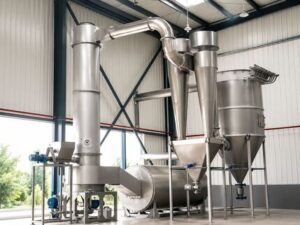
In contrast to drum drying, a pneumatic flash dryer relies on ultra-fast transport and rapid evaporation. Wet feed enters directly into a disperser unit. High-speed blades break lumps into fine particles. Simultaneously, furnaces introduce high-velocity air into the base duct. As a result, fine particles sweep upward into vertical flash pipes, evaporating moisture almost instantaneously. Subsequently, cyclones capture dry powder.
Because the disperser scatters particles finely, surface area increases exponentially. Thus, instantaneous evaporation occurs within a short pipe path (typically 10 m to 25 m high). Consequently, total residence time lasts only 1 to 3 seconds.
Process Parameters and Thermodynamic Features
- Inlet Air Temperature: 180°C to 450°C (rapid evaporation keeps core particle temperatures low).
- Outlet Air Temperature: 75°C to 110°C.
- Thermal Efficiency: 60% to 75% due to low exhaust humidity limits.
Best Applications for Flash Dryers
In practice, Flash Dryers work best for fine, surface-moisture-heavy powders. They excel where ultra-fast drying prevents thermal breakdown.
- Pre-dispersed Metal Hydroxide Filter Cakes: For example, flash action converts moist cake into fine dry powder.
- Pre-ground Copper Hydroxide Powders: In addition, short exposure protects surface chemical structures.
- Fine Potassium and Sodium Salt Powders: Similarly, high-velocity air rapidly flashes off surface water without heating core crystals.
4. Hollow Paddle Dryers
Working Principle and Conductive Heat Transfer
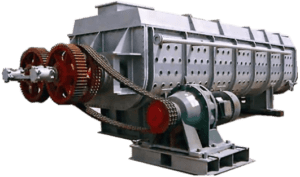
On the other hand, a hollow paddle dryer removes moisture continuously through indirect contact heating. Wet feed enters directly into a jacketed trough. Dual shafts feature intermeshing heated hollow paddles. Thermal fluid circulates through interior jackets and paddle surfaces. Consequently, heat transfers conductively into the bed. Rotating paddles shear and move wet material forward. Meanwhile, vapor exits top outlets, and dry product discharges continuously.
Indirect Heat Transfer Calculations
Unlike convective dryers, paddle dryers rely almost entirely on conductive metal surface contact:
- Off-Gas Flow Rate: Exceptionally low—typically 80% to 95% lower than convective units. This factor eliminates dust emission risks.
- Thermal Efficiency: Exceptionally high, routinely reaching 80% to 90%.
Best Applications for Hollow Paddle Dryers
Without a doubt, Hollow Paddle Dryers represent premier technology for processing sticky, gelatinous materials.
- Gelatinous Metal Hydroxide Filter Cakes: Specifically, dual agitators shear sticky cakes continuously without clogging.
- Heavy Industrial Sludges: Furthermore, high torque drives off water efficiently from high-moisture feeds.
- Heat-Sensitive Hydrates: In addition, enclosed housing operates safely in inert gas environments.
Detailed Comparative Technology Matrix
| Technical Parameter | Vibratory Fluidised Bed Dryer | Rotary Drum Dryer | Pneumatic Flash Dryer | Hollow Paddle Dryer |
| Primary Drying Mechanism | Direct Convective (Air/Gas) | Direct or Indirect Convective/Conductive | Direct Convective High Velocity | Indirect Pure Conductive |
| Typical Feed Moisture Range | 2% to 18% | 5% to 45% | 10% to 55% | 15% to 85% |
| Final Achievable Moisture | < 0.1% | 0.5% to 2% | 0.2% to 1% | < 0.5% |
| Typical Residence Time | 5 to 45 minutes | 15 to 90 minutes | 1 to 3 seconds | 20 to 120 minutes |
| Thermal Efficiency Range | 65% to 78% | 55% to 70% | 60% to 75% | 80% to 90% |
| Exhaust Gas Volume | High | High to Very High | Very High | Extremely Low |
| Mechanical Agitation Level | Low (Vibrational force) | Moderate (Cascading impact) | Extreme (Disintegrator shearing) | High Shear / Low Speed Mixing |
| Sensitivity to Sticky Feeds | Poor (Requires pre-dried recycle) | Moderate | Moderate (Requires disperser) | Outstanding (Self-cleaning) |
| Footprint Requirement | Moderate | Very Large | Vertical / Small Floor Area | Extremely Compact |
Material-to-Dryer Selection Matrix
To make a decision, selecting an industrial dryer requires evaluating feed material structure. First, for crystalline salts, process engineers determine if particle shape is fragile. If crystals are uniform and fragile, engineers select Vibratory Fluidised Bed Dryers. Otherwise, they utilize Rotary Drum Dryers. Conversely, for gelatinous hydroxide cakes, engineers evaluate moisture and stickiness. If high moisture and stickiness exist, processes require Hollow Paddle Dryers. However, if cakes disperse easily, Pneumatic Flash Dryers provide optimal solutions.
1. Copper Sulfate (Pentahydrate vs. Anhydrous)
- Primary Recommendation for Pentahydrate Crystals: Vibratory Fluidised Bed Dryer (VFBD)
- Technical Justification: Operators control fluidization temperatures between 45°C and 55°C. Consequently, the dryer removes surface water without stripping hydration water. Moreover, low vibrational shear preserves original blue crystal clarity completely.
- Alternative for Anhydrous Production: Indirect Rotary Drum Dryer or Paddle Dryer
- Technical Justification: In this case, systems maintain temperatures above 180°C over long residence times. Thus, they drive off bound hydration water fully.
2. Iron Sulfate (Heptahydrate vs. Monohydrate)
- Primary Recommendation for Heptahydrate: Vibratory Fluidised Bed Dryer (VFBD)
- Technical Justification: Above all, operators strictly keep bed temperatures below 50°C. So, the salt does not dissolve in its own bound water. In addition, high air mass flows quickly carry off surface moisture.
- Primary Recommendation for Monohydrate Production: Hollow Paddle Dryer or Flash Dryer with Recycle System
- Technical Justification: Processing iron sulfate between 120°C and 140°C rapidly converts heptahydrate feed into fine monohydrate powder.
3. Specialized Sodium and Potassium Salts (Persulfates, Metabisulfites)
- Primary Recommendation: Vibratory Fluidised Bed Dryer (VFBD)
- Technical Justification: Low-temperature convective air eliminates thermal decomposition risks entirely. Additionally, integrated cooling zones reduce product temperatures below 30°C before packaging. Thereby, they prevent moisture re-absorption.
- Secondary Recommendation (For Fine Powders): Pneumatic Flash Dryer
- Technical Justification: Rapid 2-second exposure flashes off surface moisture without raising core particle temperatures high enough to cause chemical instability.
4. Metal Hydroxide Precipitates and Heavy Metal Sludges
- Primary Recommendation: Hollow Paddle Dryer
- Technical Justification: Gelatinous hydroxide cakes stick to conventional walls. However, dual intermeshing paddles continuously shear sticky material. Furthermore, low air flows minimize toxic dust carryover effectively.
- Secondary Recommendation (For Dispersible Cakes): Pneumatic Flash Dryer with Disintegrator
- Technical Justification: High-speed disperser blades break filter cakes into fine particles. They expose them instantly to high-velocity hot air for immediate moisture removal.
Detailed Process Considerations and Operating Parameters
1. Material Degradation and Crystal Preservation
When handling crystalline products, mechanical impacts inside drying chambers break crystal structures.
- As a rule, broken crystals produce fine dust. Dust clogs bag filters and lowers market value.
- In contrast, Vibratory Fluidised Bed Dryers reduce attrition rates below 0.5% particle breakdown. Whereas conventional Rotary Drum Dryers produce 5% to 15% breakdown.
2. Materials of Construction and Corrosion Prevention
In addition, inorganic salts and acidic hydroxide cakes present severe corrosion risks during drying:
- Standard Carbon Steels: In general, carbon steel designs prove unsuitable for wet salts because corrosion rates exceed 1.5 mm/year.
- Austenitic Stainless Steels (SS304 / SS316): In comparison, stainless alloys are recommended for dry salt contact.
- Specialty Stainless Steels (SS316L / Duplex 2205): However, high-nickel grades are required for wet iron sulfate and acidic cakes. They prevent pitting corrosion.
- Abrasion Resistance: In particular, high-velocity flash dryer elbows must feature nickel-hard liners or ceramic tile inserts.
3. Dust Collection and Emission Control
Furthermore, drying inorganic powders generates fine airborne dust. Operators must capture dust efficiently to meet environmental emission standards:
- Cyclones: First, primary cyclone separators serve as effective initial filters. They capture 90% to 95% of coarse particles.
- Pulse-Jet Bag Filters: Second, pulse-jet units act as essential secondary filters. They lower exhaust dust concentrations below 10 $\text{mg}/\text{Nm}^3$.
- Wet Scrubbers: Finally, wet scrubbing systems perform best for hygroscopic or toxic powders. They eliminate fabric bag blinding risks.
Conclusion
In conclusion, drying inorganic salts and metal hydroxide precipitates requires selecting equipment based on material properties.
- To summarize, Vibratory Fluidised Bed Dryers deliver precise temperature control and gentle handling for fragile crystalline salts.
- In addition, Rotary Drum Dryers provide heavy-duty continuous capacity for robust bulk feeds.
- Similarly, Pneumatic Flash Dryers offer high-speed, instant drying for non-sticky fine powders and disintegrated cakes.
- Finally, Hollow Paddle Dryers provide high thermal efficiency and continuous self-cleaning performance for sticky gelatinous precipitates.
Therefore, by matching feed characteristics with appropriate heat transfer mechanisms, chemical processors achieve high product purity and reliable performance.
Call to Action (CTA)
Are you currently planning an upgrade to your inorganic salt recovery process? Or are you looking to optimize thermal drying of sticky metal hydroxide filter cakes?
To help you succeed, our engineering team at GENEX Tech Industries LLP provides complete technical evaluations, custom equipment design, and turnkey drying system manufacturing tailored to your exact specifications.
Therefore, contact our engineering specialists today in order to request a technical consultation, arrange product drying trials, or receive a project proposal:
-
Head Office Address: 10C, Sir William Jones Sarani (Middleton Row), Park Street, Kolkata – 700071, West Bengal, India
-
Direct Phone / WhatsApp Contact: +91-97489 06968 | +91-93300 77417
-
Official Business Email: mktg@foodtechprojects.com | sales@foodtechprojects.com
-
Official Company Websites: www.foodtechprojects.com | www.gtidryers.com