Introduction to Advanced Industrial Drying in Polymer Processing
Industrial drying of polymer emulsions, synthetic resins, and rubber latex represents one of the most critical unit operations in modern chemical processing today. Furthermore, selecting the correct thermal dehydration architecture directly governs final product quality, bulk density, particle size distribution, thermal stability, and overall operational profitability. Additionally, converting high-moisture liquid feeds, heavy pastes, or filter cakes into free-flowing, highly stable powders involves extremely intricate thermal and mechanical dynamics. Consequently, industrial manufacturers must carefully evaluate specialized drying equipment engineered specifically to handle sticky, heat-sensitive, and shear-reactive polymer matrices.
Moreover, processing specialized polymer emulsions—including melamine-formaldehyde resins, urea-formaldehyde resins, phenol-formaldehyde resins, acrylonitrile butadiene styrene (ABS) latex, natural rubber latex, synthetic rubber latex, acrylic emulsions, and vinyl acetate copolymers—presents distinct engineering challenges. In particular, these advanced materials often exhibit non-Newtonian flow behavior, thermoplastic tackiness, and temperature-dependent cross-linking reactivity. As a result, engineers must strictly control thermal exposure using precise temperature boundaries, controlled retention times, and high-efficiency air distribution systems.
Therefore, leading dryer manufacturers like Genex Tech Industries LLP (GTI Dryers) design and supply custom-engineered thermal processing systems tailored to these challenging applications. In addition, through advanced heat and mass transfer engineering, modern industrial dryers transform delicate liquid feeds into high-value solid powders while simultaneously minimizing overall energy consumption and completely preventing thermal degradation.
Processing Challenges of Thermosetting Resins, Polymers, and Latex
To begin with, process engineers must thoroughly understand the physical, chemical, and thermal properties of polymer systems before selecting an industrial dryer. Moreover, thermosetting resins and rubber latex emulsions behave fundamentally differently from inorganic minerals or food matrices.
In fact, the primary operational challenges in polymer drying include the following core factors:
- Thermal Sensitivity and Cross-Linking: Specifically, operators face the constant risk of premature curing when they expose products to temperatures above critical thresholds, typically between 50°C and 120°C. Therefore, precise thermal regulation is vital.
- Thermoplastic Tackiness and Wall Fouling: Furthermore, rapid particle softening, unwanted agglomeration, and severe adhesion to internal vessel walls create major issues. Consequently, systems require dedicated anti-sticking mechanisms.
- High Viscosity and Non-Newtonian Rheology: In addition, complex shear-thinning or dilatant flow dynamics require specialized feed pumps and atomization systems. As a result, technical teams must carefully manage fluid transport.
- Dust Explosion Risks and Safety Hazards: Similarly, highly combustible organic polymer dusts constantly necessitate inert gas loops (nitrogen blanketing) and certified explosion venting systems. Consequently, safety engineering is non-negotiable.
1. Thermal Sensitivity and Premature Curing
First and foremost, thermosetting polymers—such as melamine-formaldehyde, urea-formaldehyde, and phenol-formaldehyde—undergo irreversible polycondensation when they absorb excess thermal energy. Furthermore, if the product temperature exceeds critical thresholds (frequently between 60°C and 110°C), premature curing occurs inside the drying equipment. Consequently, this leads directly to insoluble agglomerates, reduced shelf life, and severe wall buildup. Therefore, drying systems must achieve exceptionally rapid surface water evaporation while consistently maintaining low internal particle temperatures via evaporative cooling dynamics.
2. Thermoplastic Softening and Wall Fouling
Secondly, polymer latex emulsions, such as ABS latex and rubber latex, possess distinct glass transition temperatures. Furthermore, when operating near or above their glass transition temperature, polymer particles become soft, tacky, and highly adhesive. Consequently, uncontrolled contact with hot equipment walls leads directly to severe fouling, reduced thermal transfer efficiency, degraded yields, and potential fire hazards. Therefore, modern dryers utilize air-cooled wall jackets, air sweepers, and specialized surface coatings to completely prevent adhesion.
3. Non-Newtonian Rheology and Atomization Dynamics
Thirdly, liquid polymer emulsions often exhibit complex non-Newtonian flow characteristics, ranging from shear-thinning (pseudoplastic) to shear-thickening (dilatant) behavior. Consequently, feeding these high-viscosity materials (ranging from 100 cP to over 5,000 cP) into a drying chamber requires specialized high-pressure pumps and custom-designed atomization nozzles or rotary wheels to achieve uniform droplet breakup without clogging. Therefore, engineers must specifically match fluid handling to material viscosity.
4. Explosibility and Environmental Safety Requirements
Finally, fine organic polymer powders present significant combustible dust hazards. Furthermore, airborne dust clouds of resins or rubber compounds exhibit high explosion severity factors. Consequently, modern drying plants processing polymers must incorporate inert gas recycling loops (nitrogen-blanketed closed-loop systems), explosion relief venting panels, spark detection, and automatic suppression systems to ensure safe continuous operation. As a result, plant safety increases significantly.
Detailed Analysis of Essential Drying Technologies
Furthermore, selecting the ideal drying technology requires an in-depth understanding of equipment design, thermal principles, airflow patterns, and operational performance metrics. Below is an exhaustive technical review of the five primary industrial dryer types that manufacturers utilize across the polymer, resin, and latex sectors:
- Spray Dryer: Converts liquid feeds, suspensions, and emulsions directly into fine, uniform powders. Therefore, it serves liquid feeds exceptionally well.
- Mesh Belt Dryer: Processes extruded pellets, rubber crumbs, and sheets via gentle continuous conveyor drying. Consequently, it handles solid aggregates effectively.
- Combination Dryer: Combines multi-stage spray and fluid bed drying for moisture equalization and powder finishing. Thus, it offers maximum energy efficiency.
- Vibratory Fluidised Bed Dryer: Dries moist powders, crystals, and granules using hot air combined with mechanical vibration. As a result, it prevents bed sticking.
- Flash Dryer: Delivers ultra-fast surface water removal for coagulated cakes and dewatered materials. Hence, it suits filter cakes perfectly.
1. Spray Drying Systems
Core Operating Principles
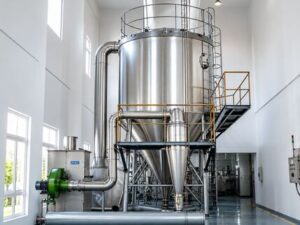
To start, spray drying is a single-step continuous processing technology that converts liquid polymer solutions, suspensions, or emulsions into dried particulate solids. Furthermore, a feed pump delivers the liquid material into an atomization device situated at the top of a drying tower. Consequently, the atomizer disperses the feed into millions of microscopic droplets, creating an enormous surface area relative to total mass. Furthermore, these droplets immediately encounter a stream of hot drying air. Because of rapid heat transfer, moisture evaporates instantly from the droplet surface within milliseconds, keeping the core product cool due to continuous evaporative cooling.
In a typical spray drying sequence, liquid feed enters through a high-pressure nozzle or rotary atomizer into the drying chamber, where it meets hot inlet air (140°C to 280°C). After rapid evaporative cooling, cyclone separators or bag houses collect the dried powder while exhaust fans safely vent the air. Consequently, operations achieve high production rates seamlessly.
Technical Specifications and Operational Data
- Inlet Air Temperature Range: 140°C to 280°C depending on polymer stability.
- Outlet Air Temperature Range: 60°C to 105°C (operators strictly monitor this to prevent resin curing). Therefore, the system avoids heat damage completely.
- Evaporation Efficiency: 65% to 82% thermal efficiency depending on heat recovery integration.
- Residence Time: 5 seconds to 45 seconds inside the primary chamber. Consequently, the process minimizes thermal exposure.
- Atomization Pressure: Up to 250 bar (for pressure nozzles) or 10,000 to 22,000 RPM (for rotary disc atomizers).
- Final Product Moisture: 0.2% to 1.5% residual moisture content. Thus, the system guarantees ideal powder dryness.
Airflow Configurations
- Co-Current Flow: Hot air and atomized droplets travel in the same direction down the chamber. Furthermore, because incoming hot air encounters the wettest droplets first, intense evaporative cooling occurs immediately. Consequently, particle temperatures remain significantly lower than the exhaust air temperature, making co-current flow ideal for heat-sensitive polymers, ABS latex, and formaldehyde resins.
- Counter-Current Flow: Hot air enters from the bottom while nozzles spray liquid from the top. Furthermore, this provides maximum thermal efficiency but exposes the driest powder to the hottest air. Consequently, engineers generally avoid counter-current flow for heat-sensitive polymer resins.
- Mixed-Flow: Combines nozzle spraying upward into a downward air stream, providing longer residence times for coarse particle agglomeration. Therefore, plants can produce larger granules efficiently.
Atomization Mechanics
- Rotary Disc Atomizers: Utilize high-speed rotating wheels to sling liquid outward via centrifugal force. Furthermore, rotary atomizers handle viscous polymer feeds with high solids content (up to 60% solids) without clogging. Consequently, plants virtually eliminate operational downtime.
- Pressure Nozzles (Single-Fluid): Use high pressure to force liquid through tiny orifices, yielding uniform spherical particles with minimal fines. Therefore, the process greatly enhances powder flowability.
- Twin-Fluid (Pneumatic) Nozzles: Utilize compressed air or steam to shear viscous liquids into micro-droplets, ideal for small-scale production or highly shear-thinning polymer emulsions. Consequently, operators achieve complete atomization flexibility.
2. Mesh Belt Dryers (Conveyor Dryers)
Core Operating Principles
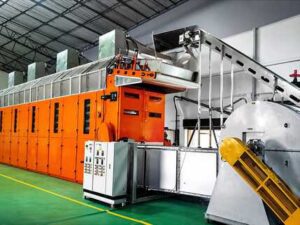
In contrast, mesh belt dryers (or continuous conveyor dryers) transport moist polymers, wet granules, or rubber coagulates through a modular tunnel on a perforated stainless steel mesh belt. Furthermore, as the product moves continuously through distinct temperature zones, powerful fans force heated air upward (up-draft) or downward (down-draft) through the bed of material. Consequently, the system removes moisture gradually without subjecting the material to violent mechanical agitation.
The moving belt carries product sequentially from high-temperature pre-drying zones to medium-temperature drying zones, and finally through an integrated cooling zone where ambient or chilled air stabilizes the polymer prior to discharge. Therefore, the equipment fully prevents product deformation.
Technical Specifications and Operational Data
- Drying Temperature Range: 50°C to 160°C across independent thermal zones. Consequently, operators can customize temperature profiling easily.
- Retention Time: 15 minutes to 180 minutes depending on bed thickness and particle size.
- Bed Depth: 25 mm to 150 mm uniform thickness. Therefore, air penetrates the material layer optimally.
- Air Velocity through Bed: 0.5 m/s to 2.2 m/s.
- Final Product Moisture: Achieves uniform moisture levels below 0.5%. As a result, the plant ensures high product stability.
Zonal Control and Air Distribution
Furthermore, advanced mesh belt dryers feature multi-zone climate control. For instance, Zone 1 can operate at a higher temperature (e.g., 120°C) to remove surface moisture rapidly. Subsequently, Zone 2 reduces the temperature (e.g., 85°C) to prevent thermal degradation as internal diffusion dominates the drying rate. Finally, an integrated cooling zone utilizes dehumidified ambient air to drop the polymer temperature below its glass transition threshold prior to discharge and packaging. Therefore, the system entirely prevents post-process clumping.
3. Combination Dryers (Multi-Stage Systems)
Core Operating Principles
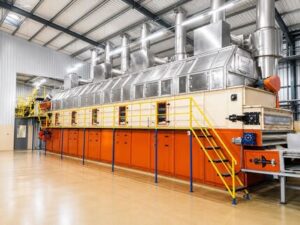
Similarly, combination dryers unite two distinct drying mechanisms within a unified continuous process line to optimize thermal efficiency and product quality. Furthermore, a typical configuration for polymer resins integrates a primary spray drying or tray stage with a secondary fluidized bed finishing stage located directly at the bottom of the drying chamber.
Top-mounted nozzles spray liquid feed into the primary tower to remove 80% to 90% of free surface water. The semi-dry powder drops directly onto an integrated fluid bed base, where secondary warm air removes deeply bound moisture and cools the finished powder. Consequently, the process significantly optimizes overall energy utilization.
Technical Specifications and Operational Data
- Primary Stage Temperature: 160°C to 240°C inlet air.
- Secondary Stage Temperature: 40°C to 80°C fluidized air. Therefore, the secondary bed assures gentle finishing.
- Thermal Energy Savings: Up to 20% to 30% reduction in specific steam consumption compared to single-stage spray dryers. Consequently, plants reduce operating costs substantially.
- Agglomeration Capability: Increases average particle size from 50 microns to 250+ microns. Therefore, the unit produces dustless powders consistently.
- Residual Moisture Control: Yields ultra-low moisture contents down to 0.1%.
Process Synergy
Furthermore, by discharging moist powder (containing 3% to 8% residual moisture) from the primary spray zone into an integrated vibrating or static fluid bed, operators dramatically reduce the overall thermal stress on the polymer. Consequently, the main chamber can operate at lower outlet air temperatures, eliminating thermal scorching while the secondary bed gently drives off deeply bound internal moisture. Therefore, sensitive polymers retain their original chemical properties.
4. Vibratory Fluidised Bed Dryers (VFBD)
Core Operating Principles
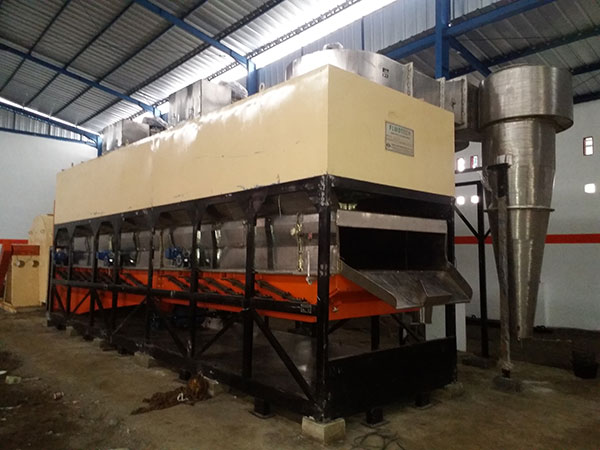
On the other hand, in a Vibratory Fluidised Bed Dryer, a perforated distributor plate supports moist polymer granules, crystals, or flakes. Furthermore, hot drying air passes upward through the plate at velocities sufficient to fluidize the bed, transforming the solid mass into a liquid-like boiling state. Simultaneously, heavy-duty eccentric motors impart directional mechanical vibrations to the entire bed frame.
Hot air passes upward through the perforated vibrating plate to fluidize the wet bed mass, while mechanical vibration drives the material forward in a plug-flow manner toward the discharge spout. Consequently, sticky materials move reliably without clogging.
Technical Specifications and Operational Data
- Operating Temperature Range: 45°C to 140°C. Therefore, it accommodates low-melting-point polymers easily.
- Vibration Amplitude: 1.5 mm to 5.0 mm.
- Vibration Frequency: 750 RPM to 1450 RPM. Consequently, operators can finely tune bed movement.
- Fluidization Air Velocity: 0.3 m/s to 1.2 m/s (significantly lower than static fluid beds). As a result, the fan system consumes less electrical power.
- Heat Transfer Performance: Delivers exceptionally efficient heat exchange capabilities across all operational stages.
Advantages of Mechanical Vibration
Furthermore, mechanical vibration forces sticky, tacky, or irregularly shaped polymer particles to move forward linearly along the bed regardless of particle size distribution. Consequently, vibration prevents static channeling, localized hot spots, and bed defluidization—common issues that operators encounter when drying moist synthetic rubber crumbs or sticky resin granules in standard static fluid beds. Therefore, the system maintains process consistency throughout production.
5. Flash Dryers (Pneumatic Dryers)
Core Operating Principles
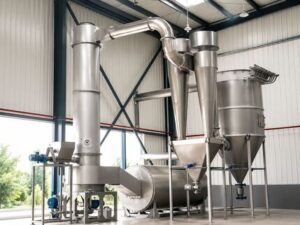
Meanwhile, Pneumatic Flash Dryers are ultra-high-speed continuous thermal processing systems designed for rapidly evaporating moisture from dewatered filter cakes, wet pastes, centrifuge cakes, and fine polymer powders. Furthermore, a specialized disintegrator, dispersion screw, or venturi feeder introduces the wet material into a high-velocity stream of turbulent hot air.
A feed mechanism delivers wet cake or paste into a high-shear disintegrator, which disperses the material into a 160°C to 320°C air stream inside a vertical duct. In a 1 to 3-second flash transport step, moisture evaporates fully before cyclone collectors separate the product. Consequently, operations achieve exceptionally high output speeds.
Technical Specifications and Operational Data
- Air Velocity: 15 m/s to 35 m/s inside the transport drying duct. Therefore, transport occurs almost instantaneously.
- Residence Time: Ultra-short duration between 0.5 seconds and 3.0 seconds. Consequently, thermal damage remains impossible.
- Inlet Air Temperature Range: 160°C to 320°C.
- Outlet Air Temperature Range: 65°C to 105°C.
- Evaporative Capacities: From 100 kg/hr to over 15,000 kg/hr of water removal. Therefore, the system handles high capacities with ease.
Hydrodynamic Dispersion Mechanics
Furthermore, inside the high-shear disintegrator at the base of the flash drying duct, mechanical blades disrupt wet polymer agglomerates into tiny fragments. Consequently, this action exposes massive surface area to the high-velocity hot air stream. Because the transit time through the vertical duct lasts less than 3 seconds, moisture evaporates almost instantaneously while the actual polymer mass remains cool due to continuous surface flash cooling. As a result, product quality remains superior.
Technical Comparison of Dryer Specifications and Performance
To evaluate the mechanical and operational parameters across these five dryer types, the following comparative matrix details key technical indicators:
| Technical Parameter | Spray Dryer | Mesh Belt Dryer | Combination Dryer | Vibratory Fluid Bed Dryer | Flash Dryer |
| Primary Feed State | Liquids, Emulsions, Slurries | Pellets, Sheets, Extrusions, Crumb | Concentrated Liquids, Heavy Pastes | Wet Powders, Granules, Crystals | Filter Cakes, Dewatered Pastes |
| Inlet Temperature Range | 140°C – 280°C | 50°C – 160°C | 160°C – 240°C | 45°C – 140°C | 160°C – 320°C |
| Outlet Temperature Range | 60°C – 105°C | 40°C – 80°C | 55°C – 90°C | 40°C – 75°C | 65°C – 105°C |
| Typical Residence Time | 5 – 45 Seconds | 15 – 180 Minutes | 20 Sec (Spray) + 15 Min (Bed) | 2 – 30 Minutes | 0.5 – 3.0 Seconds |
| Thermal Efficiency Range | 55% – 75% | 60% – 80% | 75% – 88% | 70% – 85% | 65% – 82% |
| Final Product Moisture | 0.3% – 1.5% | 0.1% – 0.5% | 0.1% – 0.3% | 0.05% – 0.2% | 0.2% – 1.0% |
| Mechanical Agitation | None (Atomized) | Gentle (Conveyor) | Low (Vibrating Base) | Moderate to High Vibration | High Shear Disintegrator |
| Particle Size Range | 10 – 150 µm | 2 mm – 50 mm | 50 – 500 µm | 100 – 5000 µm | 5 – 200 µm |
Detailed Application Analysis by Polymer and Resin Type
In addition, choosing the ideal dryer requires matching equipment characteristics with the specific thermo-physical properties of the polymer, resin, or latex product.
Recommended dryer configurations by material category include:
- Urea-Formaldehyde: Primary: Spray Dryer; Secondary: Combination Dryer. Therefore, spray drying serves as the preferred choice.
- Melamine-Formaldehyde: Primary: Spray Dryer; Secondary: Combination Dryer. Consequently, the process maintains high solubility.
- Phenol-Formaldehyde: Primary: Spray Dryer; Secondary: Combination Dryer. Thus, operators control resin cross-linking effectively.
- ABS Latex Emulsion: Primary: Combination Dryer; Secondary: Spray Dryer. As a result, design features prevent wall sticking.
- Natural / Synthetic Rubber: Primary: Mesh Belt Dryer; Secondary: Vibratory Fluidised Bed Dryer. Therefore, gentle handling protects elastomeric properties.
- Acrylic & Vinyl Emulsions: Primary: Spray Dryer; Secondary: Combination Dryer. Consequently, powder redispersibility reaches optimal levels.
- Dewatered Polymer Cakes: Primary: Flash Dryer; Secondary: Vibratory Fluidised Bed Dryer. Hence, rapid surface drying proceeds efficiently.
1. Melamine-Formaldehyde Resins
Chemical Characteristics and Heat Sensitivity
Melamine-Formaldehyde resins represent highly versatile thermosetting amino resins that industries utilize widely in high-pressure laminates, molding compounds, surface coatings, and paper impregnation. Furthermore, melamine-formaldehyde resins exhibit extreme thermal reactivity. If operators expose the material to heat beyond critical limits during drying, the condensation reaction accelerates, leading to cross-linking, loss of water solubility, and severe vessel encrustation. Consequently, thermal management remains paramount.
A feed pump delivers liquid melamine-formaldehyde resin into a co-current spray drying tower operating with an inlet temperature of 160°C to 190°C and an outlet temperature of 70°C to 85°C to produce dry, water-soluble powder. Therefore, the operational sequence flows logically.
Drying Process Dynamics
To convert liquid melamine-formaldehyde resin (typically 50% to 65% solids) into a stable, dry, water-soluble powder, Spray Drying serves as the definitive industry standard. Furthermore, a co-current airflow pattern is essential. As atomized droplets of liquid melamine-formaldehyde resin enter the tower, they encounter hot air at 160°C to 190°C. Evaporative cooling instantly lowers the localized micro-environmental temperature around the particle to roughly 45°C to 55°C, preventing cross-linking. Consequently, the resin preserves high solubility.
Best Dryer Recommendation
- Primary Choice: Co-Current Spray Dryer with Rotary Disc Atomizer.
- Why it Works Best: Provides instant surface moisture removal, short thermal residence times (10 to 20 seconds), and precise outlet temperature regulation (operators strictly control this between 70°C and 85°C). Consequently, this maintains high water solubility (above 98%) and extends product shelf life beyond 12 months.
- Secondary Choice: Combination Dryer (for high-density, low-dust molding compound powders). Therefore, agglomeration options exist for specific market needs.
2. Urea-Formaldehyde Resins
Chemical Characteristics and Heat Sensitivity
Similarly, the wood processing industry heavily consumes Urea-Formaldehyde resins as primary adhesives for particleboard, medium-density fiberboard, and plywood. Furthermore, liquid urea-formaldehyde resins suffer hydrolytic degradation if exposed to excessive moisture at elevated temperatures, while simultaneously undergoing rapid curing if overheated. Therefore, technicians must strictly monitor processing parameters.
Drying Process Dynamics
Liquid urea-formaldehyde resins (containing 55% to 68% solids) require rapid dehydration to transform into stable, non-cured adhesives. Spray dryers equipped with high-efficiency rotary atomizers operating at tip speeds exceeding 120 m/s break the viscous resin into droplets between 20 and 60 microns. Furthermore, precise exhaust temperature control ensures that the residual moisture content drops below 1.0% without triggering curing. Consequently, the facility produces high-quality shelf-stable powder.
Best Dryer Recommendation
- Primary Choice: Spray Dryer with Rotary Atomizer.
- Why it Works Best: Rotary atomization prevents clogging from high-viscosity urea-formaldehyde resins. Furthermore, short contact times ensure that the molar ratio of urea to formaldehyde remains unaltered during thermal processing.
- Key Operating Parameters: Inlet temperature: 170°C to 210°C; Outlet temperature: 75°C to 90°C; Target residual moisture: 0.5% to 1.2%. As a result, the dried resin retains superior adhesive strength.
3. Phenol-Formaldehyde Resins (Resol & Novolac Types)
Chemical Characteristics and Heat Sensitivity
In contrast, Phenol-Formaldehyde resins exist in two distinct chemical structures: Resols (base-catalyzed, self-reactive thermosets) and Novolacs (acid-catalyzed, thermoplastic until processors add a curing agent like hexamethylenetetramine). Furthermore, Resols exhibit extreme sensitivity to thermal exposure, meaning operators must dry them at low process temperatures. Conversely, Novolacs can tolerate slightly higher thermal profiles but become sticky near their softening point (60°C to 85°C). Therefore, processors require distinct drying strategies.
Liquid Phenol-Formaldehyde Resol resins require a low-temperature spray dryer (inlet 140°C to 170°C) to prevent thermal cross-linking. For solid or granular Phenol-Formaldehyde Novolac resins, a vibratory fluid bed dryer operating with inlet temperatures between 50°C and 80°C functions best. Consequently, these systems ensure total resin stability.
Drying Process Dynamics
For liquid Resol resins, Spray Drying under low outlet temperature conditions (65°C to 78°C) is mandatory to prevent gelation inside the cyclone collector. Conversely, for solid Novolac flakes or wet crushed mass, a Vibratory Fluidised Bed Dryer operating with cool, dehumidified air removes surface moisture without causing resin particles to fuse into an unprocessable mass. Therefore, processors achieve precise physical forms reliably.
Best Dryer Recommendation
- For Liquid Resol Phenol-Formaldehyde Resins: Spray Dryer (Inlet: 140°C to 170°C; Outlet: 65°C to 75°C).
- For Solid / Granular Novolac Phenol-Formaldehyde Resins: Vibratory Fluidised Bed Dryer (Inlet: 50°C to 80°C with air-cooled vibration deck).
- Why it Works Best: Prevents thermal gelation of Resols while avoiding agglomeration and surface melting of Novolacs. Consequently, process flexibility reaches maximum levels.
4. Acrylonitrile Butadiene Styrene (ABS) Latex
Emulsion Characteristics and Agglomeration Challenges
Furthermore, ABS latex is an emulsion polymer composed of rigid acrylonitrile-styrene copolymers grafted onto an elastomeric polybutadiene matrix. Furthermore, to isolate dry ABS powder, plants typically coagulate, squeeze, and dewater the latex, or spray-dry it directly. However, ABS exhibits a low glass transition temperature and high thermoplastic tackiness, leading to severe wall deposition inside hot drying equipment. Therefore, anti-stick designs are essential.
When processing coagulated ABS wet cake, the material first enters a flash dryer for 1 to 2 seconds of surface water stripping, then discharges into a vibratory fluid bed dryer to complete final drying without thermal degradation. Consequently, process efficiency reaches maximum potential.
Drying Process Dynamics
When direct spray drying liquid ABS latex, systems require specialized air-cooled sweepers and cold-jacketed chamber walls. Furthermore, when processing pre-coagulated ABS wet cake (containing 25% to 40% surface moisture), a two-stage system—combining a Flash Dryer for rapid initial moisture stripping followed by a Vibratory Fluidised Bed Dryer for gentle final moisture removal—delivers superior efficiency. Therefore, equipment design eliminates wall fouling.
Best Dryer Recommendation
- Primary Choice (From Wet Cake): Flash Dryer integrated with a Vibratory Fluid Bed Dryer.
- Primary Choice (Direct Emulsion): Combination Spray Dryer with Jacketed Cold Wall Chamber.
- Why it Works Best: The flash dryer instantly evaporates surface water within 2 seconds before the ABS reaches its sticky glass transition temperature. Subsequently, the vibratory fluid bed lowers moisture to below 0.3% without thermal degradation. Consequently, overall yield improves dramatically.
5. Rubber Latex (Natural and Synthetic Copolymers)
Physical Properties and Thermal Sensitivity
Meanwhile, Natural rubber latex and synthetic rubber latexes—such as Styrene-Butadiene Rubber, Nitrile-Butadiene Rubber, and Neoprene—represent highly heat-sensitive elastomers. Furthermore, direct thermal processing of liquid latex can cause rubber vulcanization, thermal discoloration, or severe skinning. Furthermore, coagulated rubber crumb holds substantial bound moisture inside its elastic matrix. Therefore, controlled thermal exposure remains critical.
A mechanical feeder distributes coagulated rubber crumbs onto a multi-zone mesh belt dryer. The product passes sequentially through Zone 1 at 110°C to flash off surface moisture, Zone 2 at 85°C to pull out bound moisture, and Zone 3 at 35°C to cool the polymer prior to packaging. Consequently, the elastomer retains optimal physical properties.
Drying Process Dynamics
Coagulated rubber crumbs require longer retention times at low-to-moderate temperatures to allow moisture to diffuse out of the thick polymer matrix without scorching the elastomer. Consequently, a Mesh Belt Dryer (Conveyor Dryer) provides the ultimate solution. The belt carries crumb through separate heating zones steadily. Therefore, the process avoids physical degradation completely.
Best Dryer Recommendation
- Primary Choice: Mesh Belt Dryer (Multi-Zone Continuous Conveyor).
- Why it Works Best: Offers extended, controlled residence times (30 to 90 minutes) at low temperatures (60°C to 110°C). Furthermore, zero mechanical agitation prevents rubber crumbs from compacting into dense, unprocessable blocks. Consequently, the plant produces ideal crumb quality consistently.
6. Acrylic Emulsions and Vinyl Acetate Copolymers
Application Requirements
Lastly, manufacturers consume acrylic emulsions, Polyvinyl Acetate, and Vinyl Acetate Ethylene polymers extensively in waterborne paints, construction tile adhesives, and textile coatings. Furthermore, producing dispersible polymer powders from these emulsions requires converting liquid emulsions into free-flowing, redispersible powders that immediately re-emulsify upon contact with water. Therefore, systems must create a precise particle structure.
Drying Process Dynamics
To manufacture redispersible polymer powders, operators blend liquid emulsions with protective colloids (such as Polyvinyl Alcohol) before spray drying. Furthermore, an integrated fluid bed base at the chamber bottom continuously injects anti-caking agents (like talc or calcium carbonate) while cooling the powder below its minimum film-forming temperature. Consequently, the system guarantees long-term powder stability.
Best Dryer Recommendation
- Primary Choice: Combination Spray Dryer with Integrated Fluid Bed and Anti-Caking Dosing.
- Why it Works Best: Achieves rapid atomization, prevents particle agglomeration via integrated fluidization cooling, and enables precise anti-caking powder addition. Therefore, the powder preserves full water re-dispersibility.
Detailed Comparative Analysis Matrix: Products vs. Dryer Technologies
To assist process engineers in selecting the correct drying platform, the following matrix summarizes the ideal dryer technology for each polymer, resin, and latex application:
| Product Name | Primary Recommended Dryer | Alternative Dryer | Key Operating Temperature | Critical Operational Consideration |
| Melamine-Formaldehyde | Spray Dryer (Co-Current) | Combination Dryer | Inlet: 160°C–190°C / Outlet: 70°C–85°C | Avoid premature cross-linking; maintain high water solubility (>98%). |
| Urea-Formaldehyde | Spray Dryer (Rotary Disc) | Combination Dryer | Inlet: 170°C–210°C / Outlet: 75°C–90°C | Prevent adhesive curing; control residual moisture strictly below 1.0%. |
| Phenol-Formaldehyde (Resol) | Spray Dryer (Low Temp) | Combination Dryer | Inlet: 140°C–170°C / Outlet: 65°C–75°C | Thermal gelation control; air-cooled chamber walls essential. |
| Phenol-Formaldehyde (Novolac) | Vibratory Fluid Bed Dryer | Mesh Belt Dryer | Inlet: 50°C–80°C / Outlet: 35°C–45°C | Prevent particle melting; keep process temperature below softening point. |
| ABS Latex (Wet Cake) | Flash Dryer + VFBD | Combination Dryer | Inlet: 180°C–240°C / Outlet: 65°C–80°C | Rapid initial flash evaporation to bypass glass transition softening. |
| ABS Latex (Direct Emulsion) | Combination Spray Dryer | Jacketed Spray Dryer | Inlet: 150°C–180°C / Outlet: 60°C–70°C | Wall sweep air required to prevent latex coating inside chamber. |
| Rubber Latex Crumb | Mesh Belt Dryer | Vibratory Fluid Bed | Zone 1: 110°C / Zone 2: 85°C / Zone 3: 35°C | Long residence time required; gentle transport without compaction. |
| Acrylic / VAE Emulsions | Combination Spray Dryer | Spray Dryer | Inlet: 150°C–180°C / Outlet: 55°C–68°C | In-line anti-caking agent injection; cool powder below film-forming point. |
Industrial Process Integration and Energy Optimization
In addition, designing an industrial polymer drying plant requires careful evaluation of mass balances, air psychrometrics, and heat recovery strategies. Furthermore, optimizing thermal efficiency reduces operational expenditure while improving overall plant sustainability. Therefore, engineering integration is vital.
In a heat recovery system, exhaust air exiting cyclone separators at 85°C passes through an air-to-air heat exchanger. This energy preheats fresh ambient air from 30°C to 60°C before it enters the main air heater, reducing fuel consumption. Consequently, plant energy efficiency reaches high standards.
1. Mass Balance and Water Evaporation Calculations
To calculate the required water evaporation rate for any polymer drying plant, engineers calculate the difference between the initial wet feed weight and the final dried product output based on moisture percentages. For instance, if a urea-formaldehyde resin plant produces 2,000 kg/hr of powder at 1.0% moisture from a liquid feed containing 55% moisture (45% solids), the system must continuously evaporate approximately 2,400 kg of water per hour. Consequently, the thermal air heating system must supply sufficient energy to evaporate 2,400 kg of water per hour continuously. Therefore, precise capacity sizing occurs smoothly.
2. Specific Energy Consumption and Heat Recovery Strategies
Moreover, industrial dryers consume substantial energy through steam heating, indirect natural gas firing, or thermal fluid heaters. Furthermore, typical specific energy consumption metrics across drying technologies include:
- Single-Stage Spray Dryer: 4,200 to 5,500 kJ per kg of evaporated water. Therefore, thermal recovery yields massive benefits.
- Combination Dryer (Two-Stage): 3,200 to 4,000 kJ per kg of evaporated water. Consequently, two-stage systems offer higher energy savings.
- Mesh Belt Dryer: 3,400 to 4,200 kJ per kg of evaporated water.
- Flash Dryer: 3,300 to 3,900 kJ per kg of evaporated water. Thus, rapid drying proves highly efficient.
- Vibratory Fluidised Bed Dryer: 2,900 to 3,600 kJ per kg of evaporated water. As a result, it offers the lowest overall energy intensity.
Furthermore, integrating air-to-air heat exchangers or heat pipe systems into the exhaust duct allows plants to recover up to 25% to 35% of waste heat. Consequently, this exhaust enthalpy preheats incoming fresh ambient air, reducing overall fuel consumption significantly. Therefore, companies reduce long-term operational costs effectively.
Process Safety Engineering for Polymer and Resin Drying Systems
In addition, processing organic polymer powders and thermosetting resins generates finely divided combustible dusts. Consequently, modern drying installations must integrate comprehensive explosion protection and process safety measures compliant with global safety standards. Therefore, risk mitigation remains essential.
Key process safety components include:
- Inert Gas Recycling (Closed-Loop Nitrogen Circulation): Eliminates oxygen presence below critical thresholds (under 8% oxygen) during spray drying. Consequently, design features remove explosion hazards completely.
- Explosion Relief Venting Panels: Safely discharges internal pressure surges to external atmosphere zones. Therefore, panels protect vessel structural integrity.
- Automatic Suppression Systems: Fast-acting optical detectors trigger chemical suppressant injection within milliseconds. Consequently, suppression systems halt fire propagation instantly.
- Spark Detection and Extinguishing: Infrared sensors detect embers in exhaust ducts and activate high-pressure water fog nozzles. As a result, sensors ensure total ductwork safety.
1. Closed-Loop Nitrogen Spray Drying Systems
When drying polymers containing residual organic solvents or processing dusts with high explosion severity ratings, operators must utilize closed-loop nitrogen systems. Furthermore, in a closed-loop system, an inert gas (nitrogen) replaces atmospheric air as the drying medium. Consequently, the control system maintains oxygen concentration strictly below 8%, eliminating explosion risks. Solvent vapors condense out in a cold-water chiller before circulating nitrogen gas back through the heater. Therefore, the plant achieves complete solvent recovery.
2. Explosion Relief Venting and Suppression Architecture
For open-loop systems processing synthetic resins, engineers must equip the drying tower, cyclone separators, and bag filters with certified explosion relief panels. Furthermore, these panels burst at low pressures (e.g., 0.1 bar), safely directing pressure waves and flame fronts to external atmosphere zones. In addition, automatic optical infrared sensors detect early spark formation within transport ducts, instantly triggering high-speed suppressant injection nozzles to extinguish embers within milliseconds. Consequently, plant personnel and infrastructure remain fully protected.
Why Genex Tech Industries LLP (GTI Dryers) is the Preferred Technical Partner
Ultimately, Genex Tech Industries LLP (GTI Dryers) stands as a premier manufacturer and engineering consultant specializing in custom-designed industrial drying equipment for polymers, resins, rubber compounds, food products, and specialty chemicals. Furthermore, with decades of combined engineering expertise, Genex Tech Industries LLP provides turn-key drying solutions tailored to exact client requirements. Therefore, clients receive comprehensive technical support at every phase.
Key capabilities provided by Genex Tech Industries LLP include:
- Modern Pilot Testing: Conducts rigorous testing to determine moisture evaporation kinetics and particle flowability. Consequently, pilot trials eliminate scale-up risks.
- Custom Engineering: Selects specialized alloys (316L Stainless Steel, Hastelloy) and applies anti-stick surface treatments. Therefore, engineering choices assure maximum equipment life.
- Turn-Key Fabrication: Integrates full industrial PLC/SCADA systems for continuous automated operation. Consequently, plants achieve complete control over production.
- Global Support: Delivers on-site commissioning, operator training, and comprehensive lifecycle support. As a result, clients gain absolute operational confidence.
1. Tailored Process Engineering and Custom Fabrication
Furthermore, Genex Tech Industries LLP recognizes that no two polymer matrices behave identically. Consequently, engineers custom-design every drying system based on pilot plant trials, feed rheology testing, and computational fluid dynamics airflow modeling. Fabrication teams build equipment using premium-grade stainless steels or specialized alloys with polished mirror finishes to prevent polymer adhesion. Therefore, systems guarantee long-term durability.
2. Pilot Plant Validation and Scale-Up Accuracy
In order to mitigate investment risk, GTI Dryers offers state-of-the-art pilot testing facilities. Clients can run trial batches of melamine-formaldehyde resins, urea-formaldehyde formulas, ABS latex, or synthetic rubber crumbs under real operating conditions. Consequently, test runs gather precise thermodynamic performance data, evaporation rates, and particle size distribution curves to guarantee seamless commercial scale-up. Therefore, performance guarantees protect client capital investments.
3. Integrated Automation and Controls
Furthermore, GTI Dryers equips all systems with modern industrial automation. Featuring programmable logic controllers, human-machine interfaces, and SCADA software integration, process engineers can monitor inlet temperatures, exhaust humidity, system pressures, feed pump rates, and safety interlocks in real time. Consequently, automated controls maintain operational safety and product consistency effortlessly.
Strategic Conclusion and Path Forward
In summary, drying synthetic resins, rubber latex, and polymer emulsions demands specialized thermal equipment tailored to the unique physical and chemical challenges of each product. Furthermore, whether processing heat-sensitive melamine-formaldehyde, urea-formaldehyde, phenol-formaldehyde, highly adhesive ABS latex, elastomeric rubber latex crumbs, or redispersible acrylic emulsions, selecting the right drying platform directly impacts product quality, energy efficiency, and operational profitability. Consequently, proper dryer selection remains crucial.
Furthermore, by matching feed characteristics with the appropriate equipment—such as Spray Dryers, Mesh Belt Dryers, Combination Dryers, Vibratory Fluidised Bed Dryers, or Flash Dryers—manufacturers achieve consistent moisture levels, ideal particle sizes, high solubility, and zero thermal degradation. Therefore, plant operations maximize overall productivity.
Genex Tech Industries LLP (GTI Dryers) remains dedicated to advancing thermal processing technology across the global polymer chemical sector. Contact our engineering team today to arrange pilot plant testing, request a technical consultation, or discuss your upcoming polymer drying project. Consequently, your operational success becomes a reality.
Contact Information and Head Office Details
For inquiries, pilot plant testing bookings, or technical proposals, reach out directly to the sales and engineering team at Genex Tech Industries LLP: