Section 1: Executive Summary, Industry Context, and Process Overview
In modern chemical manufacturing, the industrial drying stage represents a critical unit operation. Chemical synthesis lines producing organic acids, anhydrides, and organic intermediates rely heavily on thermal dehydration. Furthermore, this process transforms raw reaction mass, crystalline suspensions, wet filter cakes, pastes, and liquid solutions into stable dry solids. Consequently, selecting the appropriate dryer design is an essential engineering choice. In fact, your equipment choice directly dictates final crystal habit, particle size distribution, bulk density, thermal limits, plant safety, operational costs, and overall process profitability.
Thermodynamic Behaviors of Organic Intermediates
Organic compounds like citric acid, adipic acid, phthalic anhydride, maleic anhydride, and urea show diverse physical, chemical, and thermodynamic behaviors during thermal processing. Specifically, these materials range from free-flowing coarse crystals to heat-sensitive pastes, sticky polymers, and toxic or volatile solvent-laden sludges. Moisture removal is indeed routine in many organic chemical processes. However, executing it successfully demands meticulous control over gas velocities, product temperatures, residence time distributions, vapor recovery systems, and dust explosion containment measures.
Drying Kinetics and Residual Moisture Control
Industrial plants must frequently reduce moisture content from initial levels of 40 to 65 percent down to strict final standards below 0.05 to 0.10 percent total moisture. To achieve these low levels without degrading sensitive molecular structures, operators require a comprehensive understanding of drying kinetics. Properly matching fluid-bed, spray, or contact dryers to feedstock properties allows plant engineers to handle crystals, pastes, or solutions with high thermal efficiency. Conversely, improper dryer selection leads directly to severe operational issues. Poorly chosen systems cause severe wall fouling, crystal attrition, thermal degradation, discoloration, solvent loss, or dangerous dust explosions.
Thermal Limits and Modern Standards
Thermal sensitivity inherently demands strict operational temperature limits. Accordingly, engineers must often maintain bulk product temperatures below 30 to 85 degrees Celsius. This precise temperature control successfully prevents chemical decomposition, yellowing, caramelization, or violent sublimation. Therefore, this technical master guide provides a thorough analysis of industrial dryer selection, thermal design principles, process safety considerations, and equipment engineering. Specifically, it explores feedstock characterization, drying kinetics, equipment configurations, selection matrices, energy recovery systems, and commercial best practices.
As global chemical manufacturing shifts toward tighter purity standards and higher energy costs, equipment manufacturers must continuously engineer systems that minimize thermal losses while simultaneously maximizing continuous throughput. Modern drying technologies currently deliver thermal efficiencies exceeding 75 to 85 percent. Furthermore, automated control systems dynamically adjust operating conditions in real time to maintain maximum efficiency.
Section 2: Feedstock Characterization, Physical Formats, and Moisture Kinetics
First and foremost, process engineers must perform a rigorous physical and chemical characterization of the incoming feedstock. This preliminary step ensures proper specification, sizing, and engineering of an industrial drying system. Organic chemical intermediates typically arrive at the drying stage in a wide variety of physical forms. As a result, each form presents distinct mechanical handling challenges, rheological properties, and thermodynamic behaviors.
2.1 Physical Feed Formats in Organic Synthesis
Crystalline Cakes and Dewatered Suspensions
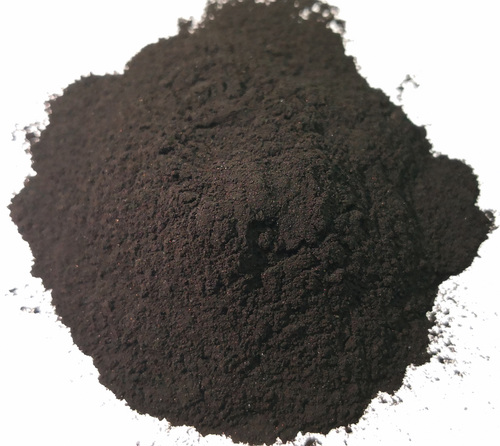
Crystalline cakes and dewatered suspensions represent one of the most common feed formats in organic acid manufacturing. Upstream liquid-solid separation units generally generate these materials using continuous centrifuges, vacuum drum filters, or pressure nutsche filters. For instance, common examples include crystalline citric acid monohydrate, adipic acid, and refined terephthalic acid. These feeds usually arrive at the dryer inlet containing free surface moisture levels between 3 and 12 percent. When processing crystalline cakes, your primary engineering goal is to remove surface liquid cleanly without inducing mechanical crystal attrition, particle breakage, or excessive fine dust generation.
High-Viscosity Pastes and Sticky Cakes
In addition, high-viscosity pastes, sticky cakes, and filter residues frequently appear during organic intermediate synthesis, dye precursor processing, and fine chemical filtration. These materials generally contain high initial moisture levels ranging from 30 to 70 percent. Furthermore, pastes and sticky filter cakes exhibit non-Newtonian fluid behavior, high yield stress, and a strong propensity to adhere to hot metal surfaces inside drying equipment. Consequently, direct thermal drying of pastes requires specialized agitators, internal choppers, back-mixing loops, or mechanical disintegrators. These active components break up sticky lumps and continuously expose fresh surface area to the heat transfer medium.
Liquid Solutions and Pumpable Slurries
On the other hand, liquid solutions, emulsions, and pumpable slurries consist of fully dissolved or suspended organic acids, salts, or anhydrides in water or organic solvents. Feed concentrations typically range between 20 and 60 percent dissolved solids. Converting a liquid solution directly into a dry powder in a continuous single-step operation requires rapid liquid atomization. Spray dryers excel particularly at this task. Atomization creates micro-droplets with an immense surface area, thereby allowing flash evaporation of the solvent phase within seconds.
Low-Melting Intermediates and Organic Melts
Meanwhile, low-melting chemical intermediates and organic melts exhibit unique phase-change behavior during thermal processing. Materials such as urea, phthalic anhydride derivatives, and specialized organic monomers have relatively low melting points or high sublimation vapor pressures. As a result, operators must conduct thermal drying under carefully controlled bulk product temperatures to prevent localized melting, caramelization, sticky phase transitions, or volatile vapor losses.
2.2 Moisture Binding States and Thermodynamic Kinetics
The Three Thermodynamic Moisture States
Moisture within wet organic solids exists in three distinct thermodynamic states: unbound surface moisture, bound capillary moisture, and chemically bound hydrate water.
First, unbound surface moisture forms a thin liquid film on the outer faces of crystals and particles. This moisture exerts a vapor pressure equal to pure water or solvent at the same temperature. During the constant rate drying period, evaporation occurs rapidly from the exposed liquid film. External gas velocity, gas temperature, ambient relative humidity, and exposed surface area primarily dictate the drying rate during this initial phase. Furthermore, as long as unbound surface moisture remains present, the evaporative cooling effect keeps the bulk product temperature near the wet-bulb temperature of the drying air (typically 35 to 55 degrees Celsius). This protective cooling effectively shields heat-sensitive organic molecules from thermal degradation.
Second, bound capillary moisture resides within micropores, internal capillary channels, and interstitial voids between agglomerated particles. Removing bound capillary moisture requires overcoming internal capillary retention forces and diffusion resistance. Once the product reaches its critical moisture content, the process subsequently enters the first falling rate drying period. During this stage, the drying rate decreases progressively. Internal moisture diffusion becomes the main rate-limiting step. Meanwhile, the bulk product temperature rises steadily toward the dry-bulb temperature of the heating gas.
Third, chemically bound hydrate water exists as part of the crystalline lattice structure itself, such as in citric acid monohydrate. Removing bound hydrate water requires supplying additional energy to disrupt the crystalline hydrate bonds, thereby transitioning the solid into an anhydrous state. This phase transformation occurs during the second falling rate period. It demands precise temperature control to achieve complete desolvation without thermally degrading the organic backbone.
Equilibrium Moisture Curves and Environmental Control
Understanding these distinct drying regimes allows engineers to design multi-zone drying profiles. These profiles maximize drying speed during the constant rate period. At the same time, they carefully throttle heat input during the falling rate period to protect overall product quality.
Process engineers evaluating organic acids, anhydrides, and chemical intermediates must pay close attention to equilibrium moisture content (EMC) curves. Equilibrium moisture content defines the lowest moisture level a product can attain when exposed to air at a specific temperature and relative humidity. Consequently, achieving extremely low residual moisture levels (under 0.05 percent) requires exposing the material to air with a very low dew point during the final drying phase. In direct-fired or steam-heated air dryers, pre-dehumidifying incoming process air using desiccant wheels or chilled-water condensation loops ensures that the driving force for mass transfer remains high even late in the process.
Material Selection and Surface Refinement
Furthermore, engineers must select the mechanical construction of the dryer vessel based on the chemical aggressiveness of the product. Many organic acids, such as citric acid, maleic acid, and acetic acid residues present in refined terephthalic acid, exhibit significant corrosivity when wet. As a result, fabricators construct wet contact surfaces using high-grade stainless steels such as AISI 316L, 317L, or duplex stainless steels (such as 2205). For highly acidic or halogenated organic intermediates, plants specify nickel-based superalloys (such as Hastelloy C-276 or C-22) or fluoropolymer-lined vessels (PTFE/PFA) to eliminate metallic contamination and extend equipment operational lifespan.
In addition, mechanical surface finishing prevents product buildup and cross-contamination. Workers grind and polish internal contact surfaces to a mirror finish with surface roughness (Ra) values of less than 0.4 to 0.8 microns. Smooth internal surfaces prevent sticky organic cakes from adhering to walls. They also simplify CIP (Clean-In-Place) and SIP (Sterilize-In-Place) procedures between product batch runs.
Section 3: Industrial Dryer Technologies: Fluid-Bed, Spray, and Contact Dryers
Process engineers designing drying systems for organic chemical production select from three primary equipment categories: fluid-bed dryers, spray dryers, and contact (conduction) dryers. Each technology utilizes distinct heat and mass transfer mechanisms. Moreover, they offer specific operational advantages depending on the feedstock format.
3.1 Fluid-Bed Drying Systems (VFBD & Stationary Fluid Beds)
Fluidization Mechanics and Heat Transfer
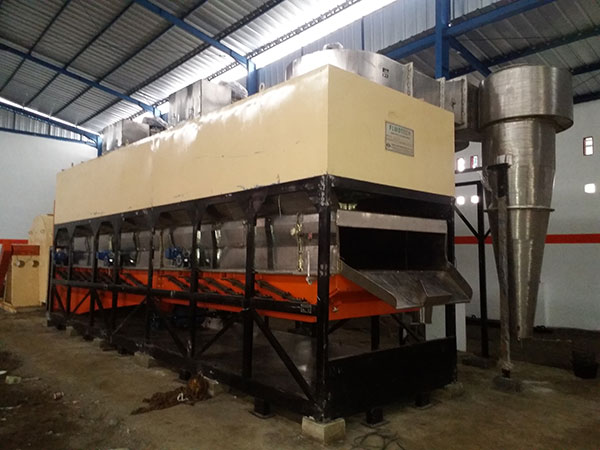
Process engineers widely consider fluid-bed dryers the gold standard for continuous drying of crystalline organic powders, free-flowing granules, and coarse chemical particles. Hot drying gas passes upward through a perforated distribution plate at a velocity exceeding the minimum fluidization velocity of the particle bed. Solid particles become suspended in the gas stream, expanding the bed and causing it to behave like a boiling liquid.
This fluidized state provides intimate contact between individual chemical particles and the hot drying gas. Consequently, fluid-bed dryers achieve exceptionally high heat and mass transfer coefficients, typically ranging between 150 W/m²·K and 450 W/m²·K. In addition, uniform mixing within the fluidized bed eliminates hot spots, ensuring precise temperature control across the entire volume.
Stationary vs. Vibratory Designs
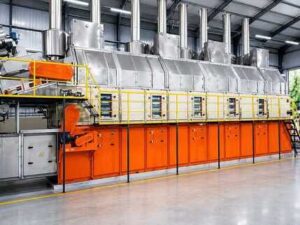
Engineers specify two main structural variations of fluid-bed dryers: stationary fluid beds and Vibratory Fluidised Bed Dryers (VFBD). Stationary fluid beds best suit uniform, free-flowing crystalline powders with a narrow particle size distribution. However, when handling cohesive, sticky, moist, or fragile crystals, stationary beds suffer from severe gas channeling, localized defluidization, or lump formation.
To overcome these operational challenges, Vibratory Fluidised Bed Dryers (VFBD) incorporate mechanical vibration motors. These motors impart directional oscillation to the fluidizing deck. This mechanical vibration conveys sticky or wide-particle-size materials across the perforated plate while breaking up localized channels and agglomerates. As a result, VFBD systems operate reliably at lower gas velocities, significantly reducing particle entrainment, dust carryover, and crystal attrition.
Multi-Zone Temperature Configuration
Continuous fluid-bed dryers frequently feature multiple internal temperature zones:
-
1: Operates at higher inlet gas temperatures (100 to 150 degrees Celsius) to rapidly drive off free surface moisture during the constant rate period.
-
2: Operates at lower temperatures (60 to 90 degrees Celsius) with extended residence times to safely remove internal capillary moisture.
-
3: Utilizes ambient or chilled air (15 to 25 degrees Celsius) to cool the dried chemical product below 35 degrees Celsius prior to conveying, storage, or packaging, thereby preventing caking inside silos.
3.2 Spray Drying Systems: Atomization and Flash Evaporation
Single-Step Liquid-to-Powder Conversion
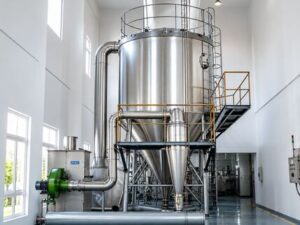
Spray drying is a single-step, continuous unit operation designed to convert liquid solutions, emulsions, or fine slurries into dry, free-flowing powders. Atomization is the central mechanical process in spray drying. Specifically, a high-pressure pump delivers liquid feedstock to an atomizer positioned at the top of a large drying chamber, dispersing it into millions of microscopic liquid droplets.
The choice of atomization technology directly dictates droplet size distribution, bulk density, particle porosity, and powder flowability.
Chemical spray drying lines deploy three primary atomizer designs:
-
Rotary Wheel Atomizers: Utilize a high-speed rotating disc operating between 10,000 RPM and 25,000 RPM. Centrifugal force accelerates liquid feed outward across the disc surface. This force shears it into fine droplets with mean diameters between 30 and 120 microns. Rotary atomizers offer exceptional operational flexibility, handling variable feed rates, abrasive slurries, and viscous solutions up to 1,500 cP without clogging.
-
Pressure Nozzle Atomizers: Force liquid feed through small orifice nozzles under high fluid pressures ranging from 50 bar to 200 bar. Pressure nozzles produce larger, uniform spherical particles with mean diameters between 80 and 300 microns. Consequently, engineers prefer pressure nozzle spray dryers when producing dust-free, high-bulk-density powders with superior flowability.
-
Twin-Fluid Pneumatic Nozzles: Use high-velocity compressed air or steam (at 2 bar to 6 bar pressure) to shear high-viscosity pastes or liquid streams into ultra-fine droplets ranging from 10 to 60 microns. Twin-fluid nozzles idealize small-scale pilot plants or specialized fine chemical intermediates where extremely small particle sizes are required.
Inside the spray drying chamber, the atomized droplet cloud meets a stream of hot drying air. Because the surface-area-to-volume ratio of micro-droplets is immense, surface moisture evaporates almost instantly—typically within 0.5 to 5.0 seconds. Continuous evaporative cooling keeps the droplet skin temperature low (typically 40 to 65 degrees Celsius) even when the inlet air temperature ranges between 160 and 250 degrees Celsius. Consequently, spray dryers are exceptionally well suited for drying heat-sensitive organic salts, organic acids, and specialty catalyst precursors.
3.3 Contact (Conduction) Drying Systems: Indirect Heat Transfer and Vacuum Operations
Benefits of Indirect Thermal Processing
In contrast, contact dryers transfer heat to wet solids through direct physical contact with a hot metallic wall. They do not rely on hot air as the main thermal medium. Instead, heat transfers via thermal conduction from steam, thermal oil, or hot water circulating inside jackets, hollow discs, internal tubes, or rotating agitator shafts.
Contact dryers offer distinct operational advantages when processing hazardous, toxic, highly flammable, or solvent-laden organic chemical intermediates. Because hot air does not convey the heat, the system reduces process exhaust gas volume by 90 to 98 percent compared to direct fluid-bed or spray dryers. Consequently, contact drying systems drastically cut dust entrainment. They also simplify gas cleaning equipment and enable near-100 percent recovery of valuable or hazardous organic solvents via closed-loop condenser systems.

Key Contact Dryer Configurations
Organic chemical processing lines utilize three major contact dryer designs:
-
Vacuum Paddle Dryers: Feature a horizontal cylindrical shell equipped with an agitated central shaft carrying heated paddles or plows. Operation under deep vacuum (down to 5 mbar to 50 mbar absolute pressure) lowers the boiling point of water or organic solvents. As a result, moisture evaporation occurs at low bulk product temperatures (30 to 60 degrees Celsius), protecting thermally sensitive organic molecules while maintaining high drying rates.
-
Indirect Rotary Steam-Tube Dryers: Utilize a rotating cylindrical drum containing internal banks of steam-heated tubes immersed within the bed of wet chemical solids. As the drum rotates, the solids tumble over the hot tubes, achieving efficient conductive heat transfer. Steam-tube dryers handle massive throughputs (up to 50 tons per hour). They serve as the industry standard for continuous drying of high-tonnage polymers and acid intermediates such as refined terephthalic acid.
-
Agitated Nutsche Filter-Dryers: Combine liquid-solid filtration, cake washing, thermal contact drying, and automatic solid discharge within a single pressure-vacuum vessel. Plants extensively use Nutsche filter-dryers in pharmaceutical intermediate and fine chemical production to eliminate cross-contamination and human exposure when handling highly potent or toxic organic compounds.
3.4 Combination Technologies and Internal Components
Hybrid Systems and Deck Geometries
Furthermore, modern process plants increasingly deploy combination drying systems to optimize thermal performance and product quality. For example, combining a multi-stage spray dryer with an integrated internal fluid bed allows preliminary flash drying in the main chamber. This step is followed by deep moisture removal and agglomeration on the fluidizing deck. Similarly, combination tray-fluid bed dryers utilize gentle upper tray drying stages for initial moisture removal followed by a lower fluid-bed finishing zone for final moisture equalization.
Gas distribution plate design plays a pivotal role in fluid-bed dryer engineering. It maintains uniform fluidization and prevents solid weeping, where material falls back into the lower plenum chamber. Engineers select from several plate geometries:
-
Perforated Sheet Plates: Straight cylindrical holes offer simple, effective processing for uniform crystalline powders. However, they can suffer from weeping during plant shutdown or low-velocity operations.
-
Directional Bubble-Cap / Concave Louvre Plates: Direct the gas flow horizontally along the deck surface. Consequently, directional plates facilitate the forward movement of heavy, wet, or non-free-flowing cakes while completely preventing solid weeping into the lower plenum.
-
Sintered Metal Mesh Plates: Offer ultra-fine gas distribution. This setup is ideal for micro-crystalline powders or delicate organic intermediates where gas channeling must be strictly avoided.
Chamber Dynamics and Air Flow Direction
Chamber geometry and air disperser design are crucial in spray drying systems to prevent wet droplet wall deposition. Co-current drying chambers, where atomized droplets and hot drying air enter together at the top of the chamber, are most widely used for heat-sensitive organic compounds. Because hot inlet air immediately meets the cold liquid droplet spray, maximum evaporation occurs at low droplet temperatures. As a result, system operators avoid product degradation entirely, and dry powder collects cleanly at the bottom cone of the chamber.
Conversely, counter-current spray drying systems spray liquid droplets downward against an upward flow of hot gas, providing higher thermal efficiency and longer residence times. However, counter-current designs expose the driest powder particles to the hottest incoming gas. This limits their use only to thermally stable organic chemical salts and inorganic-organic mineral complexes.
Section 4: Deep Application Guides for Specific Organic Chemicals
Matching specific organic chemicals with the optimal drying technology requires analyzing thermal sensitivity, crystal behavior, solvent properties, and target final moisture specifications. The following detailed guides outline operational parameters and equipment selection for major organic acids, anhydrides, and chemical intermediates.
4.1 Citric Acid Processing: Monohydrate versus Anhydrous Engineering
Manufacturers produce citric acid globally via fermentation of carbohydrate substrates. This step is followed by filtration, purification, and crystallization. Citric acid crystallizes in two distinct commercial forms: citric acid monohydrate and anhydrous citric acid. The phase transition temperature between monohydrate and anhydrous forms in aqueous solution is precisely 36.6 degrees Celsius.
Processing citric acid monohydrate requires retaining one molecule of bound water per molecule of citric acid. This equals a theoretical crystalline moisture content of 8.5 to 8.8 percent. If product temperatures during drying exceed 36 degrees Celsius, monohydrate crystals release their crystalline water. This unwanted release causes surface melting, crystal degradation, and severe caking inside storage bins.
Consequently, Vibratory Fluidised Bed Dryers (VFBD) serve as the industry standard for citric acid monohydrate. Engineers design the dryer with cold or warm dehumidified air inlet zones (28 to 34 degrees Celsius). Mechanical vibration gently conveys the delicate crystals across the bed while removing free surface water down to 8.5 percent bound moisture. The final cooling zone reduces bulk product temperatures below 25 degrees Celsius.
Conversely, producing anhydrous citric acid requires complete removal of both surface water and crystalline hydrate water. Anhydrous citric acid crystals withstand higher operating temperatures up to 85 degrees Celsius. Therefore, plants specify continuous multi-zone fluid-bed dryers or indirect contact dryers. Operators maintain inlet gas temperatures between 75 and 95 degrees Celsius, driving final residual moisture below 0.05 percent.
4.2 Adipic Acid Dehydration for Nylon 6,6 Synthesis
Adipic acid is a dicarboxylic acid utilized in the production of Nylon 6,6 polymers, polyurethane resins, and plasticizers. Adipic acid arrives at the dryer inlet as a wet centrifuge cake containing 3 to 8 percent surface water. Furthermore, adipic acid dust is highly combustible and classified as an St-1 dust explosion hazard.
Continuous fluid-bed dryers operating with inert nitrogen gas recirculation or low-velocity conditioned air work best for adipic acid drying. Operators maintain inlet air temperatures between 90 and 110 degrees Celsius. Technicians carefully tune the fluidizing velocity to prevent severe crystal attrition while ensuring rapid evaporation of surface moisture. Integrated fluid-bed cooling zones reduce product discharge temperatures below 40 degrees Celsius, preventing lump formation during bulk silo storage. Systems consistently hold final residual moisture below 0.03 percent.
4.3 Refined Terephthalic Acid (PTA), Phthalic Anhydride, and Maleic Anhydride
Refined Terephthalic Acid (PTA) is a high-tonnage chemical monomer used to manufacture polyethylene terephthalate (PET) bottles, synthetic fibers, and engineering resins. PTA crystallization cakes contain acetic acid and water solvent mixtures. Because acetic acid vapors are flammable and corrosive, drying must occur under closed-loop inert conditions.
Indirect Steam-Tube Rotary Dryers and Heavy-Duty Contact Paddle Dryers serve as the preferred choices for PTA. High-pressure saturated steam circulating inside internal tube bundles supplies thermal energy conductively. A small nitrogen purge stream sweeps evaporated acetic acid vapors into a solvent recovery condenser. Equipment reduces moisture and residual solvent contents from 10 percent initial levels down to less than 0.02 percent in the dry product.
Phthalic Anhydride and Maleic Anhydride present additional process challenges. They have relatively low melting points and tend to sublime at elevated temperatures. Contact vacuum dryers operating under deep vacuum (10 mbar to 30 mbar absolute) allow moisture and solvent removal at low bulk temperatures (35 to 55 degrees Celsius). This low-temperature conductive approach prevents sublimation losses. It also reduces energy consumption and eliminates wall fouling inside process ductwork.
4.4 Urea Drying and Granulation Finishing
Chemical plants manufacture urea from ammonia and carbon dioxide to serve as a nitrogen-rich fertilizer and technical chemical intermediate. Wet urea crystals or concentrated urea melt feeds contain 0.5 to 3.0 percent residual water. Elevated temperatures above 110 degrees Celsius cause thermal decomposition of urea into biuret. Biuret is an unwanted byproduct that harms plant growth.
Engineers specify fluid-bed urea granulators and coolers for urea finishing. Controllers regulate air inlet temperatures between 80 and 105 degrees Celsius. This maintains rapid evaporative cooling to keep bulk product temperatures well below critical decomposition thresholds. Operators strictly maintain thermal residence time inside the fluidized bed between 10 and 20 minutes. This precise window reduces final moisture content below 0.15 percent while keeping biuret concentrations strictly below 0.90 percent.
Advanced Agitation and Lump Disruption in Contact Vacuum Dryers
When analyzing contact vacuum dryers for organic intermediates, mechanical agitator design dictates heat transfer performance and product homogeneity. Agitated paddle dryers utilize dual-arm or multi-blade paddles with alternating pitch angles. These paddles continuously shear the bed, lift wet solids off heated vessel walls, and mix dry product throughout the volume.
Heated agitator shafts and hollow blades expand the available thermal transfer area by 40 to 60 percent compared to jacket-only vessels. Heat transfer fluid (such as hot water, saturated steam, or synthetic thermal oils) circulates continuously through the agitator shaft and blades. This delivers heat directly into the core of the moving solid bed. Consequently, thermal drying rates accelerate significantly, reducing overall batch cycle times by up to 35 percent.
Some materials pass through a rubbery, sticky phase during drying, such as partially dried organic salts or polymer intermediates. For these products, heavy-duty choppers mounted on the side walls of the vessel operate at high rotational speeds (1,500 RPM to 3,000 RPM). These high-shear choppers violently break up agglomerated lumps. This action exposes wet interior core moisture to the vacuum atmosphere, preventing the formation of hard, undried balls.
Section 5: Safety Engineering, Explosion Protection, and Environmental Compliance
Drying organic acids, anhydrides, and chemical intermediates involves processing finely divided organic solids and evaporating flammable organic solvents. Consequently, process safety and environmental compliance represent critical pillars of dryer engineering.
5.1 Dust Explosion Prevention (ATEX Directive and NFPA Standards)
Explosion Risks and Regulatory Frameworks
Fine airborne dust clouds of organic compounds present severe dust explosion hazards. This includes adipic acid, terephthalic acid, organic catalysts, and fine organic salts. When dry particles float in air at concentrations exceeding the Minimum Explosible Concentration (MEC), any ignition source can trigger a catastrophic explosion. Common ignition sources include static electricity, mechanical friction, or hot surfaces.
To mitigate explosion risks, chemical drying systems must comply fully with ATEX Directive 2014/34/EU and NFPA 68/69 standards. Equipment manufacturers implement four key safety measures:
-
Closed-Loop Inert Gas Systems: For processes involving flammable organic solvents or highly reactive dusts, the dryer operates under a continuous nitrogen blanket. Redundant sensors continuously monitor the oxygen concentration inside the system, keeping it strictly below 5 to 8 percent volume to render combustion physically impossible.
-
Explosion Venting Panels: Dryers operating in open air-loop configurations feature certified explosion relief vents. Rupture discs or hinged vent panels safely direct overpressure waves and flame fronts into outdoor safe zones, protecting the structural integrity of the main vessel.
-
Explosion Suppression and Isolation: Fast-acting optical or pressure sensors detect early pressure spikes within milliseconds. These sensors trigger high-speed chemical suppression bottles that inject pressurized sodium bicarbonate or monoammonium phosphate directly into the vessel, extinguishing the flame front before pressure builds.
-
Grounding and Static Dissipation: Technicians electrically bond and ground all metal components, filter frames, ductwork, and flexible sleeves. Furthermore, filter media incorporate conductive stainless steel or carbon fiber grids to safely dissipate electrostatic charges generated by moving powder particles.
5.2 Environmental Emissions Control and Solvent Recovery
Multi-Stage Dust Collection
Environmental regulations mandate extremely low dust emission limits (typically less than 5 mg/Nm³) for industrial exhaust stacks. Fluid-bed and spray drying plants rely on multi-stage dust collection systems:
High-efficiency cyclone separators perform primary collection, removing 90 to 98 percent of coarse particles from the exhaust gas stream. Secondary collection relies on pulse-jet fabric bag houses equipped with expanded PTFE membrane filter media. PTFE membranes deliver filtration efficiencies exceeding 99.97 percent for fine sub-micron particles, ensuring full compliance with environmental standards.
Closed-Loop Solvent Recovery
For closed-loop solvent drying plants, exhaust vapors pass through shell-and-tube surface condensers or spray scrubbers cooled by chilled water or glycol solutions. This arrangement enables near-100 percent recovery of valuable organic solvents (such as methanol, ethanol, acetone, or acetic acid). Consequently, plants dramatically reduce volatile organic compound (VOC) emissions while improving overall process economics.
Section 6: Energy Efficiency, Heat Recovery, and Advanced Process Control
Thermal drying operations account for a major share of utility expenses in chemical manufacturing plants, frequently consuming 30 to 50 percent of total thermal energy requirements. Therefore, modern dryer designs incorporate innovative energy recovery concepts and advanced automation to optimize utility consumption.
6.1 Energy Recovery Systems and Heat Integration
Exhaust Recirculation and Air Preheating
In direct hot-air drying systems (such as spray dryers and fluid-bed dryers), significant thermal energy leaves the system through the warm exhaust stack. Installing air-to-air heat exchangers or run-around coil loops recovers heat from the clean exhaust air stream to preheat incoming fresh ambient air. This simple heat recovery loop reduces burner fuel consumption by 15 to 25 percent.
Heat Pumps and Mechanical Vapor Recompression
Integrating mechanical vapor recompression (MVR) or high-efficiency heat pumps into low-temperature contact drying lines yields substantial energy savings. Heat pump dryers utilize refrigeration cycles to dehumidify and reheat process air in a closed loop. These systems achieve COP (Coefficient of Performance) values between 3.5 and 5.0, reducing electrical power requirements by up to 60 percent compared to direct electrical heating.
6.2 Advanced Process Control and SCADA Integration
Maintaining consistent product dryness and preventing thermal degradation requires precise real-time control over drying parameters. Modern drying plants incorporate Programmable Logic Controllers (PLC) integrated with Supervisory Control and Data Acquisition (SCADA) systems.
Engineers implement three critical control loops:
-
Inlet Temperature Modulation: Feedforward control loops adjust heat input based on measured mass flow rate and moisture content of the incoming wet feed.
-
Outlet Temperature Control: Feedback control loops continuously adjust the liquid or wet cake feed pump speed to maintain a constant exhaust air temperature. This adjustment ensures consistent final product dryness despite minor fluctuations in feedstock properties.
-
Differential Pressure Monitoring: Pressure transmitters monitor pressure drop across perforated gas distribution plates and fabric filter bags. The system automatically triggers pulse-jet cleaning cycles or alerts operators to localized bed fouling.
Section 7: Technical Selection Matrix and Comparative Benchmarks
To assist chemical engineers, plant managers, and equipment purchasers in making informed technical decisions, the following matrix summarizes recommended dryer choices, thermal limits, feed formats, and target moisture specifications across major organic chemical classes:
| Chemical Class | Feed Consistency | Thermal Limit | Primary Dryer Choice | Secondary Dryer Choice | Final Target Moisture |
| Citric Acid Monohydrate | Wet Crystalline Cake (3%–8% surface water) | Strictly < 36°C | Vibratory Fluidised Bed Dryer (VFBD) with Chilled Cooling | Low-Temp Multi-Deck Tray Dryer | 8.5%–8.8% bound moisture (<0.05% surface) |
| Anhydrous Citric Acid | Wet Crystalline Cake (4%–10% initial water) | Up to 85°C bulk product temp | Continuous Multi-Zone Fluid Bed Dryer | Indirect Steam-Tube Rotary Dryer | < 0.05% total residual moisture |
| Adipic Acid | Centrifuge Filter Cake (3%–8% water) | Up to 100°C bulk temp | Inertized Fluid Bed Dryer with Cooling Zone | Agitated Vacuum Contact Paddle Dryer | < 0.03% total residual moisture |
| Refined Terephthalic Acid (PTA) | Acetic Acid Solvent Slurry Cake (8%–12% solvent) | Up to 150°C wall temp | Indirect Steam-Tube Rotary Dryer (Closed-Loop N₂ Purged) | Continuous Contact Disc Dryer | < 0.02% residual volatile content |
| Phthalic / Maleic Anhydride | Paste / Wet Filter Residue (20%–50% moisture/solvent) | Strictly < 60°C (prevents sublimation) | Agitated Vacuum Paddle Dryer | Agitated Thin-Film Dryer | < 0.05% residual volatile content |
| Urea Granules & Prills | Prills / Melt Granules (0.5%–3.0% water) | Strictly < 95°C (prevents biuret formation) | Fluid Bed Dryer / Granulator Cooler | Direct Rotary Drum Dryer | < 0.15% total residual moisture |
| Organic Salts & Dye Intermediates | Liquid Solution / Emulsion (30%–60% solids) | Up to 180°C inlet gas temp | Industrial Spray Dryer with Rotary Atomizer | Vacuum Drum Dryer | < 0.50% total residual moisture |
Section 8: Conclusion, Commercial Recommendations, and Contact Information
In summary, moisture removal is routine in many organic chemical processes. However, achieving consistent product purity, crystal integrity, thermal stability, and operational safety requires rigorous engineering and technical expertise. Fluid-bed, spray, or contact dryers handle crystals, pastes, or solutions with exceptional efficiency when system parameters match the physical and chemical characteristics of the feedstock.
Whether deploying a Vibratory Fluidised Bed Dryer for delicate citric acid monohydrate crystals, a high-capacity Spray Dryer for liquid organic salts, or an indirect Vacuum Contact Paddle Dryer for volatile anhydrides, chemical manufacturers must prioritize precision temperature control, dust explosion safety, energy recovery, and robust mechanical construction.
Partner with Industrial Drying Pioneers
As an established pioneer and global leader in industrial drying technology, thermal processing, and process engineering solutions, GENEX Tech Industries LLP designs, manufactures, and supplies custom-built industrial drying plants. We engineer every system for maximum reliability, high energy efficiency, and long-term industrial service.
Our team of experienced process engineers assists chemical manufacturers worldwide with comprehensive pilot testing, feedstock drying trials, equipment selection, plant layout design, turnkey plant manufacturing, installation, commissioning, and dedicated after-sales technical support.
Contact our senior engineering team today to discuss your specific chemical drying requirements, request technical specifications, or schedule pilot plant drying trials.
-
Head Office Address: GENEX Tech Industries LLP, 10C, Sir William Jones Sarani (Middleton Row), Park Street, Kolkata – 700071, West Bengal, India
-
Direct Phone / WhatsApp Contact: +91-97489 06968 | +91-93300 77417
-
Official Business Email: mktg@foodtechprojects.com | sales@foodtechprojects.com
-
Official Company Websites: www.foodtechprojects.com | www.gtidryers.com