
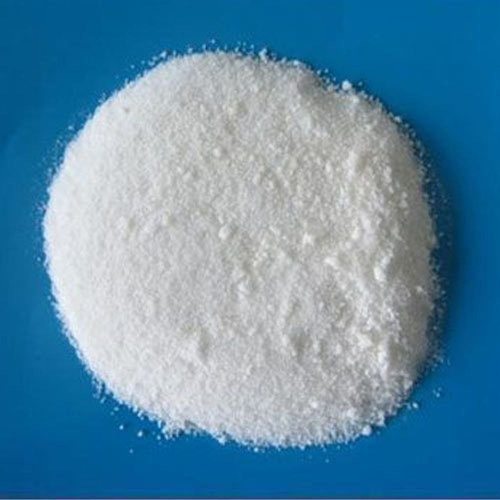
1. Introduction to Sulfuric Acid Derivatives and Inorganic Sulfates
Sulfuric acid serves as a foundational building block in chemical engineering. Global production volumes of sulfuric acid reflect national industrial capability. Manufacturers use most produced sulfuric acid to synthesize inorganic sulfate salts and chemical derivatives. Consequently, inorganic sulfates support diverse sectors:
-
Agricultural fertilizers
-
Chemical synthesis
-
Detergent manufacturing
-
Pulp and paper processing
-
Textile dyeing
-
Water treatment
-
Mining hydrometallurgy
-
Animal feed nutrition
-
Pharmaceutical formulations
Modern chemical processing synthesizes inorganic sulfates through direct neutralization of sulfuric acid using basic oxides, hydroxides, or carbonates. Plants also recover sulfates as valuable co-products from caprolactam production, flue gas desulfurization (FGD), metal leaching, and battery recycling.
These recovery routes yield inorganic salts as aqueous slurries or wet crystalline cakes after crystallization, centrifugation, or filtration. Thermal drying serves as a vital unit operation in the sulfate lifecycle.
Achieving precise final moisture control (0.05% to 1.5% residual moisture, depending on the compound) prevents caking, lump formation, chemical degradation, flowability loss, and packaging failure during transit. Selecting appropriate drying equipment—such as Rotary Drum Dryers, Fluid Bed Dryers, or Pneumatic Flash Dryers—ensures operational profitability and consistent product quality.
2. Detailed Chemical Breakdown of Major Sulfate Compounds
Primary Nitrogen and Fertilizer Compounds
Ammonium Sulfate
Ammonium sulfate delivers essential nitrogen (21% N) and available sulfur (24% S) to agricultural soils. Industrial processes generate it as a primary co-product during caprolactam, synthetic methionine, and coal-gasification liquor processing. Furthermore, synthetic production reacts anhydrous ammonia gas with concentrated sulfuric acid in continuous crystallizing reactors. As a direct result, centrifuge cake carries an initial moisture content between 2.0% and 5.0%. Target final moisture must stay below 0.1% to 0.2% by weight; otherwise, residual moisture causes hygroscopic caking during bulk storage in silos or polypropylene bags. In addition, ammonium sulfate crystals exhibit thermal sensitivity: temperatures exceeding 150°C decompose the material into ammonium bisulfate and ammonia gas, creating severe corrosion hazards and nutrient loss.
Sodium Sulfate
Sodium sulfate occurs naturally as mirabilite or decahydrate (Glauber’s salt). Synthetically, operators produce it via the Mannheim process (reacting sodium chloride with sulfuric acid) or recover it from rayon manufacturing, lithium battery refining, and dichromate synthesis. Furthermore, sodium sulfate undergoes a phase transition at approximately 32.4°C, where decahydrate dissolves in its own water of crystallization to yield anhydrous sodium sulfate (thenardite). Consequently, thermal drying requires strict phase-change control. Feed moisture from vacuum belt filters or centrifuges ranges from 4.0% to 12.0%. Target final moisture for anhydrous technical or detergent grades cannot exceed 0.05% to 0.10%. Moreover, improper thermal control causes sticky phase transformations that adhere aggressively to dryer interiors.
Potassium Sulfate
Potassium sulfate (Sulfate of Potash or SOP) provides a chloride-free fertilizer option for chlorine-sensitive crops like tobacco, fruits, vegetables, and nuts. In addition, producers manufacture SOP by reacting potassium chloride with sulfuric acid in Mannheim furnaces or through double-decomposition reactions using magnesium sulfate and potassium chloride. Wet SOP crystals exiting centrifuges retain 3.0% to 6.0% surface moisture. Therefore, thermal drying must reduce this level below 0.10% to 0.20%. Furthermore, SOP exhibits high thermal stability up to several hundred degrees Celsius, permitting higher inlet gas temperatures to optimize thermal efficiency.
Industrial and Micronutrient Hydrates
Zinc Sulfate
Zinc sulfate supports agricultural micronutrients, animal feed supplements, rayon production, and electroplating baths. In addition, it exists in multiple hydrated forms, primarily zinc sulfate monohydrate and heptahydrate. Consequently, thermal dehydration demands precise regulation. Heating heptahydrate above 39°C melts the compound in its crystal water, whereas controlled drying between 70°C and 120°C converts higher hydrates into stable monohydrate powder with surface moisture under 0.50%.
Copper Sulfate
Producers supply copper sulfate as copper sulfate pentahydrate, or blue vitriol, for agricultural fungicides, electroplating, mining flotation, and algicides. Furthermore, copper sulfate pentahydrate releases crystal water in distinct thermal stages:
-
Two water molecules evaporate near 63°C.
-
Two additional molecules release at 109°C.
-
The final water molecule departs at 200°C, yielding white anhydrous copper sulfate.
Therefore, commercial blue pentahydrate production requires removing surface moisture (from 3.0% down to 0.20%) without stripping crystal-bound water. Consequently, operators maintain strict temperature boundaries below 60°C.
Ferrous Sulfate
Titanium dioxide manufacturing (sulfate process) and steel pickling liquor recovery yield ferrous sulfate as a byproduct. In addition, it forms heptahydrate (green vitriol) and monohydrate. Heptahydrate oxidizes rapidly in warm, humid air to form ferric iron compounds while dissolving in its hydration water above 64°C. Therefore, drying ferrous sulfate heptahydrate requires precise temperature control to remove surface moisture from 5.0% down to under 0.50% using low thermal profiles.
Advanced Energy and Mineral Salts
Manganese Sulfate
Manganese sulfate serves as a precursor for cathode active materials in lithium-ion batteries, fertilizers, and animal feed. Furthermore, high-purity manganese sulfate monohydrate processing requires uniform drying of wet crystalline cake (initial moisture 6.0% to 10.0%) to achieve target moisture below 0.10% to 0.20%. Moreover, battery-grade specifications require specialized stainless steel or titanium construction to eliminate tramp iron or metallic wear particles completely.
Magnesium Sulfate
Magnesium sulfate occurs naturally as kieserite (monohydrate) and epsomite (Epsom salt, heptahydrate). In addition, Epsom salt dehydrates rapidly in warm air, losing crystal structure above 48°C. Consequently, drying industrial or pharmaceutical Epsom salt demands balanced low-temperature air handling. As a result, this process removes surface water (initial 4.0% to 8.0%, final under 0.20%) without triggering structural phase collapse.
Calcium Sulfate
Calcium sulfate occurs as dihydrate (gypsum) and hemihydrate (plaster of Paris). Processing plants generate large volumes as synthetic flue gas desulfurization (FGD) gypsum and phosphogypsum. Furthermore, removing surface moisture (from 8.0%–15.0% down to 0.50%) without converting dihydrate into hemihydrate requires low-temperature drying below 80°C. Conversely, calcination to yield hemihydrate demands elevated thermal inputs between 130°C and 160°C.
3. Crystallization, Centrifugation, and Liquid-Solid Separation
Inorganic sulfate solutions undergo crystallization and mechanical liquid-solid separation prior to thermal drying. Furthermore, crystallizers—including draft-tube baffle (DTB), forced circulation (FC), and surface cooling units—precipitate sulfate salts from saturated liquors. Consequently, particle size distribution (PSD) established during crystallization directly governs downstream drying dynamics:
-
Coarse crystals (500 to 2000 µm): Drain easily in centrifuges, reaching low cake moisture (1.0% to 3.0%).
-
Fine particles (< 100 µm): Retain higher interstitial moisture (up to 12.0%–15.0%).
Following crystallization, mechanical dewatering uses pusher centrifuges, peeler centrifuges, top-discharge basket centrifuges, or vacuum belt filters. Moreover, mechanical dewatering requires far less energy than thermal evaporation. For instance, evaporating 1 kg of water thermally consumes 2,200 to 2,800 kJ of heat, whereas mechanical centrifugation uses modest electrical power. Therefore, optimizing centrifuge performance lowers cake moisture and directly reduces downstream drying energy costs.
4. The Role of Industrial Dryers in Final Moisture Control
Thermal drying of sulfate salts involves simultaneous heat and mass transfer under phase equilibrium constraints. In addition, moisture resides within crystalline cakes in two forms:
-
Unbound (Surface) Moisture: Exerts a vapor pressure equal to pure water at the same temperature, residing on particle surfaces and in inter-particle capillaries.
-
Bound (Internal/Hydrate) Moisture: Remains trapped in micro-capillaries or chemically bound within the crystal lattice.
During the initial constant-rate period, unbound surface water evaporates freely while crystal surface temperatures remain near the wet-bulb air temperature. However, depleting surface moisture past the critical point transitions processing into the falling-rate period. As a consequence, internal moisture diffusion then governs drying kinetics, raising particle surface temperatures toward the dry-bulb air temperature. Therefore, monitoring temperatures during this phase prevents thermal decomposition or unwanted hydrate dehydration.
5. In-Depth Analysis of Industrial Drying Technologies
Mechanical Drum Processing
A. Rotary Drum Dryers
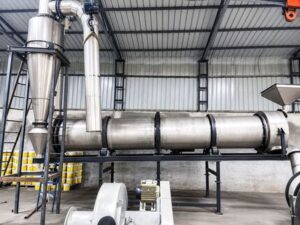
Rotary drum dryers provide continuous heavy-duty processing. The design features an inclined rotating cylindrical shell supported by steel riding rings (tires) on trunnion rollers. In addition, lifters mounted along the inner shell wall shower wet sulfate crystals through a hot gas stream. As a result of shell rotation, internal flight geometry, and a 2° to 4° drum slope, material advances smoothly through the system. Turning at 2 to 8 RPM, internal lifters shower particles through hot gas, maximizing contact area.
Furthermore, rotary drum dryers utilize two airflow configurations:
-
Co-Current Flow: Wet feed enters alongside the hottest inlet gas. Rapid initial evaporation keeps material cool via evaporative cooling, protecting heat-sensitive compounds like ammonium sulfate and ferrous sulfate heptahydrate.
-
Counter-Current Flow: Wet feed enters near the cool exhaust end while dry product exits near the hot air inlet. This configuration maximizes thermal efficiency and achieves low final moisture (< 0.05%) for thermally stable materials like potassium sulfate.
Moreover, custom flight designs optimize heat transfer: radial, curtain, and spiral flight sections prevent wet feed from sticking near the inlet while maintaining a continuous showering curtain.
Fluidized and Pneumatic Drying Methods
B. Fluid Bed Dryers (Vibratory & Stationary)
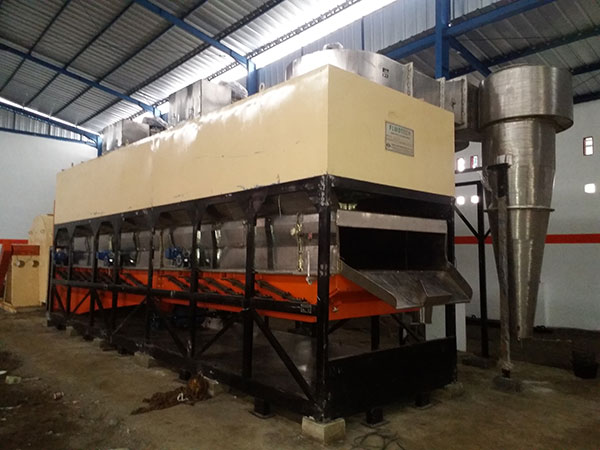
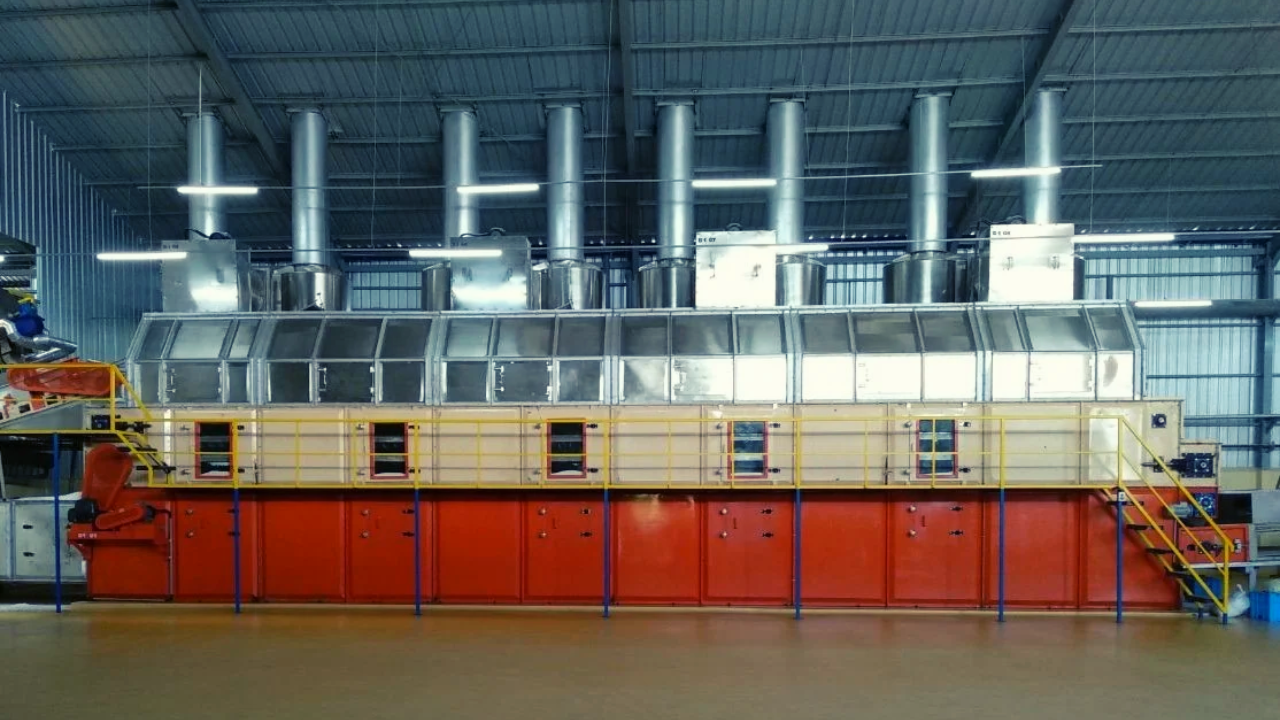
Fluid bed dryers pass hot air upward through a perforated distributor plate supporting sulfate crystals. Consequently, setting air velocity above minimum fluidization velocity suspends salt particles in the airflow so they act like a boiling fluid. As a result, this state yields high heat and mass transfer rates, uniform bed temperatures, and gentle handling.
Furthermore, stationary continuous fluid bed dryers feature multi-zone processing using separate plenums beneath the distributor plate:
-
Initial Zone: Delivers high-temperature air for rapid surface moisture flash-off.
-
Intermediate Zone: Uses reduced temperatures for falling-rate drying.
-
Final Zone: Employs ambient or chilled air to cool dried crystals below 40°C before packaging.
In addition, Vibratory Fluid Bed Dryers (VFBD) add mechanical vibration using dual counter-rotating unbalance motors. Mechanical vibration aids fluidization, enabling processing of wide particle size distributions, sticky feed cakes, and fragile crystals without particle attrition. Furthermore, VFBDs operate at lower fluidization air velocities, reducing exhaust volumes, dust entrainment, and fan energy demand.
C. Pneumatic Flash Dryers
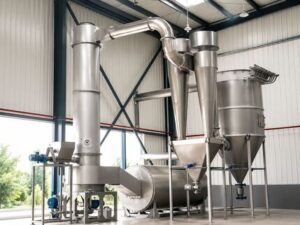
Pneumatic flash dryers complete drying in 1 to 3 seconds. High-velocity hot air streams receive wet feed—such as fine filter cakes, centrifuge cakes, or slurries—via disintegrators, screw feeders, or paddle mixers.
Furthermore, high air drag forces disperse feed agglomerates into discrete particles. Due to exposing this surface area to high-temperature air, rapid moisture evaporation occurs. As a consequence, high inlet temperatures (200°C to 450°C) combined with short residence times keep material temperatures low via evaporative cooling, preserving heat-sensitive compounds. Subsequently, high-efficiency cyclones and pulse-jet bag filters separate dry powder from exhaust air.
6. Comparative Matrix & Dryer Selection Guide
| Dryer Type | Primary Mechanism | Residence Time | Feed Size / Condition | Thermal Efficiency | Capital Cost | Maintenance |
| Rotary Drum Dryer | Cascading flight curtain in gas stream | 10 to 60 min | Coarse to fine granules, wide PSD, heavy solids | 65%–78% (Co-Current) / Up to 85% (Counter) | Moderate to High | Low (Mechanical durability) |
| Stationary Fluid Bed | Fluidized suspension over perforated plate | 5 to 30 min | Uniform free-flowing crystals (200–1500 µm) | 75%–85% | Moderate | Very Low (Static internals) |
| Vibratory Fluid Bed | Vibration-assisted air suspension | 3 to 20 min | Sticky cakes, wide PSD, fragile crystals | 80%–88% | Moderate to High | Low (Routine drive maintenance) |
| Pneumatic Flash Dryer | Pneumatic dispersion in high-velocity air | 1 to 3 sec | Fine cakes, powders, slurries (< 300 µm) | 78%–86% | Low to Moderate | Very Low (Static column) |
Specific Dryer Recommendations by Sulfate Product
Bulk Agrochemicals and Soluble Salts
-
Ammonium Sulfate: Vibratory or Stationary Fluid Bed Dryers preserve crystal size distribution without generating fines. Furthermore, integrated cooling zones drop product temperatures below 40°C to stop storage caking. In addition, large caprolactam byproduct facilities also deploy Rotary Dryers.
-
Sodium Sulfate: Rotary Drum Dryers or Vibratory Fluid Bed Dryers handle high-capacity output from rayon and battery recovery plants. Consequently, recirculating dry back-mix manages phase transition stickiness near 32.4°C.
-
Potassium Sulfate: Direct-Fired Rotary Dryers or Fluid Bed Dryers process robust SOP crystals across high-throughput lines.
Metal Micronutrients and Hydrate Compounds
-
Zinc Sulfate: Pneumatic Flash Dryers rapidly remove surface moisture for monohydrate synthesis. Alternatively, Vibratory Fluid Bed Dryers running cool air process heptahydrate crystals without melting.
-
Copper Sulfate: Vibratory Fluid Bed Dryers operating with inlet air below 55°C–60°C maintain pentahydrate integrity without forming trihydrate or monohydrate.
-
Ferrous Sulfate: Co-Current Rotary Dryers or Vibratory Fluid Bed Dryers apply rapid low-temperature drying, preventing ferrous iron oxidation to ferric iron and avoiding dissolution in crystal water.
Battery-Grade and Specialized Minerals
-
Manganese Sulfate: Vibratory Fluid Bed Dryers or Pneumatic Flash Dryers constructed with SS316L prevent metallic contamination in battery cathode precursor lines.
-
Magnesium Sulfate: Vibratory Fluid Bed Dryers using ambient-conditioned air remove surface water without stripping hydration water.
-
Calcium Sulfate: Pneumatic Flash Dryers instantly strip 10% surface water from synthetic FGD gypsum prior to plaster processing or agricultural distribution.
7. Engineering Design, Construction Materials, and Thermal Integration
Materials Selection and Environmental Controls
Corrosion, Erosion, and Material Selection
Inorganic sulfate salts with residual acidic moisture present corrosion and erosion risks. Standard carbon steel corrodes in moist sulfate environments, causing iron contamination and equipment damage. Consequently, proper material selection aligns with plant process conditions:
-
Stainless Steel 304L (SS304L): Suits neutral ammonium sulfate, dry sodium sulfate, and non-acidic potassium sulfate salts.
-
Stainless Steel 316L (SS316L): Resists pitting in zinc sulfate, manganese sulfate, copper sulfate, and acidic streams via molybdenum alloying.
-
Duplex Stainless Steel (2205 / 2507): Protects high-chloride recovery circuits against stress-corrosion cracking.
-
Titanium Gr. 2 / Rubber Linings: Handles highly acidic environments and battery-grade manganese sulfate lines requiring zero metal contamination.
Air Pollution Control Systems
Exhaust streams require integrated particulate collection systems:
-
High-Efficiency Cyclones: Provide primary separation, capturing 92% to 98% of coarse and medium dust.
-
Pulse-Jet Bag Filters: Supply secondary dry collection with PTFE-coated or hydrophobic media to lower emissions under $10\text{ mg/Nm}^3$.
-
Venturi Wet Scrubbers: Process sticky or soluble dusts, scrubbing exhaust air with recycled liquor while preheating feed streams.
Energy Efficiency Practices
Thermal Efficiency & Heat Recovery Solutions
Waste heat recovery exchangers (WHR) capture heat from dryer exhaust air to preheat combustion air or process water. Furthermore, closed-loop recirculating air systems cut thermal fuel consumption by 25% to 35% relative to open single-pass layouts.
8. Troubleshooting Industrial Sulfate Drying Operations
Mechanical and Quality Control Deficiencies
-
Caking and Agglomeration in Storage:
-
Root Cause: High residual moisture (> 0.2%), elevated discharge temperature (> 45°C), or fine particle accumulation (< 75 µm).
-
Solution: Adjust fluid bed cooling zones to lower product temperatures below 35°C, refine drying settings to hold moisture under 0.1%, and screen out ultra-fines.
-
-
Product Discoloration or Degradation:
-
Root Cause: High inlet air temperatures causing thermal decomposition, crystal water stripping, or metal oxidation.
-
Solution: Convert airflow from counter-counter to co-current, lower inlet air temperatures, or raise air mass velocity to increase evaporative cooling.
-
Structural Maintenance Challenges
-
Equipment Corrosion and Shell Erosion:
-
Root Cause: Acidic vapor condensation in exhaust ducts or mechanical abrasion from hard crystals.
-
Solution: Insulate exhaust ductwork and cyclones, maintain exhaust gas temperatures at least 15°C above dew point, and upgrade internals to duplex stainless steel or abrasion-resistant alloys.
-
9. Conclusion and Operational Call to Action
Drying sulfuric acid derivatives and inorganic sulfate salts requires matching crystal chemistry with appropriate thermal drying hardware. Delicate hydrated crystals like Copper Sulfate Pentahydrate and Ferrous Sulfate Heptahydrate require strict temperature management, whereas bulk fertilizers like Ammonium Sulfate and Potassium Sulfate demand high throughput efficiency. Consequently, controlling temperature, residence time, airflow, and particle movement ensures project success.
As a result, engineered Rotary Drum Dryers, Vibratory Fluid Bed Dryers, and Pneumatic Flash Dryers maintain target final moisture levels between 0.05% and 0.50%, eliminate product caking, optimize energy usage, and secure product consistency.
Partner with GENEX Tech Industries LLP for Advanced Industrial Drying Solutions
GENEX Tech Industries LLP designs, manufactures, and installs custom industrial drying systems for chemical processing applications. Engineering offerings include turnkey plant solutions, rotary drum dryers, fluid bed dryers, and pneumatic flash dryers optimized for inorganic sulfate processing.
Contact the engineering team at GENEX Tech Industries LLP to schedule technical consultations, arrange pilot plant testing, or configure equipment specifications for your facility.
-
Email: mktg@foodtechprojects.com | sales@foodtechprojects.com
-
Phone / WhatsApp: +91-97489 06968 | +91-93300 77417
-
Websites: www.foodtechprojects.com | www.gtidryers.com
-
Head Office: 10C, Sir William Jones Sarani (Middleton Row), Park Street, Kolkata – 700071, India