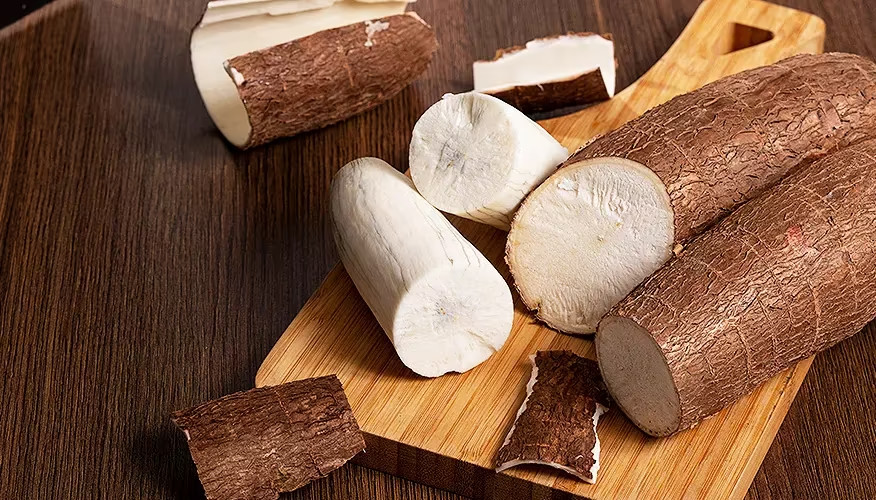
The global cassava (Manihot esculenta) processing sector is undergoing a structural transformation. Historically, cassava served mainly as a traditional subsistence food crop. However, it has rapidly evolved into a critical industrial starch and bio-commodity. Consequently, market demand for industrial cassava starch, high-quality cassava flour (HQCF), processed chips, and modified starches is growing explosively. Furthermore, several expanding markets heavily fuel this trend. These include gluten-free foods, textile sizing agents, corrugated paperboard adhesives, pharmaceutical excipients, and eco-friendly bio-based polymers.
Therefore, commercial processing enterprises must transition rapidly to automated plants. In particular, modern cassava processing requires several key technologies. These include thermal dehydration, advanced rasping, multi-stage hydrocyclone separation, and automated PLC-controlled mechanical drying. Accordingly, this guide provides a technical exploration of cassava flour, chips, native starch, and modified starch systems. Moreover, it details operational parameters, mass-balance metrics, thermal performance criteria, plus geographical dynamics across seven major production hubs: Indonesia, Vietnam, Thailand, Nigeria, Brazil, Colombia, and India.
1. Global Market Dynamics & Regional Agronomic Framework
1.1 Regional Agronomic Matrix & Processing Parameters
First of all, cassava processing requirements vary significantly by location. They depend on local agronomic conditions, root starch content, as well as regional market end-uses. For this reason, understanding regional market structures remains essential. It allows engineers to customize processing lines for specific root characteristics.
| Target Country | Primary Starch / Root Variety | Average Starch Content (%) | Dominant Industrial End-Products | Key Process Engineering Focus |
| Thailand | Kasetsart 50, Rayong 5, Rayong 72 | 26.0% – 30.0% | Native Starch, Modified Starch, Chips, Ethanol |
Ultra-high-capacity automated rasping, multi-stage hydrocyclones, flash drying |
| Vietnam | KM 94, KM 140, KM 98-7 | 25.0% – 28.0% | Native Starch, High-Quality Chips, Modified Starch |
High-speed mechanical rasping, efficient centrifugal extraction, waste dewatering |
| Indonesia | Kasesart, Malang 4, UJ-5 (Gajah) | 22.0% – 26.0% | Food-Grade Tapioca Starch, Tapioca Pearls, Modified Starch |
Hygienic SS316 food-grade design, continuous thermal drying, color optimization |
| Nigeria | TME 419, TMS 30572, Game-Changer | 20.0% – 24.0% | HQCF, Garri, Industrial Native Starch, Animal Feed Chips |
High-tonnage peeling & washing, rapid cyanogenic reduction, continuous drying |
| Brazil | IAC 12, IAC 14, BRS CS01 | 24.0% – 29.0% | Sour Starch (Polvilho Azedo), Native Starch, Modified Starch |
Controlled solar/thermal fermentation, physical starch modification, mechanical sifting |
| Colombia | Verdecita, M-Col 1505, Industrial Hybrids | 23.0% – 27.0% | HQCF, Modified Starch, Native Tapioca Starch |
Continuous flash drying, energy recovery, precise particle size classification |
| India | H-165, H-226, M-4, Sree Pavithra | 25.0% – 29.0% | Industrial Tapioca Starch, Sago (Sabudana), Dextrin |
High-efficiency washing, continuous pneumatic flash drying, water recycling |
1.2 Export-Oriented vs. Domestic Processing Ecosystems
Second, in Thailand and Vietnam, the cassava sector relies heavily on international export markets. Indeed, processing plants operate continuously at massive industrial scales. They process 500 up to 2,000 tons of fresh roots daily. Because these markets demand export-grade starches with extreme purity, operations prioritize extraction efficiency (exceeding 96.5%). They also focus on achieving ultra-low moisture retention.
Conversely, domestic food security mandates drive Nigerian cassava production. High-volume industrial substitution programs also shape the sector. As a result, Nigerian processors require heavy-duty root washing and high-capacity mechanical peeling. They also need rapid cyanogenic glycoside reduction systems. These systems convert high-moisture roots into High-Quality Cassava Flour (HQCF) and industrial starch seamlessly.
1.3 Regional End-Use Diversification
Meanwhile, in Indonesia and India, cassava processing connects deeply to food manufacturing. End-products include tapioca pearls, sago, and food thickeners. Additionally, processing supports industrial applications such as textile sizing, paper manufacturing, and corrugated box adhesives.
On the other hand, processors in Brazil and Colombia focus on specialized starch variants. These include physically modified starches and fermented sour starch (polvilho azedo). Regardless of the target market, however, achieving consistent product quality requires high-precision machinery. Plants must engineer these systems specifically for uniform processing.
2. Complete Engineering Breakdown of Cassava Processing Lines
2.1 Raw Root Receiving, Washing, and Cleaning Systems
To begin with, freshly harvested cassava roots contain 2.0% to 5.0% adherent debris. This includes soil, sand, field waste, and fibrous root caps. Therefore, preliminary cleaning prevents abrasive wear on downstream equipment. This protects parts such as rasper blades and decanter centrifuges.
-
Dry Paddle Cleaning Drum: Initially, raw roots enter a heavy-duty, rotating dry cleaning trommel. As the drum rotates at 12 to 18 RPM, root friction detaches dry dirt and loose skin without water. Simultaneously, the slotted screen lining allows loose particulate matter to fall away continuously.
-
Industrial Paddle / Bubble Washing Machine: Following this, roots transfer directly into a high-efficiency wet washing unit. Next, low-pressure, high-volume water jets combine with rotating counter-current paddles to agitate roots vigorously. In addition, micro-bubble air injection systems create intense turbulent fluid mechanics. This successfully removes deeply embedded mud and foreign contaminants. Consequently, washed root cleanliness reaches 99.2% purity prior to peeling.
2.2 High-Efficiency Root Peeling Mechanics
Subsequently, cassava roots undergo mechanical peeling. Structurally, roots consist of two outer layers. These are the thin brown outer periderm and the thicker white/pink cortex layer. Because the periderm contains high concentrations of insoluble fiber, pigments, and cyanogenic glycosides, processors must control peeling carefully.
For this purpose, modern industrial plants utilize heavy-duty abrasive roller peelers. These machines use coarse silicon carbide or stainless-steel rotary knives. At the same time, continuous water sprays flush away peeled skins instantly. During operation, plants maintain peeling efficiency between 88.0% and 94.0%. Meanwhile, they restrict root flesh loss to under 3.0% to 4.5%. As a result, peeled roots exhibit optimal starch accessibility for size reduction.
3. Deep-Dive: High-Quality Cassava Flour (HQCF) Processing
Moving on to flour production, HQCF is an unfermented, smooth, white flour. Operators produce it directly from fresh cassava roots. Because HQCF serves as a gluten-free replacement for wheat flour in foods and adhesives, operations must enforce strict parameters.
Critical HQCF Quality Standards & Specifications:
-
Moisture Content: Maximum 10.0% to 12.0% (thereby guaranteeing shelf stability exceeding 12 months).
-
Whiteness Level: Minimum 90.0% to 94.0% (based on the Hunter Lab scale).
-
Particle Size Distribution: 98.5% passing through a 100-mesh (150-micron) stainless steel sieve.
-
Cyanide Content: Less than 10.0 ppm (mg/kg) total hydrogen cyanide (HCN), thus strictly complying with WHO/FAO standards.
-
pH Level: Neutral pH ranging specifically between 5.5 and 6.5.
3.1 Mechanical Grating & Dewatering Mechanics
Immediately following peeling, operators feed washed roots into high-speed mechanical graters or hammer mills. Here, rotating stainless-steel blades run at 1,800 to 2,800 RPM. They rupture cellular structure, thus reducing whole roots into a fine wet mash containing 60.0% to 68.0% initial moisture.
Right after grating, the wet mash must undergo mechanical dewatering. This step reduces moisture content prior to thermal drying. Then, pumps transfer the slurry into high-pressure hydraulic presses or belt filter presses. Under pressures exceeding 150 bar to 200 bar, equipment compresses moisture down to 38.0% – 42.0%. Hence, this step dramatically reduces thermal energy required during final drying. It yields up to 60.0% thermal energy savings compared to direct drying.
3.2 Continuous Thermal Dehydration of HQCF
Afterwards, converting dewatered cake into dry flour without gelatinization demands precise thermal drying technology. For instance, industrial processors rely on advanced drying machinery for high-throughput HQCF production. Leading options include GTI Dryers – Mesh Belt Dryer and specialized continuous pneumatic flash dryers.
During pneumatic flash drying, equipment disperses wet cake into a high-velocity stream of clean, hot air. Inlet air temperatures range from 160.0°C to 180.0°C. As a consequence, moisture evaporates instantaneously within 1.5 to 3.0 seconds. This keeps material temperature low (under 55.0°C) and completely prevents starch gelatinization. Alternatively, mid-scale or delicate food-grade flour drying requires low velocity and extended residence time. In such cases, a multi-stage GTI Dryers – Band Dryer provides exceptional thermal efficiency, airflow control, and zero thermal degradation.
4. Industrial Cassava Chips Production & Drying Technology
In addition to flour, industrial cassava chips serve as raw material for animal feed, ethanol fermentation, and starch extraction plants. Therefore, chip uniformity, durability, and low moisture content remain essential. They are vital both for long-distance export and for long-term storage.
4.1 Mechanical Slicing & Chipping Engineering
First, workers direct washed cassava roots into high-capacity rotary disk chippers or drum slicing machines. Next, the rotating cutter disc, equipped with adjustable blades, slices roots into uniform chips quickly. Typically, technicians engineer chips according to specific physical dimensions. Thickness ranges between 3.0 mm and 8.0 mm, while length ranges between 20.0 mm and 50.0 mm. Furthermore, maintaining strict dimensional uniformity prevents uneven drying. Otherwise, thin chips burn while thick chips retain wet cores.
4.2 Thermal Dehydration via Advanced Industrial Dryers
In contrast, traditional sun-drying of cassava chips on concrete aprons works slowly. It depends heavily on weather, and invites severe microbial contamination, mold growth, plus insect infestation. Hence, modern commercial operations utilize heavy-duty mechanical drying systems instead. This allows plants to achieve export-grade quality with a maximum 12.0% moisture content.
For example, continuous multi-layer belt dryers represent the global industry standard today for large-scale chip production. Specifically, heavy-duty systems such as a Band Dryer or a stainless steel Mesh Belt Dryer ensure process control. Inside these multi-stage dryers, feeders spread wet chips uniformly onto moving mesh belts across stacked decks. Simultaneously, systems force hot air vertically through the porous bed of chips. Air temperatures are controlled between 80.0°C and 110.0°C.
| Operational Parameter | Industrial Mesh Belt Dryer Specification | Industrial Band / Apron Dryer Specification |
| Processing Capacity | 1.0 TPH to 10.0 TPH (Tons Per Hour) |
500 kg/hr to 8.0 TPH |
| Inlet Material Moisture | 62.0% – 68.0% wet basis |
60.0% – 65.0% wet basis |
| Final Product Moisture | 10.0% – 12.0% target export moisture |
10.0% – 12.0% target export moisture |
| Drying Temperature Range | 75.0°C – 105.0°C (Multi-zone control) |
80.0°C – 120.0°C (Multi-zone control) |
| Drying Residence Time | 45 minutes – 90 minutes (Variable speed) |
40 minutes – 80 minutes (Variable speed) |
| Thermal Energy Efficiency | 82.0% – 88.0% with heat recovery units |
80.0% – 86.0% with recirculating air ducts |
Because these conveyor dryers feature independent, multi-zone temperature controls, the system matches the drying profile perfectly to the falling-rate drying curve of cassava flesh. As a result, the process completely eliminates case hardening. Thus, it yields crisp, light-colored chips with superior mechanical strength for bulk handling.
5. Advanced Cassava Starch Extraction & Refining Architecture
Turning next to pure starch extraction, extractors obtain native cassava starch by liberating granules inside root cells. Consequently, achieving maximum extraction efficiency requires complete cellular rupture followed by high-precision separation.
5.1 High-Speed Rasping Mechanics
After washing and peeling, roots pass directly into a heavy-duty industrial rasper. Inside, a rotor lined with saw blades rotates at speeds between 3,000 RPM and 3,600 RPM. As roots pass through, blades slice open cell walls and release enclosed starch granules instantly. Overall, the rasping process achieves an extraction efficiency (Rasper Index) between 92.0% and 97.0%. In addition, operators inject a small dosage of sulfur dioxide ($\text{SO}_2$) or sodium metabisulfite solution. This prevents browning and maintains pure white color.
5.2 Fiber Separation & Extraction Centrifuges
Following this stage, pumps deliver rasped slurry directly to multi-stage centrifugal extraction sieves. This slurry is a mixture of starch granules, cellulose fiber, proteins, and cell liquid. In a typical 4-stage or 5-stage conical screen centrifuge setup, the machine spins slurry at high speeds. Meanwhile, it sprays process water in a counter-current flow.
-
Coarse Fiber Extraction: First, the first stage removes coarse pulp and cell walls. Then, screw presses dewater pulp and collect it as cassava bagasse (containing 12.0% to 15.0% bound starch). Feed mills then dry this bagasse for animal feed.
-
Fine Fiber Extraction: Afterwards, subsequent stages utilize finer screen mesh (down to 100 microns). This strips out residual micro-fibers, thus ensuring the starch slurry achieves total fiber purity under 0.10%.
5.3 Starch Concentration & Hydrocyclone Refining
After fiber extraction, raw starch milk still contains soluble proteins, lipids, plus fruit juice. Therefore, multi-stage hydrocyclone systems must concentrate and purify the starch milk further. Operations typically use 12-stage to 18-stage hydrocyclone batteries.
Inside the hydrocyclone battery, high centrifugal forces drive dense starch granules outward. Granules have a specific gravity of approximately $1.50\text{ g/cm}^3$. So that they exit through the underflow. Conversely, lighter protein fractions, organic acids, and water exit through the overflow. Consequently, purified starch milk discharged from the final stage achieves high purity. It reaches 99.2% to 99.8% dry-matter starch content, while reducing protein content down to less than 0.10%.
5.4 Centrifugal Dewatering & Pneumatic Flash Drying
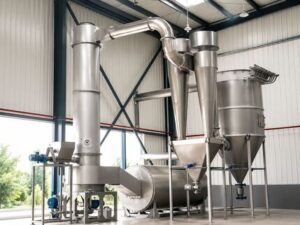
Next, pumps move purified starch milk (at 18.0 to 22.0 Be) to a high-speed peeler centrifuge or vacuum drum filter. This performs mechanical dewatering. Here, the centrifuge reduces water content from 60.0% down to a wet starch cake containing 36.0% to 40.0% moisture.
Then, continuous feeders transfer the damp starch cake into a specialized pneumatic Flash Dryer. Simultaneously, a hot, clean air stream entrains the wet starch. Inlet air temperatures range from 150.0°C to 170.0°C, while outlet temperatures range from 55.0°C to 62.0°C. Within seconds, moisture evaporates down to 12.0% to 13.0%. Finally, cyclone separators and stainless steel bag filters collect dry starch powder. Automated equipment continuously sifts and packs it into moisture-proof bags.
6. Modified Starch Processing & Chemical / Physical Transformations
Furthermore, native cassava starch exhibits excellent clarity and mild flavor. However, it exhibits inherent limitations under harsh industrial conditions. These include thermal instability, acid sensitivity, plus high retrogradation tendencies. Accordingly, chemical, physical, and enzymatic modifications overcome these limits. They allow processors to create high-performance modified starches.
6.1 Physically Modified Cassava Starches
Above all, physical modification alters starch properties without introducing chemical reagents. As a result, physically modified starches qualify easily as clean-label food ingredients.
-
Pre-gelatinized Starch (Instant Starch): In this process, systems feed starch slurry onto continuous steam-heated drum dryers. Alternatively, they process it through high-shear cook-extrusion systems. Consequently, starch granules swell and burst rapidly at 65.0°C to 75.0°C during gelatinization. Then, inline equipment flakes and pulverizes the sheet into a cold-water-soluble starch powder. Food manufacturers use it widely in instant soups, puddings, and bakery premixes.
-
Heat-Moisture Treatment (HMT): Alternatively, operators subject low-moisture starch (15.0% to 25.0% water) to elevated temperatures (100.0°C to 120.0°C). This thermal treatment lasts for several hours inside controlled reactors. Thus, HMT increases starch paste stability against thermal and shear degradation while reducing retrogradation.
6.2 Chemically Modified Cassava Starches
In contrast, chemical modification introduces functional chemical groups onto starch polymer chains. Reagents target hydroxyl ($\text{-OH}$) groups of amylose and amylopectin.
| Modification Type | Chemical Reagents Used | Functional Properties Achieved | Key Industrial End-Uses |
| Cross-Linked Starch | Sodium Trimetaphosphate (STMP), Phosphorus Oxychloride ($\text{POCl}_3$) | Extreme shear stability, high heat resistance, high acid resistance, zero breakdown |
Canned foods, retorted sauces, acidic fruit fillings, high-shear emulsion systems |
| Acetylated Starch (Starch Ester) | Acetic Anhydride, Vinyl Acetate | Low gelatinization temperature, high clarity, superior freeze-thaw stability |
Frozen foods, chilled desserts, gummy confectionery, clear sauce thickeners |
| Cationic Starch | 3-chloro-2-hydroxypropyltrimethylammonium chloride (CHPTAC) | Positive surface charge, high fiber affinity, excellent binding capability |
Paper manufacturing (internal sizing & wet-end retention agent), textile warp sizing |
| Oxidized Starch | Sodium Hypochlorite ($\text{NaOCl}$), Hydrogen Peroxide ($\text{H}_2\text{O}_2$) | Low viscosity at high solids concentration, high film-forming strength, high clarity |
Paper surface sizing, textile yarn coating, bakery glazes, confectionery coatings |
| Dextrinization (Pyrodextrins) | Hydrochloric Acid ($\text{HCl}$) catalyst + High Heat (130°C – 180°C) | Water solubility, high tackiness, rapid drying rate, controlled viscosity |
Corrugated board adhesives, envelope gums, paper bag manufacturing, foundry binders |
7. Complete Turnkey Plant Solutions & Equipment Integration
Ultimately, building a modern cassava facility requires complete technical integration. Engineering must cover mechanical systems, thermal design, water treatment, and digital automation. Indeed, generic equipment configurations often fail due to unexpected bottlenecks, energy losses, or inconsistent quality control.
As a global leader in agro-industrial equipment manufacturing, therefore, GENEX Tech Industries LLP delivers fully integrated turnkey cassava processing machinery plants. Systems are designed specifically for cassava-growing nations. From raw root reception all the way to final automated bagging, GENEX systems combine heavy-duty SS304/SS316 food-grade construction with multi-zone drying technology plus low operating costs.
Why Global Agro-Processors Partner with GENEX Tech Industries LLP:
-
40+ Years Engineering Expertise: Decades of proven field performance across Asia, Africa, and Latin America.
-
Advanced Drying Innovations: Proprietary multi-zone industrial Band Dryer and energy-efficient Mesh Belt Dryer systems engineered specifically for maximum throughput.
-
Custom Automation: Fully automated PLC and SCADA integration for real-time monitoring of temperature, moisture, and throughput metrics.
-
Certified Quality Standards: ISO 9001:2015 accredited, CE certified, as well as US FDA compliant equipment manufacturing.
-
Turnkey Project Lifecycle: Process flow design, plant layout drafting, machinery manufacturing, installation, commissioning, and full operator training from start to finish.
8. Conclusion & Strategic Call to Action (CTA)
In conclusion, global demand for cassava starch, modified starches, HQCF, and dehydrated chips continues to expand rapidly. Key markets include Indonesia, Vietnam, Thailand, Nigeria, Brazil, Colombia, and India. However, capitalizing on these lucrative global markets requires advanced processing infrastructure. Plants must deliver exceptional product purity, precise moisture regulation, and strict operating efficiency above all.
Whether you are establishing a new commercial cassava flour factory, upgrading an existing starch facility, or investing in continuous drying machinery for chips, GENEX Tech Industries LLP provides the technology, engineering expertise, and custom equipment required so as to maximize your plant yield and return on investment (ROI).
Therefore, contact our technical engineering team today in order to request a detailed technical proposal, customized plant layout design, or equipment price quotation right away:
GENEX Tech Industries LLP / Food Tech Projects
Your Trusted Global Engineering Partner for Complete Cassava Processing Solutions.
-
Email Contact: mktg@foodtechprojects.com | sales@foodtechprojects.com
-
Phone / WhatsApp: +91-97489 06968 | +91-93300 77417
-
Websites: www.foodtechprojects.com | www.gtidryers.com
-
Head Office Address: GENEX Tech Industries LLP, 10C, Sir William Jones Sarani (Middleton Row), Park Street, Kolkata – 700071, West Bengal, India