1. Comprehensive Introduction to ETP Sludge Management
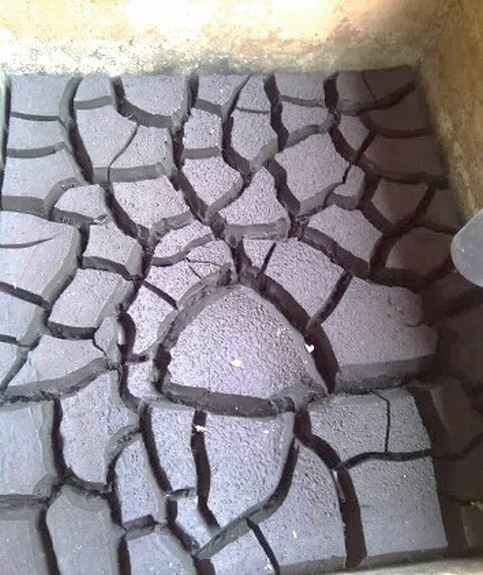
Effluent treatment plants generate high volumes of wet sludge daily. Consequently, modern industrial plants face strict environmental regulations worldwide. Mechanical dewatering units usually leave behind wet sludge cake. Furthermore, raw sludge retains between 60% and 80% moisture content. Storing untreated wet sludge causes heavy operational expenses for factories. Unconditioned sludge also releases toxic leachate into surrounding soil. Additionally, it generates foul organic odors that trigger community complaints.
Therefore, evaluating specialized Sludge Dryer & Wastewater Sludge Drying Plants is critical today. High-efficiency thermal drying reduces total sludge volume by up to 90%. Besides volume reduction, thermal processing converts wet cake into dry granules. Output moisture drops dramatically down to 10% or 20%. Moreover, high drying temperatures destroy biological pathogens and parasites completely. As a result, industrial facilities shift from costly disposal toward resource recovery. Dry sludge pellets serve effectively as alternative fuel for industrial boilers. Thus, factories turn an expensive waste problem into a valuable thermal resource.
In addition, regulatory bodies now mandate strict limits on sludge land application. Accordingly, plant managers must adopt sustainable thermal treatment technologies. Without proper drying, transportation costs for wet sludge remain exorbitantly high. Indeed, hauling water inside wet sludge drains valuable operating budgets. By contrast, drying eliminates water weight before trucks leave the facility. Furthermore, dry sludge can be stored safely for extended periods. It does not ferment or produce dangerous methane gas during storage. Consequently, factory owners gain greater operational control over waste management. To achieve this, selecting appropriate equipment manufacturers is essential.
2. Engineering Mechanics of Indirect Paddle Sludge Dryers

Indirect paddle sludge dryers deliver outstanding thermal efficiency in industrial settings. Hollow wedge-shaped paddles rotate continuously inside jacketed trough vessels. Saturated steam or thermal fluid flows directly inside the hollow shafts. Because the heating medium remains separate, process exhaust gas volumes stay low. This design minimizes the size of downstream air pollution control equipment.
Furthermore, overlapping dual shafts provide an intense self-cleaning mechanical action. This self-cleaning motion breaks through the sticky phase of sludge smoothly. Sludge typically becomes extremely sticky between 40% and 50% moisture levels. Conventional dryers often clog or bind during this critical sticky transition zone. However, intermeshing paddle blades shear sticky cake into small uniform pieces. Consequently, heat transfer rates remain high throughout the entire drying cycle.
In addition, agitator rotation promotes thorough mixing of wet incoming material. Heat transfer occurs primarily through direct contact with heated metallic surfaces. Therefore, air flow requirements inside the drying chamber remain minimal. Lower air flow reduces particulate carryover into the condenser exhaust system. As a result, dust collection systems operate with significantly higher efficiency.
Besides efficiency, paddle dryers feature a compact physical equipment footprint. Thus, they easily fit into existing treatment plant layouts with minimal civil work. Moreover, variable speed drives allow precise control over sludge residence time. Operators can adjust rotor speeds based on changing feed moisture levels. Accordingly, output product moisture content stays remarkably consistent over long runs.
3. Mechanics of Rotary Drum Sludge Dryers
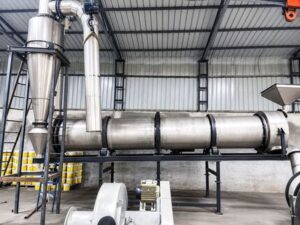
Rotary drum dryers handle heavy continuous daily tonnage in large facilities. These systems feature a slightly inclined rotating cylindrical steel drum shell. Internal lifters shower wet sludge repeatedly through hot air streams. Consequently, rapid surface evaporation occurs across uniform continuous drum rotation. Hot air flows either co-currently or counter-currently to material movement. Co-current flow keeps initial material temperatures lower during rapid evaporation. Thus, delicate organic compounds avoid thermal damage during early drying stages.
Meanwhile, counter-current configurations offer maximum thermal efficiency for dry solids. Heavy chain flights inside the drum break up large agglomerates continuously. Therefore, final dried granules exhibit consistent size distribution without manual crushing. In addition, robust mechanical drives ensure long operating lifespans under continuous load. Rotary dryers handle fluctuating feed conditions with exceptional stability.
Furthermore, direct firing systems can utilize natural gas or biogas fuel. Using bio-gas from anaerobic digestion drops operating fuel costs substantially. Accordingly, large municipal plants favor rotary drums for high-throughput processing. However, proper seals must be maintained to prevent fugitive dust emissions. Regular maintenance of trunnion rollers ensures smooth mechanical rotation. In summary, rotary drums provide rugged performance for demanding industrial applications.
4. Continuous Low-Temperature Belt Drying Systems
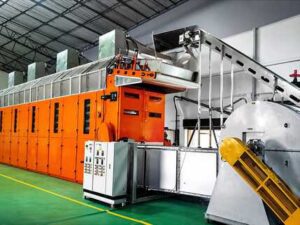
Continuous low-temperature belt dryers protect sensitive organic waste streams effectively. These machines spread wet dewatered cake evenly across perforated conveyer belts. Warm dry air circulates vertically through the porous sludge layer continuously. Operating temperatures typically range from 60°C to 120°C max. Because temperatures remain low, risks of dust explosions drop significantly. Furthermore, low operating temperatures prevent the release of foul volatile compounds. This makes belt dryers ideal for urban effluent treatment plant installations.
Besides safety advantages, belt dryers preserve organic nitrogen content in sludge. Preserved nitrogen enhances the fertilizer value of output biosolid granules. In addition, waste heat from factory processes can power these systems directly. Hot water from gas engines or cooling jackets provides economical heating energy. Consequently, overall plant energy consumption drops to minimal operational levels.
Multiple belt tiers can be stacked to maximize available vertical floor space. Slow belt movement minimizes mechanical wear on moving machine parts. As a result, maintenance costs remain exceptionally low over multi-year cycles. System automation allows remote monitoring of moisture levels in real time. Thus, operators maintain complete process control with minimal direct labor.
5. Sector-Specific Industry Applications for ETP Sludge
Chemical industry ETP sludge often contains hazardous heavy metals and solvents. Operating indirect paddle units under inert nitrogen atmospheres prevents fire hazards. Moreover, specialized Industrial Sludge Drying Systems ensure reliable toxic containment. Similarly, paper mills produce massive volumes of high-cellulose organic sludge. Installing a dedicated Paper Mill Sludge Dryer reduces final moisture down to 15%. Dry paper sludge yields between 2,500 and 3,500 kcal/kg gross calorific value.
Consequently, paper factories burn dried sludge directly inside their biomass boilers. This practice slashes coal consumption while completely eliminating sludge landfill fees. Textile dye houses produce sludge laden with complex synthetic organic dyes. Thermal drying stabilizes these dye residues into non-leaching inert solid granules.
In addition, municipal plants deploy Municipal Sludge Dryers for urban wastewater. Advanced Sewage Sludge Drying transforms municipal sewage into valuable Class-A biosolids. Farmers utilize these dried biosolid granules as rich organic soil conditioners. Food processing plants generate nutrient-rich biological sludge from wastewater systems. Drying this organic sludge produces high-protein ingredients for industrial fertilizer blends. Pharmaceutical factories rely on high-temperature drying to destroy active chemical residues. Thus, thermal drying addresses diverse industry waste challenges across all sectors.
6. ETP Process Flow & Environmental Integration
Integrating a sludge dryer requires complete system engineering across all plant stages. Initially, raw industrial wastewater enters secondary clarifier settlement tanks. Next, mechanical filter presses or centrifuges dewater raw sludge cake. Automated screw conveyors then transport dewatered cake into feed hoppers. Heavy-duty double-shaft lump breakers disintegrate wet cake before dryer entry.
Raw Effluent Wastewater
       │
       ▼
Mechanical Dewatering (Filter Press / Centrifuge to 65%-75% Moisture)
       │
       ▼
Automated Screw Feeder & Granulator Conveyance
       │
       ▼
Thermal Drying Core (Moisture Drops to 10%-20%)
       │
       ▼
Surface Condensers & Vapor Latent Heat Recovery
       │
       ▼
Cyclone Dust Collection & Active Scrubbing
       │
       ▼
Automatic Dry Granule Discharge & Packaging
Inside the dryer chamber, thermal energy evaporates moisture into process steam. Furthermore, surface condensers capture latent heat from generated exhaust steam. This recovered thermal energy preheats boiler feedwater or process water tanks. Non-condensable off-gases pass through multi-stage wet chemical scrubbers. Scrubber systems neutralize residual volatile odors and organic sulfur compounds. Active carbon filters provide final polishing before air discharges into the atmosphere.
Meanwhile, dry output granules discharge into automated cooling screw conveyors. Cooling prevents thermal degradation during bulk storage in big bags or silos. Finally, dust collection cyclones remove fine airborne particles from the system. Accordingly, the entire drying line operates cleanly under slight negative pressure. This closed-loop design ensures zero fugitive dust escapes into the factory.
7. Overview of Non-Sludge Industrial Drying Equipment
Industrial manufacturing requires precise moisture removal across diverse solid products. Therefore, selecting specialized industrial dryers optimizes production throughput significantly.
| Dryer Category | Operating Principle | Thermal Efficiency (%) | Ideal Target Materials & Applications |
| Spray Dryer | Fine liquid droplet atomization in hot air stream | 65% – 75% | Milk powder, ceramic pigments, & APIs |
| Flash / Pneumatic Dryer | High-velocity vertical hot gas pneumatic transport | 75% – 85% | Starch, gypsum, flour, & fine mineral powders |
| Vacuum Tray Dryer | Low-pressure sealed indirect contact thermal heating | 85% – 92% | Heat-sensitive active pharmaceuticals & fine chemicals |
| Rotary Calciner / Kiln | Direct high-temperature thermal gas processing | 60% – 70% | Mineral ores, catalysts, pigments, & calcined clays |
Spray dryers transform liquid slurries directly into uniform dry powder particles. High-speed centrifugal atomizers create microscopic liquid droplets inside tall towers. Consequently, liquid moisture evaporates within milliseconds of hot air contact. This ultra-fast drying preserves sensitive nutrients, flavors, and active compounds. Food processors use spray dryers extensively for milk, coffee, and egg powders. Pharmaceutical companies rely on spray drying to manufacture uniform API powders.
Flash or pneumatic dryers transport damp solids through vertical ducting systems. High-velocity hot gas streams convey particles while rapidly stripping surface moisture. Residence times in flash dryers last only a few short seconds. Thus, flash drying provides low capital cost solutions for high-capacity minerals. Chemical plants process starches, gypsum, flour, and silica powders using flash units.
Vacuum tray dryers perform low-temperature contact drying under deep vacuum conditions. Reduced operating pressures lower water boiling points to protect heat-sensitive molecules. Pharmaceutical labs utilize vacuum tray units for high-value fine chemical powders. Rotary calciners and kilns execute direct high-temperature thermal processing. They process mineral ores, catalysts, pigments, and clays at extreme thermal levels. In summary, non-sludge industrial dryers cover a vast array of manufacturing needs.
8. Spray Drying Systems Architecture and Design
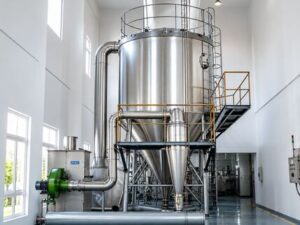
Spray drying represents a premier technology for continuous liquid-to-powder conversion. The process begins with precise liquid feed preparation and pressure pumping. Rotary wheel atomizers rotate at speeds exceeding 10,000 revolutions per minute. Alternatively, high-pressure hydraulic nozzles spray liquids into uniform droplet clouds. Hot air enters the drying chamber through specially designed air dispersers. Swirling air flow patterns maximize contact between hot gas and liquid spray.
Because evaporation occurs instantly, product temperatures remain safely low. Consequently, heat-sensitive enzymes and vitamins suffer virtually zero thermal degradation. Dried powder drops to the conical chamber bottom for continuous discharge. Simultaneously, exhaust air carries fine particles into high-efficiency cyclone separators. Baghouse fabric filters trap remaining dust before air exits through exhaust stacks.
Sanitary stainless steel construction meets strict FDA food and pharmaceutical standards. CIP or clean-in-place systems wash internal chamber walls automatically between batches. Furthermore, closed-cycle spray dryers use inert gas to dry solvent-based feeds. Solvent recovery condensers reclaim valuable chemical solvents for continuous reuse. Thus, spray dryers deliver exceptional product quality across diverse industrial markets.
9. Flash and Pneumatic Conveying Thermal Processing
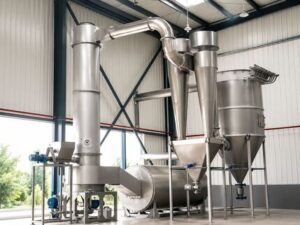
Flash dryers provide instantaneous removal of surface moisture from granular materials. Wet feed enters a vertical drying duct through high-speed screw feeders. Simultaneously, heavy-duty blowers inject high-velocity hot air into the duct base. The hot air stream suspends and transports wet particles upward rapidly. Intense turbulence maximizes convective heat transfer between gas and wet solid surfaces.
Evaporation completes in less than two to three seconds of gas contact. Because drying occurs so quickly, material temperatures stay well below gas temperatures. Consequently, flash dryers offer high thermal efficiency with low energy consumption. Discharge cyclones separate dry product from moist exhaust air at duct tops. Secondary bag filters collect residual fine dust to achieve clean exhaust emissions.
Furthermore, incorporating disintegration mills enables simultaneous grinding and drying. Deagglomeration exposes fresh wet surfaces, accelerating the overall drying rate. Mineral processors use flash dryers for calcium carbonate, kaolin clay, and gypsum. Agricultural plants dry corn starch, wheat gluten, and distillery grains efficiently. Low mechanical complexity ensures high operational uptime and simple maintenance schedules. Accordingly, flash drying remains a cost-effective choice for bulk granular solids.
10. Fluidized Bed Drying Solutions
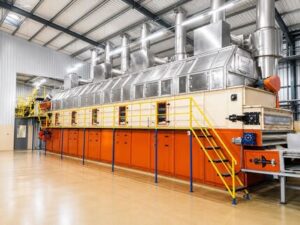
Fluidized bed dryers offer exceptional heat and mass transfer rates for wet solids. Hot air passes upward through a perforated distributor plate at controlled velocity. The upward gas velocity lifts wet solid particles into a turbulent suspended state. This suspended particle bed behaves dynamically like a boiling fluid liquid. Every solid particle receives continuous contact from all sides by hot gas streams. Consequently, moisture removal occurs rapidly with exceptionally uniform product temperature.
Batch fluidized beds dry wet pharmaceutical granules after high-shear granulation. Continuous fluidized beds handle high-volume chemicals, salts, and plastic resins. In addition, internal heat exchanger tubes can be immersed directly into fluid beds. In-bed heat exchangers supply indirect heat, reducing required gas flow rates. Lower gas volumes minimize blower electrical power and downstream duct sizes.
Vibratory fluid bed dryers assist sticky or wide-particle-size materials smooth fluidization. Mechanical vibration helps move difficult solids across the distributor plate smoothly. Zoned temperature controls allow staged drying and cooling inside a single unit. Thus, fluid bed systems deliver highly customizable performance for specialized materials.
11. Vacuum and Freeze Drying Technologies
This drying technologies cater specifically to delicate, high-value industrial materials. Operating inside sealed pressure vessels, vacuum tray dryers create deep vacuum conditions. Lowering internal pressure reduces the boiling point of water significantly. Consequently, moisture evaporates rapidly at mild temperatures around 30°C to 40°C. Heated shelves supply gentle conduction energy directly to shallow material trays. This gentle heating prevents chemical decomposition of active pharmaceutical ingredients.
Furthermore, vacuum shelf dryers protect oxygen-sensitive chemicals from oxidation. Freeze dryers take low-temperature drying further through direct ice sublimation. Material freezes solid first before vacuum pumps reduce pressure below triple point. Gentle radiant heat sublimates frozen ice directly into vapor without liquid phases.
Accordingly, delicate biological structures, vaccines, and probiotics retain full activity. Although capital costs remain higher, freeze drying provides unmatched product preservation. Rotary vacuum dryers mix sensitive materials gently during low-temperature drying. In summary, vacuum systems solve critical drying challenges for sensitive specialty products.
Lowering internal pressure reduces the boiling point of water significantly. Consequently, moisture evaporates rapidly at mild temperatures around 30°C to 40°C. Heated shelves supply gentle conduction energy directly to shallow material trays. This gentle heating prevents chemical decomposition of active pharmaceutical ingredients.
Furthermore, vacuum shelf dryers protect oxygen-sensitive chemicals from oxidation. Freeze dryers take low-temperature drying further through direct ice sublimation. Material freezes solid first before vacuum pumps reduce pressure below triple point. Gentle radiant heat sublimates frozen ice directly into vapor without liquid phases.
Accordingly, delicate biological structures, vaccines, and probiotics retain full activity. Although capital costs remain higher, freeze drying provides unmatched product preservation. Rotary vacuum dryers mix sensitive materials gently during low-temperature drying. In summary, vacuum systems solve critical drying challenges for sensitive specialty products.
12. Organic Waste & Environmental Drying Systems
Dedicated systems for Organic Waste Drying transform food waste into valuable commercial products. Food scrap, agricultural residue, and spent brewery grains contain rich organic nutrients. However, high moisture causes rapid decay and severe environmental pollution. Thermal drying stabilizes organic waste, halting bacterial decay and bad odors completely. Dried organic materials are blended into balanced high-protein animal feed supplements. Alternatively, dry organic waste serves as nutrient-rich soil fertilizer granules.
Furthermore, general Waste & Environmental Drying Solutions support global circular economy goals. Drying municipal solid waste produces high-calorific Refuse-Derived Fuel or RDF pellets. Power plants burn RDF pellets as cleaner alternatives to fossil coal. In addition, drying digestate from biogas plants yields valuable concentrated bio-fertilizers.
This process creates closed-loop resource recovery systems for modern green cities. Advanced environmental dryers feature integrated odor control and water recycling systems. Condensate water recovered during drying is treated for non-potable factory reuse. Thus, environmental drying technologies turn waste management liabilities into sustainable assets.
13. Economic ROI & Financial Analysis for Industrial Thermal Systems
Investing in industrial thermal drying equipment yields substantial, long-term financial returns. Transporting wet waste or low-grade solids wastes corporate capital on water haulage. For instance, evaporating 7.5 tons of water daily slashes haulage expenses by 75%. Consequently, reduced trucking costs generate immediate monthly operational savings.
Furthermore, converting waste into co-firing fuel offsets expensive fossil fuel purchases. Factories burning dry sludge save thousands of dollars monthly on coal or gas. Eliminating landfill tipping fees improves facility profitability even further. Most industrial plants recover their total capital equipment outlay within 12 to 24 months.
In addition, automated control systems reduce direct labor expenses significantly. Energy recovery options like exhaust heat exchangers cut thermal operating costs further. High equipment reliability prevents costly unplanned plant shut-downs. Proper financial modeling demonstrates clear positive cash flows from year one. Accordingly, thermal drying represents an economically sound capital investment.
14. Technical Summary & Engineering Contact Information
In conclusion, industrial thermal drying optimizes waste handling and material manufacturing. Transforming wet sludge cake into dry granules cuts total volume by up to 90%. Moreover, industrial facilities achieve full Zero Liquid Discharge compliance effortlessly.
GENEX Tech Industries LLP brings over 40 years of process engineering expertise. Our engineering team designs custom thermal solutions tailored to your unique specifications. Contact our specialists today for technical consultations, pilot testing, and formal equipment quotes:
-
Company Name: GENEX Tech Industries LLP (Food Tech Projects)
-
Head Office Address: 10C, Sir William Jones Sarani (Middleton Row), Park Street, Kolkata – 700071, West Bengal, India
-
Factory Address: Jalan Industrial Complex (Gate No. 1 / Right Lane 1), Biparnnapara, Jangalpur, Howrah – 711411, West Bengal, India
-
Email: mktg@foodtechprojects.com | sales@foodtechprojects.com
-
Phone / WhatsApp: +91-97489 06968 | +91-93300 77417
-
Websites: www.foodtechprojects.com | www.gtidryers.com