
1. Executive Summary & Introduction
Currently, the Kingdom of Saudi Arabia (KSA) is undergoing a massive industrial transformation. Consequently, this nationwide effort is primarily driven by Vision 2030, alongside the National Industrial Development and Logistics Program (NIDLP). As a result, while the Kingdom steadily moves away from an oil-dependent economy, it is simultaneously building advanced manufacturing sectors. In light of this economic pivot, thermal engineering has consequently become a critical operational pillar within this strategic shift. Furthermore, continuous industrial drying technology plays a vital role across multiple essential fields. Specifically, these include food security, chemical processing, mining, and municipal waste treatment.
Crucially, moisture reduction is far more than simple weight removal. On the contrary, it is a critical biological, physical, and chemical process. By controlling moisture through engineered systems, operators directly ensure product stability, microbial safety, and high final quality. In addition, proper drying noticeably improves material flowability while significantly reducing transport costs. Therefore, choosing heavy-duty thermal hardware is absolutely essential for forward-thinking Saudi industrial leaders.
To meet these demanding operational requirements, GTI (Genex Tech Industries LLP / Food Tech Projects) supplies custom-engineered drying systems. As a result of robust design practices, these units operate continuously and reliably, even under harsh desert conditions. Accordingly, this post thoroughly analyzes industrial drying applications across nine major Saudi sectors. Furthermore, it comprehensively reviews equipment mechanics, climate adaptations, and total cost of ownership (TCO) benchmarks.
2. Market Context & Economic Drivers
To begin with, Saudi Arabia currently imports substantial amounts of thermal processing equipment from global suppliers. For example, recent trade data demonstrates that KSA imported over $71.5 Million worth of HS Code 841939 machinery in 2024 alone. By definition, this classification specifically includes non-domestic industrial dryers used for large-scale dehydration. Naturally, these specialized units continuously process food ingredients, fine chemicals, valuable minerals, and municipal wastewater sludge.
Economic Implications of the $71.5M Import Baseline
-
Downstream Investments: First and foremost, such high capital import figures clearly highlight strong ongoing investments in local processing infrastructure.
-
OEM Reliance: Secondly, Saudi firms depend heavily on international OEMs like GTI for specialized, heavy-duty machinery. Consequently, equipment must strictly meet rigorous sanitary, environmental, safety, and explosion-proof standards.
-
Economic Diversification: Finally, capital is rapidly moving into non-oil sectors. As a direct outcome of this trend, long-term demand for specialized thermal systems continues to rise steadily.
Simultaneously, the GCC industrial dryer market is expanding rapidly overall. In particular, major industrial hubs—namely Jubail, Yanbu, Ras Al-Khair, and KAEC—are leading this industrial growth. As a consequence, industry analysts project that the regional market will grow at a strong CAGR of 6.8% to 8.2% through 2032. Furthermore, international OEMs like GTI—which consistently supply certified alloys (such as SS316L and Hastelloy) along with advanced automation—are exceptionally well-positioned to serve Saudi Arabia’s expanding industrial sector moving forward.
3. Sector-by-Sector Technical Applications
Because material characteristics vary, drying requirements differ significantly across various industrial sectors. In fact, specific factors—such as material state, heat sensitivity, and moisture binding mechanisms—ultimately govern equipment selection. Therefore, provided below is a detailed technical analysis across nine key Saudi industries.
Overview of Saudi Arabia Industrial Drying Sectors
-
Food & Ingredients: Hygienic thermal processing specifically engineered for flakes, starches, and natural extracts.
-
Dairy & Protein: Precision atomization combined with secondary drying for sensitive solubles and concentrates.
-
Dates Processing: Sugar-safe, low-temperature dehydration designed specifically for syrup, paste, and powder derivatives.
-
Animal Feed: Extruded pellet drying and systematic cooling aimed at completely inhibiting mold growth.
-
Chemicals & Petrochemicals: Solvent recovery alongside ATEX-rated inert drying tailored for sensitive organic compounds.
-
Minerals & Ores: Heavy-tonnage, abrasion-resistant thermal reduction engineered for bulk aggregates.
-
Fertilizers: Continuous granule moisture stabilization designed to prevent physical caking without nutrient degradation.
-
Biomass & Bioenergy: Low-density fiber processing purpose-built for efficient pellet fuel conversion.
-
Waste & Sludge: Mechanical shear coupled with intensive thermal drying specifically configured to break through sticky phases.
3.1 Food Processing & Food Ingredients
In recent years, Saudi Arabia has been rapidly expanding its domestic food manufacturing capabilities. Above all, this initiative directly strengthens national food security while simultaneously cutting finished food imports. However, processing food powders, starches, and dehydrated vegetables inevitably requires extremely precise thermal control. Thus, thermal exposure must be strictly limited in order to prevent scorching or the loss of natural flavor profiles.
Generally speaking, food processing reduces initial moisture levels from approximately 80% down to a stable 3%–5%. As a consequence of reaching this low moisture threshold, microbial growth stops completely, which subsequently extends shelf life naturally. Ultimately, this approach eliminates the need for synthetic artificial preservatives altogether.
To address these sanitary requirements, GTI explicitly builds hygienic food drying systems utilizing highly polished SS304/SS316L stainless steel. For example, standard features include dynamic Clean-In-Place (CIP) nozzles as well as smooth, crevice-free internal welds. Moreover, GTI Band Dryers utilize precise multi-zone temperature profiles (typically ranging from +60°C to +85°C). As a result, they gently dry delicate vegetable flakes while consistently preserving original color, texture, and rehydration properties.
3.2 Dairy Industry & Protein Processing
On account of growing local demand, Saudi Arabia operates extensive, vertically integrated dairy farms. Nevertheless, processing liquid milk, whey, and casein into shelf-stable powders requires exceptionally high-performance drying systems. Typically, liquid feeds enter the process at 88%–92% initial moisture. Subsequently, they must be converted into free-flowing powders containing under 4.0% final moisture.
Importantly, dairy proteins are notoriously sensitive to elevated temperatures. For instance, prolonged thermal exposure above +75°C inevitably causes severe protein denaturation and unwanted caking. Consequently, the dairy industry relies heavily on rapid atomization drying in order to protect product quality.
In response to these challenges, GTI supplies specialized Spray Dryer systems engineered specifically for dairy processing. To achieve instant drying, high-speed rotary atomizers split liquid feeds into uniform droplets measuring between 20 and 100 microns. Next, rapid evaporation in co-current hot air (+160°C to +200°C) cools the chamber instantly. Therefore, actual particle temperatures remain exceptionally low throughout the cycle. Additionally, for sticky slurries, GTI Vibratory Fluid Bed Dryers provide vital secondary cooling alongside gentle agglomeration.
3.3 Dates Processing & Value-Added Derivatives
As a global leader in agriculture, Saudi Arabia produces over 1.6 million metric tons of dates annually. Consequently, large volumes of secondary dates are systematically processed into date syrup, paste, and functional powders. Ultimately, these value-added items serve as lucrative food ingredients for both domestic and international markets.
However, date pulp contains naturally high sugar levels—specifically fructose and glucose exceeding 75% total solid content. Because of this extreme sugar concentration, date paste becomes exceptionally sticky and heat-sensitive when heated. As a result, traditional drying methods frequently cause severe sugar caramelization along with stubborn chamber wall sticking.
To solve this specific engineering problem, GTI resolves this issue with specialized Date Powder Processing Plants. Specifically, we combine low-temperature dehumidified air with custom Spray Dryers and vacuum units. In practice, date syrup is co-processed alongside natural carrier matrices at controlled temperatures strictly below +60°C. Consequently, this advanced setup consistently yields a free-flowing, non-caking date powder.
3.4 Animal Feed & Agribusiness
Similarly, Saudi Arabia’s expanding livestock and aquaculture sectors require steady, reliable feed supplies. Generally, commercial feed processing relies on direct thermal energy and moisture addition during extrusion pelleting. However, pellets exit the extrusion die containing 16% to 20% moisture. Consequently, they must be rapidly dried below 12% in order to prevent mold growth during subsequent storage and transport.
To accomplish this efficiently, GTI supplies robust multi-pass Band Dryers along with continuous Rotary Drum Dryers. Together, these advanced systems deliver uniform moisture reduction without cracking fragile feed pellets. Furthermore, because temperature zones are carefully regulated, they simultaneously protect heat-sensitive added vitamins and essential enzymes.
3.5 Chemical & Fine Chemical Manufacturing
Meanwhile, Saudi chemical plants continuously process synthetic polymers, industrial resins, technical catalysts, and fine pigments. Nevertheless, drying specialty chemicals requires exceptionally strict operational safety controls. Indeed, chemical processors routinely handle highly flammable solvents, toxic intermediates, or explosive dust atmospheres.
Accordingly, chemical drying systems must deliver extremely tight moisture control. For example, residual volatile solvents must frequently drop below 0.1% final concentration. To ensure total safety, key engineering requirements include total inert atmosphere control, continuous nitrogen recirculation, and complete solvent recovery.
To satisfy these strict regulations, GTI offers fully sealed Paddle Dryers and closed-cycle Flash Dryers designed specifically for chemical processing plants. Notably, these units feature heavy-gauge alloy construction (such as SS316Ti or Monel) alongside integrated ATEX dust relief venting. Furthermore, internal condenser loops safely recover valuable solvents during the drying cycle, thereby maximizing operational efficiency while reducing environmental emissions.
3.6 Mineral Processing & Mining Operations
Beyond agriculture and chemicals, Saudi Arabia holds exceptionally rich deposits of phosphate rock, kaolin clay, silica sand, and gypsum. However, wet mining processes initially generate dense mineral concentrates containing 15% to 35% moisture. Consequently, they must be thoroughly dried down to under 1.0% moisture before they can be utilized in downstream industrial processes or exported abroad.
Furthermore, mineral drying involves handling heavy throughputs—frequently reaching up to 200 tons per hour. Therefore, the machinery used must withstand intense mechanical abrasion alongside continuous thermal stress. At the same time, maintaining high thermal efficiency is vital in order to keep operational costs under control over long production runs.
To meet these demanding conditions, GTI supplies high-capacity Rotary Drum Dryers specifically built for mining operations. For instance, these systems feature high-tensile steel shells alongside replaceable internal lifters made from ultra-durable Hardox alloy. In terms of heating, direct-fired burners generate inlet temperatures reaching up to +800°C. Finally, multi-stage cyclone separators capture fine airborne dust to strictly minimize stack emissions.
3.7 Fertilizer Production (Organic & Inorganic)
In addition to mining, Saudi Arabia is a leading global exporter of chemical fertilizers such as DAP, MAP, and Urea. During production, primary granulation processes yield wet granules containing 4% to 8% moisture. Subsequently, these granules must be dried below 1.5% moisture in order to prevent caking and physical crushing during storage.
However, fertilizers break down easily when exposed to excessive heat. Specifically, high temperatures cause severe nitrogen loss while simultaneously weakening structural granule strength. Consequently, achieving uniform drying demands steady, precisely controlled heat transfer from start to finish.
To ensure optimal product integrity, GTI provides heavy-duty Rotary Drum Dryers alongside Vibratory Fluid Bed Dryers engineered specifically for fertilizer manufacturing. Crucially, these units feature automated multi-zone temperature controls (+120°C to +250°C) along with built-in cooling sections. As a direct result, they produce hard, dust-free granules that fully satisfy international export standards.
3.8 Biomass & Renewable Energy
Under the ambitious Saudi Green Initiative, the Kingdom is actively expanding biomass utilization across multiple energy sectors. For example, abundant agricultural wastes—such as date palm fronds and crop residues—are systematically converted into high-density bio-pellets. However, raw feedstocks typically enter processing containing 45% to 65% initial moisture. Therefore, they must be thoroughly dried down to 10%–12% before they can be successfully pelleted.
Nevertheless, processing fibrous biomass introduces serious fire hazards alongside naturally low bulk material density. Consequently, achieving consistent drying requires highly responsive air volume controls coupled with active safety monitoring systems.
To address these operational risks, GTI supplies specialized triple-pass Biomass Rotary Dryers alongside continuous Mesh Belt Dryers. Crucially, these systems feature integrated optical spark detection paired with automated water deluge safety units. Furthermore, they can utilize low-temperature hot water or recovered industrial waste heat (+80°C to +130°C) to ensure highly economical, safe operation.
3.9 Waste Processing & Sludge Management
Finally, rapid urban growth across the Kingdom generates massive annual volumes of municipal sewage sludge and industrial wastewater cake. Typically, dewatered sludge cakes exit mechanical filter presses containing 75% to 85% moisture. Consequently, environmental regulations strictly mandate overall volume reduction, complete pathogen destruction, and long-term material stabilization.
However, sludge inevitably enters a notorious “sticky phase” when its moisture content drops between 40% and 60%. During this specific phase, sludge becomes extremely adhesive and severely clogs conventional machinery. Therefore, successfully breaking through this sticky regime requires intense, continuous mechanical agitation.
To solve this notorious problem, GTI supplies specialized indirect Paddle Dryers tailored specifically for sludge treatment. In operation, dual counter-rotating shafts equipped with unique wedge-shaped paddles agitate the material continuously. Consequently, the rotating paddles shear cleanly through the sticky phase without clogging the drying trough. Ultimately, intensive thermal processing (+130°C to +160°C) pasteurizes pathogens completely, yielding stable, dry bio-solids under 10% final moisture content.
4. GTI Drying Technologies Deep Dive
Naturally, selecting the right drying equipment requires matching fundamental heat transfer modes with unique raw material properties. To assist system design, provided below is an engineering overview covering seven core GTI dryer technologies.
Summary Mapping: Core GTI Dryer Portfolio & Target Materials
-
Rotary Drum Dryer: Ideal for high-tonnage minerals, silica sand, metallic ores, agricultural grain, and chemical fertilizers.
-
Paddle Dryer: Purpose-built for wastewater sludge, industrial pastes, sticky filter cakes, and solvent recovery applications.
-
Vibratory Fluid Bed (VFB) Dryer: Perfect for fragile granules, refined table salt, crystalline sugar, delicate dairy powders, and agricultural seeds.
-
Band & Mesh Belt Dryer: Tailored for extruded pellets, pet food, dehydrated vegetable flakes, sliced fruits, and biomass fibers.
-
Drum Dryer: Engineered for gelatinized starches, instant baby cereals, and highly viscous thin-film pulps.
-
Spray Dryer: Designed for liquid milk powder, date juice powder, instant herbal extracts, and fine pharmaceuticals.
-
Biomass Dryer: Configured specifically for high-volume wood sawdust, ground chips, palm fronds, and crop residues.
4.1 Rotary Drum Dryer
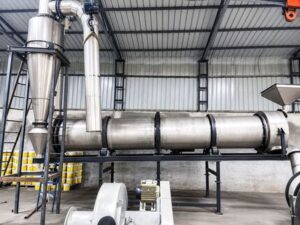
First, the GTI Rotary Drum Dryer is heavily engineered for continuous, high-capacity industrial operations. Structurally, it consists of a heavy steel drum inclined at a precise angle and driven smoothly by a robust girth gear assembly.
-
Operating Principle: In practice, internal lifter flights continuously scoop and shower wet material as the main drum rotates (typically between 2 and 12 RPM). Consequently, the tumbling material cascades through a high-velocity stream of hot gas. Thus, heat transfers directly from the hot gas stream straight into the wet product.
-
Technical Specifications: Production capacities range from 500 kg/hr up to 50 tons/hr. Operating gas temperatures span from +120°C up to +800°C. Meanwhile, adjusting the drum slope (1° to 5°) precisely controls total material residence time.
-
Target Applications: Heavy ores, construction sand, chemical fertilizers, harvested grains, and biomass wood chips.
4.2 Paddle Dryer

Second, the GTI Paddle Dryer utilizes efficient indirect heat transfer to process difficult wet pastes, industrial sludges, and sticky filter cakes safely.
-
Operating Principle: Dual parallel shafts fitted with intermeshing wedge-shaped paddles rotate inside a steam-jacketed trough. Steam or hot thermal oil circulates continuously inside both the hollow shafts and the paddles themselves. Consequently, heat transfers entirely through direct metal contact, rapidly driving off water vapor without requiring massive air volumes.
-
Technical Specifications: Total thermal efficiency frequently exceeds 85%. Operating temperatures can reach up to +300°C under internal pressures up to 10 bar.
-
Target Applications: Municipal sewage sludge, paper mill sludge, hazardous chemical effluent cakes, and toxic powders.
4.3 Vibrating Fluid Bed Dryer (VFBD)
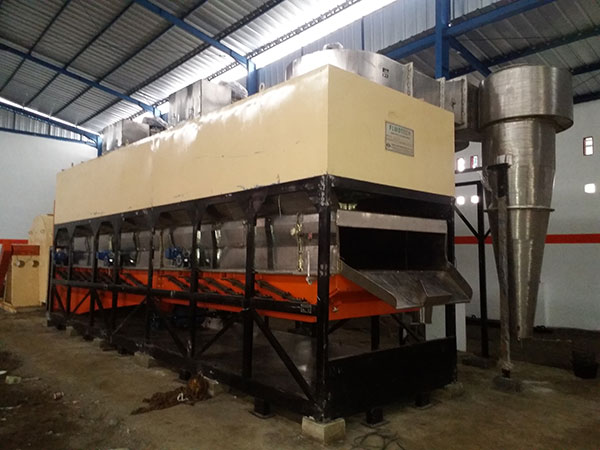
Third, the GTI Vibrating Fluid Bed Dryer cleverly combines gentle mechanical vibration with upward conditioning airflow. As a result, it delivers exceptionally uniform drying for delicate granular substances.
-
Operating Principle: Wet material feeds continuously across a perforated distributor deck. Simultaneously, heated air passes upward through the deck perforations to gently fluidize the particles. Meanwhile, twin eccentric motors vibrate the entire assembly, thereby conveying the bed smoothly forward without causing particle breakage.
-
Technical Specifications: Air inlet temperatures range from +50°C to +220°C, while process air velocity can be precisely adjusted between 0.5 and 2.5 m/s. Additionally, units often feature integrated downstream cooling zones.
-
Target Applications: Dairy powders, refined table salt, white sugar, planting seeds, and fine crystalline chemicals.
4.4 Band Dryer / Mesh Belt Dryer
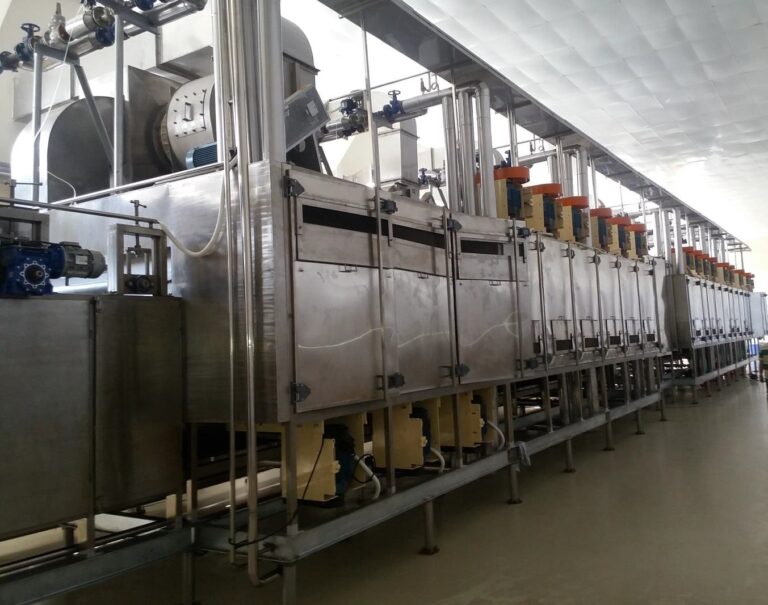
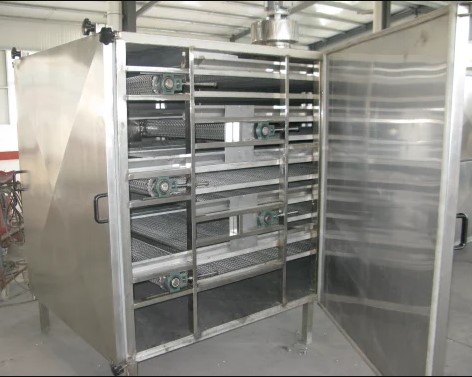
Fourth, the GTI Band Dryer is a versatile conveyor drying system purpose-built for low-temperature, highly uniform material processing.
-
Operating Principle: Heavy-duty stainless steel mesh belts convey wet product continuously through enclosed, temperature-controlled heating zones. Internally, circulating fans force heated air through the moving product layer. Furthermore, variable-speed belt drives allow operators to tailor exact drying residence curves.
-
Technical Specifications: Available in single-pass or multi-pass (such as 3-tier or 5-tier) physical layouts. Standard belt widths span from 1.0 m up to 3.2 m, with operating temperatures set between +40°C and +160°C.
-
Target Applications: Dehydrated vegetable flakes, extruded pet food, chemical catalyst pellets, and biomass briquettes.
4.5 Drum Dryer (Single / Double Drum)
Fifth, the GTI Drum Dryer relies on conductive thin-film contact drying to process liquid slurries and viscous pulps rapidly.
-
Operating Principle: A thin layer of liquid feed is applied to the outer surface of internally steam-heated revolving metal drums. Consequently, moisture boils off almost instantly within a partial rotation of the drum. Finally, stationary doctor blades continuously scrape off the dried film as continuous, uniform flakes.
-
Technical Specifications: Internal steam pressures safely reach between 2 and 10 bar. Moisture evaporation rates reach an impressive 15 to 30 kg $\text{H}_2\text{O}$/m²/hr.
-
Target Applications: Pre-gelatinized starches, instant baby cereals, commercial potato flakes, and concentrated fruit pulps.
4.6 Spray Dryer
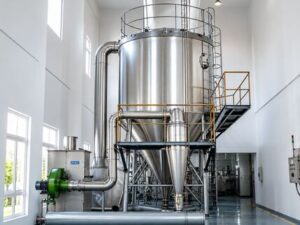
Sixth, the GTI Spray Dryer excels at transforming pumpable liquid feeds directly into fine, free-flowing powders in a single continuous step.
-
Operating Principle: High-speed rotary atomizers or specialized high-pressure nozzles transform incoming liquid into millions of fine droplets inside a tall drying chamber. Immediately upon contact with co-current hot air, rapid surface evaporation occurs. Consequently, the dried powder drops gently to the bottom cone for automated collection.
-
Technical Specifications: Evaporation capacities span from 10 kg/hr up to 5,000 kg/hr. Hot air inlet temperatures reach from +150°C to +350°C, while atomized particle sizes range between 15 and 150 microns.
-
Target Applications: Whole milk powders, heat-sensitive date juice powder, instant beverage extracts, and active pharmaceuticals.
4.7 Biomass Dryer
Seventh, the GTI Biomass Dryer is specifically configured to process high-moisture, low-density forestry products and agricultural wastes safely.
-
Operating Principle: Featuring single-pass or triple-pass internal drum designs, these units incorporate extra-wide air ducting alongside custom lifter geometry. Furthermore, negative pressure operation effectively prevents fine dust from leaking into the plant atmosphere. Finally, optical spark detectors paired with automatic water spray nozzles ensure total operational safety against fires.
-
Technical Specifications: Evaporation capacities reach up to 15,000 kg/hr. Hot gas inlet temperatures range from +80°C to +400°C depending on heat sources.
-
Target Applications: Sawdust, wood chips, shredded date palm fronds, sugarcane bagasse, and crop straw.
5. Comparative Technology Selection Guide
To assist engineering teams in choosing equipment, selecting drying hardware requires matching specific feed properties with exact thermal mechanics. Consequently, the detailed matrix below serves as a direct reference guide.
| Physical Feed Form | Initial Moisture (%) | Heat Sensitivity Limit | Target Final Moisture (%) | Recommended GTI Equipment | Primary Heat Transfer Mode |
| Liquid / Low-Viscosity Slurry | 60% – 92% | High (< +70°C Product) | 2.0% – 4.0% | Spray Dryer | Direct Convection (Instantaneous) |
| High-Viscosity Paste / Sludge | 50% – 85% | Moderate (< +140°C Product) | 5.0% – 10.0% | Paddle Dryer | Indirect Conduction (High Shear) |
| Slurry / Viscous Thin Film | 55% – 80% | Moderate (< +110°C Product) | 3.0% – 6.0% | Drum Dryer | Direct Conduction (Thin Film) |
| Free-Flowing Powder / Granules | 10% – 30% | High to Moderate | 0.1% – 2.0% | VFB Dryer | Direct Convection (Fluidized Bed) |
| Extrusions / Flakes / Vegetables | 20% – 75% | High (< +80°C Air) | 3.0% – 8.0% | Band / Mesh Dryer | Direct Convection (Zoned Cross-Flow) |
| Bulk Minerals / Ores / Sand | 10% – 35% | Very Low (Thermally Stable) | 0.1% – 0.5% | Rotary Drum Dryer | Direct Convection / Conduction |
| High-Moisture Fibrous Biomass | 40% – 65% | Low to Moderate | 8.0% – 12.0% | Biomass Dryer | Direct Convection (Triple-Pass / Belt) |
6. Operational Considerations in the Saudi Climate
Because of regional geography, Saudi Arabia’s extreme desert environment presents unique operating challenges. Consequently, industrial drying systems must be specifically engineered to handle ambient heat spikes, dense dust storms, freshwater scarcity, and local fuel specifications.
6.1 Ambient Temperature Variations & Air Density
Throughout the year, Saudi ambient temperatures fluctuate dramatically—ranging from winter lows around +5°C to summer peak highs exceeding +52°C. Because ambient air density changes significantly across this vast temperature swing, uncompensated air volume shifts can severely disrupt burner combustion balance and lower overall thermal efficiency.
To prevent these operational losses, GTI equips all regional installations with modern variable frequency drive (VFD) supply fans. Furthermore, precision mass-flow air sensors continuously monitor incoming air density. Consequently, combustion control systems utilize real-time oxygen-trim loops to maintain optimal air-to-fuel ratios year-round.
6.2 Airborne Dust & Sand Ingestion Management
Additionally, seasonal sandstorms (commonly known as Shamal winds) drastically elevate atmospheric dust concentrations, introducing fine silica particles (specifically PM10 and PM2.5). Left unchecked, fine sand ingestion can easily contaminate sensitive food products and severely damage high-speed rotating components.
To defeat this threat, GTI drying units employ multi-stage mechanical air filtration systems. Typically, air ingestion begins through self-cleaning heavy louvers, followed sequentially by G4 rated panel pre-filters and high-efficiency H13 HEPA final filters. Furthermore, process chambers operate under slight positive pressure to keep unconditioned ambient dust out entirely.
6.3 Water Scarcity & Dry Cooling Innovations
Because freshwater conservation is strictly enforced across Saudi industrial zones, traditional evaporative cooling towers consume unacceptably large volumes of water while requiring constant chemical maintenance.
In response, GTI offers advanced dry-cooling radiator loops for post-drying product cooling and solvent condensation. By utilizing air-cooled closed-loop heat exchangers, these innovative systems eliminate process water consumption completely. Most importantly, they are proven to operate reliably even during extreme ambient heat reaching +50°C.
6.4 Energy Optimization & Hybrid Solar Integration
In terms of combustion efficiency, GTI industrial burner systems operate smoothly on domestic natural gas supplied directly by Saudi Aramco. Notably, both direct and indirect burners achieve high turndown ratios (up to 10:1) while strictly maintaining low $\text{NO}_x$ emissions.
Furthermore, GTI hardware can be seamlessly integrated alongside parabolic trough solar-thermal arrays. In this hybrid operational mode, solar preheaters raise incoming process air up to +120°C before it reaches the main gas burner. Consequently, this sustainable hybrid setup cuts fossil natural gas consumption by an impressive 20% to 35% during daytime operations.
7. Regulatory & Standards Compliance
To operate legally, Saudi industrial plants must fully comply with strict national safety frameworks, sanitary codes, and environmental laws. Therefore, GTI drying systems are manufactured to satisfy all relevant regional standards:
-
SASO SABER Certification: All integrated electrical control panels, pressure vessels, and electric motors carry full SASO conformity registration for smooth import and commissioning.
-
SFDA Compliance: Food, date, and dairy drying systems strictly feature highly polished SS316L product-contact surfaces ($Ra < 0.4\ \mu\text{m}$), cGMP compliant structural layouts, and fully drainable automated CIP loops.
-
NCVC Environmental Rules: Exhaust gas cleaning systems incorporate multi-cyclones, high-temperature pulse-jet baghouses (guaranteeing dust emissions well under $10\ \text{mg/Nm}^3$), and chemical wet scrubbers.
-
Safety Protocols: Chemical and fine-powder units feature integrated ATEX explosion relief venting panels, automatic nitrogen purge loops, double-block-and-bleed gas safety valves, and complete thermal insulation lagging.
8. Total Cost of Ownership (TCO) & Economic Analysis
When evaluating industrial machinery, operating expenses (OPEX) routinely account for 70% to 85% of a heavy dryer’s total lifecycle cost over time. Above all, thermal energy consumption represents the single largest ongoing operational expense over an expected 20-year operational life.
8.1 Energy Consumption Benchmarks
-
Direct Convective Rotary Dryer: 750 to 950 kWh thermal energy equivalent. (Significantly reduced to 650–750 kWh when equipped with heat recovery systems).
-
Indirect Paddle Dryer: 680 to 780 kWh equivalent steam thermal input.
-
Spray Dryer: 900 to 1,200 kWh thermal energy equivalent. (Reduced to 800–900 kWh with heat recovery exchangers).
-
Vibratory Fluid Bed Dryer: 700 to 850 kWh thermal energy equivalent.
8.2 Operational Lifespan & Preventive Maintenance
With proper care, GTI industrial thermal equipment routinely delivers a service life spanning 15 to 25+ years. To ensure long-term performance, engineering teams should follow a structured maintenance schedule:
-
Daily / Weekly Checks: Continuously monitor drive motor vibration levels, record filter differential pressure drops, verify burner flame stability, and check mechanical shaft seals.
-
Monthly Maintenance: Thoroughly lubricate trunnion roller bearings, check drive chain tension, inspect doctor blade wear, and clean liquid spray nozzles.
-
Annual Overhaul: Perform ultrasonic wall-thickness testing on drum shells, recalibrate digital temperature sensors, and replace worn internal seals.
9. Conclusion & Call-To-Action
In conclusion, Saudi Arabia is rapidly accelerating its industrial capabilities under Vision 2030. Consequently, high-performance continuous drying technology plays a foundational role in driving this historic economic expansion forward. Whether improving domestic food production, expanding mineral processing, scaling chemical synthesis, or modernizing municipal waste treatment, precision thermal systems provide the core operational muscle required for industrial success.
By combining four decades of specialized thermal engineering expertise with international ISO, CE, and FDA certifications, GTI brings world-class drying solutions directly to the regional market. Our extensive portfolio—comprising Rotary Drum Dryers, Paddle Dryers, VFB Dryers, Band Dryers, Drum Dryers, Spray Dryers, and Biomass Dryers—is explicitly engineered to operate with total reliability, even within demanding desert environments.
From initial concept to long-term operation, GTI engineers support client projects through every single development stage. Specifically, our comprehensive services include material pilot testing, custom engineering design, precision manufacturing, complete site installation, and ongoing maintenance support.
Engage GTI for Your Saudi Arabian Industrial Drying Projects
Take the next step in optimizing your industrial thermal processing operations. Contact GTI’s thermal engineering team today to request a technical consultation, schedule pilot testing for your raw materials, or receive a customized project proposal:
GENEX TECH INDUSTRIES LLP / FOOD TECH PROJECTS
-
Email: mktg@foodtechprojects.com | sales@foodtechprojects.com
-
Phone / WhatsApp: +91-97489 06968 | +91-93300 77417
-
Websites: www.foodtechprojects.com | www.gtidryers.com
-
Head Office: 10C, Sir William Jones Sarani (Middleton Row), Park Street, Kolkata – 700071, India