
European manufacturers currently face rising energy costs, strict EU sustainability regulations, and intense pressure to improve overall product quality while simultaneously reducing operating expenses. Industrial drying frequently accounts for a significant share of total plant energy consumption — specifically, in some sectors, up to 25%. Consequently, choosing the right industrial dryer in Europe is no longer just a routine technical decision. Instead, it represents a strategic investment that directly impacts ROI, energy savings, and the overall payback period.
Furthermore, these modern systems consistently deliver measurable results. This applies whether you operate a food processing plant in Germany, a pharmaceutical facility in France, a chemical site in the Netherlands, a dairy operation in Italy, or a specialized bioprocessing facility in Spain or the UK.
Regional Market Reach & Multilingual Search Optimization
In order to effectively capture high-intent buyers across the European Union, gtidryers.com integrates localized terminology to rank successfully across regional search engines:
-
Germany (Industrietrockner Deutschland / energieeffizienter Trockner): As a result of heavy industrial demand, there is high need for chemical, biomass, and heavy engineering drying systems.
-
France (Séchoir industriel France / séchoir économe en énergie): Specifically, there is a strong focus on agricultural, dairy, and pharmaceutical standards (such as GMP and FDA).
-
Italy (Essiccatore industriale Italia / essiccatoi a risparmio energetico): In particular, this region serves as a major market for food processing, mineral, and ceramic drying applications.
-
Netherlands (Industriële droger Nederland / energiezuinige droger): Additionally, it stands out as a leading hub for chemical processing, food tech, and advanced biomass valorization.
-
Spain & UK: Correspondingly, both regions show growing investments in sustainable food processing, wastewater sludge reduction, and high-value marine biomass drying.
The Real Cost of Inefficient Drying in Europe
Undoubtedly, outdated dryers waste energy, create quality variations, and continually increase maintenance costs. On the other hand, leading European plants that proactively upgrade to optimized systems typically achieve the following:
-
First, a 20–40% reduction in thermal energy consumption as a result of advanced heat recovery and improved airflow design.
-
Second, faster processing times and higher output capacity without expanding the physical footprint.
-
Third, vastly improved product consistency, which ultimately reduces rejects and costly rework.
-
Finally, clear payback periods that generally fall between 18–36 months depending on local energy prices and overall utilization.
Importantly, these outcomes are not merely theoretical. Instead, they are precisely calculated through proper drying calculations and subsequently validated via empirical pilot testing.
Technical Solutions by Sector
1. Marine Biomass, Algae & Seaweed Dehydration
Typically, marine biomass starts at 80% to 95% initial moisture content. It must consequently be reduced to 8% to 12% for safe storage and hydrocolloid extraction. For specialized extraction, explore complete solutions for algae, seaweed, and carrageenan dehydration.
-
Refractance Window (RW) Dryers:
-
Mechanism: First, liquid algae or seaweed pulp is spread in an ultra-thin layer (0.5 to 2.0 mm) over a moving plastic belt floating on hot water (60°C to 95°C). Discover advanced designs directly at GEM RWD.
-
Thermal Control: Meanwhile, heat transfers rapidly through conduction while wet. As material dries, heat absorption automatically drops. This prevents product scorching and keeps the internal product temperature below 65°C.
-
Performance: Consequently, it evaporates 15 to 45 kg of water per square meter per hour. Nutrient retention exceeds 92% for carotenoids and active compounds.
-
-
Multi-Zone Low-Temperature Belt Dryers:
-
Mechanism: Concurrently, chopped kelp moves over perforated 316L stainless steel mesh belts. Check out high-efficiency band dryers and industrial mesh belt dryers. Furthermore, air speeds stay precisely between 1.0 and 2.5 m/s across separate heating zones to prevent heat damage.
-
2. Biomass, Bioenergy & Wood Processing
In this sector, the process reduces initial wood and crop moisture from 45%–65% down to a steady 8%–12% prior to pelleting or direct burning. Therefore, review overall solutions for biomass & renewable energy drying as well as dedicated biomass fuel drying.
-
Triple-Pass Rotary Drum Dryers:
-
Mechanism: First of all, wet wood chips enter a rotating drum equipped with internal flights. These flights continuously lift and shower material through hot air. Learn more about heavy-duty rotary drum dryers, dedicated wood chip dryers, and efficient pellet drying.
-
Separation: Due to weight differences, lighter, drier wood moves faster through the drum via airflow. Conversely, heavier, wetter pieces stay longer in high-heat zones.
-
-
Air-Recirculating Belt Dryers:
-
Mechanism: Instead of discarding thermal energy, this system uses low-grade waste hot water (70°C to 90°C) from nearby plant operations. It effectively pulls warm air down through a moving biomass bed. This design is particularly ideal for sawdust drying to control dust and save energy simultaneously.
-
3. Sludge & Environmental Waste Valorization
Primarily, this process reduces sludge volume so as to meet strict EU landfill directives. It converts wet cake (45%–65% moisture) into dry granules. For more details, check our complete range of systems for waste & environmental drying.
-
Indirect Heated Dual-Shaft Paddle Dryers:
-
Mechanism: In this design, steam or thermal oil circulates inside hollow shafts and intermeshing wedge-shaped paddles. Notably, these are engineered for heavy-duty industrial sludge drying, municipal sludge dryers, sewage sludge drying, and paper mill sludge dryers.
-
-
Closed-Loop Heat Pump Dryers:
-
Mechanism: Alternatively, this setup runs in a completely sealed circuit with zero air exhaust. As warm dry air absorbs moisture from the sludge, an internal cooling loop condenses the moisture into liquid water. It then re-heats the air and cycles it back continuously. Thus, it is exceptionally suitable for sustainable organic waste drying.
-
4. Dairy & Food Protein Powders
Above all, equipment in this category is built to hygienic standards (3-A, EHEDG) along with automated Clean-in-Place (CIP) systems. This preserves protein structure and powder solubility. Explore custom dairy processing machinery and comprehensive dairy ingredient drying solutions.
-
Multi-Stage Spray Dryers:
-
Mechanism: First, high-pressure nozzles atomize liquid milk or whey into fine droplets (20 to 150 microns) inside a tall drying tower. Indeed, see full specs on industrial spray dryers tailored for dairy protein drying, dairy powder drying, whey powder drying, and lactose drying.
-
Multi-Stage Process: Next, powders drop to an integrated static fluid bed at the bottom for final gentle drying. An external vibrating bed then provides cooling and instant-powder agglomeration.
-
-
Fluidized Bed Casein Dryers:
-
Mechanism: Meanwhile, warm air blows upward through a perforated bed plate. This floats wet casein curds so that they dry evenly without sticking together. Learn more about specialized casein drying systems.
-
5. Chemical Processing, Fine Chemicals & Resins
These systems are specifically engineered for explosive dust safety (ATEX directives), solvent recovery, and consistent particle sizing. View our full portfolio of chemical drying systems.
-
Spin Flash Dryers:
-
Mechanism: Chiefly designed to handle thick cakes and sticky pastes, check out high-efficiency flash dryers built for fine chemical drying, specialty chemical drying, catalyst drying, and pigment dryers.
-
Classifier Action: In addition, an internal top ring lets dry, lightweight particles pass through. However, it drops heavy wet pieces back down for further agitation.
-
-
Continuous Vacuum Agitated Dryers:
-
Mechanism: By contrast, this system dries heat-sensitive organics under low pressure (10 to 50 mbar). Lowering pressure reduces solvent boiling points to near room temperature. This allows safe, low-temp drying for advanced polymer drying systems and resin drying systems.
-
Technical Overview of Industrial Dryer Types
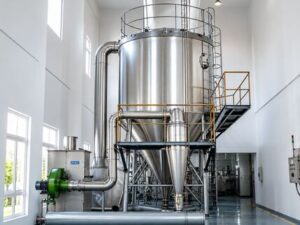
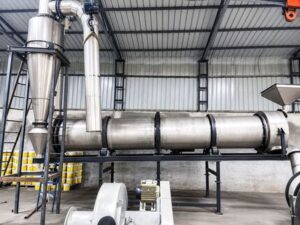
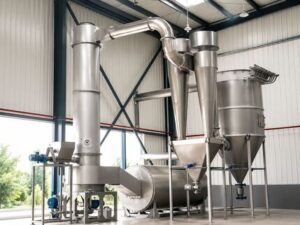
| Dryer Type | Primary Heat Method | Operating Temp Range | Processing Time | Main Advantage / Best Use | Target Final Moisture | Key Safety Systems |
| Spray Dryer | Direct Hot Air |
Inlet: 150°C–350°C Outlet: 60°C–100°C |
5 to 30 seconds | Turns liquids into instant powders rapidly | 2% – 4.5% | Explosion vents, Nitrogen purging, Spark detection |
| Rotary Drum | Direct Air / Hot Shell |
Inlet: 200°C–650°C Outlet: 80°C–120°C |
15 to 60 minutes | High-volume handling for raw bulk materials | 8% – 15% | Dust suppression, Automatic water deluge |
| Spin Flash | Direct Air + Agitation |
Inlet: 160°C–450°C Outlet: 75°C–105°C |
2 to 10 seconds | Breaks down sticky pastes and filter cakes directly | 0.1% – 1.5% | Pressure-shock rated walls, Rupture discs |
| Low-Temp Belt | Direct Air Circulation | Chamber: 40°C–110°C | 30 to 240 minutes | Gentle, low-heat drying for biomass & seaweeds | 5% – 12% | Fire-detecting wire, Belt alignment sensors |
| Indirect Paddle | Heated Metal Contact | Shell Temp: 100°C–250°C | 30 to 180 minutes | Self-cleaning paddles for sticky municipal sludges | 0.5% – 10% | Closed vapor loops, Nitrogen blanketing |
| Refractance Window | Thermal Water Contact | Water Bath: 60°C–95°C | 3 to 15 minutes | Preserves heat-sensitive bioactives, nutrients, & color | 3% – 6% | Low-temp operations, Sealed control panels |
| Vacuum Agitated | Heated Surface in Vacuum | Shell Temp: 30°C–140°C | 2 to 12 hours | Safely recovers solvents at low temperatures | 0.01% – 0.5% | Vacuum seals, Condenser solvent recovery |
How to Calculate Drying Requirements (Plain English Rules)
1. Estimating Water Evaporation Volume
In order to find out how much water must be evaporated per hour, simply follow this practical step-by-step rule:
-
Rule: First, subtract your target final moisture percentage from your starting moisture percentage. Next, divide that number by (100 minus target moisture percentage). Finally, multiply the result by your total incoming hourly feed rate.
-
Example: For instance, assume you process 10,000 kg per hour of sludge with 80% starting moisture and want a target moisture of 20%:
-
(80 minus 20) = 60
-
(100 minus 20) = 80
-
Consequently, 60 divided by 80 = 0.75
-
Therefore, 10,000 kg/h multiplied by 0.75 = 7,500 kg of water removed every hour.
-
2. Estimating Energy Consumption
To evaporate 1 kg of water under typical plant conditions, consider these two benchmarks:
-
High-Efficiency Dryers (Heat Pump / Indirect Paddle): Typically require roughly 2.6 to 3.2 Megajoules (MJ) of energy per kg of water evaporated (about 0.7 to 0.9 kWh).
-
Standard Direct Dryers (Hot Air / Rotary Drum): By comparison, these require roughly 3.5 to 4.8 Megajoules (MJ) of energy per kg of water evaporated (about 1.0 to 1.3 kWh).
Testing & Risk Mitigation Guide
Overall, testing material on a pilot scale effectively prevents expensive full-scale plant errors through a structured process:
-
Step 1: Laboratory Screening
-
To begin with, test material stickiness across different temperatures so as to avoid wall-clogging.
-
Furthermore, determine the exact temperature limit where active ingredients degrade.
-
Finally, check dust explosion ratings in order to select safe electrical and venting components.
-
-
Step 2: Pilot Plant Run
-
Subsequently, run small sample batches to balance feed rates with target outlet moisture.
-
Meanwhile, adjust spray nozzles, rotor speeds, or belt speeds so as to hit target particle sizes.
-
As a result, measure actual fuel and electricity use to confirm true utility costs.
-
-
Step 3: Quality Check
-
Lastly, verify final powder flowability, solubility, and storage stability.
-
In summary, measure bioactive retention to confirm no thermal degradation occurred.
-
Simple ROI & Payback Framework
In order to calculate the exact payback period, apply this simple formula:
Payback Period (in Years) = Total New Dryer Investment (€) ÷ Total Annual Savings (€)
Case Example: Industrial Sludge Dryer Upgrade
-
Current Plant Setup: Presently processing 10,000 tons/year of wet sludge (80% moisture) down to 20% moisture. This evaporates 7,500,000 kg of water every year.
-
Old Inefficient System Gas Bill: Consumes 4.8 MJ per kg of water evaporated = €1,008,000 / year.
-
New Indirect Paddle System Gas Bill: By contrast, consuming 3.0 MJ per kg of water evaporated = €630,000 / year.
-
Direct Thermal Savings: Consequently, thermal savings equal €378,000 / year.
-
Disposal & Transport Savings: Additionally, removing 7,500 tons of water weight cuts disposal transport costs by €450,000 / year.
-
Total Annual Savings: Thus, total combined savings reach €828,000 / year.
-
Total Investment (CAPEX): Assuming €1,850,000 for complete installation.
-
Calculated Payback Period: Therefore, €1,850,000 divided by €828,000 = 2.2 Years (approx. 26 Months).
Outcome-Based Benefits European Buyers Expect
Modern industrial drying systems address the distinct regulatory, operational, and financial demands of the European manufacturing sector. Upgrading to optimized drying equipment delivers several key advantages:
-
Significant Energy Savings: Advanced heat recovery, variable-frequency drives (VFDs), and closed-loop air systems allow facilities to routinely cut energy consumption by 20–40%.
-
Clear ROI & Rapid Payback: Lower utility bills, reduced waste disposal weights, and increased throughput help many European installations achieve full capital payback within 1.5 to 3 years.
-
Strict Regulatory Compliance: Furthermore, equipment is built for strict adherence to European safety and manufacturing standards. These include CE certification, ATEX explosion-proof directives, and hygienic GMP/FDA guidelines.
-
Sustainability Alignment: Ultimately, it directly supports corporate carbon-reduction mandates and European Union circular economy initiatives by lowering scope 1 and scope 2 emissions.
Technical Validation: Pilot Testing & Drying Calculations
Before making significant capital investments, European plant managers and project engineers predictably require empirical data. To this end, gtidryers.com provides comprehensive technical validation services. This bridges the gap between initial feedstock analysis and full-scale plant production.
Pilot Testing
Specifically, material-specific pilot testing allows plant operators to validate drying rates, end-product physical qualities, specific energy consumption, and maximum capacity under controlled conditions. Consequently, running pilot-scale trials eliminates scaling risks and ensures equipment performance before full procurement.
Drying Calculations
Meanwhile, detailed drying calculations evaluate incoming feedstock moisture percentage, target residual moisture, hourly capacity needs, available plant utility heat sources (such as waste steam or hot water), and regional energy tariffs. Thus, these calculations form the mathematical baseline for projected thermal efficiency, operational expenditure (OPEX), and ROI models tailored to specific manufacturing facilities.
How to Choose the Right Industrial Dryer Supplier for the European Market
When evaluating industrial drying systems, plant engineers should selectively choose suppliers at gtidryers.com that fulfill five key operational criteria:
-
First, Proven Energy Efficiency: Specifically demonstrated energy-reduction designs with documented performance metrics across facilities in Germany, France, Italy, the Netherlands, Spain, and the UK.
-
Second, Regulatory Expertise: Namely, comprehensive CE compliance, ATEX design options, hygienic certification (3-A/EHEDG), and full engineering documentation.
-
Third, Empirical Validation: Direct access to transparent pilot plant testing facilities and precise baseline drying calculation models.
-
Fourth, Custom Engineering: Process equipment must be customized to specific feedstock properties, particle sizes, thermal limits, and site space constraints.
-
Fifth, European Support Infrastructure: Dedicated after-sales technical support, commissioning assistance, and local spare-parts availability so as to minimize operational downtime.
Strategic Conclusion & Path Forward
Ultimately, navigating the transition toward energy-efficient thermal processing requires balancing immediate capital expenditure against long-term operational savings. Industrial thermal drying consumes significant plant utilities. Therefore, adopting targeted drying technologies—such as low-temperature heat pump systems, direct spin flash units, or indirect paddle configurations—is vital for remaining competitive across Europe. By establishing verified baseline drying calculations and conducting comprehensive pilot testing, manufacturing facilities eliminate technical risks, ensure full ATEX and CE compliance, and successfully secure measurable payback periods between 18 and 36 months.
Transform Your Drying Process Today
If your facility is currently looking to overcome capacity bottlenecks, comply with strict EU sustainability standards, or cut annual thermal energy bills by up to 40%, the engineering team at gtidryers.com is ready to assist you immediately.
Take the next step toward optimized thermal processing:
-
Request a Free Drying Calculation: First, get precise mass-balance, energy-load, and ROI projections tailored to your exact feedstock and utility rates.
-
Schedule a Pilot Test: Next, validate product quality, moisture reduction, and drying rates on continuous pilot-scale equipment before making a capital commitment.
Contact & Corporate Information
-
Call / WhatsApp Us: +91 93300 77417 / +91 87774 75596
-
Email: commercial@foodtechprojects.com / mktg@coconutprojects.com
-
Websites: coconutprojects.com | foodtechprojects.com | gtidryers.com
-
Head Office: 10C, Sir William Jones Sarani (Middleton Row), Park Street, Kolkata – 700071, West Bengal, India