
Currently, China ranks as the 3rd major importer of industrial dryers globally. Undoubtedly, this status reflects its massive processing sector and rapid manufacturing expansion.
Meanwhile, Chinese industrial processing plants actively accelerate automation and energy conservation. Furthermore, under national green manufacturing directives, procurement managers continuously and actively seek high-efficiency drying systems.
Consequently, choosing the right global engineering partner directly impacts energy consumption and ROI. Therefore, selecting the ideal technology ultimately remains paramount for every plant.
Why Chinese Companies Import Specialized Industrial Dryers
In fact, China’s processing facilities strictly require thermal equipment engineered to high technical and environmental standards. Specifically, several critical factors drive this demand:
-
Mandatory GB Standards: First of all, imported equipment must strictly comply with localized GB Standards (Guobiao). Furthermore, SELO certification is additionally mandatory for pressure vessels.
-
Dual-Carbon & Thermal Efficiency: Above all, driven directly by national carbon-neutrality goals, plants constantly demand closed-loop heat recovery designs. Consequently, as a result, these features effectively reduce energy consumption by 20% to 35%.
-
Zero-Contamination Engineering: On the other hand, for battery materials, APIs, and fine chemicals, contact surfaces strictly require mirror polishing (Ra < 0.4 µm). Likewise, specialized alloys (316L, Hastelloy, titanium) naturally prevent metallic contamination.
-
Continuous Reliability: In addition, large-scale Chinese facilities systematically operate 24/7. Consequently, imported dryers regularly feature heavy-duty mechanical drives and VFDs to specifically prevent unscheduled downtime.
-
Grid Compatibility: Finally, global suppliers reliably deliver equipment fully compatible with China’s 380V / 3-Phase / 50Hz grid.
Key Engineering Considerations for China Process Plants
To begin with, plant engineering teams must thoroughly evaluate four crucial operational dynamics:
-
Material Handling: Initially, high-viscosity slurries, cohesive filter cakes, and abrasive ores require heavily engineered feeding systems. For example, options range from positive displacement pumps to twin-screw feeders.
-
Ultra-Low Emission Controls: Simultaneously, Chinese environmental regulations strictly enforce tight limits on atmospheric discharge. Therefore, modern setups systematically pair primary cyclones with secondary pulse-jet baghouses. As a result, this keeps dust emissions well below 10 mg/Nm³.
-
Utility Flexibility: Furthermore, depending on energy availability, dryers can be flexibly configured for natural gas, high-pressure steam, thermal oil, or electric heat exchangers.
-
DCS & Automation: Ultimately, advanced plants integrate PLC controllers directly with facility SCADA or DCS systems via Industrial Ethernet.
Most In-Demand Industrial Dryer Types: Deep Technical Insights
1. Spray Dryers
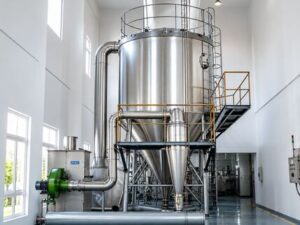
Primarily, industrial spray dryers transform liquid feeds and slurries into free-flowing powders in a single step. Accordingly, processors deploy this technology across dairy, plant proteins, coffee extracts, and APIs.
Operating Principle & Process Physics
To start, high-pressure pumps deliver liquid feed to an atomizer at the chamber top. Next, hydraulic nozzles or rotary atomizers (10,000 to 25,000 RPM) rapidly break the liquid into micro-droplets (20 to 180 microns). Immediately, co-current hot air vaporizes moisture within milliseconds before particles hit chamber walls.
Key Process Capabilities
-
Instantaneous Vaporization: For instance, inlet temperatures of 150°C to 350°C drop rapidly upon contacting moisture. Thus, outlet gas temperatures remain cool (70°C to 105°C), thereby protecting heat-sensitive ingredients.
-
Engineered Particle Morphology: In addition, precise control over atomizer speed, feed viscosity, and drying temperatures enables exact customization of powder density.
-
Closed-Loop Nitrogen Operation: Moreover, engineers configure systems with closed-loop nitrogen gas circuits and condensers. As a result, operators safely process flammable organic solvents.
Technical Highlights
Specifically, key features include sanitary 316L stainless steel contact surfaces (Ra < 0.4 µm) and automated multi-zone CIP spray balls. Besides, they include reverse-pulse baghouses (>99.9% recovery) meeting NFPA Explosion Prevention Standards.
2. Band Dryers (Apron / Continuous Belt Dryers)
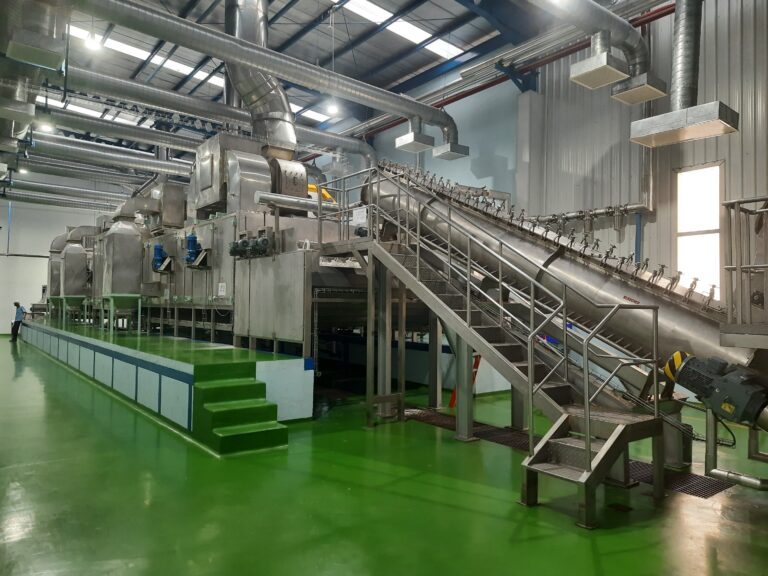
Primarily, continuous band dryers process uniform solids, crops, extruded pellets, and heat-sensitive food products across continuous lines. Hence, processors deploy this thermal technology to prevent product damage while achieving consistent moisture removal.
Operating Principle & Process Physics
First, wet material loads uniformly onto a moving perforated mesh belt or apron conveyor. Next, as the belt carries product through an insulated chamber, temperature-controlled hot air recirculates continuously. Subsequently, this airflow strips moisture gradually and uniformly.
Key Process Capabilities
-
Multi-Zone Thermal Profiling: In particular, independent temperature, airflow, and humidity controls across separate drying zones effectively prevent surface hardening.
-
Gentle Static-Bed Conveying: Furthermore, static bed movement gently protects fragile materials—such as dehydrated vegetables, herbal slices, and feeds—from mechanical impact.
-
Variable Speed Residence Time: Likewise, VFD-controlled drives allow precise adjustment of retention times ranging from 15 minutes to several hours.
Technical Highlights
Notable features include stainless steel mesh conveyors, modular insulated panel construction, and multi-fan recirculating air plenums. In addition, systems include CIP/WIP belt washing meeting EHEDG Hygienic Design Guidelines.
3. Refractance Window Dryers (RWD)
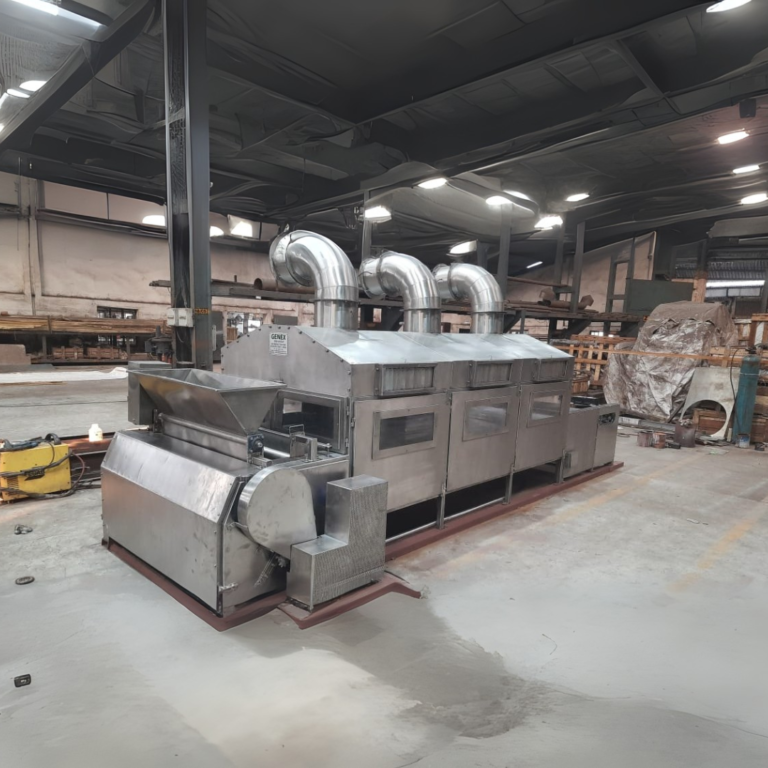
Primarily, refractance window dryers process heat-sensitive fruit purées, herbal extracts, and algae concentrates into high-value powders or flakes. Thus, processors deploy this fourth-generation method to achieve freeze-dry product quality at significantly lower capital costs.
Operating Principle & Process Physics
First, a spreader applies liquid slurry as a thin film (0.5 mm to 2.0 mm) onto a belt floating over circulating hot water (90°C to 98°C). Next, infrared thermal energy passes smoothly through the belt into the liquid film. Then, as the product dries, its refractive index shifts, automatically closing the window.
Key Process Capabilities
-
Bioactive Preservation: Indeed, RWD retains >90%–95% of heat-vulnerable vitamins, active enzymes, natural pigments, and aroma compounds without thermal degradation.
-
Rapid Drying Kinetics: Moreover, product dries within 3 to 10 minutes at low effective temperatures (60°C to 70°C).
-
Continuous Flake/Powder Discharge: Afterward, a scraper blade cleanly removes the dried sheet at the cooling section for direct milling.
Technical Highlights
Key features include food-grade thin conveyor belts compliant with FDA 21 CFR Materials Criteria. Additionally, they feature closed-loop water recirculation, infrared thermal management, and hygienic cGMP construction.
4. Rotary Drum Dryers
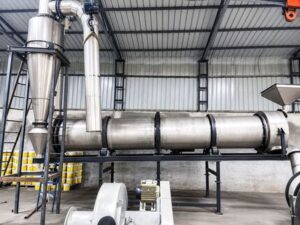
Primarily, industrial rotary drum dryers handle high-capacity moisture reduction for bulk solids, minerals, fertilizers, biomass, and agricultural by-products. Therefore, processors deploy this heavy-duty technology to reduce moisture from 50% down to under 1%.
Operating Principle & Process Physics
To begin, material enters a heavy steel cylinder mounted at a slight incline (2% to 5%). Meanwhile, the cylinder rotates on forged trunnion rolls via VFD-driven gear sets (2 to 8 RPM). Subsequently, internal flighting continuously scoops and cascades material through hot air or combustion gases.
Key Process Capabilities
-
High-Throughput Processing: For example, drums handle continuous capacities ranging from 1 to over 50+ metric tons per hour under 24/7 operation.
-
Heavy-Duty Construction: Furthermore, the heavy steel shell resists extreme thermal shock, mechanical abrasion, and heavy particle impact over long lifecycles.
-
Multi-Fuel Heating Flexibility: Besides, systems integrate seamlessly with natural gas, coal gasifiers, steam-tube bundles, or waste heat recovery loops.
Technical Highlights
Key features include heavy forged riding rings, custom internal flighting profiles, and VFD drive mechanisms. In summary, exhaust emission controls adhere strictly to ASME Pressure Vessel & Structural Codes.
5. Flash Dryers & Spin Flash Dryers
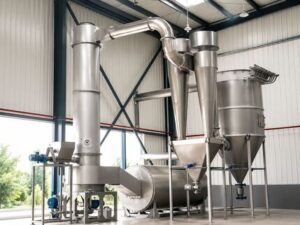
Primarily, pneumatic flash dryers process wet filter cakes, centrifuge pastes, starches, plant proteins, and sticky powders. Therefore, processors deploy these pneumatic systems when ultra-fast surface moisture evaporation (1 to 3 seconds) is required.
Operating Principle & Process Physics
Initially, wet cake (30% to 70% moisture) enters a vertical drying duct via a variable-speed feed screw. Meanwhile, in Spin Flash configurations, a bottom mechanical agitator vigorously disintegrates cohesive lumps. Then, high-velocity hot air (20 to 30 m/s) lifts particles, stripping surface moisture instantly.
Key Process Capabilities
-
Sub-3-Second Residence Time: Owing to this, short thermal exposure protects heat-sensitive compounds even at elevated inlet air temperatures (180°C to 400°C).
-
Compact Vertical Footprint: In addition, the vertical duct arrangement maximizes vertical space while significantly minimizing overall factory floor space requirements.
-
Integrated Disintegration: Likewise, the bottom agitator mechanism eliminates the need for separate pre-grinding or pre-milling process units.
Technical Highlights
Standard features include variable-speed disintegrator agitators, high-efficiency pneumatic ducting, primary process cyclones, and secondary pulse-jet baghouses. Furthermore, explosion relief panels meet ATEX Explosive Atmosphere Directives.
6. Paddle Dryers (Indirect Thermal / Vacuum)

Primarily, indirect paddle dryers process hazardous sludges, lithium battery chemicals (LFP, NCM precursors), ETP cake, and sticky filter cakes. Hence, processors deploy these indirect thermal units to dry dense materials without requiring large volumes of process gas.
Operating Principle & Process Physics
First, feed material enters a jacketed trough containing dual counter-rotating shafts with intermeshing wedge-shaped hollow paddles. Subsequently, thermal media (steam up to 15 bar, thermal oil, hot water) circulates inside the jacket and hollow paddles, transferring heat via conductive contact.
Key Process Capabilities
-
High Thermal Efficiency (>85%): Because conductive heat transfer eliminates large air volumes, off-gas treatment costs consequently decrease by up to 80%.
-
Self-Cleaning Wedge Profile: Furthermore, intermeshing wedge-shaped paddles continuously scrape heating surfaces clean, which prevents sticky sludges from forming insulating crusts.
-
Low-Temperature Vacuum Drying: In contrast, the sealed chamber enables low-temperature vacuum operation (40°C to 70°C boiling points) for safe solvent recovery.
Technical Highlights
Key features include dual hollow intermeshing shafts, jacketed thermal troughs, heavy-duty gear reducers, and vacuum-tight shaft packing seals. Moreover, corrosion-resistant alloys (316L, Hastelloy) adhere to SELO Pressure Vessel Regulations.
7. Fluid Bed Dryers (Combination & Vibratory)
Finally, fluid bed dryers perform high-efficiency drying, agglomeration, and cooling of granules, crystals, extruded pellets, and powders. Overall, fluidization ensures optimal gas-solid contact. Specifically, every particle suspends in a controlled hot air stream, maximizing heat transfer without thermal degradation.
A. Vibratory Fluidised Bed Dryers (VFBD)
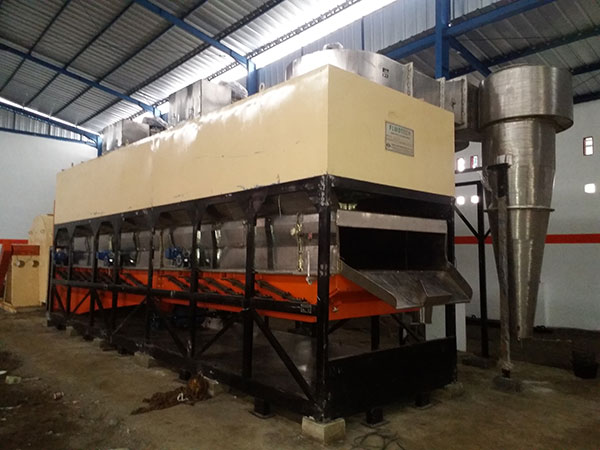
Particularly, VFBD units suit cohesive materials, wide particle-size distributions, fragile agglomerates, and wet feeds that clump under static air velocity.
Operating Principle & Mechanical Physics
To begin, filtered hot air passes upward through a perforated distributor plate. Simultaneously, dual electric motors impart high-frequency mechanical vibration (500 to 1,200 VPM) to the deck structure. As a result, the vibration vector propels the bed linearly while lowering minimum fluidization velocity (Umf).
Key Process Capabilities
-
Zero Fluidization Dead Zones: Because mechanical vibration breaks surface tension between wet particles, the system effectively prevents localized overheating and clumping.
-
Low Mechanical Shear: Furthermore, gentle conveying protects fragile crystals, instant tea granules, and extruded feeds from breaking.
-
Integrated Multi-Zone Processing: Additionally, operators split bed length into distinct thermal zones: initial drying (120°C–160°C), secondary drying (70°C–90°C), and final cooling (15°C–25°C).
Technical Highlights
Options include perforated deck-plates (Gill plate, directional, woven mesh) and built-in CIP spray nozzles. Furthermore, dust-tight baghouses deliver >99.5% powder retention compliant with ISO Cleanroom & Containment Guidelines.
B. Combination Fluid Bed Dryers (Multi-Stage Tray & Fluidized Finishing)
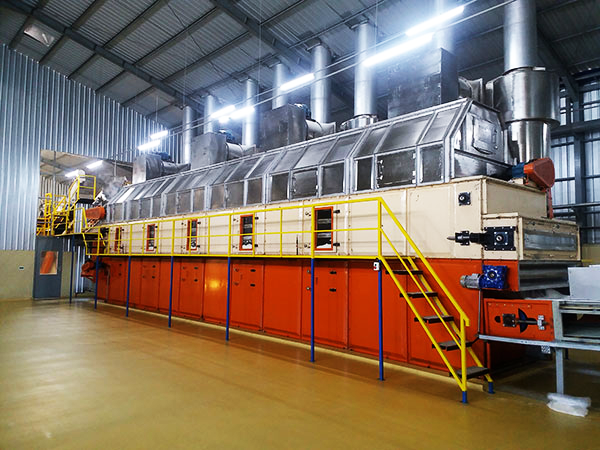
In comparison, combination systems integrate multi-pass tray/belt pre-drying with a final fluidized bed finishing phase to handle high-moisture feeds with slow internal diffusion.
Operating Principle & Thermodynamic Strategy
-
Primary Drying Zone (Multi-Layer Tray/Belt): First, high-moisture feeds (30% to 60% initial moisture) pass through continuous multi-pass perforated trays. Here, controlled hot air removes unbound surface moisture down to 12%–15%.
-
Fluidized Finishing Zone: Second, semi-dried material drops directly into an integrated fluid bed section. Here, air velocity dynamically tumbles particles, stripping internal moisture down to <0.5% without scorching.
Key Process Capabilities
-
Elimination of Wet Centers: Specifically, this setup suits dense granules, extruded foods, and botanical extracts where rapid exterior drying risks case hardening.
-
Preservation of Color & Volatiles: Moreover, graduated thermal profiles prevent thermal shock, keeping natural pigments, oils, and aromas intact.
-
Up to 35% Higher Thermal Efficiency: Besides, recirculating exhaust gas from the finishing fluid bed into the initial tray pre-drying stage drastically reduces fuel consumption.
Technical Highlights
Key features include VFD tray speed control and independent multi-zone temperature loops via PLC/SCADA. Additionally, units feature differential pressure monitoring and sanitary 316L stainless steel polished construction (Ra < 0.4 µm).
Technical Comparison Matrix
| Dryer Type | Feed Condition | Moisture Range (In → Out) | Heat Transfer Method | Operating Temperature | Residence Time | Primary Application |
| Band Dryer | Shreds, Flakes, Pellets | 70% → 5% | Direct Convective Air | 60°C – 180°C | 15 – 120 Minutes | Dehydrated Vegetables, Herbs, Extrusions, Snacks |
| Spray Dryer | Liquids, Slurries | 80% → 3% | Direct Convective Air | 150°C – 350°C | 5 – 30 Seconds | Dairy, Coffee, APIs, Battery Chemicals |
| Refractance Window | Purées, Concentrates | 80% → 3% | Infrared / Conductive Water | 90°C – 98°C (Water) | 3 – 10 Minutes | Fruit Purées, TCM Extracts, Algae |
| Rotary Dryer | Free-Flowing Solids | 50% → <1% | Direct or Indirect Convective | 200°C – 800°C | 15 – 60 Minutes | Minerals, Ores, Sand, Biomass |
| Flash Dryer | Filter Cakes, Pastes | 60% → 2% | Direct Pneumatic | 180°C – 400°C | 1 – 3 Seconds | Starches, Proteins, Pigments |
| Paddle Dryer | Sludges, Thick Pastes | 80% → 10% | Indirect Conductive | 120°C – 250°C | 30 – 120 Minutes | ETP Sludge, Fine Chemicals, Polymers |
| Vibratory FBD | Granules, Pellets | 25% → 0.5% | Direct Fluidized Air | 60°C – 160°C | 5 – 20 Minutes | Pharma Granules, Salt, Spices, Sugar |
What Chinese Procurement Teams Prioritize in International Suppliers
When evaluating global OEM drying partners, Chinese plant managers specifically focus on five core evaluation criteria:
-
Regulatory & Safety Approvals: Above all, verified compliance with Chinese GB Standards, SELO stamps, and ISO 9001 Quality Management Systems certification.
-
Electrical Grid Readiness: In addition, built-in compatibility with 380V / 3Ph / 50Hz power specs, localized PLC integration, and Chinese-language HMI interfaces.
-
Lab Feasibility & Pilot Testing: Furthermore, availability of pilot-scale test units to generate drying curves, confirm thermal balance, and verify output powder properties.
-
Hygienic Finish & Metallurgical Traceability: Likewise, Material Traceability Reports (MTRs) for contact parts, combined with sanitary mirror polishing (Ra < 0.4 µm) for food and pharma.
-
Turnkey Export Support: Finally, complete 2D/3D CAD layouts, ocean-worthy packaging, customs-clearance documentation, and remote/on-site commissioning support.
Conclusion
In summary, choosing the right industrial drying technology is a strategic investment directly impacting product quality and utility costs. Whether your process requires a band dryer, spray dryer, refractance window dryer, rotary drum dryer, flash dryer, paddle dryer, or fluid bed dryer, working with an experienced manufacturer ultimately ensures maximum efficiency and long-term reliability.
Ready to Upgrade Your Process Line?
Therefore, if your facility plans to install a new drying system or upgrade an existing line, partner with GENEX TECH INDUSTRIES LLP for export-ready thermal drying solutions.
Get a Custom Engineering Proposal & Technical Quotation
Accordingly, contact our process engineering team today for:
-
Free material drying feasibility assessments & lab testing
-
Custom evaporation rate calculations & utility heat-balance profiles
-
Complete CAD layouts, equipment sizing, and commercial quotes
📩 Email: mktg@foodtechprojects.com | sales@foodtechprojects.com
📞 Phone / WhatsApp: Message on WhatsApp (+91-97489 06968) | Call +91-9330077417
🌐 Websites: www.foodtechprojects.com | www.gtidryers.com
🏢 Head Office: 10C, Sir William Jones Sarani (Middleton Row), Park Street, Kolkata – 700071, India