The Indian bioenergy landscape is currently undergoing a massive transformation. Specifically, national mandates and the GOBARdhan scheme accelerate Compressed Biogas (CBG) adoption. As a result, green technology integration reaches unprecedented levels across India.
To evaluate emerging market needs and connect with energy leaders, our engineering team at Genex Tech Industries LLP (GTIDryers) attended the exhibition as an industry visitor. Ultimately, visiting IBET Expo 2026 in Greater Noida provided direct exposure to cutting-edge clean tech innovations.
As structured, the expo was organized jointly by IFGE and MM Activ Sci-Tech Communications. Importantly, UPNEDA served as the official state partner. Overall, IBET Expo 2026 focused on “Advancing Bioenergy Solutions for a Low Carbon World.”
By attending as a visiting technology partner, we evaluated project demands across CBG, pelletization, and ethanol production. Consequently, our primary takeaway as exhibition visitors was clear. Thermal drying efficiency directly dictates overall bioenergy plant profitability.
Moisture Management: The Hidden Bottleneck in Bioenergy
Raw organic feedstocks enter processing plants containing 60% to 90% water content. Unfortunately, unmanaged moisture creates critical operational bottlenecks across the entire production chain:
-
Reduced Energy Yield: First, excess water lowers net calorific value (NCV). Consequently, it wastes valuable boiler heat energy.
-
Storage & Biological Spoilage: In addition, high moisture causes rapid mold growth. Furthermore, it creates spontaneous combustion hazards in storage.
-
Prohibitive Transport Costs: In fact, hauling water-heavy organic waste burns up thin freight margins quickly.
Therefore, deploying purpose-built biomass drying solutions is essential for scaling renewable fuel production lines.
High-Efficiency Thermal Processing Technologies: Technical Breakdown
During our exhibition walkthrough as visitors, our engineering team evaluated specialized thermal equipment configurations. Below is a technical breakdown of four primary bioenergy drying systems:
1. Industrial Band Dryers (Continuous Mesh Belt Systems)
For instance, continuous industrial band dryers remain the gold standard for fibrous residues, sludge, and digestate. Because materials move smoothly on perforated stainless steel mesh belts, moisture evaporates gently. Thus, dust generation is completely avoided.
Technical Operating Mechanism
-
Multi-Zone Heat Control: Specifically, independent heating modules establish customized temperature profiles across the bed. For example, high thermal energy wet inlet zones prevent thermal damage near dry outlets.
-
Optimized Airflow Dynamics: In addition, hot air forces vertically through the permeable material bed. As a result, heat transfer efficiency stays exceptionally high. Meanwhile, static pressure drop stays minimal.
-
Waste Heat Integration: Furthermore, mesh belt dryers excel when utilizing low-temperature waste heat sources ($60^\circ\text{C}$ to $90^\circ\text{C}$). Consequently, plants drastically lower net operational utility costs.
2. Heavy-Duty Rotary Drum Dryers
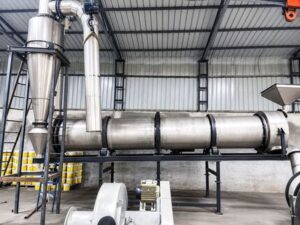
On the other hand, high-throughput rotary drum dryers handle continuous heavy bulk feedstocks. For instance, they process wood chips, sawdust, and crop waste efficiently. As a result, they provide rugged 24/7 reliability under demanding plant conditions.
Technical Operating Mechanism
-
Custom Flighting Design: Notably, internal lifters continuously shower wet material through a high-velocity hot air stream. Therefore, falling particle curtains maximize total heat transfer exposure area.
-
Triple-Pass Architecture: In addition, advanced triple-pass configurations route material through three concentric cylinders. Consequently, residence time triples within a very compact physical footprint.
-
Airflow Options: Depending on feedstock heat sensitivity, hot gas and material travel co-currently or counter-currently. As a result, operators achieve rapid surface drying or deep moisture removal easily.
3. Rapid Flash Dryer Systems (Pneumatic Dehydration)
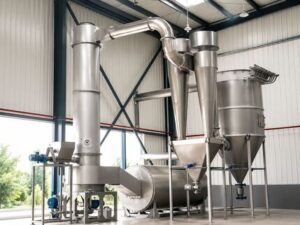
In contrast, specialized flash dryers suit fine agro-residues, bagasse fines, starch residue, and rice husk. Specifically, they process materials requiring instantaneous water removal. Thus, they deliver high thermal efficiency within a small footprint.
Technical Operating Mechanism
-
Instant Surface Evaporation: First, wet feedstock enters a high-velocity heated air duct ($20\text{ to }30\text{ m/s}$). Because surface water evaporates instantly, total residence time is measured in seconds.
-
Particle Disintegration: In addition, inline disintegrator fans break up sticky wet feed at the inlet. As a result, fine particles expose massive surface area for instant dehydration.
-
Clean Solids Separation: Finally, dried particles convey pneumatically into high-efficiency cyclone separators and pulse-jet baghouses. Consequently, plants maintain clean exhaust air compliance.
4. Precision Pellet Drying & Cooling Systems
Meanwhile, maintaining structural integrity in biomass fuel pellets requires controlled cooling and dehydration. By utilizing engineered counterflow pellet coolers and dryers, operators prevent structural failure and cracking before shipping.
Technical Operating Mechanism
-
Counterflow Thermal Transfer: Specifically, ambient air enters from the bottom while hot pellets enter continuously from top inlets. Consequently, air absorbs heat progressively, preventing severe thermal shock cracks.
-
Pellet Durability Optimization: Furthermore, gradual cooling cures natural lignin binders inside the extruded biomass. As a result, the final Pellet Durability Index (PDI) is maximized for transport.
-
Automated Grid Discharge: In addition, level sensors trigger flexible discharge grids to release pellets uniformly. Therefore, every batch achieves a consistent final moisture profile.
Equipment Selection & Application Matrix
To summarize how these key drying technologies apply to typical bioenergy plant streams, review the following guide:
| Dryer Technology | Primary Feedstocks | Heat Source Compatibility | Primary Operational Benefit |
| Industrial Band Dryer | Digestate cake, sludge, fibrous agricultural waste | Low-temp waste heat, hot water, flue gas | Gentle handling, low dust, flexible multi-zone drying |
| Rotary Drum Dryer | Wood chips, sawdust, paddy straw, heavy bulk waste | Direct burners, high-temp waste steam, flue gas | Extreme 24/7 durability, massive volumetric capacity |
| Pneumatic Flash Dryer | Bagasse fines, rice husk, sawdust powder, starch cake | Hot air generators, direct gas burners | Instantaneous surface drying, minimal footprint |
| Pellet Drying & Cooling System | Extruded biomass pellets, FOM fuel granules | Ambient/conditioned air streams | High PDI preservation, zero thermal shock cracking |
Supporting GOBARdhan: Commercializing Digestate into Biofertilizers
Above all, a major focus at IBET Expo 2026 was anaerobic digestate commercialization. Under the GOBARdhan scheme, CBG facilities must transform liquid digestate slurry into high-value organic soil conditioners:
Plaintext
Raw Digestate Slurry (80–90% Water)
       │
       ▼
[ Mechanical Dewatering ]
       │
       ▼
[ Thermal Dehydration & Drying ] ─── (Utilizing Biogas Engine Waste Heat)
       │
       ├──► Fermented Organic Manure (FOM) Granules & Pellets
       ├──► Liquid Fermented Organic Manure (LFOM) Concentrates
       └──► Phosphate Rich Organic Manure (PROM) Formulations
In order to achieve this economically, deploying dedicated digestate drying solutions reduces material mass by 75–85%. Simultaneously, thermal drying eliminates harmful pathogens. As a result, it stabilizes the organic matrix completely.
Similarly, advanced LFOM and PROM drying systems utilize low-temperature evaporation. Thus, they preserve active biological nutrients. Consequently, liquid streams turn into high-value, baggable biofertilizer products.
Furthermore, integrating continuous organic waste dryers helps municipal and agricultural facilities convert problematic waste streams into standardized dry inputs.
Conclusion & Strategic Outlook
In conclusion, attending IBET Expo 2026 as an industry visitor strongly reinforced our core mission at Genex Tech Industries LLP. Specifically, we deliver robust thermal drying infrastructure backed by Waste Heat Recovery (WHR) integration. As the bioenergy market rapidly expands, profitability will depend on moisture control efficiency and quality fuel standardization. Ultimately, optimizing your drying process is the best way to maximize long-term operational ROI.
Ready to Elevate Your Bioenergy Operations?
Whether you are establishing a greenfield CBG plant, scaling a pelletization line, or commercializing biofertilizers, our engineering team is here to help. By combining thermal processing expertise with tailored waste heat recovery integration, Genex Tech Industries delivers turnkey drying systems engineered for high yield and low energy cost.
Contact our technical sales team today to schedule a consultation, request a custom drying trial, or review your project specifications!
Contact Us
-
Head Office: 10C, Sir William Jones Sarani (Middleton Row), Park Street, Kolkata – 700071, India
-
Phone: +91-9330077417 / +91-8777475596
-
Websites: gtidryers.com | foodtechprojects.com