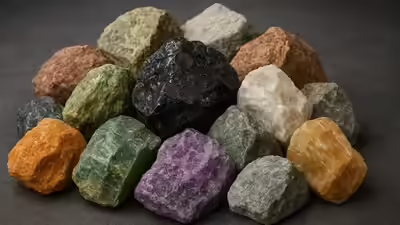
The extraction and processing of rare earth elements (REEs) and industrial minerals form the backbone of modern technology. From the neodymium magnets found in electric vehicle motors to the thin films used in consumer electronics, these materials require extreme precision during purification. Consequently, a major, yet often overlooked, stage in this supply chain is industrial thermal processing and dehydration.
Unprocessed minerals and rare earth concentrates carry varying levels of surface and chemically bound moisture. Therefore, eliminating this moisture without degrading the material’s physical structure or chemical integrity requires highly specialized equipment. Fortunately, industrial manufacturers like Genex Tech Industries (GTI) have engineered targeted thermal systems to overcome these exact hurdles. With this in mind, this article breaks down the mechanics, core systems, and industrial applications of modern mineral dehydration.
Why Rare Earths & Minerals Demand Specialized Drying
Unlike standard food or biomass products, minerals and rare earth concentrates present strict operating environments. In particular, several challenging factors must be managed:
-
High Bulk Density: Mineral slurries and ores are incredibly heavy, thereby placing immense mechanical stress on conveying and rotating parts.
-
Abrasiveness & Corrosiveness: Rare earth processing often involves acidic or alkaline leaching agents. As a result, equipment must resist rapid abrasive wear and chemical corrosion.
-
Agglomeration & Stickiness: Before becoming a free-flowing powder, fine mineral particulates often form sticky filter cakes. Consequently, they can easily clog standard drying beds.
-
Thermal Sensitivity: Certain rare earth oxides require strict temperature limits in order to prevent premature oxidation or structural phase changes.
Ultimately, failing to control these variables leads to uneven drying, lost product, and frequent maintenance downtime.
Core Industrial Drying Technologies
Depending on the initial state of the raw mineral feed—whether it is a chunky ore, a sticky filter cake, or a fine slurry—different thermodynamic principles must be applied. Accordingly, three prominent industrial systems stand out for their efficiency and adaptability:
1. Rotary Drum Dryers: The Heavy-Duty Workhorse
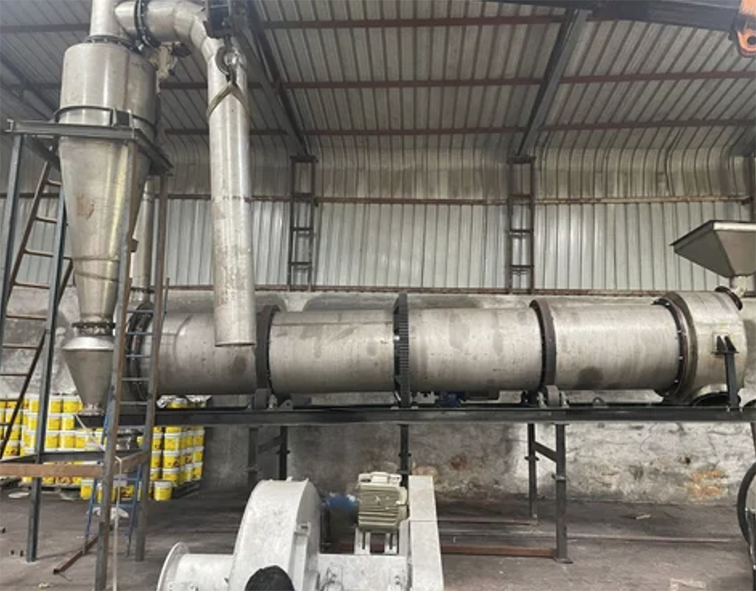
For high-capacity, rugged, and continuous 24/7 operations, the Rotary Drum Dryer remains the industry benchmark.
   Wet Feed In ───►  ┌────────────────────────┐
                     │ ═══►  Hot Air Air  ═══► │ ───► Vapor Exhaust
                     │   (Rotating Cylinder)  │
                     └────────────────────────┘
                                  └───► Dried Mineral Out
-
How It Works: Wet minerals enter a massive, sloped cylindrical drum that rotates at a controlled speed. Simultaneously, internal lifters (cascading flights) scoop up the material and drop it repeatedly through a continuous stream of direct or indirect hot air.
-
Best Suited For: Bulk raw minerals, aggregates, silica sand, ores, limestone, as well as biomass feedstocks.
-
Mineral Advantage: Furthermore, systems can be outfitted with heavy-duty abrasion-resistant liners and structural reinforcements to withstand heavy, jagged mineral loads without warping.
2. Pneumatic Flash Dryers: Instantaneous Moisture Removal
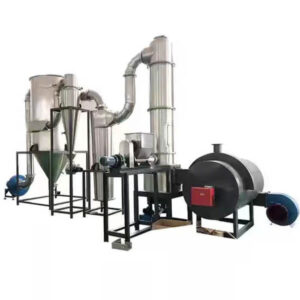
On the other hand, when dealing with pre-crushed mineral powders, fine particulates, or thin-film substrates that cannot tolerate prolonged exposure to heat, a Flash Dryer is deployed.
                  ┌─────────┐
                  │ Cyclone │ ───► Exhaust Air & Vapor
                  └───┬─────┘
                      ▼
               [ Dried Powder ]
                      ▲
                      │  (Drying Tube: 1-3 Seconds)
                      ▲
   Wet Feed ───► [Disperser] ◄─── Hot Air Stream
-
How It Works: Wet material is mechanically dispersed directly into a high-velocity, turbulent stream of hot air. As a normal result, the moisture flashes off almost instantly—typically within 1 to 3 seconds. Thereafter, the suspended, dried powder is collected at the top using high-efficiency cyclone separators and fabric bag filters.
-
Best Suited For: Starch, fine chemicals, kaolin clay, calcium carbonate, and specifically delicate rare earth powder intermediates.
-
Mineral Advantage: Notably, it offers extremely high thermal efficiency with zero internal moving parts within the primary drying column. Thus, it eliminates mechanical breakdown risks when processing fine, abrasive mineral dust.
3. Combination Dryers: Advanced Staged Processing
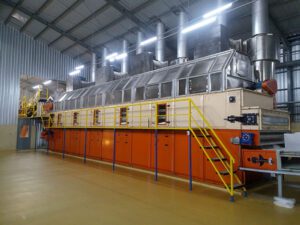
In contrast to single-stage units, for high-value specialty chemical powders, rare earth oxides, and nutraceutical-grade materials that require multi-stage moisture reduction, a Combination Dryer bridges the gap between different drying methodologies.
-
How It Works: This hybrid machinery matches a multi-layer tray drying circuit with a fluidised bed finishing stage inside a single, insulated housing. First, the material is loaded uniformly onto circulating trays for initial, gentle surface-moisture reduction. Next, once the risk of material sticking or scorching passes, the semi-dry product moves into a high-velocity fluidized bed zone. In this zone, air completely suspends the particles for total moisture equalization.
-
Best Suited For: Sensitive pharmaceutical granules, fine chemical polymers, and above all, precision rare earth compounds.
-
Mineral Advantage: Chiefly, it prevents surface hardening and case-hardening (where the exterior dries into a hard crust, trapping moisture inside), thereby ensuring an ultra-stable, homogenous final product quality.
Technical Comparison of Thermal Processing Technologies
To further illustrate, selecting the right equipment depends entirely on the material’s starting state and target properties:
| Parameter / Feature | Rotary Drum Dryer | Pneumatic Flash Dryer | Combination Fluid Bed Dryer |
| Drying Time / Retention | Long (Minutes to Hours) | Ultra-Fast (1–3 Seconds) | Intermediate (Staged) |
| Primary Material State | Bulk solids, lumps, heavy ores | Fine powders, sludges, filter cakes | Sticky granules, precision crystals |
| Footprint Requirement | Large horizontal space | Tall vertical footprint | Compact, modular housing |
| Primary Separation Needs | Direct discharge | Cyclones & Bag Filters | Fluidized bed screen extraction |
| Typical Final Moisture | Variable based on speed | 2% – 8% highly uniform | Deep, precise equalized moisture |
Maximizing Plant Efficiency and Safety
In addition to selecting the right dryer, deploying these systems at scale requires looking beyond the drying chamber alone. For example, modern systems incorporate structural and automated safety layers:
-
Dust Mitigation: Fine mineral and rare earth processing creates dust that poses an inhalation risk or explosion hazard. Hence, integrating secondary cyclone separators, industrial wet scrubbers, and automated pulse-jet bag filters captures 99.9% of escaping fine particulates.
-
Automated Control (PLC & SCADA): Real-time moisture sensors feed back directly into automated control systems. If an inlet batch arrives with higher-than-normal moisture content, then the system adjusts retention times and burner intensity on the fly to prevent under-drying.
-
Heat Recovery Systems: Moreover, thermal drying is energy-intensive. Modern systems reuse exhaust heat via gas-to-air heat exchangers so that they can preheat the incoming fresh air loop, slashing operational fuel costs.
Conclusion
In summary, the industrial processing of rare earth elements and mineral compositions leaves no room for thermodynamic error. Whether utilizing the rugged cascading capability of a Rotary Drum Dryer, the instantaneous, gentle flash of a Pneumatic Flash System, or the strict precision of a Combination Fluid Bed unit, matching the system to the mineral profile is paramount.
Therefore, for customized layout configurations, materials testing, and technical consultation on industrial dehydration setups, explore the specialized design divisions at GTI Dryers.
Connect with Our Engineering Experts
If you would like to proceed, reach out through our official support channels for project estimation, custom machinery design, or process optimization inquiries:
-
📧 Technical Inquiries: mktg@foodtechprojects.com
-
📞 Phone / WhatsApp Support: +91 93300 77417
-
🌐 Engineering Portals: www.foodtechprojects.com | www.gtidryers.com