Here is the final, fully integrated version of the blog post, complete with all sections, links, and the contact details positioned for optimal professional outreach.
The Science of Post-Harvest Preservation: Choosing the Right Industrial Grain Dryer
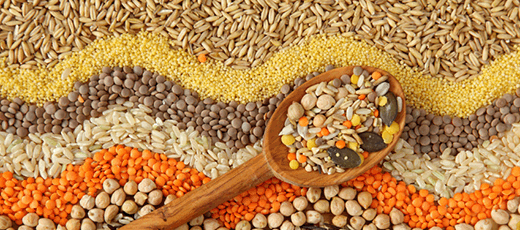
For agricultural processors and agro-industries, the period immediately following a harvest is a high-stakes race against time. Freshly harvested grains and cereals typically emerge from the field carrying a high moisture content of 18% to 30%. Left unchecked, this damp environment becomes an ideal breeding ground for mold growth, fungal contamination, and rapid insect infestation. The result? Significant post-harvest losses, degraded nutritional value, and a sharp plunge in market value.
To protect the structural integrity and biological quality of agricultural yields, reducing moisture to safe thresholds—typically 12% to 14% for cereals and 10% to 12% for long-term storage—is paramount. Modern agro-processors rely on specialized industrial drying systems to achieve uniform moisture reduction while minimizing fuel consumption.
Because different types of grains, kernel sizes, and production capacities demand specific thermal technologies, a “one-size-fits-all” approach does not work. Below is an in-depth breakdown of the four primary industrial grain drying technologies manufactured by Genex Tech Industries LLP (GTI Dryers) to help you determine the ideal fit for your facility.
1. Mesh Belt Dryers: Ideal for Continuous & Gentle Processing
When dealing with large volumes of grains or agricultural by-products that require steady, uniform handling without aggressive physical agitation, a Mesh Belt Dryer is highly effective.
-
How it Works: In this continuous drying system, the wet grains are spread evenly across a perforated stainless steel or food-grade conveyor belt. As the belt passes through multiple isolated drying zones, controlled hot air is pushed or pulled through the moving bed of grains, gradually removing moisture without subjecting the product to harsh friction.
-
Best Suited For: Paddy (rice), corn (maize), soybean drying, and grain feed preparation.
-
Key Advantage: Multi-zone temperature control allowing for varied heat profiles, gentle product transportation with low particle breakage, and easy integration with automated upstream and downstream handling equipment.
2. Combination Fluid Bed Dryers: The Multi-Stage Option for Precision
High-value grains, seeds, or specialty products often require meticulous control over final texture, color, and bulk density. For these applications, a standard dryer can sometimes cause surface hardening or leave trapped “wet pockets” in the core. A Combination Fluid Bed Dryer addresses this by merging two distinct mechanisms into a single machine.
-
How it Works: This hybrid system utilizes a staged drying process. The initial phase takes place on a multi-layer tray drying circuit where gentle airflow initiates moisture reduction safely. Once the risk of surface hardening passes, the product enters a final fluidised bed zone. Here, high-velocity air suspends the particles, creating a boiling-like action that ensures rapid moisture equalization.
-
Best Suited For: High-grade paddy, specialized agricultural granules, tea, starch, and delicate seed varieties.
-
Key Advantage: Completely eliminates wet centers and clumping, ensuring a free-flowing final product with superior color and bulk density retention.
3. Vibratory Fluid Bed Dryers: Maximizing Uniformity in Small Grains
Smaller grains, crystals, pellets, and uniform granular agricultural materials dry exceptionally well under fluidization. However, sticky or fragile grains can occasionally clump or struggle to advance evenly through a standard bed. The Vibratory Fluid Bed Dryer (VFBD) overcomes this by adding a mechanical component to thermal processing.
-
How it Works: Wet grain is fed onto a perforated deck. The system blows hot air from beneath the deck to fluidize the material, while heavy-duty vibratory motors mechanically vibrate the entire bed. The combined force of upflowing air and physical vibration moves the material forward at a highly regulated speed.
-
Best Suited For: Seed conditioning, starch, specialty food powders, seasoning blends, and animal feed grain preparation.
-
Key Advantage: Precise control over the residence (drying) time by adjusting vibration frequency and airflow. Additionally, the gentle mechanical assistance allows fluidization to happen at lower air velocities, resulting in negligible particle entrainment (reduced dust carryover).
4. Rotary Drum Dryers: Built for Heavy-Duty, Bulk Solids Dehydration
When your facility handles immense bulk capacities or rugged agricultural feedstock 24/7, mechanical simplicity and high thermal efficiency are essential. This is where the heavy-duty Rotary Drum Dryer performs best.
-
How it Works: This rugged system consists of a massive, slightly inclined rotating cylindrical drum. Wet material enters at one end, and as the drum rotates, internal lifting flights (lifters) scoop the grain and cascade it continuously through a high-velocity stream of hot air.
-
Best Suited For: Large-scale commercial corn and wheat drying, agricultural crop residues, biomass feedstock, and forage processing.
-
Key Advantage: High drying capacity per hour, an exceptionally versatile material handling capability that accommodates diverse particle sizes or varying initial moistures, and a rugged mechanical layout that requires minimal maintenance over long industrial duty cycles.
Pre-Conclusion: Mapping Technology to Operational Needs
Before finalizing an equipment investment, engineering teams must evaluate specific processing benchmarks. The table below serves as a technical checklist to cross-reference your specific grain properties with the corresponding GTI dryer technology:
| Dryer Type | Primary Application | Principal Operational Benefit |
| Mesh Belt Dryer | Continuous, gentle processing of bulk cereals (Paddy, Corn, Soybeans) | No structural grain damage, seamless multi-zone temperature profiling. |
| Combination Fluid Bed | High-value, precision crops and specialty starches | Multi-stage control that eliminates wet centers and surface hardening. |
| Vibratory Fluid Bed | Small grains, seeds, and easily clumped materials | Lower air velocity requirements, excellent residence time control, less dust. |
| Rotary Drum Dryer | Massive volumes, rugged feedstocks, and 24/7 large agricultural operations | Exceptional throughput, low mechanical maintenance, high thermal capacity. |
Conclusion
Choosing the appropriate industrial grain drying system is a balancing act between the biological properties of your crop and the specific throughput demands of your plant. Whether you require the gentle, zoned handling of a mesh belt system, the precise multi-stage conditioning of a combination fluid bed, the dust-free uniformity of a vibratory system, or the heavy-duty power of a rotary drum, selecting a tailored thermal technology is a critical step in modern agro-processing.
By partnering with an experienced manufacturer like Genex Tech Industries LLP, agricultural facilities can protect the nutritional profile of their yields, dramatically lower operating expenses, and eliminate post-harvest spoilage—ensuring their products meet both domestic storage and international export standards seamlessly.
Get in Touch for Custom Engineering Solutions
For custom configurations, formal technical proposals, or to arrange a feasibility study for your grain processing facility, connect directly with the Genex Tech Industries engineering and marketing divisions through the following channels:
-
Direct Marketing Inquiry Email: mktg@foodtechprojects.com
-
Official Communication Line: +91-9330077417
-
Websites for Technical Portfolios: gtidryers.com | foodtechprojects.com